Collected cards the almo.., p.22
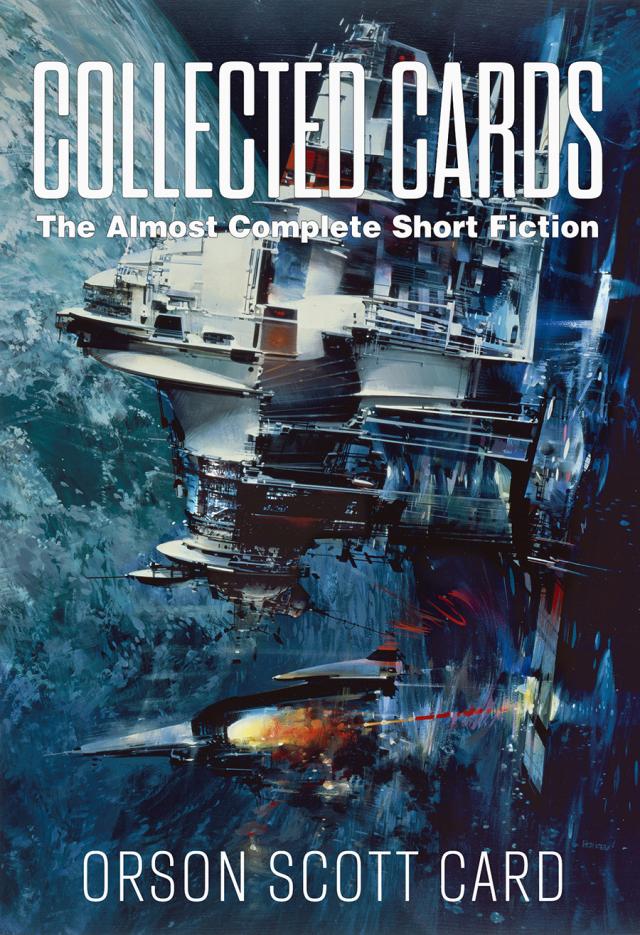
Collected Cards: The Almost Complete Short Fiction,
p.22


Ansset didn’t understand. “Why?” he asked. “He tried to kill you.”
Mikal only laughed. It was Riktors who answered. “He thinks I can hold his empire together. But I want to know the price.”
Mikal leaned forward on his chair. “A small price. A house for myself and my Songbird until I die. And then he is to be free for the rest of his life, with an income that doesn’t make him dependent on anybody’s favors. Simple enough?”
“I agree.”
“How prudent.” And Mikal laughed again.
The vows were made, the abdication and coronation took a great deal of pomp and the Capital’s caterers became wealthy. All the contenders were slaughtered, and Riktors spent a year going from system to system to quell (brutally) all the rebellions.
After the first few planets were burned over, the other rebellions mostly quelled themselves.
It was only the day after the newssheets announced the quelling of the most threatening rebellion that the soldiers appeared at the door of the little house in Brazil where Mikal and Ansset lived.
“How can he!” Ansset cried out in anguish when he saw the soldiers at the door. “He gave his word.”
“Open the door for them, Son,” Mikal said.
“They’re here to kill you!”
“A year was all that I hoped for. I’ve had that year. Did you really expect Riktors to keep his word? There isn’t room in the galaxy for two heads that know the feel of the imperial crown.”
“I can kill most of them before they could come near. If you hide, perhaps—”
“Don’t kill anyone, Ansset. That’s not your song. The dance of your hands is nothing without the dance of your voice, Songbird.”
The soldiers began to beat on the door, which, because it was steel, did not give way easily. “They’ll blow it open in a moment,” Mikal said. “Promise me you won’t kill anyone. No matter who. Please. Don’t avenge me.”
“I will.”
“Don’t avenge me. Promise. On your life. On your love for me.”
Ansset promised. The door blew open. The soldiers killed Mikal with a flash of lasers that turned his body to ashes. They kept firing until nothing but ashes was left. Then they gathered them up. Ansset watched, keeping his promise but wishing with all his heart that somewhere in his mind there was a wall he could hide behind. Unfortunately, he was too sane.
They took the ashes of the emperor and twelve-year-old Ansset to Capital. The ashes were placed in a huge urn, and displayed with state honors. Ansset they brought to the funeral feast under heavy guard, for fear of what his hands might do.
After the meal, at which everyone pretended to be somber, Riktors called Ansset to him. The guards followed, but Riktors waved them away. The crown rested on his hair.
“I know I’m safe from you,” Riktors said.
“You’re a lying bastard,” Ansset said, “and if I hadn’t given my word I’d tear you end to end.”
It might have seemed ludicrous that a twelve-year-old should speak that way to an emperor, but Riktors didn’t laugh. “If I weren’t a lying bastard, Mikal would never have given the empire to me.”
Then Riktors stood. “My friends,” he said, and the sycophants gave a cheer. “From now on I am not to be known as Riktors Ashen, but as Riktors Mikal. The name Mikal shall pass to all my successors on the throne, in honor of the man who built this empire and brought peace to all mankind.” Riktors sat amid the applause and cheers, which sounded like some of the people might have been sincere. It was a nice speech, as impromptu speeches went.
Then Riktors commanded Ansset to sing.
“I’d rather die,” Ansset said.
“You will, when the time comes,” Riktors answered.
Ansset sang then, standing on the table so that everyone could see him, just as he had stood to sing to an audience he hated on his last night of captivity in the ship. His song was wordless, for all the words he might have said were treason. Instead he sang melody, flying unaccompanied from mode to mode, each note torn from his throat in pain, each note bringing pain to the ears that heard it. The song broke up the banquet as the grief they had all pretended to feel now burned within them. Many went home weeping; all felt the great loss of the man whose ashes dusted the bottom of the urn.
Only Riktors stayed at the table after Ansset’s song was over.
“Now,” Ansset said, “they’ll never forget Father Mikal.”
“Or Mikal’s Songbird,” Riktors said. “But I am Mikal now, as much of him as could survive. A name and an empire.”
“There’s nothing of Father Mikal in you,” Ansset said coldly.
“Is there not?” Riktors said softly. “Were you fooled by Mikal’s public cruelty? No, Songbird.” And in his voice Ansset heard the hints of pain that lay behind the harsh and haughty emperor.
“Stay and sing for me, Songbird,” Riktors said. Pleading played around the edges of his voice.
Ansset reached out his hand and touched the urn of ashes that rested on the table. “I’ll never love you,” he said, meaning the words to hurt.
“Nor I you,” Riktors answered. “But we may, nonetheless, feed each other something that we hunger for. Did Mikal sleep with you?”
“He never wanted to. I never offered.”
“Neither will I,” Riktors said. “I only want to hear your songs.”
There was no voice in Ansset for the word he decided to say. He nodded. Riktors had the grace not to smile. He just nodded in return, and left the table. Before he reached the doors, Ansset spoke: “What will you do with this?”
Riktors looked at where Ansset rested his hand. “The relics are yours. Do what you want.” Then Riktors Mikal was gone.
Ansset took the urn of ashes into the chamber where he and Father Mikal had sung so many songs to each other. Ansset stood for a long time before the fire, humming the memories to himself. He gave the songs back to Father Mikal, and then reached out and emptied the urn on the blazing fire.
The ashes put the fire out.
“The transition is complete,” Songmaster Onn said to Songmaster Esste as soon as the door was closed.
“I was afraid,” Songmaster Esste confided in a low melody that trembled. “Riktors Ashen is not unwise. But Ansset’s songs are stronger than wisdom.”
They sat together in the cold sunlight that filtered through the windows of the High Room of the Songhouse. “Ah,” sang Songmaster Onn, and the melody was of love for Songmaster Esste.
“Don’t praise me. The gift and power were Ansset’s.”
“But the teacher was Esste. In other hands Ansset might have been used as a tool for power, for wealth, for control. In your hands—”
“No, Brother Onn. Ansset himself is too much made of love and loyalty. He makes other men desire what he himself already is. He is a tool that cannot be used for evil.”
“Will he ever know?”
“Perhaps; I do not think he yet suspects the power of his gift. It would be better if he never found out how little like the other Songbirds he is. And as for the last block in his mind—we laid that well. He will never know it is there, and so he will never search for the truth about who controlled the transfer of the crown.”
Songmaster Onn sang tremulously of the delicate plots woven in the mind of a child of five, plots that could have unwoven at any point. “But the weaver was wise, and the cloth has held.”
“Mikal Conqueror,” said Songmaster Esste, “learned to love peace more than he loved himself, and so will Riktors Mikal. That is enough. We have done our duty for mankind. Now we must teach other little Songbirds.”
“Only the old songs,” sighed Songmaster Onn.
“No,” answered Songmaster Esste with a smile. “We will teach them to sing of Mikal’s Songbird.”
“Ansset has already sung that.” They walked slowly out of the High Room as Songmaster Esste whispered, “Then we will harmonize!” Their laughter was music down the stairs.
I Put My Blue Genes On
Biological warfare? You ain’t seen nuthin’ yet!
It had taken three weeks to get there—longer than any man in living memory had been in space, and there were four of us crammed into the little Hunter III skipship. It gave us a hearty appreciation for the pioneers, who had had to crawl across space at a tenth of the speed of light. No wonder only three colonies ever got founded. Everybody else must have eaten each other alive after the first month in space.
Harold had taken a swing at Amauri the last day, and if we hadn’t hit the homing signal I would have ordered the ship turned around to go home to Núncamais, which was mother and apple pie to everybody but me—I’m from Pennsylvania. But we got the homing signal, and set the computer to scanning the old maps, and after a few hours found ourselves in stationary orbit over Prescott, Arizona.
At least that’s what the geologer said, and computers can’t lie. It didn’t look like what the old books said Arizona should look like.
But there was the homing signal, broadcasting in Old English: “God Bless America, come in, safe landing guaranteed.” The computer assured us that in Old English the word guarantee was not obscene but rather had something to do with a statement being particularly trustworthy—we had a chuckle over that one.
But we were excited, too. When great-great-great-great to the umpteenth power grandpa and grandma upped their balloons from old Terra Firma eight hundred years ago, it had been to escape the ravages of microbiological warfare that was just beginning (a few germs in a sneak attack on Madagascar, quickly spreading to epidemic proportions, and South Africa holding the world ransom for the antidote; quick retaliation with virulent cancer; you guess the rest). And even from a couple of miles out in space, it was pretty obvious that the war hadn’t stopped there. And yet there was this homing signal.
“Obviamente automática,” Amauri observed. “Obviously automatic.”
“Que máquina, que não pofa em tantos anos, bichinha! Não acredito!” retorted Harold, and I was afraid I might have a rerun of the day before.
“English,” I said. “Might as well get used to it. We’ll have to speak it for a few days, at least.”
Vladimir sighed. “Merda.”
I laughed. “All right, you can keep your scatalogical comments in lingua deporto.”
“Are you so sure there’s anybody alive down there?” Vladimir asked.
What could I say? I felt it in my bones? So I just threw a sponge at him, which scattered drinking water all over the cabin, and for a few minutes we had a watertight. I know, discipline, discipline. But we’re not a land army up here, and what the hell. I’d rather have my crew acting like crazy children than like crazy grownups.
Actually, I didn’t believe that at the level of technology our ancestors had reached in 1992 they could build a machine that would keep running until 2810. Somebody had to be alive down there—or else they’d gotten smart. Again, the surface of old Terra didn’t give many signs that anybody had gotten smart.
So somebody was alive down there. And that was exactly what we had been sent to find out.
They complained when I ordered monkey suits.
“That’s old mother Earth down there!” Harold argued. For a halibut with an ike of 150 he sure could act like a baiano sometimes.
“Show me the cities,” I answered. “Show me the millions of people running around taking the sun in their rawhide summer outfits.”
“And there may be germs,” Amauri added, in his snottiest voice, and immediately I had another argument going between two men brown enough to know better.
“We will follow,” I said in my nasty captain’s voice, “standard planetary procedure, whether it’s mother Earth or mother—”
And at that moment the monotonous homing signal changed.
“Please respond, please identify, please respond, or we’ll blast your asses out of the sky.”
We responded. And soon afterward found ourselves in monkey suits wandering around in thick pea soup up to our navels (if we could have located our navels without a map, surrounded as they were with life-saving devices) waiting for somebody to open a door.
A door opened and we picked ourselves up off a very hard floor. Some of the pea soup had fallen down the hatch with us. A gas came into the sterile chamber where we waited, and pretty soon the pea soup settled down and turned into mud.
“Mariajoseijesus!” Amauri muttered. “Aquela merda vivia!”
“English,” I muttered into the monkey mouth, “and clean up your language.”
“That crap was alive,” Amauri said, rephrasing and cleaning up his language.
“And now it isn’t, but we are.” It was hard to be patient.
For all we knew, what passed for humanity here liked eating spacemen. Or sacrificing them to some local deity. We passed a nervous four hours in that cubicle. And I had already laid about five hopeless escape plans—when a door opened, and a person appeared.
He was dressed in a white farmer-suit, or at least close to it. He was very short, but smiled pleasantly and beckoned. Proof positive. Living human beings. Mission successful. Now we know there was no cause for rejoicing, but at the moment we rejoiced. Back-slapping, embracing our little host (afraid of crushing him for a moment), and then into the labyrinth of U.S. MB Warfare Post 004.
They were all very small—not more than 140 centimeters tall—and the first thought that struck me was how much humanity had grown since then. The stars must agree with us, I thought.
Till quiet, methodical Vladimir, looking, as always, white as a ghost, pointedly turned a doorknob and touched a lightswitch (it actually was mechanical). They were both above eye level for our little friends. So it wasn’t the colonists who had grown—it was our cousins from old Gaea who had shrunk.
We tried to catch them up on history, but all they cared about was their own politics. “Are you American?” they kept asking.
“I’m from Pennsylvania,” I said, “but these humblebutts are from Núncamais.”
They didn’t understand.[*]
“Núncamais. It means never again. In lingua deporto.”
Again puzzled. But they asked another question. “Where did your colony come from.” One track minds.
“Pennsylvania was settled by Americans from Hawaii. We lay no bets as to why they named the damned planet Pennsylvania.”
One of the little people piped up, “That’s obvious. Cradle of liberty. And them?”
“From Brazil,” I said.
They conferred quietly on that one, and then apparently decided that while Brazilian ancestry wasn’t a capital offense, it didn’t exactly confer human status. From then on, they made no attempt to talk to my crew. Just watched them carefully, and talked to me.
Me they loved.
“God bless America,” they said.
I felt agreeable. “God bless America,” I answered.
Then, again in unison, they made an obscene suggestion as to what I should do with the Russians. I glanced at my compatriots and fellow travelers and shrugged. I repeated the little folks’ wish for the Russians’ sexual bliss.
Fact time. I won’t bore by repeating all the clever questioning and probing that elicited the following information. Partly because it didn’t take any questioning. They seemed to have been rehearsing for years what they would say to any visitors from outer space, particularly the descendants of the long-lost colonists. It went this way:
Germ warfare had begun in earnest about three years after we left. Three very cleverly designed cancer viruses had been loosed on the world, apparently by no one at all, since both the Russians and the Americans denied it and the Chinese were all dead. That was when the scientists knuckled down and set to work.
Recombinant DNA had been a rough enough science when my ancestors took off for the stars—and we hadn’t developed it much since then. When you’re developing raw planets you have better things to do with your time. But under the pressure of warfare, the science of do-it-yourself genetics had a field day on planet Earth.
“We are constantly developing new strains of viruses and bacteria,” they said. “And constantly we are bombarded by the Russians’ latest weapons.” They were hard-pressed. There weren’t many of them in that particular MB Warfare Post, and the enemy’s assaults were clever.
And finally the picture became clear. To all of us at once. It was Harold who said, “Fossa-me, mãe! You mean for eight hundred years you bunnies’ve been down here?”
They didn’t answer until I asked the question—more politely, too, since I had noticed a certain set to those inscrutable jaws when Harold called them bunnies. Well, they were bunnies, white as white could be, but it was tasteless for Harold to call them that, particularly in front of Vladimir, who had more than a slight tendency toward white skin himself.
“Have you Americans been trapped down here ever since the war began?” I asked, trying to put awe into my voice, and succeeding. Horror isn’t that far removed from awe, anyway.
They beamed with what I took for pride. And I was beginning to be able to interpret some of their facial expressions. As long as I had good words for America, I was all right.
“Yes, captain Kane Kanea,” (somewhere along in there I had introduced myself—it should be obvious by now I’m leaving out some details here and there to speed up this program). “We and our ancestors have been here from the beginning.”
“Doesn’t it get a little cramped?”
“Not for American soldiers, captain. For the right to life, liberty, and the pursuit of happiness we would sacrifice anything.” I didn’t ask how much liberty and happiness-pursuing were possible in a hole in the rock. Our hero went on: “We fight on that millions may live, free, able to breathe the clean air of America unoppressed by the lashes of communism.”