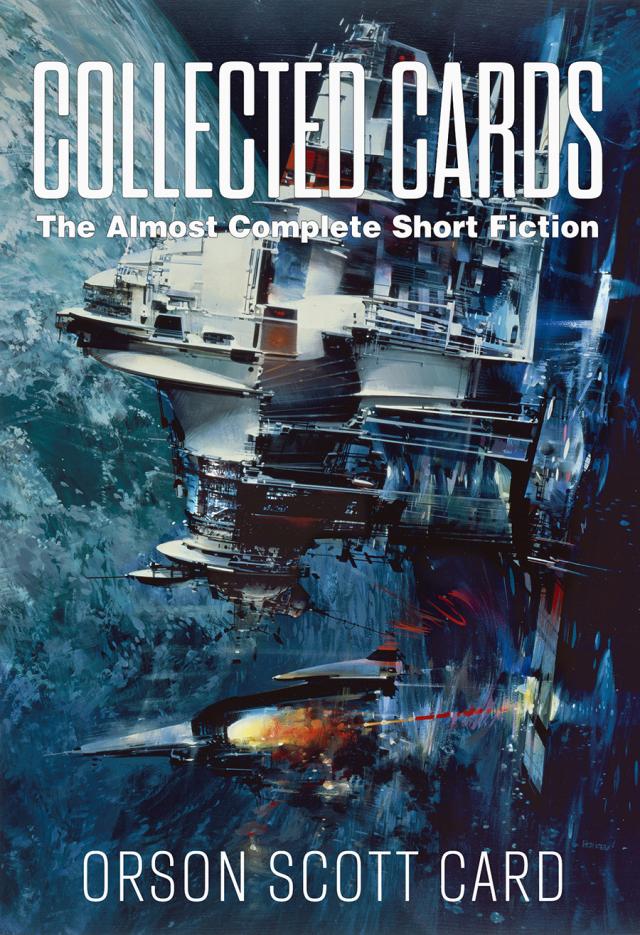
Collected cards the almo.., p.417
Collected Cards: The Almost Complete Short Fiction,
p.417


“I’ll have a plan when I need one,” said Rigg.
“In a pinch, plans kind of make themselves, mostly because you don’t have a lot of choices,” said Noxon.
“Aren’t you going to ask the advice of someone older and wiser?” asked Ram Odin.
“When we find somebody wiser,” said Noxon, “we’ll ask him for advice.”
Novel published by Simon Pulse, November 4, 2014
2015
Breeding True
The artifact wasn’t moving anywhere near as fast as light. It had blipped into the Asteroid Collision Detection System two years before anybody noticed that it was going the wrong speed and the wrong direction. Any native solar system objects whose trajectory would aim them straight at the Sun would have been swallowed up billions of years before. So this thing, this “cometoid,” had to have come from outside the system. That made it interesting.
Long before it could get inside the orbit of Venus, an Asteroid Mover (AMV) was sent on an interception course. It wasn’t long before estimates of mass and analysis of albedo and spectrum made it clear that this was not a natural object at all.
There was a brief flurry of wild speculation, based on the weirdness of an alien artifact being sent toward the Sun instead of toward Earth. Was it a starkiller? Were the aliens using a superweapon to make the Sun drop into a red giant sequence that would wipe out all life on Earth? Or would it accomplish the same effect with a superflare?
None of these. The crew of the Asteroid Mover found that it contained no weapon, no machinery of any kind beyond what was needed to keep it on a sunward course. As the pilot of the AMV said: “It isn’t a message in a bottle. It has no passenger and no cargo. It didn’t even bring a sack lunch.”
The artifact offered no resistance when the Asteroid Mover changed its trajectory to whip it around the Sun and send it toward the spot where Earth would be six months later—except a degree or two above the ecliptic. There, an Asteroid Catcher (ARV) intercepted it and brought it toward the Moon for further study.
But before it reached the Moon, everything interesting on the alien object had already been transmitted to Earth, where the combined efforts of cryptologists, computers, and scientists from every discipline revealed that the tiny markings etched all over the inside of the vehicle—so small they had looked like mere texture to the AMV’s crew—contained a long but simple message.
It was a listing of the entire human genome.
Upon closer examination, it was found to be slightly different. The changes were not in the genes that coded for normal human variations, like height, hair color, or other hereditary traits. Instead, there were deletions of a few dozen small sections, and even fewer new sequences in other locations.
When the decryption was demonstrated to be accurate, attention turned exclusively to the genetic alterations. Discussion centered on various topics:
Alien methodology. How did the aliens get the human genome in the first place? Did they locate one of our early probes, like Voyager, and find some human DNA somehow preserved in the cold of space? And then, in order to understand what the genes coded for, did the aliens figure out how to grow various humans from the genetic material they had? How could such humans grow up without any human culture or language to bring them to a full expression of their genetic potential? Or was the alien technology so advanced that they could run a reliable simulation of every process directed by the human genes in every cell, without ever growing an actual human organism?
Alterations. Were the alterations an accidental misreading of the genes they were working with? Were the original genes broken or distorted, so that what they sent us was an attempted reconstruction? Or were the alterations deliberate? Were they offering improvements to the human genome?
Genome or Individual? Was the genetic code meant to be a general statement about the human genome? Or was it meant to be the code that would produce a particular individual, missing some human genes and with new ones inserted?
God or Devil? Some religious groups became convinced that this genetic sequence was the Second Coming of Christ—and the fact that both X and Y chromosomes were offered was taken as a sign that we could take our pick as to which sex we wanted Christ to express this time around. Others thought that if this genome were used to create a living individual, he or she would be a bodhisattva or some other divine manifestation. Inevitably, there were also those who were certain that the aliens wanted us to cooperate in our own destruction by bringing the Devil to life, using this altered genome.
Alien Invasion. Maybe the aliens inserted enough alterations in their proposed new genome that any individuals created using it would act as, or even be, members of the alien species. The only way this invasion could take place, of course, was if humans were so stupid as to create living organisms with this genome, in which case the human race really would prove itself to be too dumb to live.
What Will It Do to Us? Despite the warnings by those who believed in an alien invasion, everyone quickly came to believe that someone, at some time, would inevitably try to create a living expression of the altered genome. There were elaborate containment schemes, so that any such humanesque organisms could be raised inside the highest-security compound ever built. On the other side, there were those who said, “If someone actually created such an organism, it would be a baby. It might be an enhanced baby, or a deformed baby, or a defective baby, or a nonviable embryo from the start. But these genes would try to build a baby.”
What Kind of Person Would Choose to Give Birth to a Monster? It was “giving birth” that was the first sticking point. Within a few years, six different laboratories in as many different nations demonstrated that this genome could be constructed and that, if it replaced the DNA in a newly fertilized ovum that had not yet divided, it would develop into a completely normal-seeming embryo.
At that point, politicians, jurists, ethics panels, and, in one spectacular case, violent protestors intervened, and the resulting embryos were destroyed.
The reactions generally fit into two categories:
1. Oh, what a loss to science!
2. Whew! That was a close one!
“If the aliens want to give us a message, they should deliver it in person,” said one pundit.
“If they come in person,” said another, “we can reply by blowing them to hell.”
Reading and listening to the commentaries on the matter, you would think that the whole kerfuffle about the alien-altered genome was over.
But of course the alien genome existed on thousands of computers, and thousands of scientists found the alien genome tickling the back of their mind. They had not forgotten it, they would not forget it, and with or without funding, they could not rest until they knew the answers to all the questions.
That’s why geneticist Audny Ostergard married obstetrician Sunkanmi Zuo. Using the facilities at a fertility clinic where they both had privileges, they created six embryos in vitro, all containing, not their own genes, but the alien genome. Four of them they kept for possible later use. Two of them they implanted in Audny’s womb—a male and a female, because their discussion of which sex to choose ended with Sunk quoting, “Male and female created he them; and blessed them, and called their name Adam, in the day when they were created.”
“We are not naming the boy Adam, and certainly not both of them,” said Audny.
“If they develop properly and are born, we can decide on names the way any other married couple decides.”
“And how is that?” asked Audny.
“By letting the relatives fight over the names until we give up and name one baby after the street where the hospital is located and the other after the month in which they’re born.”
“The hospital is on Medical Street,” said Audny.
“I’ve heard worse names,” said Sunk. “Or we could change hospitals.”
But they wouldn’t change hospitals, because Sunkanmi Zuo had to be the only physician who ever saw the babies’ ultrasounds. There was a strong possibility of physical anomalies, and they couldn’t afford questions. Or blood tests. Because if it became known that Audny was carrying not one but two “alien babies,” courts and legislators and mobs and assassins were likely to feel they had a right to decide whether the babies would be allowed to live.
There were no physical anomalies. Every ultrasound showed perfectly normal babies, except that they grew just a little too rapidly and seemed ready to come to full term more than three weeks early. “So they sped the kids up a little,” said Audny. “I don’t mind getting rid of this enormous belly and all the backaches and vomiting and everything else in eight months rather than nine.”
“Do you think . . . ,” said Sunk, and then trailed off.
“Do I think? Often,” Audny replied.
“Doesn’t matter.”
“Say it.”
Sunk grinned. “Do you think anybody will notice if the children don’t look like a combination of an extremely blond woman and a thoroughly black man?”
“I think that strangers will assume that the children were adopted and be polite enough not to ask.”
“And people who know you actually gave birth?” asked Sunk.
“I’ve already thought about this and, depending on how they look, racially speaking, I’ll tell them that the babies were hatched in vitro and either the ova or the sperm were from a donor. Since they really were hatched in vitro—but no, Sunk, that was not what you were going to say, because you weren’t grinning when you said, ‘Do you think.’ ”
Sunk fell silent, and then smiled a little. “What we never decided is whether our marriage is a science project or . . . a reproductive commitment.”
“You mean whether it’s a real marriage.”
“We’ve been so careful about the babies that we haven’t even . . . and I don’t know if . . .”
“The babies will need two parents, and that’s the exact number we have, one of each gender in order to provide both of them with the proper role models,” said Audny. “Are you planning on divorcing me?”
“What I was wondering was if we would ever possibly have . . .”
“Sex?” asked Audny. “Oh, early and often, as soon as the babies escape from prison.”
“Babies of our own,” said Sunk.
It was Audny’s turn to be thoughtful. “Why don’t we see how this first pair work out?” she finally said. “It’s conceivable that these two might be so demanding or . . . difficult . . . that it wouldn’t be right to have a . . . an ordinary child grow up in their wake.”
“You almost said ‘a human child,’ didn’t you?” asked Sunk.
“Maybe,” said Audny. “I don’t think I knew what I was going to say.”
“Are we only going to pretend to other people that we believe these children are human?” asked Sunk. “Or do we really believe it?”
“We don’t know yet,” said Audny. “That’s what we’re going to find out. And because of confirmation bias, we can’t even trust our own conclusions because we may seize on any evidence that supports what we want the truth to be.”
“And what do we want the truth to be?” asked Sunk.
“Truthful,” said Audny.
“Do we want the children to be human? Or . . .”
“We want what every parent wants,” said Audny. “For the children to be brilliant, beautiful, healthy, and much more successful than we were, so they can take care of us in our old age.”
“That’s a fair answer,” said Sunk. “The reason I asked is just that as the time comes closer, I’m finding myself feeling less and less like a scientist and more and more like a . . .”
“Dad,” said Audny.
“We can’t raise them to be proper humans if we don’t love them,” said Sunk.
“Well, that experiment has been performed millions of times, and many unloved children have grown up to be good people.”
“We can’t be happy if we don’t love them,” Sunk said.
“Maybe we can’t be truly unhappy unless we love them,” said Audny. “We’ll see, won’t we?”
“Do you think we’re the only ones?” Sunk asked.
“Who love their children before they’re even born?”
“Who are giving life to the altered genome.”
“For all we know, there are already a thousand two-year-olds and one-year-olds with the alien gene expressing itself,” said Audny. “Or none. And if there are others, they don’t know about us.”
What Sunk could not say aloud, though he was sure it had occurred to Audny as well, was the real question: If these children are dangerous for some reason, what is our exit strategy? How do we end the experiment if it’s too successful in all the wrong ways?
What do we do if we regret that these children were born?
Whatever the genetic differences might be—and except for unusually rapid mental and physical development, nothing had yet shown up—raising March, the daughter, and Cal, the son, was a joy for both Audny and Sunk. The kids weren’t perfect—their early dexterity and balance meant that there was no such thing as “out of reach” or “child-proof”—and it took awhile for them to sleep through the night.
Sunk thought that maybe they never slept through the night. They had simply learned to remain quiet so their parents would sleep. He once confessed this thought to Audny by asking, “What do you think they do, while we’re sleeping?”
“They sleep,” she said, but being a very bright person, she understood at once what Sunk was getting at. “What do you think they’re doing, studying Internet porn?”
“Or looking up UFO sightings,” said Sunk.
“I’ve never seen any evidence of their getting out of bed,” said Audny.
“Nor have I,” said Sunk. “I was joking, you know.”
“I believe that you want to believe that,” said Audny. “It’s natural to worry.”
“They aren’t showing us what the altered DNA is doing,” said Sunk.
“Here’s what I think,” said Audny. “The aliens who made that vessel and sent it toward the Sun have been sending identical vehicles for at least fifty thousand years. Maybe every couple of centuries, or whatever time interval makes sense to them. Only when we had the technology to intercept it would we have any chance of making children like Cal and March.”
“Interesting, but not provable or disprovable.”
“I haven’t gotten to the relevant part yet,” said Audny. “Here on Earth, there was interbreeding with Neanderthals and Denisovans—”
“The alien genome was clearly modeled on African samples, which never had them.”
“I’ve read all the same reports as you,” said Audny. “What we can’t know is how many other mutations and alterations have affected all human DNA, after the aliens got their sample.”
“Anything is possible,” said Sunk.
“And everything is also ridiculously far-fetched,” said Audny. “How could there be a complete, usable gene sample in a probe that has been moving through vacuum for at least a hundred years? But how could, and why would, the aliens take a sample of human DNA from Africa before any dispersal of Homo sapiens, preserve it, and then send it back to us mostly unchanged? Are they trying to correct errors? Expunge the other hominids from the genome? Did they make us in the first place? This is all nonsense.”
“Except for the bits that aren’t,” said Sunk. “But I know what you’re saying. Maybe our children are what the human race was meant to be. Certainly they represent what the first humans looked like. Somewhere between Malay and Dravidian, perhaps leaning toward Australian.”
“It would be a shame to wipe out the traces of Neanderthal and Denisovan DNA that the Europeans and Asians picked up.”
“That’s the flaw in our thinking right there,” said Sunk. “Who says the aliens want to replace present-day humans? What if this is more like reintroducing an ancestral strain, an heirloom human . . .”
“And now you’re making my point,” said Audny. “Just when I was about to abandon it.”
“Why, when we know these children so well, are we still thinking that they pose some kind of danger, or that they’re meant as a replacement for our species?”
“They are our species,” said Audny. “Compared to the differences between humans and chimps—which are very nearly trivial, percentagewise—the difference between us and the children is almost nonexistent.”
“They went to a lot of trouble to etch the genome into the interior surface of a spacecraft they then threw at the Sun,” said Sunk.
“And now we’re watching the success of their effort. And as far as either of us can tell, their purpose was to give us wonderful children. Who sleep through the night.”
Sunk had to laugh and concede the point. Because if it were possible, he loved March and Cal even more than Audny did, and despite his close observation for three years, he had found nothing wrong with them. They were verbally gifted, but seemed to be introverts, able to remain still and listen to other people, without any need to inject themselves into the conversation.
Even though Sunk had no evidence, he kept thinking that the kids understood far more than they said, and that they knew how to say far more than the vocabulary they chose to use in front of their parents. This was paranoid thinking, he knew, but he noticed that Audny also tended to avoid talking over the heads of the children the way most parents did. Because neither one of them had any idea just what level of conversation, if any, the children would be unable to understand.
“We’re terrible parents,” said Sunk one day. He was thinking that good parents didn’t spend so much time and effort trying to find something horribly wrong with brilliant, happy, healthy children.
“We’re wonderful parents,” said Audny, smiling. It was quite possible she knew what he meant and didn’t think it mattered.
This brief conversation took place when the children were both four. Sunk and Audny had decided against preschool because the Cal and March were already reading at a third grade level—or higher. The activities at the preschools they visited were obviously far beneath their children’s level. Now their debate was about home schooling versus tutors, because there was no school prepared to deal with March and Cal.