The complete novels of v.., p.10
The Complete Novels of Victor Hugo,
p.10


At a gesture of Biassou's hand the negroes removed the unhappy lover of the blacks to a position near me, where, overwhelmed by the honor of his position, he fell to the ground without being able to articulate a word.
CHAPTER THIRTY-ONE
“IT is your turn now,” said the general, turning to the last of the prisoners—the planter who was accused by the white men of having black blood in his veins, and who had on that account sent me a challenge.
A general clamor drowned the reply of the planter. “Muerte! Mort! Touye!” cried the negroes, grinding their teeth and shaking their fists at the unhappy captive.
“General,” said a mulatto, making himself heard above the uproar, “he is a white man, and he must die.”
The miserable planter, by cries and gesticulations, managed to edge in some words. “No, general! no, my brothers! it is an infamous calumny. I am a mulatto, like yourselves, of mixed blood; my mother was a negress, like your mothers and sisters.”
“He lies!” cried the infuriated negroes; “he is a white man; he has always detested the colored people.”
“Never!” retorted the prisoner; “it is the whites that I detest. I have always said with you, 'Negre ce blan; blan ce negre' ('The negroes are the masters; the whites are the slaves').”
“Not at all!” cried the crowd, “not at all! Kill the white man, kill him!”
Still the unhappy wretch kept repeating in heart-rending accents, “I am a mulatto, I am one of yourselves.”
“Give me a proof,” was Biassou's sole reply.
“A proof?” answered the prisoner, wildly; “the proof is that the whites have always despised me.”
“That may be true,” returned Biassou, “but you are an insolent hound to tell us so.”
A young mulatto stepped to the front and addressed the planter in an excited manner. “That the whites despised you is a fact; but, on the other hand, you affected to look down upon the mulattoes among whom they classed you. It has even been reported that you once challenged a white man who called you a half-caste.”
A howl of execration arose from the crowd, and the cry of “Death” was repeated more loudly than ever; while the planter, casting an appealing glance at me, continued, with tears in his eyes:
“It is a calumny; my greatest glory and happiness is in belonging to the blacks. I am a mulatto.”
“If you really were a mulatto,” observed Rigaud, quietly, “you would not make use of such an expression.”
“How do I know what I am saying?” asked the panic stricken wretch. “General, the proof that I am of mixed blood is in the black circle that you see round the bottom of my nails.”
Biassou thrust aside the suppliant hand. “I do not possess the knowledge of our chaplain, who can tell what a man is by looking at his hand. But listen to me: my soldiers accuse' you—some, of being a white man; others, of being a false brother. If this is the case you ought to die. You, on the other hand, assert that you belong to our race, and that you have never denied it. There is one method by which you can prove your assertion. Take this dagger and stab these two white prisoners!”
As he spoke, with a wave of his hand, Biassou designated the citizen C—and myself.
The planter drew back from the dagger which, with a devilish smile on his face, Biassou presented to him.
“What!” said the general, “do you hesitate? It is your only chance of proving your assertion to the army that you are not a white, and are one of ourselves. Come, decide at once, for we have no time to lose.”
The prisoner's eyes glared wildly; he stretched out his hand toward the dagger, then let his arm fall again, turning away his head, while every limb quivered with emotion.
“Come, come!” cried Biassou, in tones of impatience and anger, “I am in a hurry. Choose: either kill them, or die with them!”
The planter remained motionless, as if he had been turned to stone.
“Good!” said Biassou, turning toward the negroes; “he does not wish to be the executioneer, let him be the victim. I can see that he is nothing but a white man; away with him!”
The negroes advanced to seize him. This movement impelled him to immediate choice between giving or receiving death. Extreme cowardice produces a bastard species of courage. Stepping forward, he snatched the dagger that Biassou still held out to him, and without giving himself time to reflect upon what he was about to do, he precipitated himself like a tiger upon the citizen C—, who was lying on the ground near me. Then a terrible struggle commenced; The lover of the negro race, who had at the conclusion of his interview with Biassou remained plunged in a state of despair and stupor, had hardly noticed the scene between the general and the planter, so absorbed was he in the thought of his approaching death; but when he saw the man rush upon him, and the steel gleam above his head, the imminence of his danger aroused him at once. He started to his feet, grasped the arm of his would-be murderer, and exclaimed in a voice ,of terror:
“Pardon, pardon! What are you doing? What have I done?”
“You must die, sir,” said the half-caste, fixing his frenzied eyes upon his victim, and endeavoring to disengage his arm. “Let me do it; I will not hurt you.”
“Die by your hand,” cried the economist; “but why? Spare me! you wish perhaps to kill me because I used to say that you were a mulatto. But spare my life, and I vow that I will always declare that you are a white man. Yes, you are white; I will say so everywhere, but spare me!”
The unfortunate man had taken the wrong method of suing for mercy.
“Silence, silence!” cried the half-caste, furious at the idea of the danger he was incurring, and fearing that the negroes would hear the assertion.
But the other cried louder than ever that he knew that he was a white man, and of good family. The half-caste made a last effort to impose silence on him; then finding his efforts vain, he thrust aside his arms, and pressed the dagger upon C—'s breast. The unhappy man felt the point of the weapon, and in his despair bit the arm that was driving the dagger home.
“Monster! wretch!” exclaimed he, “you are murdering me!” Then casting a glance of supplication toward Biassou, he cried, “Defend me, avenger of humanity!”
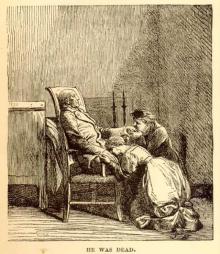
Then the murderer pressed more heavily on the dagger; a gush of blood bubbled over his fingers and spattered his face. The knees of the unhappy lover of the negro race bent beneath him, his arms fell by his side, his eyes closed, he uttered a stifled groan and fell dead.
CHAPTER THIRTY-TWO
I WAS paralyzed with horror at this scene, in which I every moment expected to play an important part.
The “avenger of humanity” had gazed on the struggle without a lineament of his features changing. When all was over, he turned to his terrified pages. “More tobacco,” said he, and began to chew calmly. The Obi and Rigaud were equally impassible, but the negroes appeared terrified at the horrible drama that their general had caused to be enacted before them.
One white man, however, yet remained to be slaughtered; my turn had come. I cast a glance upon the murderer who was about to become my executioner, and a feeling of pity came over me. His hps were violet, his teeth chattered, a convulsive tremor caused every limb to quiver. By a mechanical movement his hand was continually passed over his forehead, as if to obliterate he traces of the blood which had so liberally sprinkled it; he looked with an air of terrified wonder at the bleeding body which lay at his feet, as though he were unable to detach his strained eyeballs from the spectacle of his victim. I waited for the moment when he would resume his task of blood. The position was a strange one: he had already tried to kill me and failed, to prove that he was white; and now he was going to murder me to show that he was black.
“Come,” said Biassou, addressing him, “this is good; I am pleased with you, my friend.” Then glancing at me, he added, “You need not finish the other one; and now I declare you one of us, and name you executioner to the army.”
At these words a negro stepped out of the ranks, and bowing three times to the general, cried out in his jargon, which I will spare you:
“And I, General?”
“Well, what do you want?” asked Biassou.
“Are you going to do nothing for me, General?” asked the negro. “Here you give an important post to this dog of a white, who murders to save his own skin, and to prove that he is one of ourselves. Have you no post to give me, who am a true black?”
This unexpected request seemed to embarrass Biassou, and Rigaud whispered to him in French:
“You can't satisfy him; try to elude his request.”
“You wish for promotion, then?” asked Biassou of the true black. “Well, I am willing enough to grant it to you. What grade do you wish for?”
“I wish to be an officer.”
“An officer, eh? And what are your claims to the epaulet founded on?”
“It was I,” answered the negro, emphatically, “who set fire to the house of Lagoscelte in the first days of August last. It was I who murdered M. Clement the planter, and carried the head of his sugar refiner on my pike. I killed ten white women and seven small children, one of whom on the point of a spear served as a standard for Bouckmann's brave blacks. Later on I burned alive the families of four colonists, whom I had locked up in the strong room of Fort Galifet. My father was broken on the wheel at Cap, my brother was hung at Rocrow, and I narrowly escaped being shot. I have burned three coffee plantations, six indigo estates, and two hundred acres of sugar-cane; I murdered my master, M. Noe, and his mother—”
“Spare us the recital of your services,” said Rigaud, whose feigned benevolence was the mask for real cruelty, but who was ferocious with decency, and could not listen to this cynical confession of deeds of violence.
“I could quote many others,” continued the negro, proudly, “but you will no doubt consider that these are sufficient to insure my promotion, and to entitle me to wear a gold epaulet like my comrades there,” pointing to the staff of Biassou.
The general affected to reflect for a few minutes, and then gravely addressed the negro. “I am satisfied with your services, and should be pleased to promote you; but you must satisfy me on one point. Do you understand Latin?”
The astonished negro opened his eyes widely. “Eh, General?” said he.
“Yes,” repeated Biassou, quickly; “do you understand Latin?”
“La—Latin?” stammered the astonished negro.
“Yes, yes, yes, Latin; do you understand Latin?” said the cunning chief, and unfolding a banner upon which was embroidered the verse from the Psalms, “In exitu Israël de Egypto,” he added, “Explain the meaning of these words.”
The negro, in complete ignorance of what was meant, remained silent and motionless, fumbling with the waistband of his trousers, while his astonished eyes wandered from the banner to the general, and from the general back again to the banner.
“Come, go on!” exclaimed Biassou, impatiently.
The negro opened and shut his mouth several times, scratched his head, and at last said slowly: “I don't understand it, General.”
“How, scoundrel!” cried Biassou; “you wish to become an officer, and you do not understand Latin!”
“But, General—” stammered the puzzled negro.
“Silence!” roared Biassou, whose anger appeared to increase; “I do not know what prevents me from having you shot at once. Did you ever hear such a thing, Rigaud? He wants to be an officer, and does not understand Latin. Well, then, idiot, as you do not understand, I will explain what is written on this banner: In exitu —'Every soldier'— Israël —'who does not understand Latin'—de Eyypto —'cannot be made an officer.' Is not that the translation, reverend sir?”
The Obi bowed his head in the affirmative, and Biassou continued:
“This brother of whom you are jealous, and whom I have appointed executioner, understands Latin!” He turned to the new executioner: “You know Latin, do you not? Prove it to this blockhead. What is the meaning of Dominus vobiscum?”
The unhappy half-caste, roused from his gloomy reverie by the dreaded voice, raised his head; and though his brain was still troubled by the cowardly murder that he had just committed, terror compelled him to be obedient. There was something pitiable in his manner, as his mind went back to his schooldays, and in the midst of his terrible feelings and remorse he repeated, in the tone of a child saying its lesson, “Dominus vobiscum —that means, 'May the Lord be with you.'“
“Et cum spirito tuo,” added the mysterious Obi, solemnly.
“Amen,” repeated Biassou; then, resuming his angry manner, and mingling with his reproaches some Latin phrases to impress the negroes with the superior attainments of their chief, he cried: “Go to the rear rank, sursum corda! Never attempt to enter the places of those who know Latin, orate fratres, or I will have you hung. Bonus, bona, bonuml”
The astonished and terrified negro slunk away, greeted by the hoots and hisses of his comrades, who were indignant at his presumption, and impressed with the deep learning of their general.
Burlesque though this scene was, it inspired me with a very high idea of Biassou's administrative capabilities. He had made ridicule the means of repressing ambitious aspirations, which are always so dangerous to authority in undisciplined bodies, and his cunning gave me a fuller idea of his mental powers, as well as of the crass ignorance of the negroes under his command.
CHAPTER THIRTY-THREE
THE breakfast hour had now arrived. The shell of a turtle was placed before Biassou, in which smoked a species of olla-podrida seasoned with bacon, in which turtle-flesh took the place of lamb; an enormous carib cabbage floated on the surface of the stew, and, in addition, on strips of bark, were dried raisins and water melons, a loaf of maize bread; a bottle of wine, bound round with tarred string, completed the feast. Biassou took from his pocket a few heads of garlic and rubbed his bread with them; then, without even ordering the bleeding form to be carried away, he began to eat, inviting Rigaud to do the same. There was something terrible in Biassou's appetite.
The Obi did not join their repast; like others in his profession, I could easily understand that he never took anything in public, to induce a belief among the negroes that he lived entirely without food.
During breakfast, Biassou ordered one of his aides-de-camp to direct the review of the army to commence, and the different corps began to defile past in fairly good order. The negroes of Morne-Rouge were the first; there were about four thousand of them, divided into companies commanded by chiefs, who were distinguished by their scarlet breeches and sashes. This force was composed of tall and powerful negroes; some of them carried guns, axes, and sabers, but many had no other arms than bows and arrows, and javelins rudely fashioned by themselves. They carried no standard, and moved past in mournful silence. As they marched on, Biassou whispered to Rigaud:
“When will Blanchelande's and Rouvray's shot and shell free me from these” bandits of Morne-Rouge? I hate them; they are nearly all of them Congos, and they only believe in killing in open battle—following the example of their chief Bug-Jargal, a young fool, who plays at being generous and magnanimous. You do not know him, Rigaud, and I hope you never will; for the whites have taken him prisoner, and they may perhaps rid me of him, as they did of Bouckmann.”
“Speaking of Bouckmann,” answered Rigaud, “there are the negroes of Macaya just passing, and I see in their ranks the negro whom Jean François sent to you with the news of Bouckmann's death. Do you know that that man might upset all the prophecies of the Obi, if he were to say that he had been kept for more than half an hour at the outposts, and that he had told me the news before you sent for him?”
“Diabolo!” answered Biassou, “you. are in the right, my friend; this man's mouth must be shut. Wait a bit.”
Then raising his voice he called out “Macaya!” The leader of the division left the ranks, and approached the general with the stock of his firelock reversed, in token of respect.
“Make that man who does not belong to your division leave his rank and come forward.”
Macaya speedily brought the messenger of Jean François before the general, who at once assumed that appearance of anger which he knew so well how to simulate.
“Who are you?” cried he.
“General, I am a black.”
“Carramba! I can see that well enough; but what is your name?”
“My name is Vavelan; my patron saint is Sabas, deacon and martyr, whose feast is on the twentieth day before the nativity of our Lord.”
Biassou interrupted him: “How dare you present yourself on parade, amid shining muskets and white cross-belts, with your sword without a sheath, your breeches torn, and your feet muddy?”
“General,” answered the negro, “it is not my fault. I was dispatched by the Grand Admiral, Jean François, to bring you the news of the death of the chief of the English negroes; and if my clothes are torn and my feet bemired, it is because I have run, without stopping to take breath, to bring you the news as soon as possible; but they detained me at—”
Biassou frowned. “I did not ask you about that, but how you dared to enter the ranks in so unbecoming a dress. Commend your soul to Saint Sabas, your patron, the deacon and martyr, and go and get yourself shot.”
And here I had another proof of the ascendency that Biassou exercised over the insurgents. The unfortunate man who was ordered to go and get himself executed did not utter a protest; he bowed his head, crossed his arms on his breast, saluted his pitiless judge three times, and after having knelt to the Obi, who gave him plenary absolution, he left the cavern. A few minutes afterward a volley of musketry told us that Biassou's commands had been obeyed, and that the negro was no more.
Freed from all sources of uneasiness, the general turned to Rigaud, a gleam of pleasure in his eye, and gave a triumphant chuckle which seemed to say, “Admire me!”
CHAPTER THIRTY-FOUR
BUT the review still continued. This army, which had presented so curious a spectacle in camp, had a no less extraordinary appearance under arms. Sometimes a horde of almost naked negroes would come along armed with clubs and tomahawks, marching to the notes of a goat's horn like mere savages; then would come regiments of mulattoes, dressed in the English or Spanish manner, well armed and equipped, regulating their pace by the roll of the drum; then a band of negresses and their children carrying forks and spits; then some tag-rag, bent under the weight of an old musket without lock or barrel; then griotes with their feathered aprons, griots dancing with hideous contortions, and singing incoherent airs to the accompaniment of guitars, tomtoms, and balafos; then would be a procession of priests, or Obi men, of half-castes, quarter-castes, free mulattoes, or wandering hordes of escaped slaves with a proud look of liberty on their faces and shining muskets on their shoulders, dragging in their ranks well-filled wagons, or some artillery taken from the whites, which were looked on more as trophies than as military engines, and yelling out at the top of their voices the songs of “Grand-Pre” and “Oua-Nasse.” Above the heads of all floated flags, banners, and standards of every form, color, and device—white, red, tricolor, with the lilies, with tlie cap of liberty, bearing inscriptions: “Death to Priests and Nobles!”