The complete novels of v.., p.125
The Complete Novels of Victor Hugo,
p.125


The Bishop could not refrain from murmuring:—
"Yes? '93!"
The member of the Convention straightened himself up in his chair with an almost lugubrious solemnity, and exclaimed, so far as a dying man is capable of exclamation:—
"Ah, there you go; '93! I was expecting that word. A cloud had been forming for the space of fifteen hundred years; at the end of fifteen hundred years it burst. You are putting the thunderbolt on its trial."
The Bishop felt, without, perhaps, confessing it, that something within him had suffered extinction. Nevertheless, he put a good face on the matter. He replied:—
"The judge speaks in the name of justice; the priest speaks in the name of pity, which is nothing but a more lofty justice. A thunderbolt should commit no error." And he added, regarding the member of the Convention steadily the while, "Louis XVII.?"
The conventionary stretched forth his hand and grasped the Bishop's arm.
"Louis XVII.! let us see. For whom do you mourn? is it for the innocent child? very good; in that case I mourn with you. Is it for the royal child? I demand time for reflection. To me, the brother of Cartouche, an innocent child who was hung up by the armpits in the Place de Greve, until death ensued, for the sole crime of having been the brother of Cartouche, is no less painful than the grandson of Louis XV., an innocent child, martyred in the tower of the Temple, for the sole crime of having been grandson of Louis XV."
"Monsieur," said the Bishop, "I like not this conjunction of names."
"Cartouche? Louis XV.? To which of the two do you object?"
A momentary silence ensued. The Bishop almost regretted having come, and yet he felt vaguely and strangely shaken.
The conventionary resumed:—
"Ah, Monsieur Priest, you love not the crudities of the true. Christ loved them. He seized a rod and cleared out the Temple. His scourge, full of lightnings, was a harsh speaker of truths. When he cried, 'Sinite parvulos,' he made no distinction between the little children. It would not have embarrassed him to bring together the Dauphin of Barabbas and the Dauphin of Herod. Innocence, Monsieur, is its own crown. Innocence has no need to be a highness. It is as august in rags as in fleurs de lys."
"That is true," said the Bishop in a low voice.
"I persist," continued the conventionary G—— "You have mentioned Louis XVII. to me. Let us come to an understanding. Shall we weep for all the innocent, all martyrs, all children, the lowly as well as the exalted? I agree to that. But in that case, as I have told you, we must go back further than '93, and our tears must begin before Louis XVII. I will weep with you over the children of kings, provided that you will weep with me over the children of the people."
"I weep for all," said the Bishop.
"Equally!" exclaimed conventionary G——; "and if the balance must incline, let it be on the side of the people. They have been suffering longer."
Another silence ensued. The conventionary was the first to break it. He raised himself on one elbow, took a bit of his cheek between his thumb and his forefinger, as one does mechanically when one interrogates and judges, and appealed to the Bishop with a gaze full of all the forces of the death agony. It was almost an explosion.
"Yes, sir, the people have been suffering a long while. And hold! that is not all, either; why have you just questioned me and talked to me about Louis XVII.? I know you not. Ever since I have been in these parts I have dwelt in this enclosure alone, never setting foot outside, and seeing no one but that child who helps me. Your name has reached me in a confused manner, it is true, and very badly pronounced, I must admit; but that signifies nothing: clever men have so many ways of imposing on that honest goodman, the people. By the way, I did not hear the sound of your carriage; you have left it yonder, behind the coppice at the fork of the roads, no doubt. I do not know you, I tell you. You have told me that you are the Bishop; but that affords me no information as to your moral personality. In short, I repeat my question. Who are you? You are a bishop; that is to say, a prince of the church, one of those gilded men with heraldic bearings and revenues, who have vast prebends,—the bishopric of D—— fifteen thousand francs settled income, ten thousand in perquisites; total, twenty-five thousand francs,—who have kitchens, who have liveries, who make good cheer, who eat moor-hens on Friday, who strut about, a lackey before, a lackey behind, in a gala coach, and who have palaces, and who roll in their carriages in the name of Jesus Christ who went barefoot! You are a prelate,—revenues, palace, horses, servants, good table, all the sensualities of life; you have this like the rest, and like the rest, you enjoy it; it is well; but this says either too much or too little; this does not enlighten me upon the intrinsic and essential value of the man who comes with the probable intention of bringing wisdom to me. To whom do I speak? Who are you?"
The Bishop hung his head and replied, "Vermis sum—I am a worm."
"A worm of the earth in a carriage?" growled the conventionary.
It was the conventionary's turn to be arrogant, and the Bishop's to be humble.
The Bishop resumed mildly:—
"So be it, sir. But explain to me how my carriage, which is a few paces off behind the trees yonder, how my good table and the moor-hens which I eat on Friday, how my twenty-five thousand francs income, how my palace and my lackeys prove that clemency is not a duty, and that '93 was not inexorable."
The conventionary passed his hand across his brow, as though to sweep away a cloud.
"Before replying to you," he said, "I beseech you to pardon me. I have just committed a wrong, sir. You are at my house, you are my guest, I owe you courtesy. You discuss my ideas, and it becomes me to confine myself to combating your arguments. Your riches and your pleasures are advantages which I hold over you in the debate; but good taste dictates that I shall not make use of them. I promise you to make no use of them in the future."
"I thank you," said the Bishop.
G—— resumed.
"Let us return to the explanation which you have asked of me. Where were we? What were you saying to me? That '93 was inexorable?"
"Inexorable; yes," said the Bishop. "What think you of Marat clapping his hands at the guillotine?"
"What think you of Bossuet chanting the Te Deum over the dragonnades?"
The retort was a harsh one, but it attained its mark with the directness of a point of steel. The Bishop quivered under it; no reply occurred to him; but he was offended by this mode of alluding to Bossuet. The best of minds will have their fetiches, and they sometimes feel vaguely wounded by the want of respect of logic.
The conventionary began to pant; the asthma of the agony which is mingled with the last breaths interrupted his voice; still, there was a perfect lucidity of soul in his eyes. He went on:—
"Let me say a few words more in this and that direction; I am willing. Apart from the Revolution, which, taken as a whole, is an immense human affirmation, '93 is, alas! a rejoinder. You think it inexorable, sir; but what of the whole monarchy, sir? Carrier is a bandit; but what name do you give to Montrevel? Fouquier-Tainville is a rascal; but what is your opinion as to Lamoignon-Baville? Maillard is terrible; but Saulx-Tavannes, if you please? Duchene senior is ferocious; but what epithet will you allow me for the elder Letellier? Jourdan-Coupe-Tete is a monster; but not so great a one as M. the Marquis de Louvois. Sir, sir, I am sorry for Marie Antoinette, archduchess and queen; but I am also sorry for that poor Huguenot woman, who, in 1685, under Louis the Great, sir, while with a nursing infant, was bound, naked to the waist, to a stake, and the child kept at a distance; her breast swelled with milk and her heart with anguish; the little one, hungry and pale, beheld that breast and cried and agonized; the executioner said to the woman, a mother and a nurse, 'Abjure!' giving her her choice between the death of her infant and the death of her conscience. What say you to that torture of Tantalus as applied to a mother? Bear this well in mind sir: the French Revolution had its reasons for existence; its wrath will be absolved by the future; its result is the world made better. From its most terrible blows there comes forth a caress for the human race. I abridge, I stop, I have too much the advantage; moreover, I am dying."
And ceasing to gaze at the Bishop, the conventionary concluded his thoughts in these tranquil words:—
"Yes, the brutalities of progress are called revolutions. When they are over, this fact is recognized,—that the human race has been treated harshly, but that it has progressed."
The conventionary doubted not that he had successively conquered all the inmost intrenchments of the Bishop. One remained, however, and from this intrenchment, the last resource of Monseigneur Bienvenu's resistance, came forth this reply, wherein appeared nearly all the harshness of the beginning:—
"Progress should believe in God. Good cannot have an impious servitor. He who is an atheist is but a bad leader for the human race."
The former representative of the people made no reply. He was seized with a fit of trembling. He looked towards heaven, and in his glance a tear gathered slowly. When the eyelid was full, the tear trickled down his livid cheek, and he said, almost in a stammer, quite low, and to himself, while his eyes were plunged in the depths:—
"O thou! O ideal! Thou alone existest!"
The Bishop experienced an indescribable shock.
After a pause, the old man raised a finger heavenward and said:—
"The infinite is. He is there. If the infinite had no person, person would be without limit; it would not be infinite; in other words, it would not exist. There is, then, an I. That I of the infinite is God."
The dying man had pronounced these last words in a loud voice, and with the shiver of ecstasy, as though he beheld some one. When he had spoken, his eyes closed. The effort had exhausted him. It was evident that he had just lived through in a moment the few hours which had been left to him. That which he had said brought him nearer to him who is in death. The supreme moment was approaching.
The Bishop understood this; time pressed; it was as a priest that he had come: from extreme coldness he had passed by degrees to extreme emotion; he gazed at those closed eyes, he took that wrinkled, aged and ice-cold hand in his, and bent over the dying man.
"This hour is the hour of God. Do you not think that it would be regrettable if we had met in vain?"
The conventionary opened his eyes again. A gravity mingled with gloom was imprinted on his countenance.
"Bishop," said he, with a slowness which probably arose more from his dignity of soul than from the failing of his strength, "I have passed my life in meditation, study, and contemplation. I was sixty years of age when my country called me and commanded me to concern myself with its affairs. I obeyed. Abuses existed, I combated them; tyrannies existed, I destroyed them; rights and principles existed, I proclaimed and confessed them. Our territory was invaded, I defended it; France was menaced, I offered my breast. I was not rich; I am poor. I have been one of the masters of the state; the vaults of the treasury were encumbered with specie to such a degree that we were forced to shore up the walls, which were on the point of bursting beneath the weight of gold and silver; I dined in Dead Tree Street, at twenty-two sous. I have succored the oppressed, I have comforted the suffering. I tore the cloth from the altar, it is true; but it was to bind up the wounds of my country. I have always upheld the march forward of the human race, forward towards the light, and I have sometimes resisted progress without pity. I have, when the occasion offered, protected my own adversaries, men of your profession. And there is at Peteghem, in Flanders, at the very spot where the Merovingian kings had their summer palace, a convent of Urbanists, the Abbéy of Sainte Claire en Beaulieu, which I saved in 1793. I have done my duty according to my powers, and all the good that I was able. After which, I was hunted down, pursued, persecuted, blackened, jeered at, scorned, cursed, proscribed. For many years past, I with my white hair have been conscious that many people think they have the right to despise me; to the poor ignorant masses I present the visage of one damned. And I accept this isolation of hatred, without hating any one myself. Now I am eighty-six years old; I am on the point of death. What is it that you have come to ask of me?"
"Your blessing," said the Bishop.
And he knelt down.
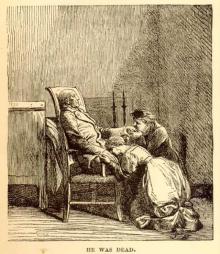
When the Bishop raised his head again, the face of the conventionary had become august. He had just expired.
The Bishop returned home, deeply absorbed in thoughts which cannot be known to us. He passed the whole night in prayer. On the following morning some bold and curious persons attempted to speak to him about member of the Convention G——; he contented himself with pointing heavenward.
From that moment he redoubled his tenderness and brotherly feeling towards all children and sufferers.
Any allusion to "that old wretch of a G——" caused him to fall into a singular preoccupation. No one could say that the passage of that soul before his, and the reflection of that grand conscience upon his, did not count for something in his approach to perfection.
This "pastoral visit" naturally furnished an occasion for a murmur of comment in all the little local coteries.
"Was the bedside of such a dying man as that the proper place for a bishop? There was evidently no conversion to be expected. All those revolutionists are backsliders. Then why go there? What was there to be seen there? He must have been very curious indeed to see a soul carried off by the devil."
One day a dowager of the impertinent variety who thinks herself spiritual, addressed this sally to him, "Monseigneur, people are inquiring when Your Greatness will receive the red cap!"—"Oh! oh! that's a coarse color," replied the Bishop. "It is lucky that those who despise it in a cap revere it in a hat."
CHAPTER XI—A RESTRICTION
We should incur a great risk of deceiving ourselves, were we to conclude from this that Monseigneur Welcome was "a philosophical bishop," or a "patriotic cure." His meeting, which may almost be designated as his union, with conventionary G——, left behind it in his mind a sort of astonishment, which rendered him still more gentle. That is all.
Although Monseigneur Bienvenu was far from being a politician, this is, perhaps, the place to indicate very briefly what his attitude was in the events of that epoch, supposing that Monseigneur Bienvenu ever dreamed of having an attitude.
Let us, then, go back a few years.
Some time after the elevation of M. Myriel to the episcopate, the Emperor had made him a baron of the Empire, in company with many other bishops. The arrest of the Pope took place, as every one knows, on the night of the 5th to the 6th of July, 1809; on this occasion, M. Myriel was summoned by Napoleon to the synod of the bishops of France and Italy convened at Paris. This synod was held at Notre-Dame, and assembled for the first time on the 15th of June, 1811, under the presidency of Cardinal Fesch. M. Myriel was one of the ninety-five bishops who attended it. But he was present only at one sitting and at three or four private conferences. Bishop of a mountain diocese, living so very close to nature, in rusticity and deprivation, it appeared that he imported among these eminent personages, ideas which altered the temperature of the assembly. He very soon returned to D—— He was interrogated as to this speedy return, and he replied: "I embarrassed them. The outside air penetrated to them through me. I produced on them the effect of an open door."
On another occasion he said, "What would you have? Those gentlemen are princes. I am only a poor peasant bishop."
The fact is that he displeased them. Among other strange things, it is said that he chanced to remark one evening, when he found himself at the house of one of his most notable colleagues: "What beautiful clocks! What beautiful carpets! What beautiful liveries! They must be a great trouble. I would not have all those superfluities, crying incessantly in my ears: 'There are people who are hungry! There are people who are cold! There are poor people! There are poor people!'"
Let us remark, by the way, that the hatred of luxury is not an intelligent hatred. This hatred would involve the hatred of the arts. Nevertheless, in churchmen, luxury is wrong, except in connection with representations and ceremonies. It seems to reveal habits which have very little that is charitable about them. An opulent priest is a contradiction. The priest must keep close to the poor. Now, can one come in contact incessantly night and day with all this distress, all these misfortunes, and this poverty, without having about one's own person a little of that misery, like the dust of labor? Is it possible to imagine a man near a brazier who is not warm? Can one imagine a workman who is working near a furnace, and who has neither a singed hair, nor blackened nails, nor a drop of sweat, nor a speck of ashes on his face? The first proof of charity in the priest, in the bishop especially, is poverty.
This is, no doubt, what the Bishop of D—— thought.
It must not be supposed, however, that he shared what we call the "ideas of the century" on certain delicate points. He took very little part in the theological quarrels of the moment, and maintained silence on questions in which Church and State were implicated; but if he had been strongly pressed, it seems that he would have been found to be an ultramontane rather than a gallican. Since we are making a portrait, and since we do not wish to conceal anything, we are forced to add that he was glacial towards Napoleon in his decline. Beginning with 1813, he gave in his adherence to or applauded all hostile manifestations. He refused to see him, as he passed through on his return from the island of Elba, and he abstained from ordering public prayers for the Emperor in his diocese during the Hundred Days.
Besides his sister, Mademoiselle Baptistine, he had two brothers, one a general, the other a prefect. He wrote to both with tolerable frequency. He was harsh for a time towards the former, because, holding a command in Provence at the epoch of the disembarkation at Cannes, the general had put himself at the head of twelve hundred men and had pursued the Emperor as though the latter had been a person whom one is desirous of allowing to escape. His correspondence with the other brother, the ex-prefect, a fine, worthy man who lived in retirement at Paris, Rue Cassette, remained more affectionate.