The complete novels of v.., p.144
The Complete Novels of Victor Hugo,
p.144


"Monsieur le Maire, permit me—"
"Not another word."
"But—"
"Leave the room," said M. Madeleine.
Javert received the blow erect, full in the face, in his breast, like a Russian soldier. He bowed to the very earth before the mayor and left the room.
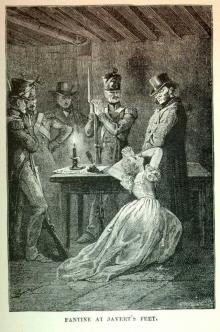
Fantine stood aside from the door and stared at him in amazement as he passed.
Nevertheless, she also was the prey to a strange confusion. She had just seen herself a subject of dispute between two opposing powers. She had seen two men who held in their hands her liberty, her life, her soul, her child, in combat before her very eyes; one of these men was drawing her towards darkness, the other was leading her back towards the light. In this conflict, viewed through the exaggerations of terror, these two men had appeared to her like two giants; the one spoke like her demon, the other like her good angel. The angel had conquered the demon, and, strange to say, that which made her shudder from head to foot was the fact that this angel, this liberator, was the very man whom she abhorred, that mayor whom she had so long regarded as the author of all her woes, that Madeleine! And at the very moment when she had insulted him in so hideous a fashion, he had saved her! Had she, then, been mistaken? Must she change her whole soul? She did not know; she trembled. She listened in bewilderment, she looked on in affright, and at every word uttered by M. Madeleine she felt the frightful shades of hatred crumble and melt within her, and something warm and ineffable, indescribable, which was both joy, confidence and love, dawn in her heart.
When Javert had taken his departure, M. Madeleine turned to her and said to her in a deliberate voice, like a serious man who does not wish to weep and who finds some difficulty in speaking:—
"I have heard you. I knew nothing about what you have mentioned. I believe that it is true, and I feel that it is true. I was even ignorant of the fact that you had left my shop. Why did you not apply to me? But here; I will pay your debts, I will send for your child, or you shall go to her. You shall live here, in Paris, or where you please. I undertake the care of your child and yourself. You shall not work any longer if you do not like. I will give all the money you require. You shall be honest and happy once more. And listen! I declare to you that if all is as you say,—and I do not doubt it,—you have never ceased to be virtuous and holy in the sight of God. Oh! poor woman."
This was more than Fantine could bear. To have Cosette! To leave this life of infamy. To live free, rich, happy, respectable with Cosette; to see all these realities of paradise blossom of a sudden in the midst of her misery. She stared stupidly at this man who was talking to her, and could only give vent to two or three sobs, "Oh! Oh! Oh!"
Her limbs gave way beneath her, she knelt in front of M. Madeleine, and before he could prevent her he felt her grasp his hand and press her lips to it.
Then she fainted.
BOOK SIXTH.—JAVERT
CHAPTER I—THE BEGINNING OF REPOSE
M. Madeleine had Fantine removed to that infirmary which he had established in his own house. He confided her to the sisters, who put her to bed. A burning fever had come on. She passed a part of the night in delirium and raving. At length, however, she fell asleep.
On the morrow, towards midday, Fantine awoke. She heard some one breathing close to her bed; she drew aside the curtain and saw M. Madeleine standing there and looking at something over her head. His gaze was full of pity, anguish, and supplication. She followed its direction, and saw that it was fixed on a crucifix which was nailed to the wall.
Thenceforth, M. Madeleine was transfigured in Fantine's eyes. He seemed to her to be clothed in light. He was absorbed in a sort of prayer. She gazed at him for a long time without daring to interrupt him. At last she said timidly:—
"What are you doing?"
M. Madeleine had been there for an hour. He had been waiting for Fantine to awake. He took her hand, felt of her pulse, and replied:—
"How do you feel?"
"Well, I have slept," she replied; "I think that I am better, It is nothing."
He answered, responding to the first question which she had put to him as though he had just heard it:—
"I was praying to the martyr there on high."
And he added in his own mind, "For the martyr here below."
M. Madeleine had passed the night and the morning in making inquiries. He knew all now. He knew Fantine's history in all its heart-rending details. He went on:—
"You have suffered much, poor mother. Oh! do not complain; you now have the dowry of the elect. It is thus that men are transformed into angels. It is not their fault they do not know how to go to work otherwise. You see this hell from which you have just emerged is the first form of heaven. It was necessary to begin there."
He sighed deeply. But she smiled on him with that sublime smile in which two teeth were lacking.
That same night, Javert wrote a letter. The next morning be posted it himself at the office of M. sur M. It was addressed to Paris, and the superscription ran: To Monsieur Chabouillet, Secretary of Monsieur le Prefet of Police. As the affair in the station-house had been bruited about, the post-mistress and some other persons who saw the letter before it was sent off, and who recognized Javert's handwriting on the cover, thought that he was sending in his resignation.
M. Madeleine made haste to write to the Thenardiers. Fantine owed them one hundred and twenty francs. He sent them three hundred francs, telling them to pay themselves from that sum, and to fetch the child instantly to M. sur M., where her sick mother required her presence.
This dazzled Thenardier. "The devil!" said the man to his wife; "don't let's allow the child to go. This lark is going to turn into a milch cow. I see through it. Some ninny has taken a fancy to the mother."
He replied with a very well drawn-up bill for five hundred and some odd francs. In this memorandum two indisputable items figured up over three hundred francs,—one for the doctor, the other for the apothecary who had attended and physicked Eponine and Azelma through two long illnesses. Cosette, as we have already said, had not been ill. It was only a question of a trifling substitution of names. At the foot of the memorandum Thenardier wrote, Received on account, three hundred francs.
M. Madeleine immediately sent three hundred francs more, and wrote, "Make haste to bring Cosette."
"Christi!" said Thenardier, "let's not give up the child."
In the meantime, Fantine did not recover. She still remained in the infirmary.
The sisters had at first only received and nursed "that woman" with repugnance. Those who have seen the bas-reliefs of Rheims will recall the inflation of the lower lip of the wise virgins as they survey the foolish virgins. The ancient scorn of the vestals for the ambubajae is one of the most profound instincts of feminine dignity; the sisters felt it with the double force contributed by religion. But in a few days Fantine disarmed them. She said all kinds of humble and gentle things, and the mother in her provoked tenderness. One day the sisters heard her say amid her fever: "I have been a sinner; but when I have my child beside me, it will be a sign that God has pardoned me. While I was leading a bad life, I should not have liked to have my Cosette with me; I could not have borne her sad, astonished eyes. It was for her sake that I did evil, and that is why God pardons me. I shall feel the benediction of the good God when Cosette is here. I shall gaze at her; it will do me good to see that innocent creature. She knows nothing at all. She is an angel, you see, my sisters. At that age the wings have not fallen off."
M. Madeleine went to see her twice a day, and each time she asked him:—
"Shall I see my Cosette soon?"
He answered:—
"To-morrow, perhaps. She may arrive at any moment. I am expecting her."
And the mother's pale face grew radiant.
"Oh!" she said, "how happy I am going to be!"
We have just said that she did not recover her health. On the contrary, her condition seemed to become more grave from week to week. That handful of snow applied to her bare skin between her shoulder-blades had brought about a sudden suppression of perspiration, as a consequence of which the malady which had been smouldering within her for many years was violently developed at last. At that time people were beginning to follow the fine Laennec's fine suggestions in the study and treatment of chest maladies. The doctor sounded Fantine's chest and shook his head.
M. Madeleine said to the doctor:—
"Well?"
"Has she not a child which she desires to see?" said the doctor.
"Yes."
"Well! Make haste and get it here!"
M. Madeleine shuddered.
Fantine inquired:—
"What did the doctor say?"
M. Madeleine forced himself to smile.
"He said that your child was to be brought speedily. That that would restore your health."
"Oh!" she rejoined, "he is right! But what do those Thenardiers mean by keeping my Cosette from me! Oh! she is coming. At last I behold happiness close beside me!"
In the meantime Thenardier did not "let go of the child," and gave a hundred insufficient reasons for it. Cosette was not quite well enough to take a journey in the winter. And then, there still remained some petty but pressing debts in the neighborhood, and they were collecting the bills for them, etc., etc.
"I shall send some one to fetch Cosette!" said Father Madeleine. "If necessary, I will go myself."
He wrote the following letter to Fantine's dictation, and made her sign it:—
"MONSIEUR THENARDIER:—
You will deliver Cosette to this person.
You will be paid for all the little things.
I have the honor to salute you with respect.
"FANTINE."
In the meantime a serious incident occurred. Carve as we will the mysterious block of which our life is made, the black vein of destiny constantly reappears in it.
CHAPTER II—HOW JEAN MAY BECOME CHAMP
One morning M. Madeleine was in his study, occupied in arranging in advance some pressing matters connected with the mayor's office, in case he should decide to take the trip to Montfermeil, when he was informed that Police Inspector Javert was desirous of speaking with him. Madeleine could not refrain from a disagreeable impression on hearing this name. Javert had avoided him more than ever since the affair of the police-station, and M. Madeleine had not seen him.
"Admit him," he said.
Javert entered.
M. Madeleine had retained his seat near the fire, pen in hand, his eyes fixed on the docket which he was turning over and annotating, and which contained the trials of the commission on highways for the infraction of police regulations. He did not disturb himself on Javert's account. He could not help thinking of poor Fantine, and it suited him to be glacial in his manner.
Javert bestowed a respectful salute on the mayor, whose back was turned to him. The mayor did not look at him, but went on annotating this docket.
Javert advanced two or three paces into the study, and halted, without breaking the silence.
If any physiognomist who had been familiar with Javert, and who had made a lengthy study of this savage in the service of civilization, this singular composite of the Roman, the Spartan, the monk, and the corporal, this spy who was incapable of a lie, this unspotted police agent—if any physiognomist had known his secret and long-cherished aversion for M. Madeleine, his conflict with the mayor on the subject of Fantine, and had examined Javert at that moment, he would have said to himself, "What has taken place?" It was evident to any one acquainted with that clear, upright, sincere, honest, austere, and ferocious conscience, that Javert had but just gone through some great interior struggle. Javert had nothing in his soul which he had not also in his countenance. Like violent people in general, he was subject to abrupt changes of opinion. His physiognomy had never been more peculiar and startling. On entering he bowed to M. Madeleine with a look in which there was neither rancor, anger, nor distrust; he halted a few paces in the rear of the mayor's arm-chair, and there he stood, perfectly erect, in an attitude almost of discipline, with the cold, ingenuous roughness of a man who has never been gentle and who has always been patient; he waited without uttering a word, without making a movement, in genuine humility and tranquil resignation, calm, serious, hat in hand, with eyes cast down, and an expression which was half-way between that of a soldier in the presence of his officer and a criminal in the presence of his judge, until it should please the mayor to turn round. All the sentiments as well as all the memories which one might have attributed to him had disappeared. That face, as impenetrable and simple as granite, no longer bore any trace of anything but a melancholy depression. His whole person breathed lowliness and firmness and an indescribable courageous despondency.
At last the mayor laid down his pen and turned half round.
"Well! What is it? What is the matter, Javert?"
Javert remained silent for an instant as though collecting his ideas, then raised his voice with a sort of sad solemnity, which did not, however, preclude simplicity.
"This is the matter, Mr. Mayor; a culpable act has been committed."
"What act?"
"An inferior agent of the authorities has failed in respect, and in the gravest manner, towards a magistrate. I have come to bring the fact to your knowledge, as it is my duty to do."
"Who is the agent?" asked M. Madeleine.
"I," said Javert.
"You?"
"I."
"And who is the magistrate who has reason to complain of the agent?"
"You, Mr. Mayor."
M. Madeleine sat erect in his arm-chair. Javert went on, with a severe air and his eyes still cast down.
"Mr. Mayor, I have come to request you to instigate the authorities to dismiss me."
M. Madeleine opened his mouth in amazement. Javert interrupted him:—
"You will say that I might have handed in my resignation, but that does not suffice. Handing in one's resignation is honorable. I have failed in my duty; I ought to be punished; I must be turned out."
And after a pause he added:—
"Mr. Mayor, you were severe with me the other day, and unjustly. Be so to-day, with justice."
"Come, now! Why?" exclaimed M. Madeleine. "What nonsense is this? What is the meaning of this? What culpable act have you been guilty of towards me? What have you done to me? What are your wrongs with regard to me? You accuse yourself; you wish to be superseded—"
"Turned out," said Javert.
"Turned out; so it be, then. That is well. I do not understand."
"You shall understand, Mr. Mayor."
Javert sighed from the very bottom of his chest, and resumed, still coldly and sadly:—
"Mr. Mayor, six weeks ago, in consequence of the scene over that woman, I was furious, and I informed against you."
"Informed against me!"
"At the Prefecture of Police in Paris."
M. Madeleine, who was not in the habit of laughing much oftener than Javert himself, burst out laughing now:—
"As a mayor who had encroached on the province of the police?"
"As an ex-convict."
The mayor turned livid.
Javert, who had not raised his eyes, went on:—
"I thought it was so. I had had an idea for a long time; a resemblance; inquiries which you had caused to be made at Faverolles; the strength of your loins; the adventure with old Fauchelevant; your skill in marksmanship; your leg, which you drag a little;—I hardly know what all,—absurdities! But, at all events, I took you for a certain Jean Valjean."
"A certain—What did you say the name was?"
"Jean Valjean. He was a convict whom I was in the habit of seeing twenty years ago, when I was adjutant-guard of convicts at Toulon. On leaving the galleys, this Jean Valjean, as it appears, robbed a bishop; then he committed another theft, accompanied with violence, on a public highway on the person of a little Savoyard. He disappeared eight years ago, no one knows how, and he has been sought, I fancied. In short, I did this thing! Wrath impelled me; I denounced you at the Prefecture!"
M. Madeleine, who had taken up the docket again several moments before this, resumed with an air of perfect indifference:—
"And what reply did you receive?"
"That I was mad."
"Well?"
"Well, they were right."
"It is lucky that you recognize the fact."
"I am forced to do so, since the real Jean Valjean has been found."
The sheet of paper which M. Madeleine was holding dropped from his hand; he raised his head, gazed fixedly at Javert, and said with his indescribable accent:—
"Ah!"
Javert continued:—
"This is the way it is, Mr. Mayor. It seems that there was in the neighborhood near Ailly-le-Haut-Clocher an old fellow who was called Father Champmathieu. He was a very wretched creature. No one paid any attention to him. No one knows what such people subsist on. Lately, last autumn, Father Champmathieu was arrested for the theft of some cider apples from—Well, no matter, a theft had been committed, a wall scaled, branches of trees broken. My Champmathieu was arrested. He still had the branch of apple-tree in his hand. The scamp is locked up. Up to this point it was merely an affair of a misdemeanor. But here is where Providence intervened.
"The jail being in a bad condition, the examining magistrate finds it convenient to transfer Champmathieu to Arras, where the departmental prison is situated. In this prison at Arras there is an ex-convict named Brevet, who is detained for I know not what, and who has been appointed turnkey of the house, because of good behavior. Mr. Mayor, no sooner had Champmathieu arrived than Brevet exclaims: 'Eh! Why, I know that man! He is a fagot! Take a good look at me, my good man! You are Jean Valjean!' 'Jean Valjean! who's Jean Valjean?' Champmathieu feigns astonishment. 'Don't play the innocent dodge,' says Brevet. 'You are Jean Valjean! You have been in the galleys of Toulon; it was twenty years ago; we were there together.' Champmathieu denies it. Parbleu! You understand. The case is investigated. The thing was well ventilated for me. This is what they discovered: This Champmathieu had been, thirty years ago, a pruner of trees in various localities, notably at Faverolles. There all trace of him was lost. A long time afterwards he was seen again in Auvergne; then in Paris, where he is said to have been a wheelwright, and to have had a daughter, who was a laundress; but that has not been proved. Now, before going to the galleys for theft, what was Jean Valjean? A pruner of trees. Where? At Faverolles. Another fact. This Valjean's Christian name was Jean, and his mother's surname was Mathieu. What more natural to suppose than that, on emerging from the galleys, he should have taken his mother's name for the purpose of concealing himself, and have called himself Jean Mathieu? He goes to Auvergne. The local pronunciation turns Jean into Chan—he is called Chan Mathieu. Our man offers no opposition, and behold him transformed into Champmathieu. You follow me, do you not? Inquiries were made at Faverolles. The family of Jean Valjean is no longer there. It is not known where they have gone. You know that among those classes a family often disappears. Search was made, and nothing was found. When such people are not mud, they are dust. And then, as the beginning of the story dates thirty years back, there is no longer any one at Faverolles who knew Jean Valjean. Inquiries were made at Toulon. Besides Brevet, there are only two convicts in existence who have seen Jean Valjean; they are Cochepaille and Chenildieu, and are sentenced for life. They are taken from the galleys and confronted with the pretended Champmathieu. They do not hesitate; he is Jean Valjean for them as well as for Brevet. The same age,—he is fifty-four,—the same height, the same air, the same man; in short, it is he. It was precisely at this moment that I forwarded my denunciation to the Prefecture in Paris. I was told that I had lost my reason, and that Jean Valjean is at Arras, in the power of the authorities. You can imagine whether this surprised me, when I thought that I had that same Jean Valjean here. I write to the examining judge; he sends for me; Champmathieu is conducted to me—"