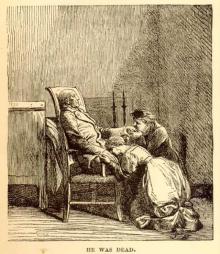
The complete novels of v.., p.423
The Complete Novels of Victor Hugo,
p.423


"A naughty stick," added Gros-Alain.
Georgette, again felt like crying, but she began to laugh.
CHAPTER V.
THE MASSACRE OF SAINT BARTHOLOMEW (V).
In the meantime, René-Jean, possibly jealous of his younger brother, Gros-Alain's discoveries, had conceived a great plan. For some time, while he was picking the berries and pricking his fingers, his eyes had been frequently turning toward the reading-desk mounted on a pivot and standing by itself like a monument in the middle of the library. On this desk was displayed the famous volume of "Saint Bartholomew."
It was really a magnificent and notable folio. This "Saint Bartholomew" had been published in Cologne by the famous publisher of the Bible in 1682, Blœuw, in Latin, Cœsius. It had been printed on movable wooden types, held in position with a band made of ox-sinew.
It was printed, not on Holland paper, but on that beautiful Arabian paper so much admired by Edrisi, made of silk and cotton, and always retaining its whiteness.
The binding was of gilded leather, and the clasps of silver; the fly leaves were of that parchment which the parchment-makers of Paris swore they would buy in the Halle Saint Mathurin and "nowhere else."
This volume was full of woodcuts and copper engravings, and geographical maps of many countries; it was prefaced with a protestation of printers, paper-makers and booksellers against the edict of 1635, placing a tax on "leather, beer, cloven-footed animals, sea-fish, and paper," and on the reverse page of the frontispiece, there was a dedication addressed to the Gryphes, who are to Lyons what the Elzévirs are to Amsterdam.
All this resulted in a famous volume, almost as rare as the Apostol at Moscow.
It was a beautiful book; that was why René-Jean looked at it; perhaps too intently. The volume was open just where there was a large engraving representing Saint Bartholomew carrying his skin over his arm. This engraving could be seen from below. When all the berries had been eaten, René-Jean looked at it with a terrible longing, and Georgette, whose eyes followed her brother's, noticed the engraving and said, "Pickshur."
This word seemed to determine René-Jean. Then, to the great amazement of Gros-Alain, he did an extraordinary thing.
A great oak chair stood in a corner of the library; René-Jean walked to this chair, seized it and dragged it all by himself to the desk. Then when the chair touched the desk, he got up on it and placed his two hands on the book.
Having reached this height, he felt that it was necessary to be, generous; he took the "pickshur" by the upper corner and carefully tore it out; Saint Bartholomew's picture tore crosswise, but that was not René-Jean's fault; he left all the left side, with one eye and a little of the old apocryphal evangelist's halo, in the book, and offered the other half of the saint, and all his skin, to Georgette. Georgette took the saint and said,—
"Mummum."
"Give me one!" cried Gros-Alain.
The first torn page is like the first drop of blood shed. It decides slaughter.
René-Jean turned the leaf; after the saint came the commentator Pantœnus; René-Jean bestowed Pantœnus on Gros-Alain.
In the meantime, Georgette tore her large piece into two small ones, then the two small ones into four; so that history might say, that after having been flayed in Armenia, Saint-Bartholomew was quartered in Brittany.
CHAPTER VI.
THE MASSACRE OF SAINT BARTHOLOMEW (VI).
Having finished the quartering, Georgette held out her hand to René-Jean, saying, "More!"
After the saint and the commentator came stern portraits of the glossarists. The earliest was Gavantus; René-Jean tore Gavantus out and placed him in Georgette's hand.
All Saint Bartholomew's glossarists followed. Giving is a privilege. René-Jean kept nothing for himself. Gros-Alain and Georgette were gazing at him; this was enough; he was satisfied with the admiration of his public.
René-Jean, inexhaustible and magnanimous, offered Fabricio Pignatelli to Gros-Alain, and Father Stilting to Georgette; he offered Alphonse Tostat to Gros-Alain, and Cornelius a Lapide to Georgette; Gros-Alain had Henry Hammond, and Georgette had Roberti, besides a view of the town of Douai, where he was born in 1619. Gros-Alain received the protestation of the paper-makers, and Georgette had the dedication to the Gryphes bestowed upon her. Then there were the maps. René-Jean distributed these. He gave Ethiopia to Gros-Alain, and Lycaonia to Georgette. When this was done, he threw the book on the floor.
It was a terrible moment. Gros-Alain and Georgette, with an ecstasy of delight mingled with fear, saw René-Jean frown, brace his legs, contract his hands, and push the massive folio volume off the desk. A majestic old book losing countenance is a tragic sight. The heavy volume, displaced, hung for a moment from the desk, hesitated, balanced itself, then fell down; and, torn, rumpled, lacerated, out of its binding, its clasps broken, flattened itself out lamentably on the floor. Fortunately, it did not fall on the children.
They were bewildered, not crushed. The adventures of conquerors do not always end as well. Like all glorious deeds, it made a great noise and a cloud of dust.
Having thrown down the book, René-Jean dismounted from the chair.
There was a moment of silence and awe; victory has its terrors. The children took hold of each other's hands, and drew away, to contemplate the great dilapidated volume.
But after some consideration, Gros-Alain started towards the book with determination and gave it a kick.
This was enough. There is such a thing as an appetite for destruction. René-Jean gave it a kick, Georgette gave it a kick, which made her tumble down, but in a sitting posture; she took advantage of this to throw herself on Saint Bartholomew; the spell was broken; René-Jean rushed on it, Gros-Alain made a dash for it; joyous, wild, triumphant, pitiless, tearing the engravings, slashing the leaves, pulling out the bookmarks, scratching the binding, ripping off the gilt leather, pulling out the nails, from the silver corners, breaking the parchment, marring the noble text, working with feet, hands, nails, and teeth, rosy, laughing, cruel, these three angels of destruction swooped down on the defenceless evangelist.
They annihilated Armenia, Judea, Benevento, where there are relics of the saint; Nathaniel, who is possibly the same as Bartholomew; Pope Gelasius, who declared the Bartholomew-Nathaniel gospel to be apocryphal, all the heads, all the maps, and the inexorable destruction of the old book absorbed them to such a degree that a mouse passed by without their noticing it.
It was an extermination.
To pull to pieces history, legend, science, miracles, true or false, church Latin, superstitions, fanaticisms, mysteries, to tear up a whole religion from top to bottom, is a work for three giants, as well as three children; the hours passed quickly over this labor, but they came to an end; nothing was left of Saint Bartholomew.
When this was at an end, when the last page was torn out, when the last engraving was destroyed, when nothing was left of the book but fragments of the text and pictures, in a skeleton of a binding, René-Jean jumped to his feet, looked at the floor strewn with all these scattered leaves, and clapped his hands.
Gros-Alain clapped his hands.
Georgette took one of the leaves from the floor, got up, leaned against the window, which came just to her chin, and began to tear the large page into little pieces, and threw them out.
Seeing this, René-Jean and Gros-Alain began to do the same. They picked up the leaves and tore them in pieces, picked up and tore them again and again, throwing the pieces out of the window as Georgette had done; and page by page, reduced to scraps by these destructive little fingers, almost the entire ancient book blew away in the wind. Georgette looked thoughtfully after these swarms of bits of white paper, scattered by all the breezes of the air and said,—
"Butterflies."
And the massacre ended with a vanishing into thin air.
CHAPTER VII.
THE MASSACRE OF SAINT BARTHOLOMEW (VII).
Such was the second putting to death of Saint Bartholomew, who had already been martyred in the year 49 of our Lord Jesus Christ.
Meanwhile, evening was approaching, the heat was increasing, the air was full of drowsiness, Georgette's eyes grew heavy, René-Jean went to his crib, drew out the bag of straw which took the place of a mattress, dragged it to the window, stretched himself out on it, and said: "Let us go to bed."
Gros-Alain put his head on René-Jean, Georgette put her head on Gros-Alain, and the three malefactors went to sleep.
Hot breezes came in through the open windows; the perfume of wild flowers, blown from the ravines and hills, floated in, mingled with the evening zephyrs; space was calm and merciful; everything beamed, everything was at peace, everything loved everything else; the sun caressed creation with light; everywhere was felt that harmony which arises from the colossal sweetness of things; there was something of maternity in the Infinite; creation is a miracle in full bloom, its immensity is perfected by its goodness; it seemed as if some invisible power could be felt taking those mysterious precautions which, in the terrible conflict of life, protect the weak against the strong; at the same time it was beautiful, the splendor breathed forth mansuetude.
The landscape, full of an ineffable drowsiness, had that magnificent wavy appearance which the alternations of light and shade give to prairies and rivers; the smoke rose toward the clouds, as a dream toward a vision; flocks of birds whirled above la Tourgue; swallows looked in at the windows, and seemed to have come to see if the children were sleeping well.
They were gracefully grouped, one on the other, still, half-naked, in loving attitudes; they were adorable and pure, all three together were not nine years old, they had dreams of Paradise, which were reflected on their mouths in vague smiles; God, perhaps, was speaking in their ears; they were those whom every human tongue calls weak and blessed, they were innocents worthy of reverence; everything kept silence, as though the breath from their sweet breasts was of consequence to the universe, and was listened to by all creation; the leaves did not rustle, the grass did not quiver. It seemed as if the wide starry world held its breath, that it might not disturb these three humble, angelic sleepers, and nothing was so sublime as the immense respect of nature toward these little creatures.
The sun was going down, and almost touched the horizon. Suddenly, in the midst of this profound peace, there shot forth a bright light, coming from the forest, then a furious noise. A cannon had just been fired. The echoes seized this noise and turned it into an uproarious din. The rumbling, prolonged from hill to hill, was monstrous. It awoke Georgette.
She raised her head a little, lifted her little finger, listened, and said, —
"Boom!"
The sound died away, and silence returned. Georgette laid her head down on Gros-Alain, and went to sleep again.
BOOK FOURTH.— THE MOTHER.
CHAPTER I.
DEATH PASSES BY.
This same evening, the mother, whom we have seen making her way almost by chance, had been walking all day long. Moreover, it was the story of all her days, to go straight on and never stop. For her sleep of exhaustion in the first corner that she came to was no more rest than what she ate here and there, as birds go picking about, wag food. She ate and slept just enough to keep her from falling down dead.
She had spent the night before in a deserted house; civil war causes such ruins. She had found, in a neglected field, four walls, an open door, a little straw under a portion of the roof, and she slept on this straw and under this roof, feeling the rats run over the straw, and seeing the stars shine through the roof. She had slept some hours, then she awoke in the middle of the night and started on her journey again, in order to travel as far as possible before the full heat of the day. For those travelling on foot in summer, midnight is more agreeable than midday.
She followed to the best of her ability the general route indicated to her by the peasant at Vautortes; she went as nearly as possible toward the west. Any one near her would have heard her say repeatedly, in a low voice, "La Tourgue." Besides the names of her three children, she knew nothing but this word.
As she walked along, she was deep in meditation. She thought of all the adventures which she had been through; she thought of all she had suffered, of all she had received; of the encounters, the indignities, the conditions made, the bargains proposed and undergone, sometimes for a shelter, sometimes for a piece of bread, sometimes merely to get some one to show her the way. A wretched woman is more unfortunate than a wretched man, because she is an instrument of pleasure. Frightful wandering on foot. But nothing made any difference to her so long as she found her children.
Her first encounter to-day had been a village on the way; it was scarcely daybreak, everything was still bathed in the gloom of night, still some doors were already ajar in the principal street of the village, and some curious heads were looking out of the windows. The inhabitants seemed as agitated as a hive which has been disturbed. This was on account of a sound of wheels and chains which had been heard.
In the square in front of the church, an astounded group, with upturned faces, was looking at something coming down the road toward the village from the top of a hill.
It was a wagon with four wheels, drawn by five horses harnessed with chains. On the wagon could be made out a heap which looked like a pile of long joists, in the middle of which was something strange and shapeless; it was covered over with an awning, which had the appearance of a shroud.
Ten men on horseback rode in front of the wagon, and ten others, behind. These men wore three-cornered hats, and rising above their shoulders could be seen points, which were apparently bare swords. All this procession, advancing slowly, stood out in clearly defined black against the horizon. The wagon looked black, the horses looked black, the cavaliers looked black. The pale morning light gleamed behind them.
It entered the village and went towards the square. It began to grow light as the wagon came down the hill, and the procession could be seen distinctly; it seemed like a march of ghosts, for not a word escaped the men.
The riders were military men. They had, indeed, drawn swords. The awning was black.
The wretched, wandering mother entered the village and drew near the gathering of peasants just as the team and the mounted men were coming into the square. In the group of spectators, voices whispered questions and answers, —
"What is that?"
"It is the guillotine passing by."
"Where does it come from?"
"From Fougères."
"Where is it going?"
"I do not know. They say that it is going to a castle toward Parigné."
"Parigné!"
"Let it go wherever it will, provided it doesn't stop here."
This great wagon, with its burden covered with a sort of shroud; these horses; these military men; the noise of these chains; the silence of these riders; the dim light, — all this was ghastly.
The procession crossed the square and left the village; the village was in a hollow between two hills. After a quarter of an hour, the peasants, who had remained as though petrified, saw the gloomy procession come into sight again on the top of the hill toward the west. The large wheels jolted over the road, the horses' chains clanked in the morning wind, the sabres glistened; the sun was rising, there was a turn in the road, they all disappeared.
This was at just the moment when Georgette, in the ball of the library, awoke beside her brothers, who were still asleep, and said good morning to her rosy feet.
CHAPTER II.
DEATH SPEAKS.
The mother watched this dark object pass by, but had not understood it, nor tried to understand, for she had another vision before her eyes, — her children lost in the darkness.
She also went out of the village, a little after the procession which had just filed past, and followed the same road, at some distance behind the second squad of policemen. Suddenly, the word "guillotine " came into her mind.
"Guillotine!" she said to herself; this peasant woman Michelle Fléchard, did not know what it was, but her instinct warned her against it; she shuddered without being able to tell why; it seemed horrible to her to walk behind it, and she turned to the left, went out of the road and entered some woods, which were the forest of Fougères.
After roaming for some time, she noticed a church tower and some roofs; it was one of the villages on the borders of the wood; she entered it. She was hungry.
This village was one of those where the Republicans had established military posts.
She went as far as the square where the town hall was.
In this village, too, there was agitation and anxiety. A crowd was gathered in front of a flight of steps which were the entrance to the town hall. On these steps were seen a man escorted by soldiers, holding in his hand a large, unrolled placard. On this man's right stood a drummer, and on his left, a bill-poster carrying a pot of paste and a brush.
On the balcony above the door stood the mayor, wearing a tricolored scarf with his peasant's dress.
The man with the placard was a public crier.
He had on a shoulder belt from which hung a little bag, which indicated that he went from village to village, and that he had something to cry throughout the country.
He had just unrolled the placard, as Michelle Fléchard drew near, and he began to read it. He said in a loud voice, —
"The French Republic. One and indivisible."
The drum rolled. There was a sort of undulation in the crowd. Some took off their caps; others pulled their hats down over their eyes. At this time, and in this country, a person's opinion could almost be told by the headgear; hats were Royalist, caps were Republican.
The murmur of confused voices ceased, the people listened, the crier read,—
"In virtue of the orders to us given, and the power to us delegated, by the Committee of Public Welfare——"
There was a second rolling of the drum. The crier continued,—