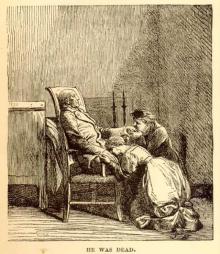
The complete novels of v.., p.280
The Complete Novels of Victor Hugo,
p.280


The dining-room was full of gay things. In the centre, above the white and glittering table, was a Venetian lustre with flat plates, with all sorts of colored birds, blue, violet, red, and green, perched amid the candles; around the chandelier, girandoles, on the walls, sconces with triple and quintuple branches; mirrors, silverware, glassware, plate, porcelain, faience, pottery, gold and silversmith's work, all was sparkling and gay. The empty spaces between the candelabra were filled in with bouquets, so that where there was not a light, there was a flower.
In the antechamber, three violins and a flute softly played quartettes by Haydn.
Jean Valjean had seated himself on a chair in the drawing-room, behind the door, the leaf of which folded back upon him in such a manner as to nearly conceal him. A few moments before they sat down to table, Cosette came, as though inspired by a sudden whim, and made him a deep courtesy, spreading out her bridal toilet with both hands, and with a tenderly roguish glance, she asked him:
"Father, are you satisfied?"
"Yes," said Jean Valjean, "I am content!"
"Well, then, laugh."
Jean Valjean began to laugh.
A few moments later, Basque announced that dinner was served.
The guests, preceded by M. Gillenormand with Cosette on his arm, entered the dining-room, and arranged themselves in the proper order around the table.
Two large arm-chairs figured on the right and left of the bride, the first for M. Gillenormand, the other for Jean Valjean. M. Gillenormand took his seat. The other arm-chair remained empty.
They looked about for M. Fauchelevent.
He was no longer there.
M. Gillenormand questioned Basque.
"Do you know where M. Fauchelevent is?"
"Sir," replied Basque, "I do, precisely. M. Fauchelevent told me to say to you, sir, that he was suffering, his injured hand was paining him somewhat, and that he could not dine with Monsieur le Baron and Madame la Baronne. That he begged to be excused, that he would come to-morrow. He has just taken his departure."
That empty arm-chair chilled the effusion of the wedding feast for a moment. But, if M. Fauchelevent was absent, M. Gillenormand was present, and the grandfather beamed for two. He affirmed that M. Fauchelevent had done well to retire early, if he were suffering, but that it was only a slight ailment. This declaration sufficed. Moreover, what is an obscure corner in such a submersion of joy? Cosette and Marius were passing through one of those egotistical and blessed moments when no other faculty is left to a person than that of receiving happiness. And then, an idea occurred to M. Gillenormand.—"Pardieu, this armchair is empty. Come hither, Marius. Your aunt will permit it, although she has a right to you. This armchair is for you. That is legal and delightful. Fortunatus beside Fortunata."—Applause from the whole table. Marius took Jean Valjean's place beside Cosette, and things fell out so that Cosette, who had, at first, been saddened by Jean Valjean's absence, ended by being satisfied with it. From the moment when Marius took his place, and was the substitute, Cosette would not have regretted God himself. She set her sweet little foot, shod in white satin, on Marius' foot.
The arm-chair being occupied, M. Fauchelevent was obliterated; and nothing was lacking.
And, five minutes afterward, the whole table from one end to the other, was laughing with all the animation of forgetfulness.
At dessert, M. Gillenormand, rising to his feet, with a glass of champagne in his hand—only half full so that the palsy of his eighty years might not cause an overflow,—proposed the health of the married pair.
"You shall not escape two sermons," he exclaimed. "This morning you had one from the cure, this evening you shall have one from your grandfather. Listen to me; I will give you a bit of advice: Adore each other. I do not make a pack of gyrations, I go straight to the mark, be happy. In all creation, only the turtle-doves are wise. Philosophers say: 'Moderate your joys.' I say: 'Give rein to your joys.' Be as much smitten with each other as fiends. Be in a rage about it. The philosophers talk stuff and nonsense. I should like to stuff their philosophy down their gullets again. Can there be too many perfumes, too many open rose-buds, too many nightingales singing, too many green leaves, too much aurora in life? can people love each other too much? can people please each other too much? Take care, Estelle, thou art too pretty! Have a care, Nemorin, thou art too handsome! Fine stupidity, in sooth! Can people enchant each other too much, cajole each other too much, charm each other too much? Can one be too much alive, too happy? Moderate your joys. Ah, indeed! Down with the philosophers! Wisdom consists in jubilation. Make merry, let us make merry. Are we happy because we are good, or are we good because we are happy? Is the Sancy diamond called the Sancy because it belonged to Harley de Sancy, or because it weighs six hundred carats? I know nothing about it, life is full of such problems; the important point is to possess the Sancy and happiness. Let us be happy without quibbling and quirking. Let us obey the sun blindly. What is the sun? It is love. He who says love, says woman. Ah! ah! behold omnipotence—women. Ask that demagogue of a Marius if he is not the slave of that little tyrant of a Cosette. And of his own free will, too, the coward! Woman! There is no Robespierre who keeps his place but woman reigns. I am no longer Royalist except towards that royalty. What is Adam? The kingdom of Eve. No '89 for Eve. There has been the royal sceptre surmounted by a fleur-de-lys, there has been the imperial sceptre surmounted by a globe, there has been the sceptre of Charlemagne, which was of iron, there has been the sceptre of Louis the Great, which was of gold,—the revolution twisted them between its thumb and forefinger, ha'penny straws; it is done with, it is broken, it lies on the earth, there is no longer any sceptre, but make me a revolution against that little embroidered handkerchief, which smells of patchouli! I should like to see you do it. Try. Why is it so solid? Because it is a gewgaw. Ah! you are the nineteenth century? Well, what then? And we have been as foolish as you. Do not imagine that you have effected much change in the universe, because your trip-gallant is called the cholera-morbus, and because your pourree is called the cachuca. In fact, the women must always be loved. I defy you to escape from that. These friends are our angels. Yes, love, woman, the kiss forms a circle from which I defy you to escape; and, for my own part, I should be only too happy to re-enter it. Which of you has seen the planet Venus, the coquette of the abyss, the Celimene of the ocean, rise in the infinite, calming all here below? The ocean is a rough Alcestis. Well, grumble as he will, when Venus appears he is forced to smile. That brute beast submits. We are all made so. Wrath, tempest, claps of thunder, foam to the very ceiling. A woman enters on the scene, a planet rises; flat on your face! Marius was fighting six months ago; to-day he is married. That is well. Yes, Marius, yes, Cosette, you are in the right. Exist boldly for each other, make us burst with rage that we cannot do the same, idealize each other, catch in your beaks all the tiny blades of felicity that exist on earth, and arrange yourselves a nest for life. Pardi, to love, to be loved, what a fine miracle when one is young! Don't imagine that you have invented that. I, too, have had my dream, I, too, have meditated, I, too, have sighed; I, too, have had a moonlight soul. Love is a child six thousand years old. Love has the right to a long white beard. Methusalem is a street arab beside Cupid. For sixty centuries men and women have got out of their scrape by loving. The devil, who is cunning, took to hating man; man, who is still more cunning, took to loving woman. In this way he does more good than the devil does him harm. This craft was discovered in the days of the terrestrial paradise. The invention is old, my friends, but it is perfectly new. Profit by it. Be Daphnis and Chloe, while waiting to become Philemon and Baucis. Manage so that, when you are with each other, nothing shall be lacking to you, and that Cosette may be the sun for Marius, and that Marius may be the universe to Cosette. Cosette, let your fine weather be the smile of your husband; Marius, let your rain be your wife's tears. And let it never rain in your household. You have filched the winning number in the lottery; you have gained the great prize, guard it well, keep it under lock and key, do not squander it, adore each other and snap your fingers at all the rest. Believe what I say to you. It is good sense. And good sense cannot lie. Be a religion to each other. Each man has his own fashion of adoring God. Saperlotte! the best way to adore God is to love one's wife. I love thee! that's my catechism. He who loves is orthodox. The oath of Henri IV. places sanctity somewhere between feasting and drunkenness. Ventre-saint-gris! I don't belong to the religion of that oath. Woman is forgotten in it. This astonishes me on the part of Henri IV. My friends, long live women! I am old, they say; it's astonishing how much I feel in the mood to be young. I should like to go and listen to the bagpipes in the woods. Children who contrive to be beautiful and contented,—that intoxicates me. I would like greatly to get married, if any one would have me. It is impossible to imagine that God could have made us for anything but this: to idolize, to coo, to preen ourselves, to be dove-like, to be dainty, to bill and coo our loves from morn to night, to gaze at one's image in one's little wife, to be proud, to be triumphant, to plume oneself; that is the aim of life. There, let not that displease you which we used to think in our day, when we were young folks. Ah! vertu-bamboche! what charming women there were in those days, and what pretty little faces and what lovely lasses! I committed my ravages among them. Then love each other. If people did not love each other, I really do not see what use there would be in having any springtime; and for my own part, I should pray the good God to shut up all the beautiful things that he shows us, and to take away from us and put back in his box, the flowers, the birds, and the pretty maidens. My children, receive an old man's blessing."
The evening was gay, lively and agreeable. The grandfather's sovereign good humor gave the key-note to the whole feast, and each person regulated his conduct on that almost centenarian cordiality. They danced a little, they laughed a great deal; it was an amiable wedding. Goodman Days of Yore might have been invited to it. However, he was present in the person of Father Gillenormand.
There was a tumult, then silence.
The married pair disappeared.
A little after midnight, the Gillenormand house became a temple.
Here we pause. On the threshold of wedding nights stands a smiling angel with his finger on his lips.
The soul enters into contemplation before that sanctuary where the celebration of love takes place.
There should be flashes of light athwart such houses. The joy which they contain ought to make its escape through the stones of the walls in brilliancy, and vaguely illuminate the gloom. It is impossible that this sacred and fatal festival should not give off a celestial radiance to the infinite. Love is the sublime crucible wherein the fusion of the man and the woman takes place; the being one, the being triple, the being final, the human trinity proceeds from it. This birth of two souls into one, ought to be an emotion for the gloom. The lover is the priest; the ravished virgin is terrified. Something of that joy ascends to God. Where true marriage is, that is to say, where there is love, the ideal enters in. A nuptial bed makes a nook of dawn amid the shadows. If it were given to the eye of the flesh to scan the formidable and charming visions of the upper life, it is probable that we should behold the forms of night, the winged unknowns, the blue passers of the invisible, bend down, a throng of sombre heads, around the luminous house, satisfied, showering benedictions, pointing out to each other the virgin wife gently alarmed, sweetly terrified, and bearing the reflection of human bliss upon their divine countenances. If at that supreme hour, the wedded pair, dazzled with voluptuousness and believing themselves alone, were to listen, they would hear in their chamber a confused rustling of wings. Perfect happiness implies a mutual understanding with the angels. That dark little chamber has all heaven for its ceiling. When two mouths, rendered sacred by love, approach to create, it is impossible that there should not be, above that ineffable kiss, a quivering throughout the immense mystery of stars.
These felicities are the true ones. There is no joy outside of these joys. Love is the only ecstasy. All the rest weeps.
To love, or to have loved,—this suffices. Demand nothing more. There is no other pearl to be found in the shadowy folds of life. To love is a fulfilment.
CHAPTER III—THE INSEPARABLE
What had become of Jean Valjean?
Immediately after having laughed, at Cosette's graceful command, when no one was paying any heed to him, Jean Valjean had risen and had gained the antechamber unperceived. This was the very room which, eight months before, he had entered black with mud, with blood and powder, bringing back the grandson to the grandfather. The old wainscoting was garlanded with foliage and flowers; the musicians were seated on the sofa on which they had laid Marius down. Basque, in a black coat, knee-breeches, white stockings and white gloves, was arranging roses round all of the dishes that were to be served. Jean Valjean pointed to his arm in its sling, charged Basque to explain his absence, and went away.
The long windows of the dining-room opened on the street. Jean Valjean stood for several minutes, erect and motionless in the darkness, beneath those radiant windows. He listened. The confused sounds of the banquet reached his ear. He heard the loud, commanding tones of the grandfather, the violins, the clatter of the plates, the bursts of laughter, and through all that merry uproar, he distinguished Cosette's sweet and joyous voice.
He quitted the Rue des Filles-du-Calvaire, and returned to the Rue de l'Homme Arme.
In order to return thither, he took the Rue Saint-Louis, the Rue Culture-Sainte-Catherine, and the Blancs-Manteaux; it was a little longer, but it was the road through which, for the last three months, he had become accustomed to pass every day on his way from the Rue de l'Homme Arme to the Rue des Filles-du-Calvaire, in order to avoid the obstructions and the mud in the Rue Vielle-du-Temple.
This road, through which Cosette had passed, excluded for him all possibility of any other itinerary.
Jean Valjean entered his lodgings. He lighted his candle and mounted the stairs. The apartment was empty. Even Toussaint was no longer there. Jean Valjean's step made more noise than usual in the chambers. All the cupboards stood open. He penetrated to Cosette's bedroom. There were no sheets on the bed. The pillow, covered with ticking, and without a case or lace, was laid on the blankets folded up on the foot of the mattress, whose covering was visible, and on which no one was ever to sleep again. All the little feminine objects which Cosette was attached to had been carried away; nothing remained except the heavy furniture and the four walls. Toussaint's bed was despoiled in like manner. One bed only was made up, and seemed to be waiting some one, and this was Jean Valjean's bed.
Jean Valjean looked at the walls, closed some of the cupboard doors, and went and came from one room to another.
Then he sought his own chamber once more, and set his candle on a table.
He had disengaged his arm from the sling, and he used his right hand as though it did not hurt him.
He approached his bed, and his eyes rested, was it by chance? was it intentionally? on the inseparable of which Cosette had been jealous, on the little portmanteau which never left him. On his arrival in the Rue de l'Homme Arme, on the 4th of June, he had deposited it on a round table near the head of his bed. He went to this table with a sort of vivacity, took a key from his pocket, and opened the valise.
From it he slowly drew forth the garments in which, ten years before, Cosette had quitted Montfermeil; first the little gown, then the black fichu, then the stout, coarse child's shoes which Cosette might almost have worn still, so tiny were her feet, then the fustian bodice, which was very thick, then the knitted petticoat, next the apron with pockets, then the woollen stockings. These stockings, which still preserved the graceful form of a tiny leg, were no longer than Jean Valjean's hand. All this was black of hue. It was he who had brought those garments to Montfermeil for her. As he removed them from the valise, he laid them on the bed. He fell to thinking. He called up memories. It was in winter, in a very cold month of December, she was shivering, half-naked, in rags, her poor little feet were all red in their wooden shoes. He, Jean Valjean, had made her abandon those rags to clothe herself in these mourning habiliments. The mother must have felt pleased in her grave, to see her daughter wearing mourning for her, and, above all, to see that she was properly clothed, and that she was warm. He thought of that forest of Montfermeil; they had traversed it together, Cosette and he; he thought of what the weather had been, of the leafless trees, of the wood destitute of birds, of the sunless sky; it mattered not, it was charming. He arranged the tiny garments on the bed, the fichu next to the petticoat, the stockings beside the shoes, and he looked at them, one after the other. She was no taller than that, she had her big doll in her arms, she had put her louis d'or in the pocket of that apron, she had laughed, they walked hand in hand, she had no one in the world but him.
Then his venerable, white head fell forward on the bed, that stoical old heart broke, his face was engulfed, so to speak, in Cosette's garments, and if any one had passed up the stairs at that moment, he would have heard frightful sobs.
CHAPTER IV—THE IMMORTAL LIVER
The old and formidable struggle, of which we have already witnessed so many phases, began once more.
Jacob struggled with the angel but one night. Alas! how many times have we beheld Jean Valjean seized bodily by his conscience, in the darkness, and struggling desperately against it!
Unheard-of conflict! At certain moments the foot slips; at other moments the ground crumbles away underfoot. How many times had that conscience, mad for the good, clasped and overthrown him! How many times had the truth set her knee inexorably upon his breast! How many times, hurled to earth by the light, had he begged for mercy! How many times had that implacable spark, lighted within him, and upon him by the Bishop, dazzled him by force when he had wished to be blind! How many times had he risen to his feet in the combat, held fast to the rock, leaning against sophism, dragged in the dust, now getting the upper hand of his conscience, again overthrown by it! How many times, after an equivoque, after the specious and treacherous reasoning of egotism, had he heard his irritated conscience cry in his ear: "A trip! you wretch!" How many times had his refractory thoughts rattled convulsively in his throat, under the evidence of duty! Resistance to God. Funereal sweats. What secret wounds which he alone felt bleed! What excoriations in his lamentable existence! How many times he had risen bleeding, bruised, broken, enlightened, despair in his heart, serenity in his soul! and, vanquished, he had felt himself the conqueror. And, after having dislocated, broken, and rent his conscience with red-hot pincers, it had said to him, as it stood over him, formidable, luminous, and tranquil: "Now, go in peace!"