The complete novels of v.., p.283
The Complete Novels of Victor Hugo,
p.283


"I swear to you, that it is indispensable that we should be alone."
"Well, am I anybody?"
Jean Valjean had not uttered a single word. Cosette turned to him:
"In the first place, father, I want you to come and embrace me. What do you mean by not saying anything instead of taking my part? who gave me such a father as that? You must perceive that my family life is very unhappy. My husband beats me. Come, embrace me instantly."
Jean Valjean approached.
Cosette turned toward Marius.
"As for you, I shall make a face at you."
Then she presented her brow to Jean Valjean.
Jean Valjean advanced a step toward her.
Cosette recoiled.
"Father, you are pale. Does your arm hurt you?"
"It is well," said Jean Valjean.
"Did you sleep badly?"
"No."
"Are you sad?"
"No."
"Embrace me if you are well, if you sleep well, if you are content, I will not scold you."
And again she offered him her brow.
Jean Valjean dropped a kiss upon that brow whereon rested a celestial gleam.
"Smile."
Jean Valjean obeyed. It was the smile of a spectre.
"Now, defend me against my husband."
"Cosette! " ejaculated Marius.
"Get angry, father. Say that I must stay. You can certainly talk before me. So you think me very silly. What you say is astonishing! business, placing money in a bank a great matter truly. Men make mysteries out of nothing. I am very pretty this morning. Look at me, Marius."
And with an adorable shrug of the shoulders, and an indescribably exquisite pout, she glanced at Marius.
"I love you!" said Marius.
"I adore you!" said Cosette.
And they fell irresistibly into each other's arms.
"Now," said Cosette, adjusting a fold of her dressing-gown, with a triumphant little grimace, "I shall stay."
"No, not that," said Marius, in a supplicating tone. "We have to finish something."
"Still no?"
Marius assumed a grave tone:
"I assure you, Cosette, that it is impossible."
"Ah! you put on your man's voice, sir. That is well, I go. You, father, have not upheld me. Monsieur my father, monsieur my husband, you are tyrants. I shall go and tell grandpapa. If you think that I am going to return and talk platitudes to you, you are mistaken. I am proud. I shall wait for you now. You shall see, that it is you who are going to be bored without me. I am going, it is well."
And she left the room.
Two seconds later, the door opened once more, her fresh and rosy head was again thrust between the two leaves, and she cried to them:
"I am very angry indeed."
The door closed again, and the shadows descended once more.
It was as though a ray of sunlight should have suddenly traversed the night, without itself being conscious of it.
Marius made sure that the door was securely closed.
"Poor Cosette!" he murmured, "when she finds out . "
At that word Jean Valjean trembled in every limb. He fixed on Marius a bewildered eye.
"Cosette! oh yes, it is true, you are going to tell Cosette about this. That is right. Stay, I had not thought of that. One has the strength for one thing, but not for another. Sir, I conjure you, I entreat now, sir, give me your most sacred word of honor, that you will not tell her. Is it not enough that you should know it? I have been able to say it myself without being forced to it, I could have told it to the universe, to the whole world,—it was all one to me. But she, she does not know what it is, it would terrify her. What, a convict! we should be obliged to explain matters to her, to say to her: 'He is a man who has been in the galleys.' She saw the chain-gang pass by one day. Oh! My God!" He dropped into an arm-chair and hid his face in his hands.
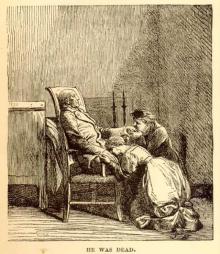
His grief was not audible, but from the quivering of his shoulders it was evident that he was weeping. Silent tears, terrible tears.
There is something of suffocation in the sob. He was seized with a sort of convulsion, he threw himself against the back of the chair as though to gain breath, letting his arms fall, and allowing Marius to see his face inundated with tears, and Marius heard him murmur, so low that his voice seemed to issue from fathomless depths:
"Oh! would that I could die!"
"Be at your ease," said Marius, "I will keep your secret for myself alone." x And, less touched, perhaps, than he ought to have been, but forced, for the last hour, to familiarize himself with something as unexpected as it was dreadful, gradually beholding the convict superposed before his very eyes, upon M. Fauchelevent, overcome, little by little, by that lugubrious reality, and led, by the natural inclination of the situation, to recognize the space which had just been placed between that man and himself, Marius added:
"It is impossible that I should not speak a word to you with regard to the deposit which you have so faithfully and honestly remitted. That is an act of probity. It is just that some recompense should be bestowed on you. Fix the sum yourself, it shall be counted out to you. Do not fear to set it very high."
"I thank you, sir," replied Jean Valjean, gently.
He remained in thought for a moment, mechanically passing the tip of his fore-finger across his thumb-nail, then he lifted up his voice:
"All is nearly over. But one last thing remains for me . "
"What is it?"
Jean Valjean struggled with what seemed a last hesitation, and, without voice, without breath, he stammered rather than said:
"Now that you know, do you think, sir, you, who are the master, that I ought not to see Cosette any more?"
"I think that would be better," replied Marius coldly.
"I shall never see her more," murmured Jean Valjean. And he directed his steps towards the door.
He laid his hand on the knob, the latch yielded, the door opened. Jean Valjean pushed it open far enough to pass through, stood motionless for a second, then closed the door again and turned to Marius.
He was no longer pale, he was livid. There were no longer any tears in his eyes, but only a sort of tragic flame. His voice had regained a strange composure.
"Stay, sir," he said. "If you will allow it, I will come to see her. I assure you that I desire it greatly. If I had not cared to see Cosette, I should not have made to you the confession that I have made, I should have gone away; but, as I desired to remain in the place where Cosette is, and to continue to see her, I had to tell you about it honestly. You follow my reasoning, do you not? it is a matter easily understood. You see, I have had her with me for more than nine years. We lived first in that hut on the boulevard, then in the convent, then near the Luxembourg. That was where you saw her for the first time. You remember her blue plush hat. Then we went to the Quartier des Invalides, where there was a railing on a garden, the Rue Plumet. I lived in a little back court-yard, whence I could hear her piano. That was my life. We never left each other. That lasted for nine years and some months. I was like her own father, and she was my child. I do not know whether you understand, Monsieur Pontmercy, but to go away now, never to see her again, never to speak to her again, to no longer have anything, would be hard. If you do not disapprove of it, I will come to see Cosette from time to time. I will not come often. I will not remain long. You shall give orders that I am to be received in the little waiting-room. On the ground floor. I could enter perfectly well by the back door, but that might create surprise perhaps, and it would be better, I think, for me to enter by the usual door. Truly, sir, I should like to see a little more of Cosette. As rarely as you please. Put yourself in my place, I have nothing left but that. And then, we must be cautious. If I no longer come at all, it would produce a bad effect, it would be considered singular. What I can do, by the way, is to come in the afternoon, when night is beginning to fall."
"You shall come every evening," said Marius, "and Cosette will be waiting for you."
"You are kind, sir," said Jean Valjean.
Marius saluted Jean Valjean, happiness escorted despair to the door, and these two men parted.
CHAPTER II—THE OBSCURITIES WHICH A REVELATION CAN CONTAIN
Marius was quite upset.
The sort of estrangement which he had always felt towards the man beside whom he had seen Cosette, was now explained to him. There was something enigmatic about that person, of which his instinct had warned him.
This enigma was the most hideous of disgraces, the galleys. This M. Fauchelevent was the convict Jean Valjean.
To abruptly find such a secret in the midst of one's happiness resembles the discovery of a scorpion in a nest of turtledoves.
Was the happiness of Marius and Cosette thenceforth condemned to such a neighborhood? Was this an accomplished fact? Did the acceptance of that man form a part of the marriage now consummated? Was there nothing to be done?
Had Marius wedded the convict as well?
In vain may one be crowned with light and joy, in vain may one taste the grand purple hour of life, happy love, such shocks would force even the archangel in his ecstasy, even the demigod in his glory, to shudder.
As is always the case in changes of view of this nature, Marius asked himself whether he had nothing with which to reproach himself. Had he been wanting in divination? Had he been wanting in prudence? Had he involuntarily dulled his wits? A little, perhaps. Had he entered upon this love affair, which had ended in his marriage to Cosette, without taking sufficient precautions to throw light upon the surroundings? He admitted,—it is thus, by a series of successive admissions of ourselves in regard to ourselves, that life amends us, little by little,—he admitted the chimerical and visionary side of his nature, a sort of internal cloud peculiar to many organizations, and which, in paroxysms of passion and sorrow, dilates as the temperature of the soul changes, and invades the entire man, to such a degree as to render him nothing more than a conscience bathed in a mist. We have more than once indicated this characteristic element of Marius' individuality.
He recalled that, in the intoxication of his love, in the Rue Plumet, during those six or seven ecstatic weeks, he had not even spoke to Cosette of that drama in the Gorbeau hovel, where the victim had taken up such a singular line of silence during the struggle and the ensuing flight. How had it happened that he had not mentioned this to Cosette? Yet it was so near and so terrible! How had it come to pass that he had not even named the Thenardiers, and, particularly, on the day when he had encountered Eponine? He now found it almost difficult to explain his silence of that time. Nevertheless, he could account for it. He recalled his benumbed state, his intoxication with Cosette, love absorbing everything, that catching away of each other into the ideal, and perhaps also, like the imperceptible quantity of reason mingled with this violent and charming state of the soul, a vague, dull instinct impelling him to conceal and abolish in his memory that redoubtable adventure, contact with which he dreaded, in which he did not wish to play any part, his agency in which he had kept secret, and in which he could be neither narrator nor witness without being an accuser.
Moreover, these few weeks had been a flash of lightning; there had been no time for anything except love.
In short, having weighed everything, turned everything over in his mind, examined everything, whatever might have been the consequences if he had told Cosette about the Gorbeau ambush, even if he had discovered that Jean Valjean was a convict, would that have changed him, Marius? Would that have changed her, Cosette? Would he have drawn back? Would he have adored her any the less? Would he have refrained from marrying her? No. Then there was nothing to regret, nothing with which he need reproach himself. All was well. There is a deity for those drunken men who are called lovers. Marius blind, had followed the path which he would have chosen had he been in full possession of his sight. Love had bandaged his eyes, in order to lead him whither? To paradise.
But this paradise was henceforth complicated with an infernal accompaniment.
Marius' ancient estrangement towards this man, towards this Fauchelevent who had turned into Jean Valjean, was at present mingled with horror.
In this horror, let us state, there was some pity, and even a certain surprise.
This thief, this thief guilty of a second offence, had restored that deposit. And what a deposit! Six hundred thousand francs.
He alone was in the secret of that deposit. He might have kept it all, he had restored it all.
Moreover, he had himself revealed his situation. Nothing forced him to this. If any one learned who he was, it was through himself. In this avowal there was something more than acceptance of humiliation, there was acceptance of peril. For a condemned man, a mask is not a mask, it is a shelter. A false name is security, and he had rejected that false name. He, the galley-slave, might have hidden himself forever in an honest family; he had withstood this temptation. And with what motive? Through a conscientious scruple. He himself explained this with the irresistible accents of truth. In short, whatever this Jean Valjean might be, he was, undoubtedly, a conscience which was awakening. There existed some mysterious re-habilitation which had begun; and, to all appearances, scruples had for a long time already controlled this man. Such fits of justice and goodness are not characteristic of vulgar natures. An awakening of conscience is grandeur of soul.
Jean Valjean was sincere. This sincerity, visible, palpable, irrefragable, evident from the very grief that it caused him, rendered inquiries useless, and conferred authority on all that that man had said.
Here, for Marius, there was a strange reversal of situations. What breathed from M. Fauchelevent? distrust. What did Jean Valjean inspire? confidence.
In the mysterious balance of this Jean Valjean which the pensive Marius struck, he admitted the active principle, he admitted the passive principle, and he tried to reach a balance.
But all this went on as in a storm. Marius, while endeavoring to form a clear idea of this man, and while pursuing Jean Valjean, so to speak, in the depths of his thought, lost him and found him again in a fatal mist.
The deposit honestly restored, the probity of the confession—these were good. This produced a lightening of the cloud, then the cloud became black once more.
Troubled as were Marius' memories, a shadow of them returned to him.
After all, what was that adventure in the Jondrette attic? Why had that man taken to flight on the arrival of the police, instead of entering a complaint?
Here Marius found the answer. Because that man was a fugitive from justice, who had broken his ban.
Another question: Why had that man come to the barricade?
For Marius now once more distinctly beheld that recollection which had re-appeared in his emotions like sympathetic ink at the application of heat. This man had been in the barricade. He had not fought there. What had he come there for? In the presence of this question a spectre sprang up and replied: "Javert."
Marius recalled perfectly now that funereal sight of Jean Valjean dragging the pinioned Javert out of the barricade, and he still heard behind the corner of the little Rue Mondetour that frightful pistol shot. Obviously, there was hatred between that police spy and the galley-slave. The one was in the other's way. Jean Valjean had gone to the barricade for the purpose of revenging himself. He had arrived late. He probably knew that Javert was a prisoner there. The Corsican vendetta has penetrated to certain lower strata and has become the law there; it is so simple that it does not astonish souls which are but half turned towards good; and those hearts are so constituted that a criminal, who is in the path of repentance, may be scrupulous in the matter of theft and unscrupulous in the matter of vengeance. Jean Valjean had killed Javert. At least, that seemed to be evident.
This was the final question, to be sure; but to this there was no reply. This question Marius felt like pincers. How had it come to pass that Jean Valjean's existence had elbowed that of Cosette for so long a period?
What melancholy sport of Providence was that which had placed that child in contact with that man? Are there then chains for two which are forged on high? and does God take pleasure in coupling the angel with the demon? So a crime and an innocence can be room-mates in the mysterious galleys of wretchedness? In that defiling of condemned persons which is called human destiny, can two brows pass side by side, the one ingenuous, the other formidable, the one all bathed in the divine whiteness of dawn, the other forever blemished by the flash of an eternal lightning? Who could have arranged that inexplicable pairing off? In what manner, in consequence of what prodigy, had any community of life been established between this celestial little creature and that old criminal?
Who could have bound the lamb to the wolf, and, what was still more incomprehensible, have attached the wolf to the lamb? For the wolf loved the lamb, for the fierce creature adored the feeble one, for, during the space of nine years, the angel had had the monster as her point of support. Cosette's childhood and girlhood, her advent in the daylight, her virginal growth towards life and light, had been sheltered by that hideous devotion. Here questions exfoliated, so to speak, into innumerable enigmas, abysses yawned at the bottoms of abysses, and Marius could no longer bend over Jean Valjean without becoming dizzy. What was this man-precipice?
The old symbols of Genesis are eternal; in human society, such as it now exists, and until a broader day shall effect a change in it, there will always be two men, the one superior, the other subterranean; the one which is according to good is Abel; the other which is according to evil is Cain. What was this tender Cain? What was this ruffian religiously absorbed in the adoration of a virgin, watching over her, rearing her, guarding her, dignifying her, and enveloping her, impure as he was himself, with purity?