The complete novels of v.., p.262
The Complete Novels of Victor Hugo,
p.262


All nature was breakfasting; creation was at table; this was its hour; the great blue cloth was spread in the sky, and the great green cloth on earth; the sun lighted it all up brilliantly. God was serving the universal repast. Each creature had his pasture or his mess. The ring-dove found his hemp-seed, the chaffinch found his millet, the goldfinch found chickweed, the red-breast found worms, the green finch found flies, the fly found infusoriae, the bee found flowers. They ate each other somewhat, it is true, which is the misery of evil mixed with good; but not a beast of them all had an empty stomach.
The two little abandoned creatures had arrived in the vicinity of the grand fountain, and, rather bewildered by all this light, they tried to hide themselves, the instinct of the poor and the weak in the presence of even impersonal magnificence; and they kept behind the swans' hutch.
Here and there, at intervals, when the wind blew, shouts, clamor, a sort of tumultuous death rattle, which was the firing, and dull blows, which were discharges of cannon, struck the ear confusedly. Smoke hung over the roofs in the direction of the Halles. A bell, which had the air of an appeal, was ringing in the distance.
These children did not appear to notice these noises. The little one repeated from time to time: "I am hungry."
Almost at the same instant with the children, another couple approached the great basin. They consisted of a goodman, about fifty years of age, who was leading by the hand a little fellow of six. No doubt, a father and his son. The little man of six had a big brioche.
At that epoch, certain houses abutting on the river, in the Rues Madame and d'Enfer, had keys to the Luxembourg garden, of which the lodgers enjoyed the use when the gates were shut, a privilege which was suppressed later on. This father and son came from one of these houses, no doubt.
The two poor little creatures watched "that gentleman" approaching, and hid themselves a little more thoroughly.
He was a bourgeois. The same person, perhaps, whom Marius had one day heard, through his love fever, near the same grand basin, counselling his son "to avoid excesses." He had an affable and haughty air, and a mouth which was always smiling, since it did not shut. This mechanical smile, produced by too much jaw and too little skin, shows the teeth rather than the soul. The child, with his brioche, which he had bitten into but had not finished eating, seemed satiated. The child was dressed as a National Guardsman, owing to the insurrection, and the father had remained clad as a bourgeois out of prudence.
Father and son halted near the fountain where two swans were sporting. This bourgeois appeared to cherish a special admiration for the swans. He resembled them in this sense, that he walked like them.
For the moment, the swans were swimming, which is their principal talent, and they were superb.
If the two poor little beings had listened and if they had been of an age to understand, they might have gathered the words of this grave man. The father was saying to his son:
"The sage lives content with little. Look at me, my son. I do not love pomp. I am never seen in clothes decked with gold lace and stones; I leave that false splendor to badly organized souls."
Here the deep shouts which proceeded from the direction of the Halles burst out with fresh force of bell and uproar.
"What is that?" inquired the child.
The father replied:
"It is the Saturnalia."
All at once, he caught sight of the two little ragged boys behind the green swan-hutch.
"There is the beginning," said he.
And, after a pause, he added:
"Anarchy is entering this garden."
In the meanwhile, his son took a bite of his brioche, spit it out, and, suddenly burst out crying.
"What are you crying about?" demanded his father.
"I am not hungry any more," said the child.
The father's smile became more accentuated.
"One does not need to be hungry in order to eat a cake."
"My cake tires me. It is stale."
"Don't you want any more of it?"
"No."
The father pointed to the swans.
"Throw it to those palmipeds."
The child hesitated. A person may not want any more of his cake; but that is no reason for giving it away.
The father went on:
"Be humane. You must have compassion on animals."
And, taking the cake from his son, he flung it into the basin.
The cake fell very near the edge.
The swans were far away, in the centre of the basin, and busy with some prey. They had seen neither the bourgeois nor the brioche.
The bourgeois, feeling that the cake was in danger of being wasted, and moved by this useless shipwreck, entered upon a telegraphic agitation, which finally attracted the attention of the swans.
They perceived something floating, steered for the edge like ships, as they are, and slowly directed their course toward the brioche, with the stupid majesty which befits white creatures.
"The swans [cygnes] understand signs [signes]," said the bourgeois, delighted to make a jest.
At that moment, the distant tumult of the city underwent another sudden increase. This time it was sinister. There are some gusts of wind which speak more distinctly than others. The one which was blowing at that moment brought clearly defined drum-beats, clamors, platoon firing, and the dismal replies of the tocsin and the cannon. This coincided with a black cloud which suddenly veiled the sun.
The swans had not yet reached the brioche.
"Let us return home," said the father, "they are attacking the Tuileries."
He grasped his son's hand again. Then he continued:
"From the Tuileries to the Luxembourg, there is but the distance which separates Royalty from the peerage; that is not far. Shots will soon rain down."
He glanced at the cloud.
"Perhaps it is rain itself that is about to shower down; the sky is joining in; the younger branch is condemned. Let us return home quickly."
"I should like to see the swans eat the brioche," said the child.
The father replied:
"That would be imprudent."
And he led his little bourgeois away.
The son, regretting the swans, turned his head back toward the basin until a corner of the quincunxes concealed it from him.
In the meanwhile, the two little waifs had approached the brioche at the same time as the swans. It was floating on the water. The smaller of them stared at the cake, the elder gazed after the retreating bourgeois.
Father and son entered the labyrinth of walks which leads to the grand flight of steps near the clump of trees on the side of the Rue Madame.
As soon as they had disappeared from view, the elder child hastily flung himself flat on his stomach on the rounding curb of the basin, and clinging to it with his left hand, and leaning over the water, on the verge of falling in, he stretched out his right hand with his stick towards the cake. The swans, perceiving the enemy, made haste, and in so doing, they produced an effect of their breasts which was of service to the little fisher; the water flowed back before the swans, and one of these gentle concentric undulations softly floated the brioche towards the child's wand. Just as the swans came up, the stick touched the cake. The child gave it a brisk rap, drew in the brioche, frightened away the swans, seized the cake, and sprang to his feet. The cake was wet; but they were hungry and thirsty. The elder broke the cake into two portions, a large one and a small one, took the small one for himself, gave the large one to his brother, and said to him:
"Ram that into your muzzle."
CHAPTER XVII—MORTUUS PATER FILIUM MORITURUM EXPECTAT
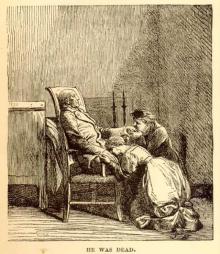
Marius dashed out of the barricade, Combeferre followed him. But he was too late. Gavroche was dead. Combeferre brought back the basket of cartridges; Marius bore the child.
"Alas!" he thought, "that which the father had done for his father, he was requiting to the son; only, Thenardier had brought back his father alive; he was bringing back the child dead."
When Marius re-entered the redoubt with Gavroche in his arms, his face, like the child, was inundated with blood.
At the moment when he had stooped to lift Gavroche, a bullet had grazed his head; he had not noticed it.
Courfeyrac untied his cravat and with it bandaged Marius' brow.
They laid Gavroche on the same table with Mabeuf, and spread over the two corpses the black shawl. There was enough of it for both the old man and the child.
Combeferre distributed the cartridges from the basket which he had brought in.
This gave each man fifteen rounds to fire.
Jean Valjean was still in the same place, motionless on his stone post. When Combeferre offered him his fifteen cartridges, he shook his head.
"Here's a rare eccentric," said Combeferre in a low voice to Enjolras. "He finds a way of not fighting in this barricade."
"Which does not prevent him from defending it," responded Enjolras.
"Heroism has its originals," resumed Combeferre.
And Courfeyrac, who had overheard, added:
"He is another sort from Father Mabeuf."
One thing which must be noted is, that the fire which was battering the barricade hardly disturbed the interior. Those who have never traversed the whirlwind of this sort of war can form no idea of the singular moments of tranquillity mingled with these convulsions. Men go and come, they talk, they jest, they lounge. Some one whom we know heard a combatant say to him in the midst of the grape-shot: "We are here as at a bachelor breakfast." The redoubt of the Rue de la Chanvrerie, we repeat, seemed very calm within. All mutations and all phases had been, or were about to be, exhausted. The position, from critical, had become menacing, and, from menacing, was probably about to become desperate. In proportion as the situation grew gloomy, the glow of heroism empurpled the barricade more and more. Enjolras, who was grave, dominated it, in the attitude of a young Spartan sacrificing his naked sword to the sombre genius, Epidotas.
Combeferre, wearing an apron, was dressing the wounds: Bossuet and Feuilly were making cartridges with the powder-flask picked up by Gavroche on the dead corporal, and Bossuet said to Feuilly: "We are soon to take the diligence for another planet"; Courfeyrac was disposing and arranging on some paving-stones which he had reserved for himself near Enjolras, a complete arsenal, his sword-cane, his gun, two holster pistols, and a cudgel, with the care of a young girl setting a small dunkerque in order. Jean Valjean stared silently at the wall opposite him. An artisan was fastening Mother Hucheloup's big straw hat on his head with a string, "for fear of sun-stroke," as he said. The young men from the Cougourde d'Aix were chatting merrily among themselves, as though eager to speak patois for the last time. Joly, who had taken Widow Hucheloup's mirror from the wall, was examining his tongue in it. Some combatants, having discovered a few crusts of rather mouldy bread, in a drawer, were eagerly devouring them. Marius was disturbed with regard to what his father was about to say to him.
CHAPTER XVIII—THE VULTURE BECOME PREY
We must insist upon one psychological fact peculiar to barricades. Nothing which is characteristic of that surprising war of the streets should be omitted.
Whatever may have been the singular inward tranquillity which we have just mentioned, the barricade, for those who are inside it, remains, none the less, a vision.
There is something of the apocalypse in civil war, all the mists of the unknown are commingled with fierce flashes, revolutions are sphinxes, and any one who has passed through a barricade thinks he has traversed a dream.
The feelings to which one is subject in these places we have pointed out in the case of Marius, and we shall see the consequences; they are both more and less than life. On emerging from a barricade, one no longer knows what one has seen there. One has been terrible, but one knows it not. One has been surrounded with conflicting ideas which had human faces; one's head has been in the light of the future. There were corpses lying prone there, and phantoms standing erect. The hours were colossal and seemed hours of eternity. One has lived in death. Shadows have passed by. What were they?
One has beheld hands on which there was blood; there was a deafening horror; there was also a frightful silence; there were open mouths which shouted, and other open mouths which held their peace; one was in the midst of smoke, of night, perhaps. One fancied that one had touched the sinister ooze of unknown depths; one stares at something red on one's finger nails. One no longer remembers anything.
Let us return to the Rue de la Chanvrerie.
All at once, between two discharges, the distant sound of a clock striking the hour became audible.
"It is midday," said Combeferre.
The twelve strokes had not finished striking when Enjolras sprang to his feet, and from the summit of the barricade hurled this thundering shout:
"Carry stones up into the houses; line the windowsills and the roofs with them. Half the men to their guns, the other half to the paving-stones. There is not a minute to be lost."
A squad of sappers and miners, axe on shoulder, had just made their appearance in battle array at the end of the street.
This could only be the head of a column; and of what column? The attacking column, evidently; the sappers charged with the demolition of the barricade must always precede the soldiers who are to scale it.
They were, evidently, on the brink of that moment which M. Clermont-Tonnerre, in 1822, called "the tug of war."
Enjolras' order was executed with the correct haste which is peculiar to ships and barricades, the only two scenes of combat where escape is impossible. In less than a minute, two thirds of the stones which Enjolras had had piled up at the door of Corinthe had been carried up to the first floor and the attic, and before a second minute had elapsed, these stones, artistically set one upon the other, walled up the sash-window on the first floor and the windows in the roof to half their height. A few loop-holes carefully planned by Feuilly, the principal architect, allowed of the passage of the gun-barrels. This armament of the windows could be effected all the more easily since the firing of grape-shot had ceased. The two cannons were now discharging ball against the centre of the barrier in order to make a hole there, and, if possible, a breach for the assault.
When the stones destined to the final defence were in place, Enjolras had the bottles which he had set under the table where Mabeuf lay, carried to the first floor.
"Who is to drink that?" Bossuet asked him.
"They," replied Enjolras.
Then they barricaded the window below, and held in readiness the iron cross-bars which served to secure the door of the wine-shop at night.
The fortress was complete. The barricade was the rampart, the wine-shop was the dungeon. With the stones which remained they stopped up the outlet.
As the defenders of a barricade are always obliged to be sparing of their ammunition, and as the assailants know this, the assailants combine their arrangements with a sort of irritating leisure, expose themselves to fire prematurely, though in appearance more than in reality, and take their ease. The preparations for attack are always made with a certain methodical deliberation; after which, the lightning strikes.
This deliberation permitted Enjolras to take a review of everything and to perfect everything. He felt that, since such men were to die, their death ought to be a masterpiece.
He said to Marius: "We are the two leaders. I will give the last orders inside. Do you remain outside and observe."
Marius posted himself on the lookout upon the crest of the barricade.
Enjolras had the door of the kitchen, which was the ambulance, as the reader will remember, nailed up.
"No splashing of the wounded," he said.
He issued his final orders in the tap-room in a curt, but profoundly tranquil tone; Feuilly listened and replied in the name of all.
"On the first floor, hold your axes in readiness to cut the staircase. Have you them?"
"Yes," said Feuilly.
"How many?"
"Two axes and a pole-axe."
"That is good. There are now twenty-six combatants of us on foot. How many guns are there?"
"Thirty-four."
"Eight too many. Keep those eight guns loaded like the rest and at hand. Swords and pistols in your belts. Twenty men to the barricade. Six ambushed in the attic windows, and at the window on the first floor to fire on the assailants through the loop-holes in the stones. Let not a single worker remain inactive here. Presently, when the drum beats the assault, let the twenty below stairs rush to the barricade. The first to arrive will have the best places."
These arrangements made, he turned to Javert and said:
"I am not forgetting you."
And, laying a pistol on the table, he added:
"The last man to leave this room will smash the skull of this spy."
"Here?" inquired a voice.
"No, let us not mix their corpses with our own. The little barricade of the Mondetour lane can be scaled. It is only four feet high. The man is well pinioned. He shall be taken thither and put to death."
There was some one who was more impassive at that moment than Enjolras, it was Javert. Here Jean Valjean made his appearance.
He had been lost among the group of insurgents. He stepped forth and said to Enjolras:
"You are the commander?"
"Yes."
"You thanked me a while ago."
"In the name of the Republic. The barricade has two saviors, Marius Pontmercy and yourself."