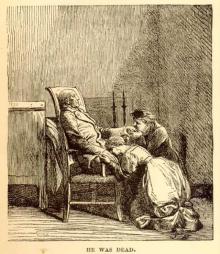
The complete novels of v.., p.360
The Complete Novels of Victor Hugo,
p.360


On the side of Phelem-ghe-Madone was Colonel Moncreif, as umpire; and Kilter, as second, to support him on his knee.
On the side of Helmsgail, the Honourable Pughe Beaumaris was umpire, with Lord Desertum, from Kilcarry, as bottle-holder, to support him on his knee.
The two combatants stood for a few seconds motionless in the ring, whilst the watches were being compared. They then approached each other and shook hands.
Phelem-ghe-Madone said to Helmsgail,—
"I should prefer going home."
Helmsgail answered, handsomely,—
"The gentlemen must not be disappointed, on any account."
Naked as they were, they felt the cold. Phelem-ghe-Madone shook. His teeth chattered.
Dr. Eleanor Sharpe, nephew of the Archbishop of York, cried out to them,—
"Set to, boys; it will warm you."
Those friendly words thawed them.
They set to.
But neither one nor the other was angry. There were three ineffectual rounds. The Rev. Doctor Gumdraith, one of the forty Fellows of All Souls' College, cried,—
"Spirit them up with gin."
But the two umpires and the two seconds adhered to the rule. Yet it was exceedingly cold.
First blood was claimed.
They were again set face to face.
They looked at each other, approached, stretched their arms, touched each other's fists, and then drew back.
All at once, Helmsgail, the little man, sprang forward. The real fight had begun.
Phelem-ghe-Madone was struck in the face, between the Ryes. His whole face streamed with blood. The crowd cried,—
"Helmsgail has tapped his claret!"
There was applause. Phelem-ghe-Madone, turning his arms like the sails of a windmill, struck out at random.
The Honourable Peregrine Bertie said, "Blinded;" but he was not blind yet.
Then Helmsgail heard on all sides these encouraging words,—
"Bung up his peepers!"
On the whole, the two champions were really well matched; and, notwithstanding the unfavourable weather, it was seen that the fight would be a success.
The great giant, Phelem-ghe-Madone, had to bear the inconveniences of his advantages; he moved heavily. His arms were massive as clubs; but his chest was a mass. His little opponent ran, struck, sprang, gnashed his teeth; redoubling vigour by quickness, from knowledge of the science.
On the one side was the primitive blow of the fist—savage, uncultivated, in a state of ignorance; on the other side, the civilized blow of the fist. Helmsgail fought as much with his nerves as with his muscles, and with as much intention as force. Phelem-ghe-Madone was a kind of sluggish mauler—somewhat mauled himself, to begin with. It was art against nature. It was cultivated ferocity against barbarism.
It was clear that the barbarian would be beaten, but not very quickly. Hence the interest.
A little man against a big one, and the chances are in favour of the little one. The cat has the best of it with a dog. Goliaths are always vanquished by Davids.
A hail of exclamations followed the combatants.
"Bravo, Helmsgail! Good! Well done, Highlander! Now, Phelem!"
And the friends of Helmsgail repeated their benevolent exhortation,—
"Bung up his peepers!"
Helmsgail did better. Rapidly bending down and back again, with the undulation of a serpent, he struck Phelem-ghe-Madone in the sternum. The Colossus staggered.
"Foul blow!" cried Viscount Barnard.
Phelem-ghe-Madone sank down on the knee of his second, saying,—
"I am beginning to get warm."
Lord Desertum consulted the umpires, and said,—
"Five minutes before time is called."
Phelem-ghe-Madone was becoming weaker. Kilter wiped the blood from his face and the sweat from his body with a flannel, and placed the neck of a bottle to his mouth. They had come to the eleventh round. Phelem, besides the scar on his forehead, had his breast disfigured by blows, his belly swollen, and the fore part of the head scarified. Helmsgail was untouched.
A kind of tumult arose amongst the gentlemen.
Lord Barnard repeated, "Foul blow."
"Bets void!" said the Laird of Lamyrbau.
"I claim my stake!" replied Sir Thomas Colpepper.
And the honourable member for the borough of Saint Ives, Sir Bartholomew Gracedieu, added, "Give me back my five hundred guineas, and I will go. Stop the fight."
Phelem arose, staggering like a drunken man, and said,—
"Let us go on fighting, on one condition—that I also shall have the right to give one foul blow."
They cried "Agreed!" from all parts of the ring. Helmsgail shrugged his shoulders. Five minutes elapsed, and they set to again.
The fighting, which was agony to Phelem, was play to Helmsgail. Such are the triumphs of science.
The little man found means of putting the big one into chancery—that is to say, Helmsgail suddenly took under his left arm, which was bent like a steel crescent, the huge head of Phelem-ghe-Madone, and held it there under his armpits, the neck bent and twisted, whilst Helmsgail's right fist fell again and again like a hammer on a nail, only from below and striking upwards, thus smashing his opponent's face at his ease. When Phelem, released at length, lifted his head, he had no longer a face.
That which had been a nose, eyes, and a mouth now looked only like a black sponge, soaked in blood. He spat, and on the ground lay four of his teeth.
Then he fell. Kilter received him on his knee.
Helmsgail was hardly touched: he had some insignificant bruises and a scratch on his collar bone.
No one was cold now. They laid sixteen and a quarter to one on Helmsgail.
Harry Carleton cried out,—
"It is all over with Phelem-ghe-Madone. I will lay my peerage of Bella-aqua, and my title of Lord Bellew, against the Archbishop of Canterbury's old wig, on Helmsgail."
"Give me your muzzle," said Kilter to Phelem-ghe-Madone. And stuffing the bloody flannel into the bottle, he washed him all over with gin. The mouth reappeared, and he opened one eyelid. His temples seemed fractured.
"One round more, my friend," said Kilter; and he added, "for the honour of the low town."
The Welsh and the Irish understand each other, still Phelem made no sign of having any power of understanding left.
Phelem arose, supported by Kilter. It was the twenty-fifth round. From the way in which this Cyclops, for he had but one eye, placed himself in position, it was evident that this was the last round, for no one doubted his defeat. He placed his guard below his chin, with the awkwardness of a failing man.
Helmsgail, with a skin hardly sweating, cried out,—
"I'll back myself, a thousand to one."
Helmsgail, raising his arm, struck out; and, what was strange, both fell. A ghastly chuckle was heard. It was Phelem-ghe-Madone's expression of delight. While receiving the terrible blow given him by Helmsgail on the skull, he had given him a foul blow on the navel.
Helmsgail, lying on his back, rattled in his throat.
The spectators looked at him as he lay on the ground, and said, "Paid back!" All clapped their hands, even those who had lost. Phelem-ghe-Madone had given foul blow for foul blow, and had only asserted his right.
They carried Helmsgail off on a hand-barrow. The opinion was that he would not recover.
Lord Robartes exclaimed, "I win twelve hundred guineas."
Phelem-ghe-Madone was evidently maimed for life.
As she left, Josiana took the arm of Lord David, an act which was tolerated amongst people "engaged." She said to him,—
"It is very fine, but—"
"But what?"
"I thought it would have driven away my spleen. It has not."
Lord David stopped, looked at Josiana, shut his mouth, and inflated his cheeks, whilst he nodded his head, which signified attention, and said to the duchess,—
"For spleen there is but one remedy."
"What is it?"
"Gwynplaine."
The duchess asked,—
"And who is Gwynplaine?"
BOOK THE SECOND.
GWYNPLAINE AND DEA.
CHAPTER I.
WHEREIN WE SEE THE FACE OF HIM OF WHOM WE HAVE HITHERTO SEEN ONLY THE ACTS.
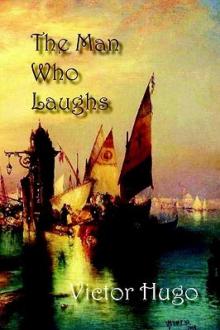
Nature had been prodigal of her kindness to Gwynplaine. She had bestowed on him a mouth opening to his ears, ears folding over to his eyes, a shapeless nose to support the spectacles of the grimace maker, and a face that no one could look upon without laughing.
We have just said that nature had loaded Gwynplaine with her gifts. But was it nature? Had she not been assisted?
Two slits for eyes, a hiatus for a mouth, a snub protuberance with two holes for nostrils, a flattened face, all having for the result an appearance of laughter; it is certain that nature never produces such perfection single-handed.
But is laughter a synonym of joy?
If, in the presence of this mountebank—for he was one—the first impression of gaiety wore off, and the man were observed with attention, traces of art were to be recognized. Such a face could never have been created by chance; it must have resulted from intention. Such perfect completeness is not in nature. Man can do nothing to create beauty, but everything to produce ugliness. A Hottentot profile cannot be changed into a Roman outline, but out of a Grecian nose you may make a Calmuck's. It only requires to obliterate the root of the nose and to flatten the nostrils. The dog Latin of the Middle Ages had a reason for its creation of the verb denasare. Had Gwynplaine when a child been so worthy of attention that his face had been subjected to transmutation? Why not? Needed there a greater motive than the speculation of his future exhibition? According to all appearance, industrious manipulators of children had worked upon his face. It seemed evident that a mysterious and probably occult science, which was to surgery what alchemy was to chemistry, had chiselled his flesh, evidently at a very tender age, and manufactured his countenance with premeditation. That science, clever with the knife, skilled in obtusions and ligatures, had enlarged the mouth, cut away the lips, laid bare the gums, distended the ears, cut the cartilages, displaced the eyelids and the cheeks, enlarged the zygomatic muscle, pressed the scars and cicatrices to a level, turned back the skin over the lesions whilst the face was thus stretched, from all which resulted that powerful and profound piece of sculpture, the mask, Gwynplaine.
Man is not born thus.
However it may have been, the manipulation of Gwynplaine had succeeded admirably. Gwynplaine was a gift of Providence to dispel the sadness of man.
Of what providence? Is there a providence of demons as well as of God? We put the question without answering it.
Gwynplaine was a mountebank. He showed himself on the platform. No such effect had ever before been produced. Hypochondriacs were cured by the sight of him alone. He was avoided by folks in mourning, because they were compelled to laugh when they saw him, without regard to their decent gravity. One day the executioner came, and Gwynplaine made him laugh. Every one who saw Gwynplaine held his sides; he spoke, and they rolled on the ground. He was removed from sadness as is pole from pole. Spleen at the one; Gwynplaine at the other.
Thus he rose rapidly in the fair ground and at the cross roads to the very satisfactory renown of a horrible man.
It was Gwynplaine's laugh which created the laughter of others, yet he did not laugh himself. His face laughed; his thoughts did not. The extraordinary face which chance or a special and weird industry had fashioned for him, laughed alone. Gwynplaine had nothing to do with it. The outside did not depend on the interior. The laugh which he had not placed, himself, on his brow, on his eyelids, on his mouth, he could not remove. It had been stamped for ever on his face. It was automatic, and the more irresistible because it seemed petrified. No one could escape from this rictus. Two convulsions of the face are infectious; laughing and yawning. By virtue of the mysterious operation to which Gwynplaine had probably been subjected in his infancy, every part of his face contributed to that rictus; his whole physiognomy led to that result, as a wheel centres in the nave. All his emotions, whatever they might have been, augmented his strange face of joy, or to speak more correctly, aggravated it. Any astonishment which might seize him, any suffering which he might feel, any anger which might take possession of him, any pity which might move him, would only increase this hilarity of his muscles. If he wept, he laughed; and whatever Gwynplaine was, whatever he wished to be, whatever he thought, the moment that he raised his head, the crowd, if crowd there was, had before them one impersonation: an overwhelming burst of laughter.
It was like a head of Medusa, but Medusa hilarious. All feeling or thought in the mind of the spectator was suddenly put to flight by the unexpected apparition, and laughter was inevitable. Antique art formerly placed on the outsides of the Greek theatre a joyous brazen face, called comedy. It laughed and occasioned laughter, but remained pensive. All parody which borders on folly, all irony which borders on wisdom, were condensed and amalgamated in that face. The burden of care, of disillusion, anxiety, and grief were expressed in its impassive countenance, and resulted in a lugubrious sum of mirth. One corner of the mouth was raised, in mockery of the human race; the other side, in blasphemy of the gods. Men confronted that model of the ideal sarcasm and exemplification of the irony which each one possesses within him; and the crowd, continually renewed round its fixed laugh, died away with delight before its sepulchral immobility of mirth.
One might almost have said that Gwynplaine was that dark, dead mask of ancient comedy adjusted to the body of a living man. That infernal head of implacable hilarity he supported on his neck. What a weight for the shoulders of a man—an everlasting laugh!
An everlasting laugh!
Let us understand each other; we will explain. The Manichæans believed the absolute occasionally gives way, and that God Himself sometimes abdicates for a time. So also of the will. We do not admit that it can ever be utterly powerless. The whole of existence resembles a letter modified in the postscript. For Gwynplaine the postscript was this: by the force of his will, and by concentrating all his attention, and on condition that no emotion should come to distract and turn away the fixedness of his effort, he could manage to suspend the everlasting rictus of his face, and to throw over it a kind of tragic veil, and then the spectator laughed no longer; he shuddered.
This exertion Gwynplaine scarcely ever made. It was a terrible effort, and an insupportable tension. Moreover, it happened that on the slightest distraction, or the slightest emotion, the laugh, driven back for a moment, returned like a tide with an impulse which was irresistible in proportion to the force of the adverse emotion.
With this exception, Gwynplaine's laugh was everlasting.
On seeing Gwynplaine, all laughed. When they had laughed they turned away their heads. Women especially shrank from him with horror. The man was frightful. The joyous convulsion of laughter was as a tribute paid; they submitted to it gladly, but almost mechanically. Besides, when once the novelty of the laugh had passed over, Gwynplaine was intolerable for a woman to see, and impossible to contemplate. But he was tall, well made, and agile, and no way deformed, excepting in his face.
This led to the presumption that Gwynplaine was rather a creation of art than a work of nature. Gwynplaine, beautiful in figure, had probably been beautiful in face. At his birth he had no doubt resembled other infants. They had left the body intact, and retouched only the face.
Gwynplaine had been made to order—at least, that was probable. They had left him his teeth; teeth are necessary to a laugh. The death's head retains them. The operation performed on him must have been frightful. That he had no remembrance of it was no proof that it had not taken place. Surgical sculpture of the kind could never have succeeded except on a very young child, and consequently on one having little consciousness of what happened to him, and who might easily take a wound for a sickness. Besides, we must remember that they had in those times means of putting patients to sleep, and of suppressing all suffering; only then it was called magic, while now it is called anæsthesia.
Besides this face, those who had brought him up had given him the resources of a gymnast and an athlete. His articulations usefully displaced and fashioned to bending the wrong way, had received the education of a clown, and could, like the hinges of a door, move backwards and forwards. In appropriating him to the profession of mountebank nothing had been neglected. His hair had been dyed with ochre once for all; a secret which has been rediscovered at the present day. Pretty women use it, and that which was formerly considered ugly is now considered an embellishment. Gwynplaine had yellow hair. His hair having probably been dyed with some corrosive preparation, had left it woolly and rough to the touch. Its yellow bristles, rather a mane than a head of hair, covered and concealed a lofty brow, evidently made to contain thought. The operation, whatever it had been, which had deprived his features of harmony, and put all their flesh into disorder, had had no effect on the bony structure of his head. The facial angle was powerful and surprisingly grand. Behind his laugh there was a soul, dreaming, as all our souls dream.
However, his laugh was to Gwynplaine quite a talent. He could do nothing with it, so he turned it to account. By means of it he gained his living.
Gwynplaine, as you have doubtless already guessed, was the child abandoned one winter evening on the coast of Portland, and received into a poor caravan at Weymouth.
CHAPTER II.
DEA.
That boy was at this time a man. Fifteen years had elapsed. It was in 1705. Gwynplaine was in his twenty-fifth year.
Ursus had kept the two children with him. They were a group of wanderers. Ursus and Homo had aged. Ursus had become quite bald. The wolf was growing gray. The age of wolves is not ascertained like that of dogs. According to Molière, there are wolves which live to eighty, amongst others the little koupara, and the rank wolf, the Canis nubilus of Say.