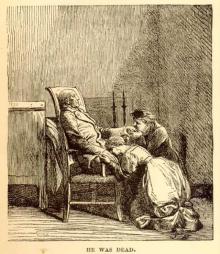
The complete novels of v.., p.202
The Complete Novels of Victor Hugo,
p.202


M. Gillenormand continued:—
"It is like their Sieyes! A regicide ending in a senator; for that is the way they always end. They give themselves a scar with the address of thou as citizens, in order to get themselves called, eventually, Monsieur le Comte. Monsieur le Comte as big as my arm, assassins of September. The philosopher Sieyes! I will do myself the justice to say, that I have never had any better opinion of the philosophies of all those philosophers, than of the spectacles of the grimacer of Tivoli! One day I saw the Senators cross the Quai Malplaquet in mantles of violet velvet sown with bees, with hats a la Henri IV. They were hideous. One would have pronounced them monkeys from the tiger's court. Citizens, I declare to you, that your progress is madness, that your humanity is a dream, that your revolution is a crime, that your republic is a monster, that your young and virgin France comes from the brothel, and I maintain it against all, whoever you may be, whether journalists, economists, legists, or even were you better judges of liberty, of equality, and fraternity than the knife of the guillotine! And that I announce to you, my flne fellows!"
"Parbleu!" cried the lieutenant, "that is wonderfully true."
M. Gillenormand paused in a gesture which he had begun, wheeled round, stared Lancer Theodule intently in the eyes, and said to him:—
"You are a fool."
BOOK SIXTH.—THE CONJUNCTION OF TWO STARS
CHAPTER I—THE SOBRIQUET: MODE OF FORMATION OF FAMILY NAMES
Marius was, at this epoch, a handsome young man, of medium stature, with thick and intensely black hair, a lofty and intelligent brow, well-opened and passionate nostrils, an air of calmness and sincerity, and with something indescribably proud, thoughtful, and innocent over his whole countenance. His profile, all of whose lines were rounded, without thereby losing their firmness, had a certain Germanic sweetness, which has made its way into the French physiognomy by way of Alsace and Lorraine, and that complete absence of angles which rendered the Sicambres so easily recognizable among the Romans, and which distinguishes the leonine from the aquiline race. He was at that period of life when the mind of men who think is composed, in nearly equal parts, of depth and ingenuousness. A grave situation being given, he had all that is required to be stupid: one more turn of the key, and he might be sublime. His manners were reserved, cold, polished, not very genial. As his mouth was charming, his lips the reddest, and his teeth the whitest in the world, his smile corrected the severity of his face, as a whole. At certain moments, that pure brow and that voluptuous smile presented a singular contrast. His eyes were small, but his glance was large.
At the period of his most abject misery, he had observed that young girls turned round when he passed by, and he fled or hid, with death in his soul. He thought that they were staring at him because of his old clothes, and that they were laughing at them; the fact is, that they stared at him because of his grace, and that they dreamed of him.
This mute misunderstanding between him and the pretty passers-by had made him shy. He chose none of them for the excellent reason that he fled from all of them. He lived thus indefinitely,—stupidly, as Courfeyrac said.
Courfeyrac also said to him: "Do not aspire to be venerable" [they called each other thou; it is the tendency of youthful friendships to slip into this mode of address]. "Let me give you a piece of advice, my dear fellow. Don't read so many books, and look a little more at the lasses. The jades have some good points about them, O Marius! By dint of fleeing and blushing, you will become brutalized."
On other occasions, Courfeyrac encountered him and said:—"Good morning, Monsieur l' Abbé!"
When Courfeyrac had addressed to him some remark of this nature, Marius avoided women, both young and old, more than ever for a week to come, and he avoided Courfeyrac to boot.
Nevertheless, there existed in all the immensity of creation, two women whom Marius did not flee, and to whom he paid no attention whatever. In truth, he would have been very much amazed if he had been informed that they were women. One was the bearded old woman who swept out his chamber, and caused Courfeyrac to say: "Seeing that his servant woman wears his beard, Marius does not wear his own beard." The other was a sort of little girl whom he saw very often, and whom he never looked at.
For more than a year, Marius had noticed in one of the walks of the Luxembourg, the one which skirts the parapet of the Pepiniere, a man and a very young girl, who were almost always seated side by side on the same bench, at the most solitary end of the alley, on the Rue de l'Ouest side. Every time that that chance which meddles with the strolls of persons whose gaze is turned inwards, led Marius to that walk,—and it was nearly every day,—he found this couple there. The man appeared to be about sixty years of age; he seemed sad and serious; his whole person presented the robust and weary aspect peculiar to military men who have retired from the service. If he had worn a decoration, Marius would have said: "He is an ex-officer." He had a kindly but unapproachable air, and he never let his glance linger on the eyes of any one. He wore blue trousers, a blue frock coat and a broad-brimmed hat, which always appeared to be new, a black cravat, a quaker shirt, that is to say, it was dazzlingly white, but of coarse linen. A grisette who passed near him one day, said: "Here's a very tidy widower." His hair was very white.
The first time that the young girl who accompanied him came and seated herself on the bench which they seemed to have adopted, she was a sort of child thirteen or fourteen years of age, so thin as to be almost homely, awkward, insignificant, and with a possible promise of handsome eyes. Only, they were always raised with a sort of displeasing assurance. Her dress was both aged and childish, like the dress of the scholars in a convent; it consisted of a badly cut gown of black merino. They had the air of being father and daughter.
Marius scanned this old man, who was not yet aged, and this little girl, who was not yet a person, for a few days, and thereafter paid no attention to them. They, on their side, did not appear even to see him. They conversed together with a peaceful and indifferent air. The girl chattered incessantly and merrily. The old man talked but little, and, at times, he fixed on her eyes overflowing with an ineffable paternity.
Marius had acquired the mechanical habit of strolling in that walk. He invariably found them there.
This is the way things went:—
Marius liked to arrive by the end of the alley which was furthest from their bench; he walked the whole length of the alley, passed in front of them, then returned to the extremity whence he had come, and began again. This he did five or six times in the course of his promenade, and the promenade was taken five or six times a week, without its having occurred to him or to these people to exchange a greeting. That personage, and that young girl, although they appeared,—and perhaps because they appeared,—to shun all glances, had, naturally, caused some attention on the part of the five or six students who strolled along the Pepiniere from time to time; the studious after their lectures, the others after their game of billiards. Courfeyrac, who was among the last, had observed them several times, but, finding the girl homely, he had speedily and carefully kept out of the way. He had fled, discharging at them a sobriquet, like a Parthian dart. Impressed solely with the child's gown and the old man's hair, he had dubbed the daughter Mademoiselle Lanoire, and the father, Monsieur Leblanc, so that as no one knew them under any other title, this nickname became a law in the default of any other name. The students said: "Ah! Monsieur Leblanc is on his bench." And Marius, like the rest, had found it convenient to call this unknown gentleman Monsieur Leblanc.
We shall follow their example, and we shall say M. Leblanc, in order to facilitate this tale.
So Marius saw them nearly every day, at the same hour, during the first year. He found the man to his taste, but the girl insipid.
CHAPTER II—LUX FACTA EST
During the second year, precisely at the point in this history which the reader has now reached, it chanced that this habit of the Luxembourg was interrupted, without Marius himself being quite aware why, and nearly six months elapsed, during which he did not set foot in the alley. One day, at last, he returned thither once more; it was a serene summer morning, and Marius was in joyous mood, as one is when the weather is fine. It seemed to him that he had in his heart all the songs of the birds that he was listening to, and all the bits of blue sky of which he caught glimpses through the leaves of the trees.
He went straight to "his alley," and when he reached the end of it he perceived, still on the same bench, that well-known couple. Only, when he approached, it certainly was the same man; but it seemed to him that it was no longer the same girl. The person whom he now beheld was a tall and beautiful creature, possessed of all the most charming lines of a woman at the precise moment when they are still combined with all the most ingenuous graces of the child; a pure and fugitive moment, which can be expressed only by these two words,—"fifteen years." She had wonderful brown hair, shaded with threads of gold, a brow that seemed made of marble, cheeks that seemed made of rose-leaf, a pale flush, an agitated whiteness, an exquisite mouth, whence smiles darted like sunbeams, and words like music, a head such as Raphael would have given to Mary, set upon a neck that Jean Goujon would have attributed to a Venus. And, in order that nothing might be lacking to this bewitching face, her nose was not handsome—it was pretty; neither straight nor curved, neither Italian nor Greek; it was the Parisian nose, that is to say, spiritual, delicate, irregular, pure,—which drives painters to despair, and charms poets.
When Marius passed near her, he could not see her eyes, which were constantly lowered. He saw only her long chestnut lashes, permeated with shadow and modesty.
This did not prevent the beautiful child from smiling as she listened to what the white-haired old man was saying to her, and nothing could be more fascinating than that fresh smile, combined with those drooping eyes.
For a moment, Marius thought that she was another daughter of the same man, a sister of the former, no doubt. But when the invariable habit of his stroll brought him, for the second time, near the bench, and he had examined her attentively, he recognized her as the same. In six months the little girl had become a young maiden; that was all. Nothing is more frequent than this phenomenon. There is a moment when girls blossom out in the twinkling of an eye, and become roses all at once. One left them children but yesterday; today, one finds them disquieting to the feelings.
This child had not only grown, she had become idealized. As three days in April suffice to cover certain trees with flowers, six months had sufficed to clothe her with beauty. Her April had arrived.
One sometimes sees people, who, poor and mean, seem to wake up, pass suddenly from indigence to luxury, indulge in expenditures of all sorts, and become dazzling, prodigal, magnificent, all of a sudden. That is the result of having pocketed an income; a note fell due yesterday. The young girl had received her quarterly income.
And then, she was no longer the school-girl with her felt hat, her merino gown, her scholar's shoes, and red hands; taste had come to her with beauty; she was a well-dressed person, clad with a sort of rich and simple elegance, and without affectation. She wore a dress of black damask, a cape of the same material, and a bonnet of white crape. Her white gloves displayed the delicacy of the hand which toyed with the carved, Chinese ivory handle of a parasol, and her silken shoe outlined the smallness of her foot. When one passed near her, her whole toilette exhaled a youthful and penetrating perfume.
As for the man, he was the same as usual.
The second time that Marius approached her, the young girl raised her eyelids; her eyes were of a deep, celestial blue, but in that veiled azure, there was, as yet, nothing but the glance of a child. She looked at Marius indifferently, as she would have stared at the brat running beneath the sycamores, or the marble vase which cast a shadow on the bench, and Marius, on his side, continued his promenade, and thought about something else.
He passed near the bench where the young girl sat, five or six times, but without even turning his eyes in her direction.
On the following days, he returned, as was his wont, to the Luxembourg; as usual, he found there "the father and daughter;" but he paid no further attention to them. He thought no more about the girl now that she was beautiful than he had when she was homely. He passed very near the bench where she sat, because such was his habit.
CHAPTER III—EFFECT OF THE SPRING
One day, the air was warm, the Luxembourg was inundated with light and shade, the sky was as pure as though the angels had washed it that morning, the sparrows were giving vent to little twitters in the depths of the chestnut-trees. Marius had thrown open his whole soul to nature, he was not thinking of anything, he simply lived and breathed, he passed near the bench, the young girl raised her eyes to him, the two glances met.
What was there in the young girl's glance on this occasion? Marius could not have told. There was nothing and there was everything. It was a strange flash.
She dropped her eyes, and he pursued his way.
What he had just seen was no longer the ingenuous and simple eye of a child; it was a mysterious gulf which had half opened, then abruptly closed again.
There comes a day when the young girl glances in this manner. Woe to him who chances to be there!
That first gaze of a soul which does not, as yet, know itself, is like the dawn in the sky. It is the awakening of something radiant and strange. Nothing can give any idea of the dangerous charm of that unexpected gleam, which flashes suddenly and vaguely forth from adorable shadows, and which is composed of all the innocence of the present, and of all the passion of the future. It is a sort of undecided tenderness which reveals itself by chance, and which waits. It is a snare which the innocent maiden sets unknown to herself, and in which she captures hearts without either wishing or knowing it. It is a virgin looking like a woman.
It is rare that a profound revery does not spring from that glance, where it falls. All purities and all candors meet in that celestial and fatal gleam which, more than all the best-planned tender glances of coquettes, possesses the magic power of causing the sudden blossoming, in the depths of the soul, of that sombre flower, impregnated with perfume and with poison, which is called love.
That evening, on his return to his garret, Marius cast his eyes over his garments, and perceived, for the first time, that he had been so slovenly, indecorous, and inconceivably stupid as to go for his walk in the Luxembourg with his "every-day clothes," that is to say, with a hat battered near the band, coarse carter's boots, black trousers which showed white at the knees, and a black coat which was pale at the elbows.
CHAPTER IV—BEGINNING OF A GREAT MALADY
On the following day, at the accustomed hour, Marius drew from his wardrobe his new coat, his new trousers, his new hat, and his new boots; he clothed himself in this complete panoply, put on his gloves, a tremendous luxury, and set off for the Luxembourg.
On the way thither, he encountered Courfeyrac, and pretended not to see him. Courfeyrac, on his return home, said to his friends:—
"I have just met Marius' new hat and new coat, with Marius inside them. He was going to pass an examination, no doubt. He looked utterly stupid."
On arriving at the Luxembourg, Marius made the tour of the fountain basin, and stared at the swans; then he remained for a long time in contemplation before a statue whose head was perfectly black with mould, and one of whose hips was missing. Near the basin there was a bourgeois forty years of age, with a prominent stomach, who was holding by the hand a little urchin of five, and saying to him: "Shun excess, my son, keep at an equal distance from despotism and from anarchy." Marius listened to this bourgeois. Then he made the circuit of the basin once more. At last he directed his course towards "his alley," slowly, and as if with regret. One would have said that he was both forced to go there and withheld from doing so. He did not perceive it himself, and thought that he was doing as he always did.
On turning into the walk, he saw M. Leblanc and the young girl at the other end, "on their bench." He buttoned his coat up to the very top, pulled it down on his body so that there might be no wrinkles, examined, with a certain complaisance, the lustrous gleams of his trousers, and marched on the bench. This march savored of an attack, and certainly of a desire for conquest. So I say that he marched on the bench, as I should say: "Hannibal marched on Rome."
However, all his movements were purely mechanical, and he had interrupted none of the habitual preoccupations of his mind and labors. At that moment, he was thinking that the Manuel du Baccalaureat was a stupid book, and that it must have been drawn up by rare idiots, to allow of three tragedies of Racine and only one comedy of Moliere being analyzed therein as masterpieces of the human mind. There was a piercing whistling going on in his ears. As he approached the bench, he held fast to the folds in his coat, and fixed his eyes on the young girl. It seemed to him that she filled the entire extremity of the alley with a vague blue light.
In proportion as he drew near, his pace slackened more and more. On arriving at some little distance from the bench, and long before he had reached the end of the walk, he halted, and could not explain to himself why he retraced his steps. He did not even say to himself that he would not go as far as the end. It was only with difficulty that the young girl could have perceived him in the distance and noted his fine appearance in his new clothes. Nevertheless, he held himself very erect, in case any one should be looking at him from behind.
He attained the opposite end, then came back, and this time he approached a little nearer to the bench. He even got to within three intervals of trees, but there he felt an indescribable impossibility of proceeding further, and he hesitated. He thought he saw the young girl's face bending towards him. But he exerted a manly and violent effort, subdued his hesitation, and walked straight ahead. A few seconds later, he rushed in front of the bench, erect and firm, reddening to the very ears, without daring to cast a glance either to the right or to the left, with his hand thrust into his coat like a statesman. At the moment when he passed,—under the cannon of the place,—he felt his heart beat wildly. As on the preceding day, she wore her damask gown and her crape bonnet. He heard an ineffable voice, which must have been "her voice." She was talking tranquilly. She was very pretty. He felt it, although he made no attempt to see her. "She could not, however," he thought, "help feeling esteem and consideration for me, if she only knew that I am the veritable author of the dissertation on Marcos Obregon de la Ronde, which M. Francois de Neufchateau put, as though it were his own, at the head of his edition of Gil Blas." He went beyond the bench as far as the extremity of the walk, which was very near, then turned on his heel and passed once more in front of the lovely girl. This time, he was very pale. Moreover, all his emotions were disagreeable. As he went further from the bench and the young girl, and while his back was turned to her, he fancied that she was gazing after him, and that made him stumble.