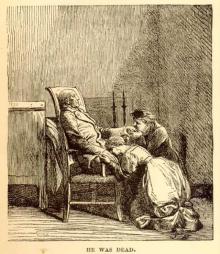
The complete novels of v.., p.304
The Complete Novels of Victor Hugo,
p.304


The Jacressade was rather a courtyard than a house; and more of a well than a courtyard. It had no stories looking on the street. Its façade was simply a high wall, with a low gateway. You raised the latch, pushed the gate, and were at once in the courtyard.
In the midst of this yard might be perceived a round hole, encircled with a margin of stones, and even with the ground. The yard was small, the well large. A broken pavement surrounded it.
The courtyard was square, and built on three sides only. On the side of the street was only the wall; facing you as you entered the gateway stood the house, the two wings of which formed the sides to right and left.
Any one entering there after nightfall, at his own risk and peril, would have heard a confused murmur of voices; and, if there had been moonlight or starlight enough to give shape to the obscure forms before his eyes, this is what he would have seen.
The courtyard: the well. Around the courtyard, in front of the gate, a lean-to or shed, in a sort of horse-shoe form, but with square corners; a rotten gallery, with a roof of joists supported by stone pillars at unequal distances. In the centre, the well; around the well, upon a litter of straw, a kind of circular chaplet, formed of the soles of boots and shoes; some trodden down at heel, some showing the toes of the wearers, some the naked heels. The feet of men, women, and children, all asleep.
Beyond these feet, the eye might have distinguished, in the shadow of the shed, bodies, drooping heads, forms stretched out lazily, bundles of rags of both sexes, a promiscuous assemblage, a strange and revolting mass of life. The accommodation of this sleeping chamber was open to all, at the rate of two sous a week. On a stormy night the rain fell upon the feet, the whirling snow settled on the bodies of those wretched sleepers.
Who were these people? The unknown. They came there at night, and departed in the morning. Creatures of this kind form part of the social fabric. Some stole in during the darkness, and paid nothing. The greater part had scarcely eaten during the day. All kinds of vice and baseness, every sort of moral infection, every species of distress were there. The same sleep settled down upon all in this bed of filth. The dreams of all these companions in misery went on side by side. A dismal meeting-place, where misery and weakness, half-sobered debauchery, weariness from long walking to and fro, with evil thoughts, in quest of bread, pallor with closed eyelids, remorse, envy, lay mingled and festering in the same miasma, with faces that had the look of death, and dishevelled hair mixed with the filth and sweepings of the streets. Such was the putrid heap of life fermenting in this dismal spot. An unlucky turn of the wheel of fortune, a ship arrived on the day before, a discharge from prison, a dark night, or some other chance, had cast them here, to find a miserable shelter. Every day brought some new accumulation of such misery. Let him enter who would, sleep who could, speak who dared; for it was a place of whispers. The new comers hastened to bury themselves in the mass, or tried to seek oblivion in sleep, since there was none in the darkness of the place. They snatched what little of themselves they could from the jaws of death. They closed their eyes in that confusion of horrors which every day renewed. They were the embodiment of misery, thrown off from society, as the scum is from the sea.
It was not every one who could even get a share of the straw. More than one figure was stretched out naked upon the flags. They lay down worn out with weariness, and awoke paralysed. The well, without lid or parapet, and thirty feet in depth, gaped open night and day. Rain fell around it; filth accumulated about, and the gutters of the yard ran down and filtered through its sides. The pail for drawing the water stood by the side. Those who were thirsty drank there; some, disgusted with life, drowned themselves in it—slipped from their slumber in the filthy shed into that profounder sleep. In the year 1819, the body of a boy, of fourteen years old, was taken up out of this well.
To be safe in this house, it was necessary to be of the "right sort." The uninitiated were regarded with suspicion.
Did these miserable wretches, then, know each other? No; yet they scented out the genuine guest of the Jacressade.
The mistress of the house was a young and rather pretty woman, wearing a cap trimmed with ribbons. She washed herself now and then with water from the well. She had a wooden leg.
At break of day, the courtyard became empty. Its inmates dispersed.
An old cock and some other fowls were kept in the courtyard, where they raked among the filth of the place all day long. A long horizontal beam, supported by posts, traversed the yard—a gibbet-shaped erection, not out of keeping with the associations of the place. Sometimes on the morrow of a rainy-day, a silk dress, mudded and wet, would be seen hanging out to dry upon this beam. It belonged to the woman with the wooden leg.
Over the shed, and like it, surrounding the yard, was a story, and above this story a loft. A rotten wooden ladder, passing through a hole in the roof of the shed, conducted to this story; and up this ladder the woman would climb, sometimes staggering while its crazy rounds creaked beneath her.
The occasional lodgers, whether by the week or the night, slept in the courtyard; the regular inmates lived in the house.
Windows without a pane of glass, door-frames with no door, fireplaces without stoves; such were the chief features of the interior. You might pass from one room to the other, indifferently, by a long square aperture which had been the door, or by a triangular hole between the joists of the partitions. The fallen plaster of the ceiling lay about the floor. It was difficult to say how the old house still stood erect. The high winds indeed shook it. The lodgers ascended as they could by the worn and slippery steps of the ladder. Everything was open to the air. The wintry atmosphere was absorbed into the house, like water into a sponge. The multitude of spiders seemed alone to guarantee the place against falling to pieces immediately. There was no sign of furniture. Two or three paillasses were in the corner, their ticking torn in parts, and showing more dust than straw within. Here and there were a water-pot and an earthen pipkin. A close, disagreeable odour haunted the rooms.
The windows looked out upon the square yard. The scene was like the interior of a scavenger's cart. The things, not to speak of the human beings, which lay rusting, mouldering, and putrefying there, were indescribable. The fragments seemed to fraternise together. Some fell from the walls, others from the living tenants of the place. The débris were sown with their tatters.
Besides the floating population which bivouacked nightly in the square yard, the Jacressade had three permanent lodgers—a charcoal man, a rag-picker, and a "gold-maker." The charcoal man and the rag-picker occupied two of the paillasses of the first story; the "gold-maker," a chemist, lodged in the loft, which was called, no one knew why, the garret. Nobody knew where the woman slept. The "gold-maker" was a poet in a small way. He inhabited a room in the roof, under the tiles—a chamber with a narrow window, and a large stone fireplace forming a gulf, in which the wind howled at will. The garret window having no frame, he had nailed across it a piece of iron sheathing, part of the wreck of a ship. This sheathing left little room for the entrance of light and much for the entrance of cold. The charcoal-man paid rent from time to time in the shape of a sack of charcoal; the rag-picker paid with a bowl of grain for the fowls every week; the "gold-maker" did not pay at all. Meanwhile the latter consumed the very house itself for fuel. He had pulled down the little woodwork which remained; and every now and then he took from the wall or the roof a lath or some scantling, to heat his crucible. Upon the partition, above the rag-picker's mattress, might have been seen two columns of figures, marked in chalk by the rag-picker himself from week to week—a column of threes, and a column of fives—according as the bowl of grain had cost him three liards or five centimes. The gold-pot of the "chemist" was an old fragment of a bomb-shell, promoted by him to the dignity of a crucible, in which he mixed his ingredients. The transmutation of metals absorbed all his thoughts. He was determined before he died to revenge himself by breaking the windows of orthodox science with the real philosopher's stone. His furnace consumed a good deal of wood. The hand-rail of the stairs had disappeared. The house was slowly burning away. The landlady said to him, "You will leave us nothing but the shell." He mollified her by addressing her in verses.
Such was the Jacressade.
A boy of twelve, or, perhaps, sixteen—for he was like a dwarf, with a large wen upon his neck, and always carrying a broom in his hand—was the domestic of the place.
The habitués entered by the gateway of the courtyard; the public entered by the shop.
In the high wall, facing the street, and to the right of the entrance to the courtyard, was a square opening, serving at once as a door and a window. This was the shop. The square opening had a shutter and a frame—the only shutter in all the house which had hinges and bolts. Behind this square aperture, which was open to the street, was a little room, a compartment obtained by curtailing the sleeping shed in the courtyard. Over the door, passers-by read the inscription in charcoal, "Curiosities sold here." On three boards, forming the shop front, were several china pots without ears, a Chinese parasol made of goldbeater's skin, and ornamented with figures, torn here and there, and impossible to open or shut; fragments of iron, and shapeless pieces of old pottery, and dilapidated hats and bonnets, three or four shells, some packets of old bone and metal buttons, a tobacco-box with a portrait of Marie-Antoinette, and a dog's-eared volume of Boisbertrand's Algebra. Such was the stock of the shop; this assortment completed the "curiosities." The shop communicated by a back door with the yard in which was the well. It was furnished with a table and a stool. The woman with a wooden leg presided at the counter.
VII
NOCTURNAL BUYERS AND MYSTERIOUS SELLERS
Clubin had been absent from the Jean Auberge all the evening of Tuesday. On the Wednesday night he was absent again.
In the dusk of that evening, two strangers penetrated into the mazes of the Ruelle Coutanchez. They stopped in front of the Jacressade. One of them knocked at the window; the door of the shop opened, and they entered. The woman with the wooden leg met them with the smile which she reserved for respectable citizens. There was a candle on the table.
The strangers were, in fact, respectable citizens. The one who had knocked said, "Good-day, mistress. I have come for that affair."
The woman with the wooden leg smiled again, and went out by the back-door leading to the courtyard, and where the well was. A moment afterwards the back-door was opened again, and a man stood in the doorway. He wore a cap and a blouse. It was easy to see the shape of something under his blouse. He had bits of old straw in his clothes, and looked as if he had just been aroused from sleep.
He advanced and exchanged glances with the strangers. The man in the blouse looked puzzled, but cunning; he said—
"You are the gunsmith?"
The one who had tapped at the window replied—
"Yes; you are the man from Paris?"
"Known as Redskin. Yes."
"Show me the thing."
The man took from under his blouse a weapon extremely rare at that period in Europe. It was a revolver.
The weapon was new and bright. The two strangers examined it. The one who seemed to know the house, and whom the man in the blouse had called "the gunsmith," tried the mechanism. He passed the weapon to the other, who appeared less at home there, and kept his back turned to the light.
The gunsmith continued—
"How much?"
The man in the blouse replied—
"I have just brought it from America. Some people bring monkeys, parrots, and other animals, as if the French people were savages. For myself I brought this. It is a useful invention."
"How much?" inquired the gunsmith again.
"It is a pistol which turns and turns."
"How much?"
"Bang! the first fire. Bang! the second fire. Bang! the third fire. What a hailstorm of bullets! That will do some execution."
"The price?"
"There are six barrels."
"Well, well, what do you want for it?"
"Six barrels; that is six Louis."
"Will you take five?"
"Impossible. One Louis a ball. That is the price."
"Come, let us do business together. Be reasonable."
"I have named a fair price. Examine the weapon, Mr. Gunsmith."
"I have examined it."
"The barrel twists and turns like Talleyrand himself. The weapon ought to be mentioned in the Dictionary of Weathercocks. It is a gem."
"I have looked at it."
"The barrels are of Spanish make."
"I see they are."
"They are twisted. This is how this twisting is done. They empty into a forge the basket of a collector of old iron. They fill it full of these old scraps, with old nails, and broken horseshoes swept out of farriers' shops."
"And old sickle-blades."
"I was going to say so, Mr. Gunsmith. They apply to all this rubbish a good sweating heat, and this makes a magnificent material for gun-barrels."
"Yes; but it may have cracks, flaws, or crosses."
"True; but they remedy the crosses by little twists, and avoid the risk of doublings by beating hard. They bring their mass of iron under the great hammer; give it two more good sweating heats. If the iron has been heated too much, they re-temper it with dull heats, and lighter hammers. And then they take out their stuff and roll it well; and with this iron they manufacture you a weapon like this."
"You are in the trade, I suppose?"
"I am of all trades."
"The barrels are pale-coloured."
"That's the beauty of them, Mr. Gunsmith. The tint is obtained with antimony."
"It is settled, then, that we give you five Louis?"
"Allow me to observe that I had the honour of saying six."
The gunsmith lowered his voice.
"Hark you, master. Take advantage of the opportunity. Get rid of this thing. A weapon of this kind is of no use to a man like you. It will make you remarked."
"It is very true," said the Parisian. "It is rather conspicuous. It is more suited to a gentleman."
"Will you take five Louis?"
"No, six; one for every shot."
"Come, six Napoleons."
"I will have six Louis."
"You are not a Bonapartist, then. You prefer a Louis to a Napoleon."
The Parisian nicknamed "Redskin" smiled.
"A Napoleon is greater," said he, "but a Louis is worth more."
"Six Napoleons."
"Six Louis. It makes a difference to me of four-and-twenty francs."
"The bargain is off in that case."
"Good: I keep the toy."
"Keep it."
"Beating me down! a good idea! It shall never be said that I got rid like that of a wonderful specimen of ingenuity."
"Good-night, then."
"It marks a whole stage in the progress of making pistols, which the Chesapeake Indians call Nortay-u-Hah."
"Five Louis, ready money. Why, it is a handful of gold."
"'Nortay-u-Hah,' that signifies 'short gun.' A good many people don't know that."
"Will you take five Louis, and just a bit of silver?"
"I said six, master."
The man who kept his back to the candle, and who had not yet spoken, was spending his time during the dialogue in turning and testing the mechanism of the pistol. He approached the armourer's ear and whispered—
"Is it a good weapon?"
"Excellent."
"I will give the six Louis."
Five minutes afterwards, while the Parisian nicknamed "Redskin" was depositing the six Louis which he had just received in a secret slit under the breast of his blouse, the armourer and his companion carrying the revolver in his trousers pocket, stepped out into the straggling street.
VIII
A "CANNON" OFF THE RED BALL AND THE BLACK
On the morrow, which was a Thursday, a tragic circumstance occurred at a short distance from St. Malo, near the peak of the "Décollé," a spot where the cliff is high and the sea deep.
A line of rocks in the form of the top of a lance, and connecting themselves with the land by a narrow isthmus, stretch out there into the water, ending abruptly with a large peak-shaped breaker. Nothing is commoner in the architecture of the sea. In attempting to reach the plateau of the peaked rock from the shore, it was necessary to follow an inclined plane, the ascent of which was here and there somewhat steep.
It was upon a plateau of this kind, towards four o'clock in the afternoon, that a man was standing, enveloped in a large military cape, and armed; a fact easy to be perceived from certain straight and angular folds in his mantle. The summit on which this man was resting was a rather extensive platform, dotted with large masses of rock, like enormous paving-stones, leaving between them narrow passages. This platform, on which a kind of thick, short grass grew here and there, came to an end on the sea side in an open space, leading to a perpendicular escarpment. The escarpment, rising about sixty feet above the level of the sea, seemed cut down by the aid of a plumb-line. Its left angle, however, was broken away, and formed one of those natural staircases common to granite cliffs worn by the sea, the steps of which are somewhat inconvenient, requiring sometimes the strides of a giant or the leaps of an acrobat. These stages of rock descended perpendicularly to the sea, where they were lost. It was a break-neck place. However, in case of absolute necessity, a man might succeed in embarking there, under the very wall of the cliff.
A breeze was sweeping the sea. The man wrapped in his cape and standing firm, with his left hand grasping his right shoulder, closed one eye, and applied the other to a telescope. He seemed absorbed in anxious scrutiny. He had approached the edge of the escarpment, and stood there motionless, his gaze immovably fixed on the horizon. The tide was high; the waves were beating below against the foot of the cliffs.