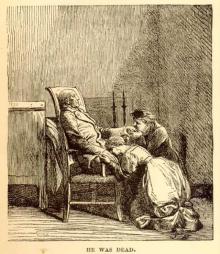
The complete novels of v.., p.406
The Complete Novels of Victor Hugo,
p.406


And at the same time a head appeared from a hole ia the ruins.
Then another face appeared in another place.
They were two peasants, who were hiding; the only ones who had survived.
The familiar voice of the caimand had reassured them, and brought them out of the nook where they were crouching.
They came up to Tellmarch still all of a tremble.
Tellmarch could have screamed, but he was unable to speak: such are deep emotions.
He pointed to the woman stretched out at his feet.
"Is she still alive?" said one of the peasants.
Tellmarch nodded assent.
"Is the other woman alive?" asked the other peasant.
Tellmarch shook his head.
The peasant who appeared first added,—
"All the others are dead, are they not? I saw it all. I was in my cellar. How one thanks God in times like these for not having a family! My house was burned. Lord Jesus! they have killed them all. This woman had children. Three children, all little things! The children cried: "Mother!" The mother cried: "My children!" They killed the mother and carried away the children. I saw it all, my God! my God! my God! Those who massacred them all have gone. They were satisfied. They took away the little ones and killed the mother. But she is not dead, is she; she is not dead? Tell me, caimand, do you believe you can save her? Do you want us to help you carry her to your carnichot?"
Tellmarch nodded assent.
The woods touched the farm. They quickly fashioned a litter out of leaves and brakes. They placed the woman, still motionless, on the litter and started to go through the thicket, the two peasants carrying the litter, one at her head, the other at her feet, while Tellmarch held the woman's arm, and felt her pulse.
As they went along, the two peasants talked, and, over the bleeding woman, whose pale face was lighted up by the moon, they gave utterance to exclamations of dismay.
"All killed!"
"Everything burned!"
"Ah, Lord God! Is this the way it is going to be now?"
"It was that tall old man who wanted it done."
"Yes, he gave the orders."
"I did not see him when they were shooting. Was he there?"
"No, he had gone. But it is all the same: it was all done by his order."
"Then he was the one who did it all."
"He said: 'Kill! Burn! No quarter!'"
"He is a marquis."
"Yes, for he is our marquis."
"What do they call him?"
"He is Monsieur de Lantenac."
Tellmarch raised his eyes towards heaven first, and muttered between his teeth,—
"If I had known it!"
PART SECOND— IN PARIS.
BOOK FIRST.—CIMOURDAIN.
CHAPTER I.
THE STREETS OF PARIS AT THIS PERIOD.
The people lived in public, they ate from tables spread in front of their doors, the women sat on church steps making lint and singing the Marseillaise; Pare Monceaux and the Luxembourg gardens were parade grounds; there were smiths' shops in full blast at every crossing; they made guns under the eyes of the passers-by, who applauded them; this was the word in everybody's mouth: "Patience, we are in the midst of revolution." The people smiled heroically. They went to the play as they did in Athens during the Peloponnesian War; there were notices posted at the corners of the streets: "The Siege of Thionville." "The Mother of a Family Rescued from the Flames."
"The Club of Sans Souci."
"The Oldest of the Popes Joan."
"The Philosopher-Soldiers."
"The Art of Loving in the Village."
The Germans were at the gates; it was rumored that the king of Prussia had engaged boxes at the opera. Everything was frightful and nobody was frightened. The mysterious law against the suspected, Merlin de Donai's crime, made the guillotine threaten the heads of all. A denounced lawyer, named Seran, sat by his window, in dressing-gown and slippers and played the flute while waiting to be arrested.
Nobody seemed to have time enough. Everybody was in haste. Not a hat without a cockade. The women said: The red cap is becoming to us. Paris seemed to be full of removals. The bric-à-brac shops were encumbered with crowns, mitres, sceptres of gilded wood and decorated with fleurs-de-lis, the relics of royal houses: the destruction of the monarchy was in progress. In old-clothes shops there were copes and rochets to be had for the asking. At the Porcherons' and at Ramponneau's, men decked out in surplices and stoles, mounted on asses, caparisoned with chasubles, had wine from the public-house poured into a cathedral ciboria. In Rue Saint-Jacques, barefooted street-pavers stopped a pedler's cart with boots and shoes to sell, clubbed together, and bought fifteen pairs of shoes to send to the Convention for our soldiers.
Busts of Franklin, Rousseau, Brutus, and it must be added, of Marat, were everywhere; underneath one of these busts of Marat, in Rue Cloche-Perce, was hung up under glass, in a black wooden frame, a speech against Malouet, with testimony in support of it and these two lines on the margin:
"These details were given me by Sylvian Bailly's mistress, a good patriot who was kindly disposed toward me. Signed: Marat."
In the Place du Palais-Royal, the inscription on the fountain: Quantos effundit in usus! was covered over with two great pictures painted in distemper, one representing Cahier de Gerville denouncing the rallying cry of the "Chiffonistes" of Aries to the National Assembly the other, Louis XVI., brought back from Varennes in his royal coach, and under this coach a plank fastened by ropes, on each end of which was a grenadier with fixed bayonet.
Few large shops were open; haberdashers' and toy shops on wheels were dragged about by women, and were lighted with candles, the tallow dripping over the goods; stalls in the open air were kept by ex-nuns in blonde wigs; one stocking-mender, darning stockings in a stall, was a countess: another seamstress was a marchioness: Madame de Bouffiers lived in a garret from which she could see her own mansion. Street criers went about, offering newspapers. Those who wore cravats hiding their chins were called "écrouelleux,"—scrofulous. Strolling singers swarmed. The crowd hooted Pitou, the royalist song-writer, formerly so popular, because he had been imprisoned twenty-two times, and was brought before the revolutionary tribunal for having slapped his hindquarters in pronouncing the word civisme; seeing that his head was in danger, he exclaimed: "But it is the opposite of my head, which is guilty!" this made the judges laugh, and saved him. This same Pitou made fun of the fashion for Greek and Latin names; his favorite song was about a cobbler named "Cujus," and whose wife he called " Cujusdam."
They made revolutionary songs and dances; they no longer said gentleman and lady, but citizen and citizeness. They danced in ruined cloisters, with church lamps on the altar, with two sticks crossed and bearing four candles under the arched roof, and tombs beneath their feet.
They wore blue tyrant jackets. They had "liberty cap" shirt pins made of red, white, and blue stones. Rue Richelieu was called the Street of the Law; the Faubourg Saint-Antoine, was called the Faubourg of Glory; there was a statue of Nature in the Place de la Bastille.
Certain well-known characters were pointed out: Chatelet, Didier, Nicolas, and Garnier-Delaunay, who stood guard at Duplay the carpenter's door; Voullaut, who never missed a guillotine day, and followed the wagons carrying the condemned, and who called it, "going to the red mass"; Montflabert,a revolutionary juror, and a marquis, who called himself "Dix-Août" (tenth of August.)
People watched the pupils of the Military School as they passed by; they were termed by the decree of the Convention "aspirants to the School of Mars," and by the people, "Robespierre's pages."
The people read the proclamations of Fréron, denouncing those suspected of the crime of "negotiantism." Young swells collected at the door of the mayoralty, to scoff at civil marriages, placing themselves in the way of the bride and bridegroom and saying: "married civilly." At the Invalides the statues of saints and kings had on Phrygian caps. They played cards on the curbstones at the crossings; playing-cards, too, were in a state of revolution; kings were replaced by genii; queens, by the Goddess of Liberty; knaves, by Equality personified; and aces, by characters representing Law.
They tilled the public gardens; they ploughed up the gardens of the Tuileries. With all this, especially among the conquered parties, was mingled a strange, haughty weariness of life; a man wrote to Fouquier-Tinville,—
"Have the kindness to release me from life. Here is my address." Champcenetz was arrested for having cried out in full sight of the Palais-Royal: "When will the revolution of Turkey be? I want to see the republic à la Porte. "
Newspapers were everywhere. Wig-makers curled women's wigs in public, while the master read the Moniteur aloud; others, surrounded by a crowd, made comments, with vehement gesticulations, on the journal Entendons-nous, belonging to Dubois-Crancé, or the Trompéte du Père Belle-rose. Sometimes, barbers were also pork-butchers; and hams and chitterlings might be seen hanging beside a dummy with golden hair; Merchants sold wines of the emigrés on the public streets; one merchant proclaimed wines of fifty-two sorts; others sold second-hand harp-shaped clocks, and duchesse sofas; one wig-maker had this for a sign: "I shave the clergy, comb the hair of the nobility, accommodate the Third Estate."
"People went to have their fortunes told by Martin, number 173 Rue d'Anjou, formerly Rue Dauphine. There was lack of bread, there was lack of coal, there was lack of soap; numbers of milch cows might be seen passing along as they came from the provinces. At la Vallée, lamb sold for fifteen francs a pound. An order of the Commune assigned a pound of meat to each person every ten days. The people formed in line in front of the shops; one of these lines has become famous; it reached from the door of a grocer's shop in Rue du Petit-Carreau to the middle of Rue Montorgueil. Forming the line, was called "holding the cord" on account of a long rope which those in file held in their hands one behind another. The women were brave and sweet in their misery. They spent whole nights awaiting their turn to enter the bakers' shops. Expedients were used with success during the revolution; this universal distress was alleviated by two perilous means, the assignat and the maximum; the assignat was the lever, the maximum the fulcrum. This empiricism was the saving of France. The enemy, both in Coblentz and in London, gambled in assignats.
Girls went about selling lavender water, garters, and braids of hair, and dabbling in stocks. On the Perron, in Rue Vivienne, there were stockbrokers with dirty shoes, greasy hair, and fur capes trimmed with fox tails, and magoiets from Rue de Valois, in polished boots, toothpicks in their mouths, shaggy hats on their heads, to whom the girls spoke familiarly. The people went in pursuit of them as they did of the thieves, whom the royalists called "active citizens." Beyond this, there was very little theft. Cruel destitution, stoical integrity. The barefooted and the starving, with eyes solemnly cast down, passed by the windows of the jewelry shops in the Palais Egalité. While the Section Antoine was searching the house of Beaumarchais, a woman picked a flower in the garden; the people boxed her ears. Wood cost four hundred francs in silver, a cord; people could be seen in the streets sawing up their beds for wood; in winter-time, the fountains were frozen: two pails of water cost twenty sous; everybody turned water-carrier. A Louis d'or was worth three thousand, nine hundred and fifty francs. A ride in a hackney-coach cost six hundred francs. After using a hackney-coach for a day this conversation was overheard:—
"Coachman, how much do I owe you?"
"Six thousand francs."
A greengrocer woman made twenty thousand francs a day. A beggar said: "For the sake of charity, assist me! I need two hundred and thirty livres to pay for my shoes."
At the entrance to the bridges might be seen colossal figures sculptured and painted by David, which Mercier insulted by calling them: "Enormous wooden puppets." These enormous figures represented Federalism and Coalition overthrown. No faltering among this people. The gloomy joy of having made an end of thrones. Volunteers abounded, exposing their breasts. Each street had its battalion. The flags of the districts came and went, each with its own device. On the flag of the district of the Capucins was this inscription: "Nobody shall shave us." On another: "No more nobility except, in the heart." On every wall there were placards large, small, white, yellow, green, red, printed, and written, with this exclamation: "Long live the Republic!" The little children lisped: " Ca ira! "
These little children were to be the great future.
Later on, the tragic city was succeeded by the cynical city; the streets of had two very distinct aspects during the revolution, before and after the ninth Thermidor; the Paris of Saint-Just gave place to the Paris of Tallien; and, these are the continual antitheses of God; immediately after Sinai, la Courtille appeared.
An outburst of public madness now appeared. It was a repetition of what had been seen eighty years before. The people left Louis XIV. as they left Robespierre, with a great need for breath; hence the Regency which opens the century and the Directory with which it closes. Two saturnalia after two reigns of terror. France fled from the puritan cloister as from the monarchical cloister, with the joyfulness of an escaped nation.
After the ninth Thermidor, Paris was gay, insanely gay. An unhealthy joy burst forth. The frenzy of dying was succeeded by the frenzy of living, and grandeur outdid itself. They had a Trimalcion, called " Grimod de la Regnière; " they had the " Almanach des Gourmands. " They dined to the sound of trumpets in the entresols of the Palais Royal, with orchestras of women beating the drum and sounding the trumpet.
The "rigodooner" reigned, bow in hand; they took supper "in oriental fashion" at Méot's house, surrounded with perfumes. The artist Boze, painted his daughters, charming, innocent girls of sixteen years, "en guillotines," that is to say in low-necked dresses with red underwaists.
The boisterous dances in the ruined churches were followed by the balls of Ruggieri, of Luquet Wenzel, of Mauduit, of la Montansier; serious women making lint, were followed by sultanas, savages, nymphs; barefooted soldiers covered with blood, mud, and dust, were followed by barefooted women decorated with diamonds; dishonesty appeared simultaneously with immodesty; it had its purveyors in the upper classes, and associations of thieves in the lower classes; a swarm of pickpockets filled Paris, and everybody was obliged to keep watch over his "luc," that was his pocketbook; it was one of the pastimes to go to the Place-du-Palais-de-Justice to see the women thieves on the stool; they were obliged to fasten their petticoats securely.
As people came from the theatres, street-boys offered cabs, saying "citizen and citizeness there is room for two; they no longer cried "The old Franciscan" and the "Friend of the People," but in their places "Punch's Letter" and "The Rogues' Petition;" the Marquis de Sade presided over the Section des Piques, in Place Vendôme.
The reaction was jocund and ferocious; the "Dragons of Liberty" of '92 came to life again under the name of "Chevaliers of the Dagger." At the same time, there appeared in the booths the type, Jocrisse. They had "The Wonder," and besides these marvellous women the "Inconceivables," they swore by the " paole victimé " and the " paole verte; " they retrograded from Mirabeau to Bobèche.
Thus Paris sways to and fro; it is the enormous pendulum of civilization; it touches alternately one pole and then the other, Thermopylæ and Gomorrha. After '93, the, Revolution passed through a singular occultation, the century seemed to forget to finish what it had begun, some strange orgy was interposed, took the foreground, pushed the frightful apocalypse in to the background, veiled the inordinate vision, and burst into a laugh after the fright; tragedy disappeared in parody, and on the edge of the horizon, carnival smoke mysteriously effaced Medusa.
But in '93, where we now are, the streets of Paris still had all the grandiose and wild appearance of the beginning. They had their orators; there was Varlet, who went about in a booth on wheels, from the top of which he harangued to the passers-by; they had their heroes, one of which was called "the captain of the iron-tipped sticks." They had their favorites—Guffroy, author of the pamphlet "Rougiff." Some of these popular favorites were mischievous; others were healthful. One among them all was honest and fatal; he was Cimourdain.
CHAPTER II.
CIMOURDAIN.
Cimourdain was a pure-minded but gloomy man. He had "the absolute" within him. He had been a priest, which is a solemn thing. Man may have, like the sky, a dark and impenetrable serenity; that something should have caused night to fall in his soul is all that is required. Priesthood had been the cause of night within Cimourdain. Once a priest, always a priest.
Whatever causes night in our souls may leave stars. Cimourdain was full of virtues and truth, but they shine out of a dark background.
His history was quickly told. He had been a village priest and a tutor in a great family; then a little inheritance fell to him, and he became free.
He was, above all, an obstinate man. He made use of meditation as one does of pincers, he believed that he had no right to leave an idea till he had thought it out to the end; he thought desperately. He knew all the languages of Europe and others somewhat; this man studied ceaselessly, which helped him to keep his chastity, but there is nothing more dangerous than such repression.
As a priest he had, though pride, chance, or loftiness of soul, kept his vows; but he had not been able to keep his belief. Science had destroyed his faith; dogma had vanished in him. Then examining himself, he had felt as though he were mutilated, and being unable to change himself as a priest, he tried to make himself over as a man, but in an austere fashion; he had been deprived of a family, he adopted his country; he had been refused a wife, he espoused humanity. Such vast repletion is at bottom emptiness.
His parents, peasants, in making a priest, of him, had wished to remove him from the people; he had come back to the people.
And he had returned with passionate fondness. He regarded their suffering with a fierce tenderness. First a priest, then philosopher, and lastly, athlete. Louis XV. was still alive when Cimourdain began to feel dimly that he was a republican. Of what republic? The republic of Plato, perhaps, and perhaps also of the republic of Draco.