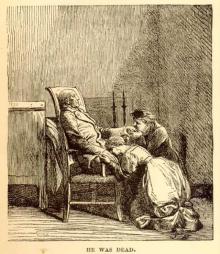
The complete novels of v.., p.28
The Complete Novels of Victor Hugo,
p.28


"Do you speak the truth?" cried the count, his stern, dark face beaming.
“Mr. Frederic declares that it is so, and he told the countess the same story."
The count rose and paced the room, rubbing his hands.
“Musdœmon, dear Musdœmon, but one more effort, and our end is gained. The young shoot is blasted. We have only to uproot the parent tree. Have you any other good news? "
“Dispolsen has been murdered."
The count's features brightened.
“Ah, you see that we advance from victory to victory. Have we his papers? Above all, have we that iron casket? "
“I regret to inform your Grace that the murder was not committed by our people. He was killed and robbed upon Urchtal Sands, and the deed is attributed to Hans of Iceland."
“Hans of Iceland! " repeated his master, his brow again clouding. " What! that famous brigand whom we meant to put in charge of our rebellion? "
“The same, noble Count; and I fear, from what I can gather, that it will be no easy task to find him. At any rate, I have secured a leader who will take his name, and can replace him if necessary, a wild mountaineer, tall and strong as an oak, fierce and bold as a wolf in a wilderness of snow, this terrible giant must surely look much like the real Hans of Iceland."
“Then Hans of Iceland is tall? " inquired the count.
“That is the general opinion, your Grace."
“I cannot but admire, my dear Musdœmon, the art with which you lay your plans. When is the insurrection to break out? "
“Oh, very soon, your Grace; perhaps it is on foot even now. The royal protectorate has long been odious to the miners; they all grasped with joy at the idea of revolt. The movement will begin at Guldbrandsdal, extend to Sund-Moer, and reach Kongsberg. Two thousand miners can be raised in three days. The rebellion will be kindled in Schumacker's name; our emissaries use no other. The reserve forces in the South and the garrisons at Throndhjem and Skongen can be called out, and you will be here on the spot most opportunely to put down the rebellion, a fresh and significant service in the eyes of the king, and to rid him of this Schumacker, the source of such anxiety to the throne. Upon these firm foundations will rise the structure to be crowned by the marriage of our noble lady Ulrica and Baron Thorwick."
A private interview between two scoundrels is never long, because all that is human in their souls quickly takes alarm at the infernal qualities revealed. When two depraved spirits mutually display their naked vices, each is disgusted by the other's iniquity. Crime itself revolts at crime; and two evil-doers conversing, with all the cynicism of intimacy, of their pleasures and their interests, are like a fearful mirror, each reflecting the other's monstrous features. Their own degradation mortifies them when seen in another, their own pride confounds them, their own nothingness alarms them; and they cannot fly from themselves or disavow their own portrait in their fellowman; for each odious harmony, each frightful coincidence, each hideous parallel finds within them an untiring voice to denounce them in their ever-wearied ear. However secret may be their intercourse, it has always two intolerable witnesses, God, whom they cannot see, and conscience, which they feel.
His confidential talks with Musdœmon distressed the count the more because the latter always unhesitatingly imputed to his master a good share of the crimes committed or about to be committed. Many courtiers think it wise to save great men from the appearance of wrong doing; they assume the responsibility of evil, and often spare their patron's blushes by allowing him to feign resistance to advantageous crime. Musdœmon, by a refinement of skill, pursued the contrary course. He wished it to seem that he seldom advised, and always obeyed. He knew his master's soul as familiarly as that master knew his heart; therefore he never compromised himself without compromising the count. There was no head, save that of Schumacker, that the count would have been so glad to see fall; Musdœmon knew this as well as if his master had told him, and his master knew that he knew it.
The count had learned all that he wished to learn; he was satisfied; he was now eager to dismiss Musdœmon.
“Musdœmon," said he, with a gracious smile, " you are the most faithful and most zealous of all my servants. All goes well, and I owe it to your devotion. I make you private secretary to the chancellor's office."
Musdœmon bowed low. " Nor is that all," added the count; " I will ask for you, for the third time, the Order of the Dannebrog. But I still fear that your birth, your humble relations.
Musdœmon blushed, turned pale, and hid his change of color by another bow.
"Come," said the count, offering him his hand to kiss, " come, Mr. Private Secretary, draw up your pluecat! It may chance to find the king in gracious mood."
“Whether his Majesty grant my petition or not, your Grace's kindness overwhelms me."
“Make haste, my dear fellow, for I am anxious to be off. We must try to get some exact information about this Hans."
Musdœmon, with a third bow, opened the door.
“Ah! " said the count, " I forgot. In your new position as private secretary, you may write to the chancellor's office and order them to dismiss this mayor of Loevig, who compromises the dignity of his position in the eyes of the villagers by his servility to strangers whom he does not know."
CHAPTER XIV GREEK MEETS GREEK.
The monk at midnight visiting the cross,
The knight taming his fiery steed,
The man who with dread sound of trumpet dies.
And he who dies with peaceful voice of prayer,
Are all the objects of Thy care, lavished alike
On every pious soul, whether he tonsure wear or helm.
Hymn to Saint Anselm.
Yes, master, we really owe a pilgrimage to Lynrass grotto. "Who would have thought that the hermit, whom I cursed as if he had been the Devil, would prove to be our guardian angel, and that the sword which seemed to threaten our very lives would serve for a bridge to take us over the abyss? "
It was in these somewhat grotesquely figurative terms that Benignus Spiagudry poured into Ordener's ears his joy, his admiration, and his gratitude for the mysterious monk. As will readily be supposed, our two travellers Had left the Cursed Tower; nay, when we again encounter them, they have even left the village of Vygla far behind them, and are painfully pursuing a steep path, interrupted by frequent pools or blocked by huge stones, which transient torrents caused by storms had washed down from the wet, sticky soil. Day had not yet dawned; but the bushes growing above the rocks on either side of the road stood out against the clear sky like dark silhouettes, and various objects, although still colorless, gradually assumed form in the dim, dull light which daybreak in the North filters through the chill fogs of early morning.
Ordener was silent, for he had yielded to that somnolent state sometimes permitted by the mechanical motion of walking. He had not slept since the night before, when he allowed himself to rest in a fishing-boat moored in Throndhjem harbor for the few hours intervening between his departure from the Spladgest and his arrival at Munkholm. Accordingly, while his body moved toward Skongen his spirit had flown back to Throndhjem Fjord, to that gloomy prison and those melancholy towers which contained the only being on earth to whom he attached any idea of hope and happiness.
Awake, thoughts of his Ethel filled his mind; asleep, her memory became a fanciful image which irradiated all his dreams. In this second life of sleep, where for a time the soul alone exists, and the physical being with all its material ills seems to disappear, he saw the beloved maiden, no more beautiful, no purer, than in reality, but happier, freer, more wholly his own. Only, upon the road to Skongen, the oblivion of his body, the torpor of his senses, could not be complete; for from time to time a bog, a stone, the branch of a tree, impeding his progress, recalled him suddenly from the ideal to the real. He would then raise his head, half open his drowsy eyes, and regret the fall from bright celestial wanderings to his painful earthly journey, where nothing could compensate for his lost illusions, save that he felt close to his heart the ringlet which was his until Ethel herself should be his own. Then this memory revived the charming dream image, and he gently relapsed, not into slumber, but into a vague, persistent revery.
“Master," repeated Spiagudry, in a louder tone, which, combined with a blow from the trunk of a tree, aroused Ordener, " fear nothing. The bowmen turned to the right with the hermit when they left the tower, and we are far enough away from them to venture to speak. It is true that silence was most prudent until now."
“Indeed," said Ordener, yawning, " you push your prudence to extremes. It is at least three hours since we left the tower and the bowmen behind us."
“That is true, sir; but prudence never does any harm. Only think, if I had declared myself when the chief of that infernal troop asked for Beniguus Spiagudry in a voice like that of Saturn calling for his new-born son that he might devour him! Suppose, even, I had not taken refuge in a prudent silence at that awful moment, where should I be now, noble master? "
“Faith, old man, I fancy that at that moment nothing, not even pincers, could have drawn your name from you."
“Was I wrong, master? If I had spoken, the monk, may Saint Hospitius, and Saint Usbald the Solitary, bless him! the monk would have had no opportunity to ask the captain of the archers whether his men did not belong to the Munkholm regiment; a trifling question, merely asked in order to gain time. Did you notice, sir, after that stupid archer answered ' Yes,' with what a peculiar smile the monk requested him to follow him, saying that he knew the hiding-place of the fugitive, Benignus Spiagudry? "
Here the keeper paused for a moment, as if to make a fresh start; for he suddenly resumed, in a voice quivering with emotion. " A good priest, a worthy and upright anchorite, practising the principles of Christian virtue and evangelic charity; and I was alarmed at his mere outward appearance, forbidding enough, truly; but what a beautiful soul lies beneath! Did you notice too, noble master, that there was something peculiar in the tone with which he said to me, ' We shall meet again! ' as he led away the archers? At any other time that tone would have alarmed me; but it is not the pious and excellent hermit's fault. Solitude undoubtedly gives that strange intonation; for I know, sir," here the voice of Benignus sank lower, "I know another hermit, that dreadful fellow who But no; out of respect for the venerable hermit of Lynrass I will not make so odious a comparison. Neither was there anything peculiar about his gloves; it is quite cold enough to wear them; and his salty beverage does not surprise me either. Catholic anchorites often follow singular examples; the very same thing, master, is alluded to in this line by the famous Urensius, the monk of Mount Caucasus:-
' Rivos despiciens, marls uudain potat amaram.'
"Why didn't I think of that verse while I was in that confounded ruin at Vygla? A little better memory would have spared me much needless alarm. To be sure, it is not easy, is it, sir, to collect your thoughts in such a den, seated at the table of a hangman, a hangman, a creature given over to universal scorn and execration, who only differs from an assassin in the frequency and impunity of his murders; whose heart to all the atrocity of the most awful brigands unites the cowardice of which at least their daring crimes do not admit; a being who offers food and drink with the same hand that wields the instruments of torture, and crushes the bones of his miserable victims between the planks of the rack! Think of breathing the same air with a hangman! And the vilest beggar, if polluted by his loathsome touch, would cast aside with horror the last rags which protected his nakedness and his disease from the wintry blast! And the chancellor, after sealing his commission, flings the paper under the table in token of his malediction and his disgust! And in France, when the hangman dies in his turn, the provost's assistants would rather pay a fine of forty pounds than succeed him '. And at Pesth, when Churchill was condemned to die, and they offered to pardon him if he would turn executioner, he preferred death to such a trade. Is it not still notorious, noble sir, that Turmeryn, bishop of Maastricht, ordered a church to be purified because the hangman had entered it; and that Czarina Petrowna washed her face whenever she witnessed an execution? You know also that the kings of France, to honor warriors, permit them to be punished by their comrades, so that these brave men, even if they be criminals, may not be made infamous by contact with the hangman. And finally, which is decisive, in the ' Descent of Saint George into Hell,' by the learned Melasius Iturham, does not Charon give the robber, Robin Hood, precedence over the hangman, Philip Crass? Truly, master, if ever I attain to power, which God alone can foresee, I shall put down hangmen, and restore the ancient custom and the ancient tariff. For the murder of a prince a man shall pay, as in 1150, fourteen hundred and forty doublecrown pieces; for the murder of a count, fourteen hundred and forty plain crowns; for that of a baron, fourteen hundred and forty half-crowns; the killing of a mere noble shall be rated at fourteen hundred and forty escalins; and that of a citizen "-
“Don't I hear the tread of a horse coming toward us? " interrupted Ordener.
They looked back, and, as day had dawned during Spiagudry's long soliloquy, they could distinguish, a hundred paces behind them, a man dressed in black waving one hand to them, and with the other urging on one of those small dingy white ponies so often seen, either wild or domesticated, in the lower mountain ranges of Norway.
“For mercy's sake, master," said the timid keeper, " let us hasten; that black fellow looks to me just like an archer! "
“What, old raau; we are two, and we should fly before a single man! "
“Alas! twenty sparrows fly before an owl. What glory is there in waiting for an officer of the law? "
“And wlio tells you that this is one? " rejoined Ordener, whose eyes were not blinded by fear. " Keep up your courage, my valiant guide; I recognize this traveller. Let us wait for him."
The keeper was forced to submit. A moment later the horseman came up with them, and Spiagudry ceased to tremble when he saw the grave, calm face of the chaplain, Athanasius Munder.
The latter greeted them with a smile, and reined in his steed, saying in an almost breathless voice, " My dear children, it is for your sake that I retrace my steps; and the Lord will surely not permit my absence, prolonged with a charitable intent, to injure those who sorely need my presence.''
“Sir minister," answered Ordener, " we shall be happy to aid you in any way we can."
“On the contrary, it is I, noble young man, who desire to serve you. Will you deign to tell me the object of your journey? "
“Reverend sir, I cannot."
“All I ask, my son, is that your refusal may proceed from inability, and not from distrust. If not, I am indeed unhappy! Unhappy is he whom the good man distrusts, even if he have seen him but once! "
The priest's modesty and unction touched Ordener deeply.
“All that I can tell you, Father, is that we are bound to the mountains of the North."
“So I thought, my son, and that is why I followed you. There are bands of roving hunters and miners in those mountains who might injure travellers."
"What then?"
"Well, I know that it is useless to dissuade a noble young man in search of adventure; but the esteem I feel for you inspires me with another plan for helping you. The unfortunate counterfeiter to whom I bore the last consolations of religion yesterday was a miner. Just before he died he gave me a paper inscribed with his name, saying that this passport would protect me from all danger if I ever had to travel among those mountains. Alas! what can it avail a poor priest who must live and die among prisoners, and who, moreover, inter castra latronum, should seek no other defence than patience and prayer, the only weapons of God! I did not decline the pass, because we should never distress by refusal the heart of one who in a few minutes more will have nothing to receive or to give on earth. The good God deigned to inspire rne, for now I can offer you this parchment, that it may go with you in all the perils of your journey, and that the gift of the dying man may benefit the traveller."
Ordener accepted the old priest's gift with emotion.
“Sir Chaplain," said he, " God grant that your prayer may be heard! Thank you.' But," he added, laying his hand on his sword, " I already carry my passport at my side."
"Young man," said the priest, "that poor parchment may perhaps protect you better than your steel blade. The gaze of a penitent man is more potent than the archangel's sword. Farewell! My prisoners await me. Pray sometimes for them and me."
"Holy priest," rejoined Ordener, with a smile, "I told you that your prisoners should be pardoned, and they shall be."
“Oh, do not speak with such assurance, my son! Do not tempt the Lord! No man can know what passes in the mind of another, and you cannot tell what the viceroy's son may decide to do. Perhaps, alas! he will never condescend to admit a humble chaplain to his presence. Farewell, my son; may your journey be blessed, and may you sometimes remember the poor priest and pray for his unhappy prisoners."
CHAPTER XV THE CHAPLAIN'S FREE PASS.
Welcome, Hugo; tell me, did you ever see so terrible a storm?
Maturin: Bertram.
In a room communicating with the apartments of the Governor of Throndhjem, three of his Excellency's secretaries sat at a table loaded with parchments, papers, inkstands, and seals, a fourth chair, left vacant, showing that one of the scribes was late. They had been silently writing and thinking for some time, when one of them exclaimed: " Did you know, Wapherney, that the poor librarian, Foxtipp, is to be dismissed by the bishop, owing to the letter which you wrote recommending Dr. Anglyvius's petition to his favorable notice? "
“What nonsense are you talking, Richard? " hastily inquired the secretary to whom Richard had not spoken. " Wapherney could not have written in favor of Anglyvius, for the fellow's petition disgusted the general when I read it to him."
“So you told me," answered Wapherney; " but I found the word tribuatur written on the petition in his Excellency's own hand."