Henry iv parts one and t.., p.1
Henry IV Parts One and Two,
p.1
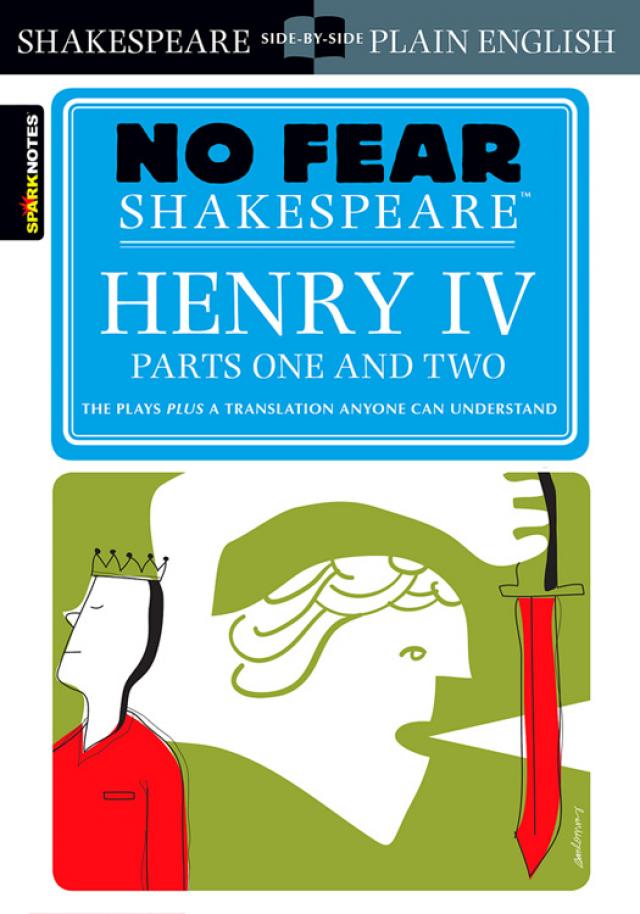


NO FEAR SHAKESPEARE
As You Like It
The Comedy of Errors
Hamlet
Henry IV, Parts One and Two
Henry V
Julius Caesar
King Lear
Macbeth
The Merchant of Venice
A Midsummer Night’s Dream
Much Ado About Nothing
Othello
Richard III
Romeo and Juliet
Sonnets
The Taming of the Shrew
The Tempest
Twelfth Night
NO FEAR SHAKESPEARE
HENRY IV,
PARTS
ONE AND
TWO
Copyright © 2005 by Spark Publishing
All rights reserved. No part of this publication may be reproduced, stored in a retrieval system, or transmitted, in any form or by any means, electronic, mechanical, photocopying, recording, or otherwise, without prior written permission from the publisher.
SPARKNOTES is a registered trademark of SparkNotes LLC
The original text and translation for this edition were prepared by John Crowther.
Spark Publishing
120 Fifth Avenue
New York, NY 10011
www.sparknotes.com
ISBN: 978-1-4114-7921-0
Library of Congress Cataloging-in-Publication Data
Shakespeare, William, 1564–1616.
[King Henry IV]
Henry IV / edited by John Crowther.
p. cm. — (No fear Shakespeare)
Summary: Presents the original text of Shakespeare’s play side by side with a modern version, with marginal notes and explanations and full descriptions of each character.
ISBN 1-4114-0436-X (alk. paper)
1. Henry IV, King of England, 1367–1413—Drama. 2. Great Britain—History—Henry IV, 1399–1413—Drama. I. Crowther, John (John C.) II. Title. III. Series.
PR2809.A2C76 2005
822.3′3—dc22
2005006780
There’s matter in these sighs, these profound heaves.
You must translate: ’tis fit we understand them.
(Hamlet, 4.1.1–2)
FEAR
NOT.
Have you ever found yourself looking at a Shakespeare play, then down at the footnotes, then back at the play, and still not understanding? You know what the individual words mean, but they don’t add up. SparkNotes’ No Fear Shakespeare will help you break through all that. Put the pieces together with our easy-to-read translations. Soon you’ll be reading Shakespeare’s own words fearlessly—and actually enjoying it.
No Fear Shakespeare pairs Shakespeare’s language with translations into modern English—the kind of English people actually speak today. When Shakespeare’s words make your head spin, our translations will help you sort out what’s happening, who’s saying what, and why.
HENRY IV,
PART ONE
Characters
ACT ONE
Scene 1
Scene 2
Scene 3
ACT TWO
Scene 1
Scene 2
Scene 3
Scene 4
ACT THREE
Scene 1
Scene 2
Scene 3
ACT FOUR
Scene 1
Scene 2
Scene 3
Scene 4
ACT FIVE
Scene 1
Scene 2
Scene 3
Scene 4
Scene 5
HENRY IV,
PART TWO
Characters
Prologue
ACT ONE
Scene 1
Scene 2
Scene 3
ACT TWO
Scene 1
Scene 2
Scene 3
Scene 4
ACT THREE
Scene 1
Scene 2
ACT FOUR
Scene 1
Scene 2
Scene 3
ACT FIVE
Scene 1
Scene 2
Scene 3
Scene 4
Scene 5
Epilogue
NO FEAR SHAKESPEARE
HENRY IV,
PART ONE
CHARACTERS
King Henry IV—The ruling King of England; also known as Henry Bolingbroke. When the play opens, King Henry is anxious about the legitimacy and stability of his position. He nurses guilty feelings about having deposed the former King, Richard II, through a civil war (depicted in Shakespeare’s Richard II). In addition, his reign has not brought an end to internal strife in England, which has now erupted into an even larger, more violent civil war. Finally, the King is vexed by the irresponsible antics of his eldest son, Prince Henry. Regal, proud, and somewhat aloof, King Henry is not the protagonist of the play that bears his name, but he is its historical focus. He gives the play a center of power, though his actions and emotions are largely secondary to the plot.
Henry, Prince of Wales—King Henry IV’s son, who will eventually become King Henry V. Prince Henry is sometimes called Harry Monmouth, after the town he was born in, and he is known as Hal to his friends in Eastcheap. Though Prince Henry freely associates with highwaymen, robbers, and whores, he has secret plans to transform himself into a noble prince, and his regal qualities emerge as the play unfolds. Complex and shrewd, Prince Henry is the closest character this play has to a protagonist. However, exactly how we should perceive this simultaneously deceitful and heroic young Prince remains an unresolved question.
Hotspur—The son and heir of the Earl of Northumberland and the nephew of the Earl of Worcester. Though Hotspur’s real name is Henry Percy, he is usually referred to by his nickname, which he earned because of his fierceness in battle and hastiness of action. He is a member of the powerful Percy family of the North, which helped bring King Henry IV to power in Richard II. When Henry IV, Part One opens, the Percy family feels that the new King has forgotten his debt to them. In Shakespeare’s account, Hotspur is the same age as Prince Harry and becomes his archrival. Quick-tempered and impatient, Hotspur is preoccupied with the idea of honor and glory, to the exclusion of all other qualities.
Sir John Falstaff—A fat, lecherous, dishonorable old knight between the ages of fifty and sixty-five. Falstaff spends most of his time in the taverns of Eastcheap, a sordid area of London, and seems to make his living as a thief, highwayman, and mooch. He acts as a kind of mentor to Prince Henry, instructing him in the practices of criminals and vagabonds, and is the only member of the Eastcheap gang who can match Henry’s sharp wit pun for pun. However, despite their repartee, there is an edge to Falstaff and Prince Henry’s relationship. Though Falstaff seems to have real affection for the young Prince, Prince Henry continually insults and pulls pranks on Falstaff, and at the end of Henry IV, Part Two he dismisses his old friend completely.
Earl of Westmoreland—A nobleman and military leader, and a close companion and valuable ally to King Henry IV.
Lord John of Lancaster—The younger son of King Henry, and the younger brother of Prince Henry. Lancaster proves himself wise and valiant in battle, despite his youth.
Sir Walter Blunt—A loyal and trusted ally of King Henry IV, and a valuable warrior.
Thomas Percy, Earl of Worcester—Hotspur’s uncle. Shrewd and manipulative, Worcester is the mastermind behind the Percy rebellion.
Henry Percy, Earl of Northumberland—Hotspur’s father. Northumberland conspires and raises troops on the Percy side, but he claims that he is sick before the Battle of Shrewsbury and does not actually bring his troops into the fray.
Edmund Mortimer, called the Earl of March—A brave warrior, and the brother of Hotspur’s wife, Lady Percy. At the beginning of the play, Mortimer has been captured by the Welsh rebel Owen Glendower, and has converted to the rebel cause and married Glendower’s daughter. Mortimer has a strong claim to the English throne through Richard II, who was deposed by King Henry IV.
Owen Glendower—The leader of the Welsh rebels and father of Lady Mortimer. Glendower joins with the Percys in their insurrection against King Henry. Well read, English-educated, and highly capable in battle, Glendower is also steeped in the traditional lore of Wales and claims to command great magic. He is mysterious and superstitious and sometimes acts according to prophecies and omens. Some editions refer to Glendower by his Welsh name, Owain Glyndwr.
Lady Percy—Hotspur’s wife. A feisty match for her hot-tempered husband, Lady Percy disapproves of Hotspur’s military plans.
Lady Mortimer—The daughter of Owen Glendower, and the new wife of Edmund Mortimer. Lady Mortimer only speaks Welsh, so she cannot fully communicate with her beloved husband.
Archibald, Earl of Douglas—The leader of the large Scottish faction rebelling against King Henry. Usually called simply “the Douglas” (a traditional way of referring to a Scottish clan chief), the deadly and fearless Douglas fights on the side of the Percys.
Sir Richard Vernon—A relative and ally of the Earl of Worcester.
The Archbishop of York—The Archbishop, whose given name is Richard Scroop. The Archbishop conspires on the side of the Percys, lending the rebellion his authority as a religious leader.
Ned Poins, Bardolph, and Peto—Criminals and highwaymen. Poins, Bardolph, and Peto are friends of Falstaff and Prince Henry, who drink with them at the Boar’s Head Tavern, assist them in highway robb
ery, and accompany them in war.
Gadshill—Another highwayman friend of Harry, Falstaff, and the rest. Gadshill seems to be nicknamed after the place on the London road—called Gad’s Hill—where he has set up many robberies.
Mistress Quickly—Hostess of the Boar’s Head Tavern, a seedy dive in Eastcheap, London, where Falstaff and his friends go to drink.
Francis—An assistant drawer, or tavern servant, at the Boar’s Head.
NO FEAR SHAKESPEARE
HENRY IV,
PART ONE
ACT ONE
SCENE 1
Original Text
Enter the KING, Lord John of LANCASTER, Earl of WESTMORELAND, with others
KING
So shaken as we are, so wan with care,
Find we a time for frighted peace to pant
And breathe short-winded accents of new broils
To be commenced in strands afar remote.
5
No more the thirsty entrance of this soil
Shall daub her lips with her own children’s blood.
Nor more shall trenching war channel her fields,
Nor bruise her flow’rets with the armed hoofs
Of hostile paces. Those opposèd eyes,
10
Which, like the meteors of a troubled heaven,
All of one nature, of one substance bred,
Did lately meet in the intestine shock
And furious close of civil butchery
Shall now, in mutual well-beseeming ranks,
15
March all one way and be no more opposed
Against acquaintance, kindred, and allies.
The edge of war, like an ill-sheathèd knife,
No more shall cut his master. Therefore, friends,
As far as to the sepulcher of Christ—
20
Whose soldier now, under whose blessed cross
We are impressèd and engaged to fight—
Forthwith a power of English shall we levy,
Whose arms were molded in their mothers’ womb
To chase these pagans in those holy fields
25
Over whose acres walked those blessèd feet
Which fourteen hundred years ago were nailed
For our advantage on the bitter cross.
But this our purpose now is twelve month old,
And bootless ’tis to tell you we will go.
30
Therefor we meet not now. Then let me hear
Of you, my gentle cousin Westmoreland,
What yesternight our council did decree
In forwarding this dear expedience.
WESTMORELAND
My liege, this haste was hot in question,
35
And many limits of the charge set down
But yesternight: when all athwart there came
A post from Wales loaden with heavy news,
Whose worst was that the noble Mortimer,
Leading the men of Herefordshire to fight
40
Against the irregular and wild Glendower,
Was by the rude hands of that Welshman taken,
A thousand of his people butcherèd,
Upon whose dead corpse there was such misuse,
Such beastly shameless transformation
45
By those Welshwomen done, as may not be
Without much shame retold or spoken of.
KING
It seems then that the tidings of this broil
Brake off our business for the Holy Land.
WESTMORELAND
This matched with other did, my gracious lord.
50
For more uneven and unwelcome news
Came from the north and thus it did import:
On Holy-rood Day, the gallant Hotspur there,
Young Harry Percy, and brave Archibald,
That ever valiant and approvèd Scot,
55
At Holmedon met, where they did spend
A sad and bloody hour—
As by discharge of their artillery
And shape of likelihood the news was told;
For he that brought them, in the very heat
60
And pride of their contention did take horse,
Uncertain of the issue any way.
KING
Here is a dear, a true-industrious friend,
Sir Walter Blunt, new lighted from his horse.
Stained with the variation of each soil
65
Betwixt that Holmedon and this seat of ours,
And he hath brought us smooth and welcome news.
The Earl of Douglas is discomfited;
Ten thousand bold Scots, two-and-twenty knights,
Balked in their own blood, did Sir Walter see
70
On Holmedon’s plains. Of prisoners Hotspur took
Mordake, Earl of Fife, and eldest son
To beaten Douglas, and the Earl of Atholl,
Of Murray, Angus, and Menteith.
And is not this an honorable spoil?
75
A gallant prize? Ha, cousin, is it not?
WESTMORELAND
In faith, it is a conquest for a prince to boast of.
KING
Yea, there thou mak’st me sad, and mak’st me sin
In envy that my Lord Northumberland
Should be the father to so blest a son,
80
A son who is the theme of Honor’s tongue,
Amongst a grove the very straightest plant,
Who is sweet Fortune’s minion and her pride;
Whilst I, by looking on the praise of him,
See riot and dishonor stain the brow
85
Of my young Harry. O, that it could be proved
That some night-tripping fairy had exchanged
In cradle-clothes our children where they lay,
And called mine “Percy,” his “Plantagenet”!
Then would I have his Harry, and he mine.
90
But let him from my thoughts. What think you, coz,
Of this young Percy’s pride? The prisoners,
Which he in this adventure hath surprised
To his own use he keeps, and sends me word
I shall have none but Mordake, Earl of Fife.
WESTMORELAND
95
This is his uncle’s teaching. This is Worcester,
Malevolent to you in all aspects,
Which makes him prune himself, and bristle up
The crest of youth against your dignity.
KING
But I have sent for him to answer this.
100
And for this cause awhile we must neglect
Our holy purpose to Jerusalem.
Cousin, on Wednesday next our council we
Will hold at Windsor. So inform the lords.
But come yourself with speed to us again,
105
For more is to be said and to be done
Than out of anger can be utterèd.
WESTMORELAND
I will, my liege.
Exeunt
ACT ONE
SCENE 1
Modern Text
The KING, Lord John of LANCASTER, the Earl of WESTMORELAND, and others enter.
KING
Despite how shaken and pale with worry we are, let’s take advantage of this moment of peace to catch our breath, and as we pant we’ll speak about the battles we’ll soon fight in foreign lands. England will no longer be wet with her own people’s blood. War will no longer damage her fields, and warhorses will no longer trample her flowers. The soldiers on either side of this vicious civil war were countrymen and brothers, as similar to one another as shooting stars. They may have clashed recently, but now they will march together in beautiful formation, no longer struggling against family and friend. War is like a mishandled knife: it can cut its owner, but it will no longer cut us. My friends, we are now soldiers for Christ, and we take his blessed cross as our battle flag. We’ll raise a new army of Englishmen and march all the way to the Holy Land. Our soldiers were born to chase non-believers from that holy ground touched by Jesus’ feet—feet which, fourteen hundred years ago, were nailed to the cross for our sins.
But that’s been my plan for a year now, so there’s no point in telling you all this again. That’s not the issue at hand. So tell me, my noble kinsman Westmoreland, what my royal advisors decided last night about this important undertaking.
WESTMORELAND
Your Highness, there was hot debate about this urgent mission, and many responsibilities had just been assigned when we were suddenly cut off by a messenger with bad news from Wales. The worst of it was that the noble Mortimer, who was leading the men of Herefordshire in battle against that barbarian Glendower, was captured. A thousand of his men have been butchered, their dead corpses desecrated by the Welsh women. The things they did were so horrible that I’m too ashamed to report them.