Complete works of robert.., p.205
Complete Works of Robert Louis Stevenson (Illustrated),
p.205


Joy that she should be so little hurt, and the love of her brave nature, supported me. I embraced her, I kissed the wound.
“And am I to be out of the kissing, me that never lost a chance?” says Alan; and putting me aside and taking Catriona by either shoulder, “My dear,” he said, “you’re a true daughter of Alpin. By all accounts, he was a very fine man, and he may weel be proud of you. If ever I was to get married, it’s the marrow of you I would be seeking for a mother to my sons. And I bear’s a king’s name and speak the truth.”
He said it with a serious heat of admiration that was honey to the girl, and through her, to me. It seemed to wipe us clean of all James More’s disgraces. And the next moment he was just himself again.
“And now by your leave, my dawties,” said he, “this is a’ very bonny; but Alan Breck’ll be a wee thing nearer to the gallows than he’s caring for; and Dod! I think this is a grand place to be leaving.”
The word recalled us to some wisdom. Alan ran upstairs and returned with our saddle-bags and James More’s portmanteau; I picked up Catriona’s bundle where she had dropped it on the stair; and we were setting forth out of that dangerous house, when Bazin stopped the way with cries and gesticulations. He had whipped under a table when the swords were drawn, but now he was as bold as a lion. There was his bill to be settled, there was a chair broken, Alan had sat among his dinner things, James More had fled.
“Here,” I cried, “pay yourself,” and flung him down some Lewie d’ors; for I thought it was no time to be accounting.
He sprang upon that money, and we passed him by, and ran forth into the open. Upon three sides of the house were seamen hasting and closing in; a little nearer to us James More waved his hat as if to hurry them; and right behind him, like some foolish person holding up his hands, were the sails of the windmill turning.
Alan gave but one glance, and laid himself down to run. He carried a great weight in James More’s portmanteau; but I think he would as soon have lost his life as cast away that booty which was his revenge; and he ran so that I was distressed to follow him, and marvelled and exulted to see the girl bounding at my side.
As soon as we appeared, they cast off all disguise upon the other side; and the seamen pursued us with shouts and view-hullohs. We had a start of some two hundred yards, and they were but bandy-legged tarpaulins after all, that could not hope to better us at such an exercise. I suppose they were armed, but did not care to use their pistols on French ground. And as soon as I perceived that we not only held our advantage but drew a little away, I began to feel quite easy of the issue. For all which, it was a hot, brisk bit of work, so long as it lasted; Dunkirk was still far off; and when we popped over a knowe, and found a company of the garrison marching on the other side on some manoeuvre, I could very well understand the word that Alan had.
He stopped running at once; and mopping at his brow, “They’re a real bonny folk, the French nation,” says he.
CONCLUSION
No sooner were we safe within the walls of Dunkirk than we held a very necessary council-of-war on our position. We had taken a daughter from her father at the sword’s point; any judge would give her back to him at once, and by all likelihood clap me and Alan into jail; and though we had an argument upon our side in Captain Palliser’s letter, neither Catriona nor I were very keen to be using it in public. Upon all accounts it seemed the most prudent to carry the girl to Paris to the hands of her own chieftain, Macgregor of Bohaldie, who would be very willing to help his kinswoman, on the one hand, and not at all anxious to dishonour James upon other.
We made but a slow journey of it up, for Catriona was not so good at the riding as the running, and had scarce sat in the saddle since the ‘Forty-five. But we made it out at last, reached Paris early of a Sabbath morning, and made all speed, under Alan’s guidance, to find Bohaldie. He was finely lodged, and lived in a good style, having a pension on the Scots Fund, as well as private means; greeted Catriona like one of his own house, and seemed altogether very civil and discreet, but not particularly open. We asked of the news of James More. “Poor James!” said he, and shook his head and smiled, so that I thought he knew further than he meant to tell. Then we showed him Palliser’s letter, and he drew a long face at that.
“Poor James!” said he again. “Well, there are worse folk than James More, too. But this is dreadful bad. Tut, tut, he must have forgot himself entirely! This is a most undesirable letter. But, for all that, gentlemen, I cannot see what we would want to make it public for. It’s an ill bird that fouls his own nest, and we are all Scots folk and all Hieland.”
Upon this we all agreed, save perhaps Alan; and still more upon the question of our marriage, which Bohaldie took in his own hands, as though there had been no such person as James More, and gave Catriona away with very pretty manners and agreeable compliments in French. It was not till all was over, and our healths drunk, that he told us James was in that city, whither he had preceded us some days, and where he now lay sick, and like to die. I thought I saw by my wife’s face what way her inclination pointed.
“And let us go see him, then,” said I.
“If it is your pleasure,” said Catriona. These were early days.
He was lodged in the same quarter of the city with his chief, in a great house upon a corner; and we were guided up to the garret where he lay by the sound of Highland piping. It seemed he had just borrowed a set of them from Bohaldie to amuse his sickness; though he was no such hand as was his brother Rob, he made good music of the kind; and it was strange to observe the French folk crowding on the stairs, and some of them laughing. He lay propped in a pallet. The first look of him I saw he was upon his last business; and, doubtless, this was a strange place for him to die in. But even now I find I can scarce dwell upon his end with patience. Doubtless, Bohaldie had prepared him; he seemed to know we were married, complimented us on the event, and gave us a benediction like a patriarch.
“I have been never understood,” said he. “I forgive you both without an afterthought;” after which he spoke for all the world in his old manner, was so obliging as to play us a tune or two upon his pipes, and borrowed a small sum before I left.
I could not trace even a hint of shame in any part of his behaviour; but he was great upon forgiveness; it seemed always fresh to him. I think he forgave me every time we met; and when after some four days he passed away in a kind of odour of affectionate sanctity, I could have torn my hair out for exasperation. I had him buried; but what to put upon his tomb was quite beyond me, till at last I considered the date would look best alone.
I thought it wiser to resign all thoughts of Leyden, where we had appeared once as brother and sister, and it would certainly look strange to return in a new character. Scotland would be doing for us; and thither, after I had recovered that which I had left behind, we sailed in a Low Country ship.
And now, Miss Barbara Balfour (to set the ladies first), and Mr. Alan Balfour younger of Shaws, here is the story brought fairly to an end. A great many of the folk that took a part in it, you will find (if you think well) that you have seen and spoken with. Alison Hastie in Limekilns was the lass that rocked your cradle when you were too small to know of it, and walked abroad with you in the policy when you were bigger. That very fine great lady that is Miss Barbara’s name-mamma is no other than the same Miss Grant that made so much a fool of David Balfour in the house of the Lord Advocate. And I wonder whether you remember a little, lean, lively gentleman in a scratch-wig and a wraprascal, that came to Shaws very late of a dark night, and whom you were awakened out of your beds and brought down to the dining-hall to be presented to, by the name of Mr. Jamieson? Or has Alan forgotten what he did at Mr. Jamieson’s request - a most disloyal act - for which, by the letter of the law, he might be hanged - no less than drinking the king’s health across the water? These were strange doings in a good Whig house! But Mr. Jamieson is a man privileged, and might set fire to my corn-barn; and the name they know him by now in France is the Chevalier Stewart.
As for Davie and Catriona, I shall watch you pretty close in the next days, and see if you are so bold as to be laughing at papa and mamma. It is true we were not so wise as we might have been, and made a great deal of sorrow out of nothing; but you will find as you grow up that even the artful Miss Barbara, and even the valiant Mr. Alan, will be not so very much wiser than their parents. For the life of man upon this world of ours is a funny business. They talk of the angels weeping; but I think they must more often be holding their sides as they look on; and there was one thing I determined to do when I began this long story, and that was to tell out everything as it befell.
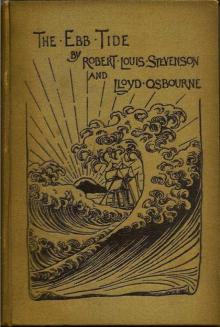
THE EBB-TIDE
A TRIO AND QUARTETTE
By Robert Louis Stevenson and Lloyde Osbourne
Published in 1894, this short novel was written by Stevenson and his stepson Lloyd Osbourne, and was published the same year Stevenson died. The novel opens by introducing three destitute beggars in the port of Papeete on Tahiti. They are Herrick, a failed English businessman; Davis, an American sea captain disgraced by the loss of his last ship; and Huish, a dishonest Cockney of various employments.
CONTENTS
PART I
CHAPTER 1. NIGHT ON THE BEACH
CHAPTER 2. MORNING ON THE BEACH — THE THREE LETTERS
CHAPTER 3. THE OLD CALABOOSE — DESTINY AT THE DOOR
CHAPTER 4. THE YELLOW FLAG
CHAPTER 5. THE CARGO OF CHAMPAGNE
CHAPTER 6. THE PARTNERS
PART II
THE QUARTETTE
CHAPTER 7. THE PEARL-FISHER
CHAPTER 8. BETTER ACQUAINTANCE
CHAPTER 9. THE DINNER PARTY
CHAPTER 10. THE OPEN DOOR
CHAPTER 11. DAVID AND GOLIATH
CHAPTER 12. TAIL-PIECE
PART I
CHAPTER 1. NIGHT ON THE BEACH
Throughout the island world of the Pacific, scattered men of many European races and from almost every grade of society carry activity and disseminate disease. Some prosper, some vegetate. Some have mounted the steps of thrones and owned islands and navies. Others again must marry for a livelihood; a strapping, merry, chocolate-coloured dame supports them in sheer idleness; and, dressed like natives, but still retaining some foreign element of gait or attitude, still perhaps with some relic (such as a single eye-glass) of the officer and gentleman, they sprawl in palm-leaf verandahs and entertain an island audience with memoirs of the music-hall. And there are still others, less pliable, less capable, less fortunate, perhaps less base, who continue, even in these isles of plenty, to lack bread.
At the far end of the town of Papeete, three such men were seated on the beach under a purao tree.
It was late. Long ago the band had broken up and marched musically home, a motley troop of men and women, merchant clerks and navy officers, dancing in its wake, arms about waist and crowned with garlands. Long ago darkness and silence had gone from house to house about the tiny pagan city. Only the street lamps shone on, making a glow-worm halo in the umbrageous alleys or drawing a tremulous image on the waters of the port. A sound of snoring ran among the piles of lumber by the Government pier. It was wafted ashore from the graceful clipper-bottomed schooners, where they lay moored close in like dinghies, and their crews were stretched upon the deck under the open sky or huddled in a rude tent amidst the disorder of merchandise.
But the men under the purao had no thought of sleep. The same temperature in England would have passed without remark in summer; but it was bitter cold for the South Seas. Inanimate nature knew it, and the bottle of cocoanut oil stood frozen in every bird-cage house about the island; and the men knew it, and shivered. They wore flimsy cotton clothes, the same they had sweated in by day and run the gauntlet of the tropic showers; and to complete their evil case, they had no breakfast to mention, less dinner, and no supper at all.
In the telling SouthSea phrase, these three men were ON THE BEACH. Common calamity had brought them acquainted, as the three most miserable English-speaking creatures in Tahiti; and beyond their misery, they knew next to nothing of each other, not even their true names. For each had made a long apprenticeship in going downward; and each, at some stage of the descent, had been shamed into the adoption of an alias. And yet not one of them had figured in a court of justice; two were men of kindly virtues; and one, as he sat and shivered under the purao, had a tattered Virgil in his pocket.
Certainly, if money could have been raised upon the book, Robert Herrick would long ago have sacrificed that last possession; but the demand for literature, which is so marked a feature in some parts of the South Seas, extends not so far as the dead tongues; and the Virgil, which he could not exchange against a meal, had often consoled him in his hunger. He would study it, as he lay with tightened belt on the floor of the old calaboose, seeking favourite passages and finding new ones only less beautiful because they lacked the consecration of remembrance. Or he would pause on random country walks; sit on the path side, gazing over the sea on the mountains of Eimeo; and dip into the Aeneid, seeking sortes. And if the oracle (as is the way of oracles) replied with no very certain nor encouraging voice, visions of England at least would throng upon the exile’s memory: the busy schoolroom, the green playing-fields, holidays at home, and the perennial roar of London, and the fireside, and the white head of his father. For it is the destiny of those grave, restrained and classic writers, with whom we make enforced and often painful acquaintanceship at school, to pass into the blood and become native in the memory; so that a phrase of Virgil speaks not so much of Mantua or Augustus, but of English places and the student’s own irrevocable youth.
Robert Herrick was the son of an intelligent, active, and ambitious man, small partner in a considerable London house. Hopes were conceived of the boy; he was sent to a good school, gained there an Oxford scholarship, and proceeded in course to the WesternUniversity. With all his talent and taste (and he had much of both) Robert was deficient in consistency and intellectual manhood, wandered in bypaths of study, worked at music or at metaphysics when he should have been at Greek, and took at last a paltry degree. Almost at the same time, the London house was disastrously wound up; Mr Herrick must begin the world again as a clerk in a strange office, and Robert relinquish his ambitions and accept with gratitude a career that he detested and despised. He had no head for figures, no interest in affairs, detested the constraint of hours, and despised the aims and the success of merchants. To grow rich was none of his ambitions; rather to do well. A worse or a more bold young man would have refused the destiny; perhaps tried his future with his pen; perhaps enlisted. Robert, more prudent, possibly more timid, consented to embrace that way of life in which he could most readily assist his family. But he did so with a mind divided; fled the neighbourhood of former comrades; and chose, out of several positions placed at his disposal, a clerkship in New York.
His career thenceforth was one of unbroken shame. He did not drink, he was exactly honest, he was never rude to his employers, yet was everywhere discharged. Bringing no interest to his duties, he brought no attention; his day was a tissue of things neglected and things done amiss; and from place to place and from town to town, he carried the character of one thoroughly incompetent. No man can bear the word applied to him without some flush of colour, as indeed there is none other that so emphatically slams in a man’s face the door of self-respect. And to Herrick, who was conscious of talents and acquirements, who looked down upon those humble duties in which he was found wanting, the pain was the more exquisite. Early in his fall, he had ceased to be able to make remittances; shortly after, having nothing but failure to communicate, he ceased writing home; and about a year before this tale begins, turned suddenly upon the streets of San Francisco by a vulgar and infuriated German Jew, he had broken the last bonds of self-respect, and upon a sudden Impulse, changed his name and invested his last dollar in a passage on the mail brigantine, the City of Papeete. With what expectation he had trimmed his flight for the South Seas, Herrick perhaps scarcely knew. Doubtless there were fortunes to be made in pearl and copra; doubtless others not more gifted than himself had climbed in the island world to be queen’s consorts and king’s ministers. But if Herrick had gone there with any manful purpose, he would have kept his father’s name; the alias betrayed his moral bankruptcy; he had struck his flag; he entertained no hope to reinstate himself or help his straitened family; and he came to the islands (where he knew the climate to be soft, bread cheap, and manners easy) a skulker from life’s battle and his own immediate duty. Failure, he had said, was his portion; let it be a pleasant failure.
It is fortunately not enough to say ‘I will be base.’ Herrick continued in the islands his career of failure; but in the new scene and under the new name, he suffered no less sharply than before. A place was got, it was lost in the old style; from the long-suffering of the keepers of restaurants he fell to more open charity upon the wayside; as time went on, good nature became weary, and after a repulse or two, Herrick became shy. There were women enough who would have supported a far worse and a far uglier man; Herrick never met or never knew them: or if he did both, some manlier feeling would revolt, and he preferred starvation. Drenched with rains, broiling by day, shivering by night, a disused and ruinous prison for a bedroom, his diet begged or pilfered out of rubbish heaps, his associates two creatures equally outcast with himself, he had drained for months the cup of penitence. He had known what it was to be resigned, what it was to break forth in a childish fury of rebellion against fate, and what it was to sink into the coma of despair. The time had changed him. He told himself no longer tales of an easy and perhaps agreeable declension; he read his nature otherwise; he had proved himself incapable of rising, and he now learned by experience that he could not stoop to fall. Something that was scarcely pride or strength, that was perhaps only refinement, withheld him from capitulation; but he looked on upon his own misfortune with a growing rage, and sometimes wondered at his patience.