Complete works of robert.., p.323
Complete Works of Robert Louis Stevenson (Illustrated),
p.323


‘Madam and my very good friend,’ said he, ‘is my face so much changed that you no longer recognise Prince Florizel in Mr. Godall?’
‘To be sure!’ she cried, looking at him through her glasses. ‘I have always regarded your Highness as a perfect man; and in your altered circumstances, of which I have already heard with deep regret, I will beg you to consider my respect increased instead of lessened.’
‘I have found it so,’ returned the Prince, ‘with every class of my acquaintance. But, madam, I pray you to be seated. My business is of a delicate order, and regards your daughter.’
‘In that case,’ said Mrs. Luxmore, ‘you may save yourself the trouble of speaking, for I have fully made up my mind to have nothing to do with her. I will not hear one word in her defence; but as I value nothing so particularly as the virtue of justice, I think it my duty to explain to you the grounds of my complaint. She deserted me, her natural protector; for years, she has consorted with the most disreputable persons; and to fill the cup of her offence, she has recently married. I refuse to see her, or the being to whom she has linked herself. One hundred and twenty pounds a year, I have always offered her: I offer it again. It is what I had myself when I was her age.’
‘Very well, madam,’ said the Prince; ‘and be that so! But to touch upon another matter: what was the income of the Reverend Bernard Fanshawe?’
‘My father?’ asked the spirited old lady. ‘I believe he had seven hundred pounds in the year.’
‘You were one, I think, of several?’ pursued the Prince.
‘Of four,’ was the reply. ‘We were four daughters; and painful as the admission is to make, a more detestable family could scarce be found in England.’
‘Dear me!’ said the Prince. ‘And you, madam, have an income of eight thousand?’
‘Not more than five,’ returned the old lady; ‘but where on earth are you conducting me?’
‘To an allowance of one thousand pounds a year,’ replied Florizel, smiling. ‘For I must not suffer you to take your father for a rule. He was poor, you are rich. He had many calls upon his poverty: there are none upon your wealth. And indeed, madam, if you will let me touch this matter with a needle, there is but one point in common to your two positions: that each had a daughter more remarkable for liveliness than duty.’
‘I have been entrapped into this house,’ said the old lady, getting to her feet. ‘But it shall not avail. Not all the tobacconists in Europe . . .’
‘Ah, madam,’ interrupted Florizel, ‘before what is referred to as my fall, you had not used such language! And since you so much object to the simple industry by which I live, let me give you a friendly hint. If you will not consent to support your daughter, I shall be constrained to place that lady behind my counter, where I doubt not she would prove a great attraction; and your son-in-law shall have a livery and run the errands. With such young blood my business might be doubled, and I might be bound in common gratitude to place the name of Luxmore beside that of Godall.’
‘Your Highness,’ said the old lady, ‘I have been very rude, and you are very cunning. I suppose the minx is on the premises. Produce her.’
‘Let us rather observe them unperceived,’ said the Prince; and so saying he rose and quietly drew back the curtain.
Mrs. Desborough sat with her back to them on a chair; Somerset and Harry were hanging on her words with extraordinary interest; Challoner, alleging some affair, had long ago withdrawn from the detested neighbourhood of the enchantress.
‘At that moment,’ Mrs. Desborough was saying, ‘Mr Gladstone detected the features of his cowardly assailant. A cry rose to his lips: a cry of mingled triumph . . .’
‘That is Mr. Somerset!’ interrupted the spirited old lady, in the highest note of her register. ‘Mr. Somerset, what have you done with my house-property?’
‘Madam,’ said the Prince, ‘let it be mine to give the explanation; and in the meanwhile, welcome your daughter.’
‘Well, Clara, how do you do?’ said Mrs. Luxmore. ‘It appears I am to give you an allowance. So much the better for you. As for Mr. Somerset, I am very ready to have an explanation; for the whole affair, though costly, was eminently humorous. And at any rate,’ she added, nodding to Paul, ‘he is a young gentleman for whom I have a great affection, and his pictures were the funniest I ever saw.’
‘I have ordered a collation,’ said the Prince. ‘Mr. Somerset, as these are all your friends, I propose, if you please, that you should join them at table. I will take the shop.’
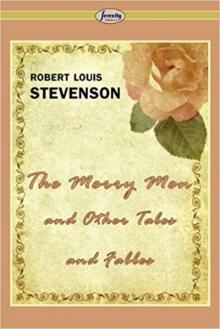
THE MERRY MEN AND OTHER TALES AND FABLES
This collection of short stories was first published in 1893 and contains some of Stevenson’s last finished works before he died the following year.
The very rare first edition
CONTENTS
THE MERRY MEN
WILL O’ THE MILL.
THRAWN JANET
OLALLA
THE TREASURE OF FRANCHARD.
Dedication
My dear Lady Taylor,
To your name, if I wrote on brass, I could add nothing; it has been already written higher than I could dream to reach, by a strong and dear hand; and if I now dedicate to you these tales, it is not as the writer who brings you his work, but as the friend who would remind you of his affection.
ROBERT LOUIS STEVENSON
THE MERRY MEN
CHAPTER I. EILEAN AROS.
It was a beautiful morning in the late July when I set forth on foot for the last time for Aros. A boat had put me ashore the night before at Grisapol; I had such breakfast as the little inn afforded, and, leaving all my baggage till I had an occasion to come round for it by sea, struck right across the promontory with a cheerful heart.
I was far from being a native of these parts, springing, as I did, from an unmixed lowland stock. But an uncle of mine, Gordon Darnaway, after a poor, rough youth, and some years at sea, had married a young wife in the islands; Mary Maclean she was called, the last of her family; and when she died in giving birth to a daughter, Aros, the sea-girt farm, had remained in his possession. It brought him in nothing but the means of life, as I was well aware; but he was a man whom ill-fortune had pursued; he feared, cumbered as he was with the young child, to make a fresh adventure upon life; and remained in Aros, biting his nails at destiny. Years passed over his head in that isolation, and brought neither help nor contentment. Meantime our family was dying out in the lowlands; there is little luck for any of that race; and perhaps my father was the luckiest of all, for not only was he one of the last to die, but he left a son to his name and a little money to support it. I was a student of Edinburgh University, living well enough at my own charges, but without kith or kin; when some news of me found its way to Uncle Gordon on the Ross of Grisapol; and he, as he was a man who held blood thicker than water, wrote to me the day he heard of my existence, and taught me to count Aros as my home. Thus it was that I came to spend my vacations in that part of the country, so far from all society and comfort, between the codfish and the moorcocks; and thus it was that now, when I had done with my classes, I was returning thither with so light a heart that July day.
The Ross, as we call it, is a promontory neither wide nor high, but as rough as God made it to this day; the deep sea on either hand of it, full of rugged isles and reefs most perilous to seamen — all overlooked from the eastward by some very high cliffs and the great peals of Ben Kyaw. The Mountain of the Mist, they say the words signify in the Gaelic tongue; and it is well named. For that hill-top, which is more than three thousand feet in height, catches all the clouds that come blowing from the seaward; and, indeed, I used often to think that it must make them for itself; since when all heaven was clear to the sea level, there would ever be a streamer on Ben Kyaw. It brought water, too, and was mossy to the top in consequence. I have seen us sitting in broad sunshine on the Ross, and the rain falling black like crape upon the mountain. But the wetness of it made it often appear more beautiful to my eyes; for when the sun struck upon the hill sides, there were many wet rocks and watercourses that shone like jewels even as far as Aros, fifteen miles away.
The road that I followed was a cattle-track. It twisted so as nearly to double the length of my journey; it went over rough boulders so that a man had to leap from one to another, and through soft bottoms where the moss came nearly to the knee. There was no cultivation anywhere, and not one house in the ten miles from Grisapol to Aros. Houses of course there were — three at least; but they lay so far on the one side or the other that no stranger could have found them from the track. A large part of the Ross is covered with big granite rocks, some of them larger than a two-roomed house, one beside another, with fern and deep heather in between them where the vipers breed. Anyway the wind was, it was always sea air, as salt as on a ship; the gulls were as free as moorfowl over all the Ross; and whenever the way rose a little, your eye would kindle with the brightness of the sea. From the very midst of the land, on a day of wind and a high spring, I have heard the Roost roaring, like a battle where it runs by Aros, and the great and fearful voices of the breakers that we call the Merry Men.
Aros itself — Aros Jay, I have heard the natives call it, and they say it means the House of God — Aros itself was not properly a piece of the Ross, nor was it quite an islet. It formed the south-west corner of the land, fitted close to it, and was in one place only separated from the coast by a little gut of the sea, not forty feet across the narrowest. When the tide was full, this was clear and still, like a pool on a land river; only there was a difference in the weeds and fishes, and the water itself was green instead of brown; but when the tide went out, in the bottom of the ebb, there was a day or two in every month when you could pass dryshod from Aros to the mainland. There was some good pasture, where my uncle fed the sheep he lived on; perhaps the feed was better because the ground rose higher on the islet than the main level of the Ross, but this I am not skilled enough to settle. The house was a good one for that country, two storeys high. It looked westward over a bay, with a pier hard by for a boat, and from the door you could watch the vapours blowing on Ben Kyaw.
On all this part of the coast, and especially near Aros, these great granite rocks that I have spoken of go down together in troops into the sea, like cattle on a summer’s day. There they stand, for all the world like their neighbours ashore; only the salt water sobbing between them instead of the quiet earth, and clots of sea-pink blooming on their sides instead of heather; and the great sea conger to wreathe about the base of them instead of the poisonous viper of the land. On calm days you can go wandering between them in a boat for hours, echoes following you about the labyrinth; but when the sea is up, Heaven help the man that hears that cauldron boiling.
Off the south-west end of Aros these blocks are very many, and much greater in size. Indeed, they must grow monstrously bigger out to sea, for there must be ten sea miles of open water sown with them as thick as a country place with houses, some standing thirty feet above the tides, some covered, but all perilous to ships; so that on a clear, westerly blowing day, I have counted, from the top of Aros, the great rollers breaking white and heavy over as many as six-and-forty buried reefs. But it is nearer in shore that the danger is worst; for the tide, here running like a mill race, makes a long belt of broken water — a Roost we call it — at the tail of the land. I have often been out there in a dead calm at the slack of the tide; and a strange place it is, with the sea swirling and combing up and boiling like the cauldrons of a linn, and now and again a little dancing mutter of sound as though the Roost were talking to itself. But when the tide begins to run again, and above all in heavy weather, there is no man could take a boat within half a mile of it, nor a ship afloat that could either steer or live in such a place. You can hear the roaring of it six miles away. At the seaward end there comes the strongest of the bubble; and it’s here that these big breakers dance together — the dance of death, it may be called — that have got the name, in these parts, of the Merry Men. I have heard it said that they run fifty feet high; but that must be the green water only, for the spray runs twice as high as that. Whether they got the name from their movements, which are swift and antic, or from the shouting they make about the turn of the tide, so that all Aros shakes with it, is more than I can tell.
The truth is, that in a south-westerly wind, that part of our archipelago is no better than a trap. If a ship got through the reefs, and weathered the Merry Men, it would be to come ashore on the south coast of Aros, in Sandag Bay, where so many dismal things befell our family, as I propose to tell. The thought of all these dangers, in the place I knew so long, makes me particularly welcome the works now going forward to set lights upon the headlands and buoys along the channels of our iron-bound, inhospitable islands.
The country people had many a story about Aros, as I used to hear from my uncle’s man, Rorie, an old servant of the Macleans, who had transferred his services without afterthought on the occasion of the marriage. There was some tale of an unlucky creature, a sea-kelpie, that dwelt and did business in some fearful manner of his own among the boiling breakers of the Roost. A mermaid had once met a piper on Sandag beach, and there sang to him a long, bright midsummer’s night, so that in the morning he was found stricken crazy, and from thenceforward, till the day he died, said only one form of words; what they were in the original Gaelic I cannot tell, but they were thus translated: ‘Ah, the sweet singing out of the sea.’ Seals that haunted on that coast have been known to speak to man in his own tongue, presaging great disasters. It was here that a certain saint first landed on his voyage out of Ireland to convert the Hebrideans. And, indeed, I think he had some claim to be called saint; for, with the boats of that past age, to make so rough a passage, and land on such a ticklish coast, was surely not far short of the miraculous. It was to him, or to some of his monkish underlings who had a cell there, that the islet owes its holy and beautiful name, the House of God.
Among these old wives’ stories there was one which I was inclined to hear with more credulity. As I was told, in that tempest which scattered the ships of the Invincible Armada over all the north and west of Scotland, one great vessel came ashore on Aros, and before the eyes of some solitary people on a hill-top, went down in a moment with all hands, her colours flying even as she sank. There was some likelihood in this tale; for another of that fleet lay sunk on the north side, twenty miles from Grisapol. It was told, I thought, with more detail and gravity than its companion stories, and there was one particularity which went far to convince me of its truth: the name, that is, of the ship was still remembered, and sounded, in my ears, Spanishly. The Espirito Santo they called it, a great ship of many decks of guns, laden with treasure and grandees of Spain, and fierce soldadoes, that now lay fathom deep to all eternity, done with her wars and voyages, in Sandag bay, upon the west of Aros. No more salvos of ordnance for that tall ship, the ‘Holy Spirit,’ no more fair winds or happy ventures; only to rot there deep in the sea-tangle and hear the shoutings of the Merry Men as the tide ran high about the island. It was a strange thought to me first and last, and only grew stranger as I learned the more of Spain, from which she had set sail with so proud a company, and King Philip, the wealthy king, that sent her on that voyage.
And now I must tell you, as I walked from Grisapol that day, the Espirito Santo was very much in my reflections. I had been favourably remarked by our then Principal in Edinburgh College, that famous writer, Dr. Robertson, and by him had been set to work on some papers of an ancient date to rearrange and sift of what was worthless; and in one of these, to my great wonder, I found a note of this very ship, the Espirito Santo, with her captain’s name, and how she carried a great part of the Spaniard’s treasure, and had been lost upon the Ross of Grisapol; but in what particular spot, the wild tribes of that place and period would give no information to the king’s inquiries. Putting one thing with another, and taking our island tradition together with this note of old King Jamie’s perquisitions after wealth, it had come strongly on my mind that the spot for which he sought in vain could be no other than the small bay of Sandag on my uncle’s land; and being a fellow of a mechanical turn, I had ever since been plotting how to weigh that good ship up again with all her ingots, ounces, and doubloons, and bring back our house of Darnaway to its long-forgotten dignity and wealth.
This was a design of which I soon had reason to repent. My mind was sharply turned on different reflections; and since I became the witness of a strange judgment of God’s, the thought of dead men’s treasures has been intolerable to my conscience. But even at that time I must acquit myself of sordid greed; for if I desired riches, it was not for their own sake, but for the sake of a person who was dear to my heart — my uncle’s daughter, Mary Ellen. She had been educated well, and had been a time to school upon the mainland; which, poor girl, she would have been happier without. For Aros was no place for her, with old Rorie the servant, and her father, who was one of the unhappiest men in Scotland, plainly bred up in a country place among Cameronians, long a skipper sailing out of the Clyde about the islands, and now, with infinite discontent, managing his sheep and a little ‘long shore fishing for the necessary bread. If it was sometimes weariful to me, who was there but a month or two, you may fancy what it was to her who dwelt in that same desert all the year round, with the sheep and flying sea-gulls, and the Merry Men singing and dancing in the Roost!
CHAPTER II. WHAT THE WRECK HAD BROUGHT TO AROS.
It was half-flood when I got the length of Aros; and there was nothing for it but to stand on the far shore and whistle for Rorie with the boat. I had no need to repeat the signal. At the first sound, Mary was at the door flying a handkerchief by way of answer, and the old long-legged serving-man was shambling down the gravel to the pier. For all his hurry, it took him a long while to pull across the bay; and I observed him several times to pause, go into the stern, and look over curiously into the wake. As he came nearer, he seemed to me aged and haggard, and I thought he avoided my eye. The coble had been repaired, with two new thwarts and several patches of some rare and beautiful foreign wood, the name of it unknown to me.