Complete works of robert.., p.428
Complete Works of Robert Louis Stevenson (Illustrated),
p.428
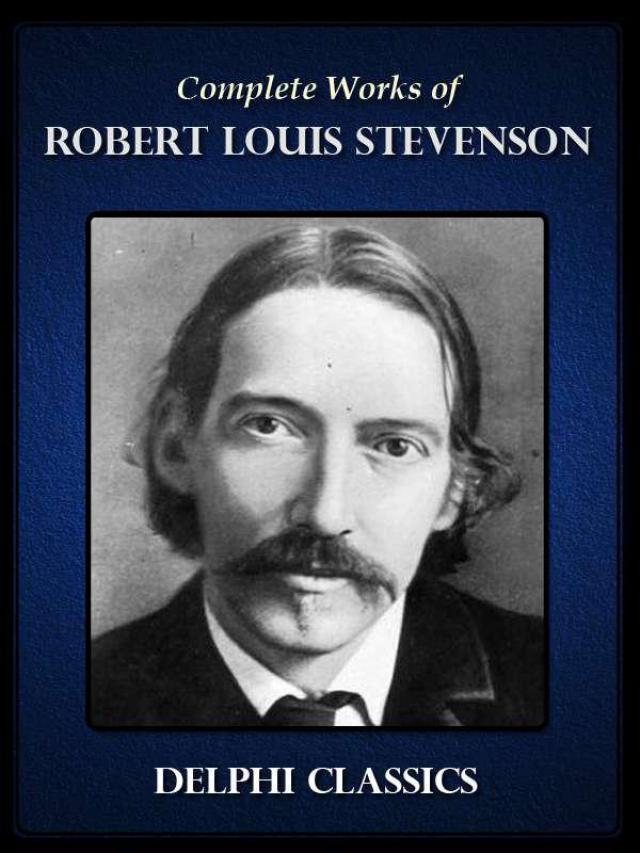


The Arethusa was unwisely dressed. He is no precisian in attire; but by all accounts he was never so ill-inspired as on that tramp; having set forth, indeed, upon a moment’s notice, from the most unfashionable spot in Europe, Barbizon. On his head he wore a smoking-cap of Indian work, the gold lace pitifully frayed and tarnished. A flannel shirt of an agreeable dark hue, which the satirical called black; a light tweed coat made by a good English tailor; ready-made cheap linen trousers and leathern gaiters completed his array. In person, he is exceptionally lean; and his face is not, like those of happier mortals, a certificate. For years he could not pass a frontier, or visit a bank, without suspicion; the police everywhere, but in his native city, looked askance upon him; and (although I am sure it will not be credited) he is actually denied admittance to the casino of Monte Carlo. If you will imagine him dressed as above, stooping under his knapsack, walking nearly five miles an hour with the folds of the ready-made trousers fluttering about his spindle shanks, and still looking eagerly round him as if in terror of pursuit — the figure, when realised, is far from reassuring. When Villon journeyed (perhaps by the same pleasant valley) to his exile at Roussillon, I wonder if he had not something of the same appearance. Something of the same preoccupation he had beyond a doubt, for he too must have tinkered verses as he walked, with more success than his successor. And if he had anything like the same inspiring weather, the same nights of uproar, men in armour rolling and resounding down the stairs of heaven, the rain hissing on the village streets, the wild bull’s-eye of the storm flashing all night long into the bare inn-chamber — the same sweet return of day, the same unfathomable blue of noon, the same high-coloured, halcyon eves — and above all, if he had anything like as good a comrade, anything like as keen a relish for what he saw, and what he ate, and the rivers that he bathed in, and the rubbish that he wrote, I would exchange estates to-day with the poor exile, and count myself a gainer.
But there was another point of similarity between the two journeys, for which the Arethusa was to pay dear: both were gone upon in days of incomplete security. It was not long after the Franco-Prussian war. Swiftly as men forget, that countryside was still alive with tales of uhlans and outlying sentries, and hairbreadth ‘scapes from the ignominious cord, and pleasant momentary friendships between invader and invaded. A year, at the most two years, later you might have tramped all that country over and not heard one anecdote. And a year or two later, you would — if you were a rather ill-looking young man in nondescript array — have gone your rounds in greater safety; for along with more interesting matter, the Prussian spy would have somewhat faded from men’s imaginations.
For all that, our voyager had got beyond Château Renard before he was conscious of arousing wonder. On the road between that place and Châtillon-sur-Loing, however, he encountered a rural postman; they fell together in talk, and spoke of a variety of subjects; but through one and all, the postman was still visibly preoccupied, and his eyes were faithful to the Arethusa’s knapsack. At last, with mysterious roguishness, he inquired what it contained, and on being answered, shook his head with kindly incredulity. “Non,” said he, “non, vous avez des portraits.” And then with a languishing appeal, “Voyons, show me the portraits!” It was some little time before the Arethusa, with a shout of laughter, recognized his drift. By portraits he meant indecent photographs; and in the Arethusa, an austere and rising author, he thought to have identified a pornographic colporteur. When country-folk in France have made up their minds as to a person’s calling, argument is fruitless. Along all the rest of the way, the postman piped and fluted meltingly to get a sight of the collection; now he would upbraid, now he would reason — ”Voyons, I will tell nobody”; then he tried corruption, and insisted on paying for a glass of wine; and at last, when their ways separated — ”Non,” said he, “ce n’est pas bien de votre part. O non, ce n’est pas bien.” And shaking his head with quite a sentimental sense of injury, he departed unrefreshed.
On certain little difficulties encountered by the Arethusa at Châtillon-sur-Loing, I have not space to dwell; another Châtillon, of grislier memory, looms too near at hand. But the next day, in a certain hamlet called La Jussière, he stopped to drink a glass of syrup in a very poor, bare drinking-shop. The hostess, a comely woman, suckling a child, examined the traveller with kindly and pitying eyes. “You are not of this Department?” she asked. The Arethusa told her he was English. “Ah!” she said, surprised. “We have no English. We have many Italians, however, and they do very well; they do not complain of the people of hereabouts. An Englishman may do very well also; it will be something new.” Here was a dark saying, over which the Arethusa pondered as he drank his grenadine; but when he rose and asked what was to pay, the light came upon him in a flash. “O, pour vous,” replied the landlady, “a halfpenny!” Pour vous? By heaven, she took him for a beggar! He paid his halfpenny, feeling that it were ungracious to correct her. But when he was forth again upon the road, he became vexed in spirit. The conscience is no gentleman, he is a rabbinical fellow; and his conscience told him he had stolen the syrup.
That night the travellers slept in Gien; the next day they passed the river and set forth (severally, as their custom was) on a short stage through the green plain upon the Berry side, to Châtillon-sur-Loire. It was the first day of the shooting; and the air rang with the report of fire-arms and the admiring cries of sportsmen. Overhead the birds were in consternation, wheeling in clouds, settling and re-arising. And yet with all this bustle on either hand, the road itself lay solitary. The Arethusa smoked a pipe beside a milestone, and I remember he laid down very exactly all he was to do at Châtillon: how he was to enjoy a cold plunge, to change his shirt, and to await the Cigarette’s arrival, in sublime inaction, by the margin of the Loire. Fired by these ideas, he pushed the more rapidly forward, and came, early in the afternoon, and in a breathing heat, to the entering-in of that ill-fated town. Childe Roland to the dark tower came.
A polite gendarme threw his shadow on the path.
“Monsieur est voyageur?” he asked.
And the Arethusa, strong in his innocence, forgetful of his vile attire, replied — I had almost said with gaiety: “So it would appear.”
“His papers are in order?” said the gendarme. And when the Arethusa, with a slight change of voice, admitted he had none, he was informed (politely enough) that he must appear before the Commissary.
The Commissary sat at a table in his bedroom, stripped to the shirt and trousers, but still copiously perspiring; and when he turned upon the prisoner a large meaningless countenance, that was (like Bardolph’s) “all whelks and bubuckles,” the dullest might have been prepared for grief. Here was a stupid man, sleepy with the heat and fretful at the interruption, whom neither appeal nor argument could reach.
The Commissary: “You have no papers?”
The Arethusa: “Not here.”
The Commissary: “Why?”
The Arethusa: “I have left them behind in my valise.”
The Commissary: “You know, however, that it is forbidden to circulate without papers?”
The Arethusa: “Pardon me: I am convinced of the contrary. I am here on my rights as an English subject by international treaty.”
The Commissary (with scorn): “You call yourself an Englishman?”
The Arethusa: “I do.”
The Commissary: “Humph. — What is your trade?”
The Arethusa: “I am a Scottish Advocate.”
The Commissary (with singular annoyance): “A Scottish Advocate! Do you then pretend to support yourself by that in this Department?”
The Arethusa modestly disclaimed the pretension. The Commissary had scored a point.
The Commissary: “Why, then, do you travel?”
The Arethusa: “I travel for pleasure.”
The Commissary (pointing to the knapsack, and with sublime incredulity): “Avec ça? Voyez-vous, je suis un homme intelligent!” (With that? Look here, I am a person of intelligence!)
The culprit remaining silent under this home-thrust, the Commissary relished his triumph for a while, and then demanded (like the postman, but with what different expectations!) to see the contents of the knapsack. And here the Arethusa, not yet sufficiently awake to his position, fell into a grave mistake. There was little or no furniture in the room except the Commissary’s chair and table; and to facilitate matters, the Arethusa (with all the innocence on earth) leant the knapsack on a corner of the bed. The Commissary fairly bounded from his seat; his face and neck flushed past purple, almost into blue; and he screamed to lay the desecrating object on the floor.
The knapsack proved to contain a change of shirts, of shoes, of socks, and of linen trousers, a small dressing-case, a piece of soap in one of the shoes, two volumes of the Collection Jannet lettered “Poésies de Charles d’Orleans,” a map, and a version-book containing divers notes in prose and the remarkable English roundels of the voyager, still to this day unpublished: the Commissary of Châtillon is the only living man who has clapped an eye on these artistic trifles. He turned the assortment over with a contumelious finger; it was plain from his daintiness that he regarded the Arethusa and all his belongings as the very temple of infection. Still there was nothing suspicious about the map, nothing really criminal except the roundels; as for Charles of Orleans, to the ignorant mind of the prisoner, he seemed as good as a certificate; and it was supposed the farce was nearly over.
The inquisitor resumed his seat.
The Commissary (after a pause): “Eh bien, je vais vous dire ce que vous êtes. Vous êtes allemand el vous venez chanter à la foire.” (Well, then, I will tell you what you are. You are a German, and have come to sing at the fair.)
The Arethusa: “Would you like to hear me sing? I believe I could convince you of the contrary.”
The Commissary: “Pas de plaisanterie, monsieur!”
The Arethusa: “Well, sir, oblige me at least by looking at this book. Here, I open it with my eyes shut. Read one of these songs — read this one — and tell me, you who are a man of intelligence, if it would be possible to sing it at a fair?”
The Commissary (critically): “Mais oui. Tres bien.”
The Arethusa: “Comment, monsieur! What! But do you not observe it is antique? It is difficult to understand, even for you and me; but for the audience at a fair, it would be meaningless.”
The Commissary (taking a pen): “Enfin, il faut en finir. What is your name?”
The Arethusa (speaking with the swallowing vivacity of the English): “Robert-Louis-Stev’ns’n.”
The Commissary (aghast): “Hé! Quoi?”
The Arethusa (perceiving and improving his advantage): “Rob’rt-Lou’s-Stev’ns’n.”
The Commissary (after several conflicts with his pen): “Eh bien, il faut se passer du nom. Ça ne s’écrit pas.” (Well, we must do without the name: it is unspellable.)
The above is a rough summary of this momentous conversation, in which I have been chiefly careful to preserve the plums of the Commissary; but the remainder of the scene, perhaps because of his rising anger, has left but little definite in the memory of the Arethusa. The Commissary was not, I think, a practiced literary man; no sooner, at least, had he taken pen in hand and embarked on the composition of the procès-verbal, than he became distinctly more uncivil, and began to show a predilection for that simplest of all forms of repartee: “You lie.” Several times the Arethusa let it pass, and then suddenly flared up, refused to accept more insults or to answer further questions, defied the Commissary to do his worst, and promised him, if he did, that he should bitterly repent it. Perhaps if he had worn this proud front from the first, instead of beginning with a sense of entertainment and then going on to argue, the thing might have turned otherwise; for even at this eleventh hour the Commissary was visibly staggered. But it was too late; he had been challenged; the procès-verbal was begun; and he again squared his elbows over his writing, and the Arethusa was led forth a prisoner.
A step or two down the hot road stood the gendarmerie. Thither was our unfortunate conducted, and there he was bidden to empty forth the contents of his pockets. A handkerchief, a pen, a pencil, a pipe and tobacco, matches, and some ten francs of change: that was all. Not a file, not a cipher, not a scrap of writing whether to identify or to condemn. The very gendarme was appalled before such destitution.
“I regret,” he said, “that I arrested you, for I see that you are no voyou.” And he promised him every indulgence.
The Arethusa, thus encouraged, asked for his pipe. That he was told was impossible, but if he chewed, he might have some tobacco. He did not chew, however, and asked instead to have his handkerchief.
“Non,” said the gendarme. “Nous avons eu des histoires de gens qui se sont pendus.” (No, we have had histories of people who hanged themselves.)
“What!” cried the Arethusa. “And is it for that you refuse me my handkerchief? But see how much more easily I could hang myself in my trousers!”
The man was struck by the novelty of the idea, but he stuck to his colours, and only continued to repeat vague offers of service.
“At least,” said the Arethusa, “be sure that you arrest my comrade; he will follow me ere long on the same road, and you can tell him by the sack upon his shoulders.”
This promised, the prisoner was led round into the back court of the building, a cellar door was opened, he was motioned down the stair, and bolts grated and chains clanged behind his descending person.
The philosophic and still more the imaginative mind is apt to suppose itself prepared for any mortal accident. Prison, among other ills, was one that had been often faced by the undaunted Arethusa. Even as he went down the stairs, he was telling himself that here was a famous occasion for a roundel, and that like the committed linnets of the tuneful cavalier, he too would make his prison musical. I will tell the truth at once: the roundel was never written, or it should be printed in this place, to raise a smile. Two reasons interfered: the first moral, the second physical.
It is one of the curiosities of human nature, that although all men are liars, they can none of them bear to be told so of themselves. To get and take the lie with equanimity is a stretch beyond the stoic; and the Arethusa, who had been surfeited upon that insult, was blazing inwardly with a white heat of smothered wrath. But the physical had also its part. The cellar in which he was confined was some feet underground, and it was only lighted by an unglazed, narrow aperture high up in the wall, and smothered in the leaves of a green vine. The walls were of naked masonry, the floor of bare earth; by way of furniture there was an earthenware basin, a water-jug, and a wooden bedstead with a blue-grey cloak for bedding. To be taken from the hot air of a summer’s afternoon, the reverberation of the road and the stir of rapid exercise, and plunged into the gloom and damp of this receptacle for vagabonds, struck an instant chill upon the Arethusa’s blood. Now see in how small a matter a hardship may consist: the floor was exceedingly uneven under foot, with the very spade-marks, I suppose, of the labourers who dug the foundations of the barrack; and what with the poor twilight and the irregular surface, walking was impossible. The caged author resisted for a good while, but the chill of the place struck deeper and deeper; and at length, with such reluctance as you may fancy, he was driven to climb upon the bed and wrap himself in the public covering. There, then, he lay upon the verge of shivering, plunged in semi-darkness, wound in a garment whose touch he dreaded like the plague, and (in a spirit far removed from resignation) telling the roll of the insults he had just received. These are not circumstances favourable to the muse.
Meantime (to look at the upper surface where the sun was still shining and the guns of sportsmen were still noisy through the tufted plain) the Cigarette was drawing near at his more philosophic pace. In those days of liberty and health he was the constant partner of the Arethusa, and had ample opportunity to share in that gentleman’s disfavour with the police. Many a bitter bowl had he partaken of with that disastrous comrade. He was himself a man born to float easily through life, his face and manner artfully recommending him to all. There was but one suspicious circumstance he could not carry off, and that was his companion. He will not readily forget the Commissary in what is ironically called the free town of Frankfort-on-the-Main; nor the Franco-Belgian frontier; nor the inn at La Fère; last, but not least, he is pretty certain to remember Châtillon-sur-Loire.
At the town entry, the gendarme culled him like a wayside flower; and a moment later two persons in a high state of surprise were confronted in the Commissary’s office. For if the Cigarette was surprised to be arrested, the Commissary was no less taken aback by the appearance and appointments of his captive. Here was a man about whom there could be no mistake: a man of an unquestionable and unassailable manner, in apple-pie order, dressed not with neatness merely but elegance, ready with his passport at a word, and well supplied with money: a man the Commissary would have doffed his hat to on chance upon the highway; and this beau cavalier unblushingly claimed the Arethusa for his comrade! The conclusion of the interview was foregone; of its humours I remember only one. “Baronet?” demanded the magistrate, glancing up from the passport. “Alors, monsieur, vous êtes le fils d’un baron?” And when the Cigarette (his one mistake throughout the interview) denied the soft impeachment, “Alors,” from the Commissary, “ce n’est pas voire passeport!” But these were ineffectual thunders; he never dreamed of laying hands upon the Cigarette; presently he fell into a mood of unrestrained admiration, gloating over the contents of the knapsack, commending our friend’s tailor. Ah! what an honoured guest was the Commissary entertaining! What suitable clothes he wore for the warm weather! What beautiful maps, what an attractive work of history he carried in his knapsack! You are to understand there was now but one point of difference between them: what was to be done with the Arethusa? the Cigarette demanding his release, the Commissary still claiming him as the dungeon’s own. Now it chanced that the Cigarette had passed some years of his life in Egypt, where he had made acquaintance with two very bad things, cholera morbus and pashas; and in the eye of the Commissary, as he fingered the volume of Michelet, it seemed to our traveller there was something Turkish. I pass over this lightly; it is highly possible there was some misunderstanding, highly possible that the Commissary (charmed with his visitor) supposed the attraction to be mutual, and took for an act of growing friendship what the Cigarette himself regarded as a bribe. And at any rate, was there ever a bribe more singular than an odd volume of Michelet’s history! The work was promised him for the morrow, before our departure; and presently after, either because he had his price, or to show that he was not the man to be behind in friendly offices, “Eh bien,” he said, “je suppose qu’il faut lâcher votre camarade.” And he tore up that feast of humour, the unfinished procès-verbal. Ah, if he had only torn up instead the Arethusa’s roundels! There are many works burnt at Alexandria, there are many treasured in the British Museum, that I could better spare than the procès-verbal of Châtillon. Poor bubuckled Commissary! I begin to be sorry that he never had his Michelet: perceiving in him fine human traits, a broad-based stupidity, a gusto in his magisterial functions, a taste for letters, a ready admiration for the admirable. And if he did not admire the Arethusa, he was not alone in that.