Complete works of robert.., p.884
Complete Works of Robert Louis Stevenson (Illustrated),
p.884


As has been said, her dislike of deceit and treachery was one of the most strongly marked traits in her character. Once when she had reason to fear that a person whom she was befriending was deceiving her, and she was told that a simple inquiry would settle the matter, she replied: “But I couldn’t bear to find out that he is lying to me.”
Her charities were many, but they were always of the quiet, unobtrusive sort, of which few heard except those most nearly concerned. For instance, when she heard of a poor woman in her neighbourhood whose life could only be saved by an expensive operation, she paid to have it done. Her life was full of such acts, and there are many, many people who have good reason to be grateful to her memory.
But when all is said, it has always seemed to me that the bright star of her character, shining above all other traits, was her loyalty — that staunch fidelity that made her cling, through thick and thin, through good or evil report, to those whom she loved. But as she loved, so she hated, and as she endowed her friends with all the virtues, so she could see no good at all in an enemy. Yet, just when you thought you were beginning to understand her nature — with its love and hate of the primal woman — her anger would suddenly soften, not into tenderness, but into a sort of dispassionate wisdom, and she would quote her favourite saying: “To know all is to forgive all.”
That she had infinite tenderness for the feelings of others, living or dead, she proved every day. In a letter to Mr. Scribner asking advice about the publication in London of certain letters of her husband, she says:
“Some of the letters that are intended to go into the book should not, in my judgment, appear at all. When my husband was a boy in his late ‘teens’ and early twenties he and his father — a rigid old Calvinist — quarrelled on the subject of religion. Louis being young enough to like the melodrama, it took on an undue importance, out of all keeping with the real facts. During this turbulent period Louis poured out his soul in letters, the publication of many of which would give a false impression of the relations between the son and the father. Louis was twenty-five when I first met him, and the period of the religious discussion was long past. Mr. Thomas Stevenson loved me and was as kind to me as though I were his own daughter. I cannot, for the sake of an extra volume that would produce a certain amount of money, do anything that in my heart would seem disloyal to the dear old man’s memory — all the more because he is dead.”
In her character there were many strange contradictions, and I think sometimes this was a part of her attraction, for even after knowing her for years one could always count on some surprise, some unexpected contrast which went far in making up her fascinating personality. Notwithstanding the broad view that she took of life in most of its aspects, in some things she was old-fashioned. She was never reconciled, for instance, to female suffrage, and once when she was persuaded to attend a political meeting at which her daughter was one of the speakers, she sat looking on with mingled pride in her daughter’s eloquence and horror at her sentiments. Yet, after the suffrage was granted to women in California, her family was amused to see her go to the polls and vote and carefully advise the men employed on her place concerning their ballots.
Some persons were repelled by what they considered Mrs. Stevenson’s cold and distant manner, but they were not aware of what it took her own family a long time to discover — that this apparent detachment and sphinxlike immobility covered a real and childlike shyness; yet it was never apathy, but the stillness of a frightened wild creature that has never been tamed. Though she said so little, she never failed to create an impression. Some one once said of her that her silence was more fascinating than the most brilliant conversation of other women, and, indeed, “Where Macgregor sits is the head of the table” applied very aptly to her. Her manner had nothing of the aggressive self-confidence of the “capable woman.” She seemed so essentially feminine, low-voiced, quiet, even helplessly appealing, that it was difficult to realise that she was a fair shot, a fearless horsewoman, a first-rate cook, an expert seamstress, a really scientific gardener, a most skillful nurse, and had, besides, some working acquaintance with many trades and professions upon which she could draw in an emergency.
Her physical courage was remarkable; she would get on any horse, jump into a boat in any sea, face a burglar — do anything, in fact, that circumstances seemed to require. But perhaps her moral courage, that which gave her strength to face great crises — as when Louis was near death — with a smile on her face, was even greater. This I know came to her as a direct inheritance from our mother, Esther Van de Grift, who was never known to give way under the stress of great need.
In her fondness for animals she reminds one of her maternal ancestress, Elizabeth Knodle, who used to rush out and seize horses by the bridle when she thought they were being driven too fast by their cruel drivers. Nothing would more surely arouse her anger than the sight of any unkindness to one of these “little brothers.” Once at Vailima a gentleman, who ought to have known better, came riding up on a horse that showed signs of being in pain. “That horse has a sore back,” she cried. The rider angrily denied it, but she insisted on his dismounting, and when the saddle was removed found that her suspicions were but too well founded. She compelled him to leave the suffering creature in her care until its back was entirely cured.
I have been surprised sometimes to hear people speak of her as “bohemian.” Simplicity and genuineness were the foundation-stones of her character, and she certainly dispensed with many of the useless conventions of society, but she was a serious-minded woman for whom the cheap affectations generally labelled as “bohemianism” could have no attractions.
She was entirely feminine in her love of pretty clothes. In choosing her own attire, though she followed the fashions and never tried to be extravagant or outré, she had a discriminating taste that made her always seem to be dressed more attractively than other people. All who think of her, even in her last days, must have a picture in their minds of the dainty, lacy, silken prettiness in which she sat enshrined.
She was pretty as a young woman, but as she grew older she was beautiful — with that rare type of beauty that “age cannot wither nor custom stale.” With her clear-cut profile, like an exquisite cameo, colour like old ivory, delicate oval face, eyes dark, vivid, and youthful, her appearance was most unusual. Louis used to say of her eyes that her glance was like that of one aiming a pistol — direct, steady, and to some persons rather alarming. Her voice, as I think I have said somewhere else in these pages, was low, with few inflections, and was compared by her husband to the murmur of a brook running under ice. The poet Gosse said of her: “She is dark and rich-hearted, like some wonderful wine-red jewel.”
For years she had worn her hair short, not in the fashion of a strong-minded female, but in a frame of soft grey curls which was exceedingly becoming to her face.
Everywhere she went her appearance attracted attention. One evening at Santa Barbara when David Bispham was giving a concert, she sat in a box at the theatre, wearing a bandeau of pearls and diamonds round her head and a collar and necklace of the same. Leaning over the edge of the box, deeply interested in the singing, she didn’t realise the impression she was making or the fact that Bispham was singing “Oh, the pretty, pretty creature” directly at her box. Suddenly she became aware of his compliment, gave a startled, embarrassed look at the audience, and retired behind her big ostrich-feather fan. People often turned to look at her in the street, and at such times she would say to her companions: “Is there anything wrong with my hat? The people all seem to be smiling at me.” They were, but it was with surprised admiration. Saleswomen and shop-girls adored her, and at all the shops they vied with each other in waiting on her. On the way home she would say, with naïve surprise: “How nice all those young women were! There were five of them all waiting on me at once.”
One of her vanities was her small feet, on which she always wore the daintiest of shoes, often totally unsuited to the occasion. Whenever I looked at her feet I was reminded of our maternal grandmother, sweet Kitty Weaver, and how she caught her death going to a ball in the red satin slippers.
Her beauty was of the elusive type that is the despair of artists, and of all the portraits painted of her none seemed to me to represent her true self. I quote from The Craftsman of May, 1912, a reference to a reproduction of the portrait painted of her by Mrs. Will Low:
“We are sure that our readers the world over will enjoy the opportunity of this glimpse of Mrs. Stevenson, however the limitations imposed by black and white may prevent a full realisation of the great charm of this unusual woman, whose personality is so magnetic, so serene in its poise, so richly intellectual, that those who have had the opportunity of knowing her always remember her as one of the most interesting and beautiful among women.”
She kept her spirit young to the last, so that no one could ever think of her as an old woman, and young people always enjoyed her company.
As to her literary accomplishments, had she chosen to devote her time and strength to the development of her own talents, instead of using them, as has been the wont of women since the world began, in the support and encouragement of others, there is no saying how far she might have gone, for she had an active, creative imagination, and a discriminating, critical judgment of style. As it was, her writings were not extensive, and were almost all produced under the spur of some particular need. They consist of:
Several fairy stories published years ago in Our Young Folks and St. Nicholas, magazines for young people.
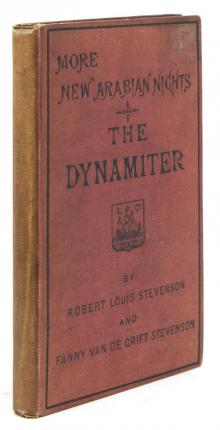
The Dynamiter, written in collaboration with her husband.
Introductions to her husband’s works.
A number of short stories in Scribner’s and McClure’s magazines, among which “Anne” and “The Half-White” attracted the most attention.
The Cruise of the Janet Nichol, a posthumous work.
Her own estimate of her talents and achievements was extremely modest, and it was always with the greatest reluctance that she put pen to paper. Yet she was intensely proud of the work of any member of her family — whether it might be sister, daughter, son, nephew, or grandson — and seemed to get more happiness out of anything we did than from her own work.
She was appalled at the great flood of mediocre writing that has been pouring over the United States in the last decade or two, and speaks of it thus in a letter written to Mr. Scribner from her quiet haven at Sausal:
“If I had a magazine of my own I should bar from its pages any story in which a young woman urges a young man to ‘do things’ when he doesn’t have to. There would also be a list of words and phrases that I would not have within my covers. But, if I had a magazine what would become of my peace and quiet that I care so much for? No — no such strenuous life for me! They may call houses ‘homes’ and spell words so that children and foreigners must be unable to find out how to pronounce them — I need not know of such annoyances in El Sausal unless I choose. I have before me a great pile of magazines — hence these cries. I read them with wonder and interest. There seems to be such an extraordinary quantity of clever, talented, ignorant, unliterary literature let loose in them. Where does it all come from? And why isn’t it better done — or worse done? I suppose we might call it ‘near literature.’ Sometimes, indeed, it is very near. I suppose it is the public school system that is accountable. Well, I never believed in general education, and here’s a justification of my attitude.”
When one casts a backward glance over the life of Fanny Van de Grift Stevenson, it cannot be said that she knew much of that for which she had always longed — peace. Her girlhood was cut short by a too early marriage. Her first romance was soon wrecked, and her second was constantly overshadowed by fear for the loved one. Storm and stress, varied by some peaceful intervals, filled the larger portion of her days, and at their end it was in storm and flood that her spirit took its flight. But it was a full, rich life, and had she had the choosing, I believe she would have elected no other.
After something more than a year had elapsed from the time of her death, Mrs. Stevenson’s daughter, who had now become the wife of Mr. Field, sailed with her husband in the spring of 1915 for Samoa, bearing with them the sacred ashes to be placed within the tomb on Mount Vaea.
Early in the war the New Zealand Expeditionary Forces had taken possession of German Samoa, so that when Mr. and Mrs. Field arrived they found the Union Jack flying over Vailima, now used as Government House by the Administrator, Colonel Logan, and his staff. The natives, interested spectators of these stirring events, remarked among themselves that Tusitala, not going back to his own country, had drawn his country out to him.
Two friends of the old Vailima days were a great help in making the arrangements for the funeral — Amatua, often referred to in the Stevenson letters as Sitione, now a serious elderly chief, and Laulii, a charming Samoan lady of rank, and a warm and attached friend of the Stevenson family. Of the Vailima household time and wars had eliminated all but the youngest — Mitaele, who looked much the same in spite of grey hair and a family of nine children.
It was Amatua who saw to it that those who remained of the builders of the “Road of the Loving Hearts” and the chiefs who had cut the path up the mountain for Tusitala’s funeral were included in the list of guests, and it was he who took personal charge of all the arrangements for the native ceremonies, which were conducted in the elaborate Samoan fashion as for a chief of the highest rank.
Colonel and Mrs. Logan very graciously invited the Fields to Vailima and placed the house and grounds at their disposal.
“It is strange,” wrote Mrs. Field, “being here at Vailima. I was so afraid to come, but mercifully it is not the same. Rooms have been added, the polished redwood panels in the large hall are painted over in white; the lawn where the tennis courts were is cut up into flower beds; many of the great trees have gone; and the atmosphere of the place has changed so utterly that I have to say to myself ‘This is Vailima’ to believe that I am here after so many years. Mrs. Logan and the Governor came out to meet us when we arrived, and as we turned into the road and I saw the house for the first time it was the Union Jack flying from the flag-staff that affected me most. I felt like a person in a dream as we walked over the house — the same and yet changed out of all recognition. We had tea, and then in the soft sunset we went down to the waterfall, no longer a fairy dell of loveliness but improved with a dam, cement flooring, and a row of neat bathrooms. In the evening we sat on the upper veranda looking out over the moonlit tree-tops; the scene was very beautiful, with the view of the sea and Vaea mountain so green and so close. ‘Here we wrote St. Ives and Hermiston,’ I tell myself, but I don’t believe it.”
It had been their intention to have their old missionary friend, Dr. Brown, conduct the services, but at the last moment word was brought that he was detained on one of the other islands by storms. For a time they were much troubled, but at last Colonel Logan lifted a load off their hearts by offering to read the Church of England service himself.
The day before that set for the funeral, June 22, it blew and rained, and there was much anxious foreboding about the weather. In the night, however, the wind blew away the clouds and rain, and morning broke, still, sunny, but cool — a perfect day.
The small bronze case containing the ashes, wrapped in a fine mat, had been laid on a table in one of the rooms that had wide doors opening on the veranda. The guests began to arrive early, in Samoan fashion, bringing flowers and wreaths, and soon the table was a mass of lovely blooms — all colours, for the Samoans do not adhere to white for funerals. The high chief Tamasese, with his wife Vaaiga, both wearing mourning bands on their arms, were the first to arrive. Then came Malietoa Tanu, who was a prominent figure in the war in which the United States and England joined to fight against Samoa. Following them came a long concourse of the old friends of Mr. and Mrs. Stevenson — natives, half-castes, and whites, and last of all, in a little carriage, three sweet sisters from the Sacred Heart Convent. The sisters could not stay for the ceremony on the hill, but begged to be allowed to say a little prayer, and the three knelt before the table and said an ave for one who had always been their friend.