Complete works of robert.., p.781
Complete Works of Robert Louis Stevenson (Illustrated),
p.781


30th. — After I had written you, I re-read my hurricane, which is very poor; the life of the journalist is hard, another couple of writings and I could make a good thing, I believe, and it must go as it is! But, of course, this book is not written for honour and glory, and the few who will read it may not know the difference. Very little time. I go down with the mail shortly, dine at the Chinese restaurant, and go to the club to dance with islandresses. Think of my going out once a week to dance.
Politics are on the full job again, and we don’t know what is to come next. I think the whole treaty raj seems quite played out! They have taken to bribing the faipule men (parliament men) to stay in Mulinuu, we hear; but I have not yet sifted the rumour. I must say I shall be scarce surprised if it prove true; these rumours have the knack of being right. — Our weather this last month has been tremendously hot, not by the thermometer, which sticks at 86°, but to the sensation: no rain, no wind, and this the storm month. It looks ominous, and is certainly disagreeable.
No time to finish. — Yours ever,
R. L. S.
To E. L. Burlingame
The first sentences of the following refer to A Footnote to History, Chapter x. of which, relating to the hurricane of 1889, was first published in the Scots Observer, edited by Mr. Henley.
[Vailima, March 1892.]
MY DEAR BURLINGAME, — Herewith Chapters IX. and X., and I am left face to face with the horrors and dilemmas of the present regimen: pray for those that go down to the sea in ships. I have promised Henley shall have a chance to publish the hurricane chapter if he like, so please let the slips be sent quam primum to C. Baxter, W.S., 11 S. Charlotte Street, Edinburgh. I got on mighty quick with that chapter — about five days of the toughest kind of work. God forbid I should ever have such another pirn to wind! When I invent a language, there shall be a direct and an indirect pronoun differently declined — then writing would be some fun.
Direct
He
Him
His
Indirect
Tu
Tum
Tus
Ex.: He seized tum by tus throat; but tu at the same moment caught him by his hair. A fellow could write hurricanes with an inflection like that! Yet there would be difficulties too.
Please add to my former orders —
Le Chevalier Des Touches
Les Diabohques
}
by Barbey d’Aurevilly.
Correspondence de Henri Beyle (Stendahl).
Yours sincerely,
R. L. Stevenson.
To the Rev. S. J. Whitmee
In this letter the essential points of Stevenson’s policy for Samoa are defined more clearly than anywhere else. His correspondent, an 175 experienced missionary who had been absent from the islands and lately returned, and whom Stevenson describes as being of a nature essentially “childlike and candid,” had been induced to support the idea of a one-man power as necessary for putting an end to the existing confusion, and to suggest the Chief Justice, Mr. Cedercrantz, as the person to wield such power. In the present letter and a subsequent conversation Stevenson was able to persuade his correspondent to abandon at least that part of his proposal which concerned the Chief Justice.
[Vailima] Sunday. Better Day, Better Deed.
April 24th, 1892.
Private and confidential.
DEAR MR. WHITMEE, — I have reflected long and fully on your paper, and at your kind request give you the benefit of my last thoughts.
I. I cannot bring myself to welcome your idea of one man. I fear we are too far away from any moderative influence; and suppose it to be true that the paper is bought, we should not even have a voice. Could we be sure to get a Gordon or a Lawrence, ah! very well. But in this out-of-the-way place, are these extreme experiments wise? Remember Baker; with much that he has done, I am in full sympathy; and the man, though wholly insincere, is a thousand miles from ill-meaning; and see to what excesses he was forced or led.
II. But I willingly admit the idea is possible with the right man, and this brings me with greater conviction to my next point. I cannot endorse, and I would rather beg of you to reconsider, your recommendation of the Chief Justice. I told you the man has always attracted me, yet as I have earnestly reconsidered the points against him, I find objection growing....
But there is yet another argument I have to lay before you. We are both to write upon this subject. Many of our opinions coincide, and, as I said the other day, on these we may reasonably suppose that we are not far wrong. Now here is a point on which we shall directly counter. No doubt but this will lessen the combined 176 weight of our arguments where they coincide. And to avoid this effect, it might seem worth while to you to modify or cancel the last paragraph of your article.
III. But I now approach what seems to me by far the most important. White man here, white man there, Samoa is to stand or fall (bar actual seizure) on the Samoan question. And upon this my mind is now really made up. I do not believe in Laupepa alone; I do not believe in Mataafa alone. I know that their conjunction implies peace; I am persuaded that their separation means either war or paralysis. It is the result of the past, which we cannot change, but which we must accept and use or suffer by. I have now made up my mind to do all that I may be able — little as it is — to effect a reconciliation between these two men Laupepa and Mataafa; persuaded as I am that there is the one door of hope. And it is my intention before long to approach both in this sense. Now, from the course of our interview, I was pleased to see that you were, if not equally strong with myself, at least inclined to much the same opinion. And in a carefully weighed paper, such as that you read me, I own I should be pleased to have this cardinal matter touched upon. At home it is not, it cannot be, understood: Mataafa is thought a rebel; the Germans profit by the thought to pursue their career of vengeance for Fagalii; the two men are perpetually offered as alternatives — they are no such thing — they are complementary; authority, supposing them to survive, will be impossible without both. They were once friends, fools and meddlers set them at odds, they must be friends again or have so much wisdom and public virtue as to pretend a friendship. There is my policy for Samoa. And I wish you would at least touch upon that point, I care not how; because, although I am far from supposing you feel it to be necessary in the same sense or to the same degree as I do, I am well aware that no man knows Samoa but must see its huge advantages. Excuse this long and tedious lecture, which I see I have 177 to mark private and confidential, or I might get into deep water, and believe me, yours very truly,
Robert Louis Stevenson.
To Charles Baxter
The maps herein bespoken do not adorn the ordinary editions of Catriona, only the Edinburgh edition, for which they were executed by Messrs. Bartholomew in a manner that would have rejoiced the writer’s heart.
[Vailima] April 28, 1892.
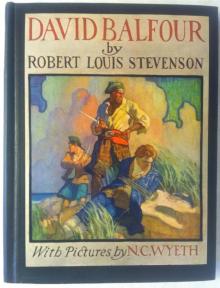
MY DEAR CHARLES, — I have just written the dedication of David Balfour to you, and haste to put a job in your hands. This is a map of the environs of Edinburgh circa 1750. It must contain Hope Park, Hunter’s Bog, Calton Hill, the Mouter Hill, Lang Dykes, Nor’ Loch, West Kirk, Village of Dean, pass down the water to Stockbridge, Silver Mills, the two mill lakes there, with a wood on the south side of the south one which I saw marked on a plan in the British Museum, Broughton, Picardy, Leith Walk, Leith, Pilrig, Lochend, Figgate Whins. And I would like a piece in a corner, giving for the same period Figgate Whins, Musselburgh, Inveresk, Prestonpans, battlefield of Gladsmuir, Cockenzie, Gullane — which I spell Gillane — Fidra, Dirleton, North Berwick Law, Whitekirk, Tantallon Castle and Castleton, Scougal and Auldhame, the Bass, the Glenteithy rocks, Satan’s Bush, Wildfire rocks, and, if possible, the May. If need were, I would not stick at two maps. If there is but one, say, Plan to illustrate David Balfour’s adventures in the Lothians. If two, call the first Plan to illustrate David Balfour’s adventures about the city of Edinburgh, and the second, Plan to illustrate David Balfour’s adventures in East Lothian. I suppose there must be a map-maker of some taste in Edinburgh; I wish few other names in, but what I have given, as far as possible. As soon as may be I will let you have the text, when you might 178 even find some amusement in seeing that the maps fill the bill. If your map-maker be a poor creature, plainness is best; if he were a fellow of some genuine go, he might give it a little of the bird’s-eye quality. I leave this to your good taste. If I have time I will copy the dedication to go herewith; I am pleased with it. The first map (suppose we take two) would go in at the beginning, the second at Chapter XI. The topography is very much worked into the story, and I have alluded in the dedication to our common fancy for exploring Auld Reekie.
The list of books came duly, for which many thanks. I am plunged to the nostrils in various business. — Yours ever,
R. L. S.
To Sidney Colvin
[Vailima] May 1st, 1892.
MY DEAR COLVIN, — As I rode down last night about six, I saw a sight I must try to tell you of. In front of me, right over the top of the forest into which I was descending, was a vast cloud. The front of it accurately represented the somewhat rugged, long-nosed, and beetle-browed profile of a man, crowned by a huge Kalmuck cap; the flesh part was of a heavenly pink, the cap, the moustache, the eyebrows were of a bluish grey; to see this with its childish exactitude of design and colour, and hugeness of scale — it covered at least 25° — held me spell-bound. As I continued to gaze, the expression began to change; he had the exact air of closing one eye, dropping his jaw, and drawing down his nose; had the thing not been so imposing, I could have smiled; and then almost in a moment, a shoulder of leaden-coloured bank drove in front and blotted it. My attention spread to the rest of the cloud, and it was a thing to worship. It rose from the horizon, and its top was within thirty degrees of the zenith; the lower parts were like a glacier in shadow, varying from dark indigo to a clouded white in exquisite 179 gradations. The sky behind, so far as I could see, was all of a blue already enriched and darkened by the night, for the hill had what lingered of the sunset. But the top of my Titanic cloud flamed in broad sunlight, with the most excellent softness and brightness of fire and jewels, enlightening all the world. It must have been far higher than Mount Everest, and its glory, as I gazed up at it out of the night, was beyond wonder. Close by rode the little crescent moon; and right over its western horn, a great planet of about equal lustre with itself. The dark woods below were shrill with that noisy business of the birds’ evening worship. When I returned, after eight, the moon was near down; she seemed little brighter than before, but now that the cloud no longer played its part of a nocturnal sun, we could see that sight, so rare with us at home that it was counted a portent, so customary in the tropics, of the dark sphere with its little gilt band upon the belly. The planet had been setting faster, and was now below the crescent. They were still of an equal brightness.
I could not resist trying to reproduce this in words, as a specimen of these incredibly beautiful and imposing meteors of the tropic sky that make so much of my pleasure here; though a ship’s deck is the place to enjoy them. O what awful scenery, from a ship’s deck, in the tropics! People talk about the Alps, but the clouds of the trade wind are alone for sublimity.
Now to try and tell you what has been happening. The state of these islands, and of Mataafa and Laupepa (Malietoas ambo), had been much on my mind. I went to the priests and sent a message to Mataafa, at a time when it was supposed he was about to act. He did not act, delaying in true native style, and I determined I should go to visit him. I have been very good not to go sooner; to live within a few miles of a rebel camp, to be a novelist, to have all my family forcing me to go, and to refrain all these months, counts for virtue. But 180 hearing that several people had gone and the government done nothing to punish them, and having an errand there which was enough to justify myself in my own eyes, I half determined to go, and spoke of it with the half-caste priest. And here (confound it) up came Laupepa and his guards to call on me; we kept him to lunch, and the old gentleman was very good and amiable. He asked me why I had not been to see him? I reminded him a law had been made, and told him I was not a small boy to go and ask leave of the consuls, and perhaps be refused. He told me to pay no attention to the law but come when I would, and begged me to name a day to lunch. The next day (I think it was) early in the morning, a man appeared; he had metal buttons like a policeman — but he was none of our Apia force; he was a rebel policeman, and had been all night coming round inland through the forest from Malie. He brought a letter addressed
I lana susuga
Misi Mea.
To his Excellency
Mr. Thingumbob.
(So as not to compromise me.) I can read Samoan now, though not speak it. It was to ask me for last Wednesday. My difficulty was great; I had no man here who was fit, or who would have cared, to write for me; and I had to postpone the visit. So I gave up half-a-day with a groan, went down to the priests, arranged for Monday week to go to Malie, and named Thursday as my day to lunch with Laupepa. I was sharply ill on Wednesday, mail day. But on Thursday I had to trail down and go through the dreary business of a feast, in the King’s wretched shanty, full in view of the President’s fine new house; it made my heart burn.
This gave me my chance to arrange a private interview with the king, and I decided to ask Mr. Whitmee to be my interpreter. On Friday, being too much exhausted to go down, I begged him to come up. He did. I told him the heads of what I meant to say; and he not only 181 consented, but said, if we got on well with the king, he would even proceed with me to Malie. Yesterday, in consequence, I rode down to W.’s house by eight in the morning; waited till ten; received a message that the king was stopped by a meeting with the president and faipule; made another engagement for seven at night; came up; went down; waited till eight, and came away again, bredouille, and a dead body. The poor, weak, enslaved king had not dared to come to me even in secret. Now I have to-day for a rest, and to-morrow to Malie. Shall I be suffered to embark? It is very doubtful; they are on the trail. On Thursday, a policeman came up to me and began that a boy had been to see him, and said I was going to see Mataafa. — ”And what did you say?” said I. — ”I told him I did not know about where you were going,” said he. — ”A very good answer,” said I, and turned away. It is lashing rain to-day, but to-morrow, rain or shine, I must at least make the attempt; and I am so weary, and the weather looks so bad. I could half wish they would arrest me on the beach. All this bother and pother to try and bring a little chance of peace; all this opposition and obstinacy in people who remain here by the mere forbearance of Mataafa, who has a great force within six miles of their government buildings, which are indeed only the residences of white officials. To understand how I have been occupied, you must know that “Misi Mea” has had another letter, and this time had to answer himself; think of doing so in a language so obscure to me, with the aid of a Bible, concordance, and dictionary! What a wonderful Baboo compilation it must have been! I positively expected to hear news of its arrival in Malie by the sound of laughter. I doubt if you will be able to read this scrawl, but I have managed to scramble somehow up to date; and to-morrow, one way or another, should be interesting. But as for me, I am a wreck, as I have no doubt style and handwriting both testify.
8 P.M. — Wonderfully rested; feel almost fit for to-morrow’s dreary excursion — not that it will be dreary if the weather favour, but otherwise it will be death; and a native feast, and I fear I am in for a big one, is a thing I loathe. I wonder if you can really conceive me as a politician in this extra-mundane sphere — presiding at public meetings, drafting proclamations, receiving mis-addressed letters that have been carried all night through tropical forests? It seems strange indeed, and to you, who know me really, must seem stranger. I do not say I am free from the itch of meddling, but God knows this is no tempting job to meddle in; I smile at picturesque circumstances like the Misi Mea (Monsieur Chose is the exact equivalent) correspondence, but the business as a whole bores and revolts me. I do nothing and say nothing; and then a day comes, and I say “this can go on no longer.”
9.30 P.M. — The wretched native dilatoriness finds me out. News has just come that we must embark at six to-morrow; I have divided the night in watches, and hope to be called to-morrow at four and get under way by five. It is a great chance if it be managed; but I have given directions and lent my own clock to the boys, and hope the best. If I get called at four we shall do it nicely. Good-night; I must turn in.
May 3rd. — Well, we did get off by about 5.30, or, by’r lady! quarter to six; myself on Donald, the huge grey cart-horse, with a ship-bag across my saddle bow, Fanny on Musu and Belle on Jack. We were all feeling pretty tired and sick, and I looked like heaven knows what on the cart-horse: “death on the pale horse,” I suggested — and young Hunt the missionary, who met me to-day on the same charger, squinted up at my perch and remarked, “There’s a sweet little cherub that sits up aloft.” The boat was ready and we set off down the lagoon about seven, four oars, and Talolo, my cook, steering.