Complete works of robert.., p.858
Complete Works of Robert Louis Stevenson (Illustrated),
p.858


Those sung at Vailima parties were usually written by one of the house “boys” and “they were danced and acted with great spirit.... Sometimes every member of the family would be represented ... but the central figure, the heart of the song was always Tusitala.”
It is a marvel with the many demands made upon him, his varied interests, and frequent visits to neighboring islands, Stevenson still found time to write stories, poems, prayers, notes of the South Sea Islands, Samoan history, and many, many letters. “It is a life that suits me but absorbs me like an ocean,” he said. Through it all his health continued fairly good. He was able to take long tramps and rides that would have been physically impossible two years before.
Mrs. Strong acted as his secretary and the majority of his writing now was done by dictation. “He generally makes notes early in the morning,” she wrote, “which he elaborates as he reads them aloud ... he never falters for a word, but gives me the sentence with capital letters and all the stops as clearly and steadily as though he were reading from an unseen book.”
The two South Sea books occupied much of his time, but it was of his own land and people so far away that he had so little hope of ever seeing again, he loved best to write.
“It is a singular thing,” he wrote to James Barrie, “that I should live here in the South Seas, and yet my imagination so continually inhabit the cold old huddle of grey hills from which we came.”
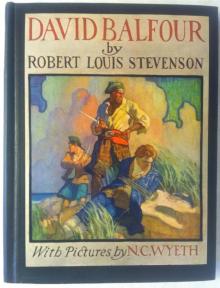
He finished and sent away further adventures of David Balfour and Alan Breck under the title of “David Balfour.” “St. Ives” followed with its scenes laid around Edinburgh Castle, Swanston Cottage, and the Pentland Hills. In his last book, “Weir of Hermiston,” the one he left unfinished, broken off in the midst of a word, he roamed the streets of Auld Reekie again with a hero very like what he had once been himself, who was likewise an enthusiastic member of the “Spec.”
Something which pleased him greatly at this time was the news from his friend Charles Baxter in Edinburgh that a complete edition of his works was to be published in the best possible form with a limited number of copies, to be called the “Edinburgh Edition.”
“I suppose it was your idea to give it that name,” Stevenson wrote, thanking him. “No other would have affected me in the same manner.... Could a more presumptuous idea have occurred to us in those days when we used to search our pockets for coppers, too often in vain, and combine forces to produce the threepence necessary for two glasses of beer, than that I should be strong and well at the age of forty three in the island of Upolu, and that you should be at home bringing out the ‘Edinburgh Edition’?”
In spite of the many interests in his present life, his love for the people and the country, the yearning for the friends far away grew daily.
How he longed to have them see Vailima with all its beauties! To talk over old times again. Such visits were continually planned, but they were never realised.
He seldom complained and those who were with him every day rarely found him low in spirits. It was into the letters to his old intimates that these longings crept when it swept over him that, though a voluntary exile in a pleasant place, he was an exile none the less, with the fate of him who wrote:
“There’s a track across the deep,
And a path across the sea,
But for me there’s nae return
To my ain countree.”
“When the smell of the good wet earth” came to him it came “with a kind of Highland tone.” A tropic shower found him in a “frame of mind and body that belonged to Scotland.” And when he turned to write the chronicle of his grandfather’s life and work, the beautiful words in which he described the old gentleman’s farewell to “Sumbraugh and the wild crags of Skye” meant likewise his own farewell to those shores. No more was he to “see the topaz and ruby interchange on the summit of Bell Rock,” no more to see “the castle on its hills,” or the venerable city which he always thought of as his home.
“Like Leyden,” he wrote, “I have gone into a far land to die, not stayed like Burns to mingle in the end with Scottish soil.”
It was drawing near the close of their fourth year in Apia. On November 13 his birthday had been celebrated with the usual festivities, and on Thanksgiving Day he had given a dinner to his American friends — and then the end of all his wanderings and working came suddenly.
“He wrote hard all that morning of the last day,” says Lloyd Osbourne, “on his half-finished book Hermiston.... In the afternoon the mail fell to be answered; not business correspondence — but replies to the long, kindly letters of distant friends, received but two days since, and still bright in memory.
“At sunset he came downstairs.... He was helping his wife on the verandah, and gaily talking, when suddenly he put both hands to his head, and cried out, ‘What’s that?’ Then he asked quickly, ‘Do I look strange?’ Even as he did so he fell on his knees beside her. He was helped into the great hall, between his wife and body-servant, Sosimo, losing consciousness instantly, as he lay back in the arm-chair that had once been his grandfather’s. Little time was lost in bringing the doctors, Anderson of the man-of-war, and his friend Dr. Funk. They looked at him and shook their heads ... he had passed the bounds of human skill....
“The dozen and more Samoans that formed part of the clan of which he was chief, sat in a wide semicircle on the floor, their reverent, troubled, sorrow-stricken faces all fixed upon their dying master. Some knelt on one knee to be instantly ready for any command that might be laid upon them....
“He died at ten minutes past eight on Monday evening the 3rd of December, in the forty-fifth year of his age.
“The great Union Jack that flew over the house was hauled down and laid over the body, fit shroud for a loyal Scotsman. He lay in the hall which was ever his pride, where he had passed the gayest and most delightful hours of his life.... In it were the treasures of his far off Scottish home.... The Samoans passed in procession beside his bed, kneeling and kissing his hand, each in turn, before taking their places for the long night watch beside him. No entreaty could induce them to retire, to rest themselves for the painful arduous duties of the morrow. It would show little love for Tusitala, they said, if they did not spend their last night beside him. Mournful and silent, they sat in deep dejection, poor, simple, loyal folks, fulfilling the duty that they owed their chief.
“A messenger was dispatched to a few chiefs connected with the family, to announce the tidings and bid them assemble their men on the morrow for the work there was to do....
“The morning of the 4th of December broke cool and sunny.... A meeting of chiefs was held to apportion the work and divide the men into parties. Forty were sent with knives and axes to cut a path up the steep face of the mountain, and the writer himself led another party to the summit — men chosen from the immediate family — to dig the grave on the spot where it was Robert Louis Stevenson’s wish that he should lie.... Nothing more picturesque can be imagined than the ledge that forms the summit to Væa, a place no wider than a room, and flat as a table. On either side the land descends precipitously; in front lies the vast ocean and surf-swept reefs; to the right and left green mountains rise....
“All the morning Samoans were arriving with flowers, few of these were white, for they have not learned our foreign custom, and the room glowed with the many colours. There were no strangers on that day, no acquaintances; those only were called who would deeply feel the loss. At one o’clock a body of powerful Samoans bore away the coffin, hid beneath a tattered red ensign that had flown above his vessel in many a remote corner of the South Seas. A path so steep and rugged taxed their strength to the utmost, for not only was the journey difficult in itself, but extreme care was requisite to carry the coffin shoulder high....
“No stranger hand touched him.... Those who loved him carried him to his last home; even the coffin was the work of an old friend. The grave was dug by his own men.”
Tusitala had left them, and his friends in the South Seas had lost a faithful friend and companion, a wise and just master.
His family and friends the world over had lost not only these but far more. His life had been a chivalrous one with all the best that chivalry stands for, “loyalty, honesty, generosity, courage, courtesy, and self-devotion; to impute no unworthy motives and to bear no grudges; to bear misfortune with cheerfulness and without a murmur; to strike hard for the right and to take no mean advantage; to be gentle to women and kind to all that are weak; to be rigorous with oneself and very lenient to others — these ... were the traits that distinguished Stevenson.”
“They do not make life easy as he frequently found.”
His resting-place on the crest of Væa Mountain is covered by a tomb of gray stone. On one side is inscribed in English the verses he had written for his own requiem:
A
1850
ROBERT LOUIS
STEVENSON
©
1894
“Under the wide and starry sky,
Dig the grave and let me lie,
Glad did I live and gladly die,
And I laid me down with a will.
“This be the verse you grave for me:
Here he lies where he longed to be;
Home is the sailor, home from the sea,
And the hunter home from the hill.”
The tomb of Stevenson on Væa Mountain
On the other side, written in Samoan and surrounded by carvings of thistles, his native flowers, and the hibiscus flowers, emblem of the South, are the words from the Bible:
“Whither thou goest I will go, and where thou lodgest I will lodge; thy people shall be my people; and thy God my God; where thou diest will I die, and there will I be buried.”
The Samoan chiefs have forbidden the use of firearms upon Væa hillside, “that the birds may live there undisturbed, and raise above his grave the songs he loved so well.”
“Tusitala, the lover of children, the teller of tales,
Giver of counsels and dreams, a wonder, a world’s delight,
Looks o’er the labours of men in the plain and the hills; and the sails
Pass and repass on the sea that he loved, in the day and the night.”
— ANDREW LANG.
THE LIFE OF MRS. ROBERT LOUIS STEVENSON By Nellie Van De Grift Sanchez
This biography of Stevenson’s wife was first published in 1920.
Fanny Van de Grift Stevenson
CONTENTS
PREFACE
CHAPTER I
ANCESTORS
CHAPTER II
EARLY DAYS IN INDIANA
CHAPTER III
ON THE PACIFIC SLOPE
CHAPTER IV
FRANCE, AND THE MEETING AT GREZ
CHAPTER V
IN CALIFORNIA WITH ROBERT LOUIS STEVENSON
CHAPTER VI
EUROPE AND THE BRITISH ISLES
CHAPTER VII
AWAY TO SUNNIER LANDS
CHAPTER VIII
THE HAPPY YEARS IN SAMOA
CHAPTER IX
THE LONELY DAYS OF WIDOWHOOD
CHAPTER X
BACK TO CALIFORNIA
CHAPTER XI
TRAVELS IN MEXICO AND EUROPE
CHAPTER XII
THE LAST DAYS AT SANTA BARBARA
PREFACE
When I first set out to tell the life story of Mrs. Robert Louis Stevenson, I received the following letter from her old friend Mr. Bruce Porter:
“Once when I urged your sister to set down the incidents of her life she listened, pondered, and then dismissed the suggestion as impossible, as her life had been like a dazed rush on a railroad express, and she despaired of recovering the incidental memories. The years with Stevenson have of course been adequately told, but the earlier period — Indianapolis and California — had a romance as stirring, even if sharpened by the American glare. This sharpness has already, for all of us, begun to fade, to take on the glamour of time and distance, and I cannot think of a better literary service than to make the fullest possible record now, before it utterly fades away.”
It was not only the difficulty of recalling events that caused her to resist all urgings to undertake this task, but a certain shy reluctance in speaking of herself that was characteristic of her. It has, therefore, fallen to me to collect the widely scattered material from various parts of the world and weave it into a coherent whole as best I may, but my regret will never cease that she did not herself tell her own story.
It would take a more competent pen than mine to do her justice; but whoever reads this book from cover to cover will surely agree that no woman ever had a life of more varied experiences nor went through them all with a stauncher courage.
It is right that I should acknowledge here my profound obligation to the kind friends who have generously placed their personal recollections at my disposal. These are more definitely referred to in the body of the book. Aside from these personal contributions, the main sources of material have been as follows:
Ancestral genealogies, including The Descendants of Jöran Kyn, by Doctor Gregory B. Keen, secretary of the Pennsylvania Historical Society.
Data concerning the genealogy of the Keen and Van de Grift families collected by Frederic Thomas, of New York, nephew of Mrs. Stevenson.
Notes covering the life of Mrs. Stevenson up to the age of sixteen years, as dictated by herself.
A collection of her own letters to friends and relatives.
Letters to Mrs. Stevenson from friends.
Extracts from various books and magazines, including The Letters of Mrs. M. I. Stevenson (Methuen and Company, London); The Life of Robert Louis Stevenson, by Graham Balfour; The Letters of Robert Louis Stevenson, edited by Sidney Colvin; Vailima Memories, by Lloyd Osbourne and Isobel Osbourne Strong, now Mrs. Salisbury Field; The Cruise of the Janet Nichol, by Mrs. Robert Louis Stevenson; McClure’s, Scribner’s, and the Century magazines. Acknowledgment is due the publishers of the above books and periodicals for their courteous permissions.
A diary kept by Mrs. Stevenson of her life in Samoa, for which I am indebted to the considerate kindness of Miss Gladys Peacock, an English lady, into whose hands the diary fell by accident.
My own personal recollections.
Above all, I wish to express my heartfelt gratitude to Mrs. Stevenson’s daughter, Isobel Field, without whose unflagging zeal in forwarding the work it could scarcely have been carried to a successful conclusion, and to my son, Louis A. Sanchez, for valuable assistance in the actual writing of the book.
N. V. S.
Berkeley, California, January, 1919.
THE LIFE OF MRS. ROBERT LOUIS STEVENSON
CHAPTER I
ANCESTORS
To arrive at a full understanding of the complex and unusual character of Fanny Van de Grift Stevenson, which perhaps played as large a part as her beauty and intellectual charm in drawing to her the affections of one of the greatest romance writers of our day, one must go back and seek out all the uncommon influences that combined to produce it — a long line of sturdy ancestors, running back to the first adventurers who left their sheltered European homes and sailed across the sea to try their fortunes in a wild, unknown land; her childhood days spent among the hardy surroundings of pioneer Indiana, with its hints of a past tropical age and its faint breath of Indian reminiscence; the early breaking of her own family ties and her fearless adventuring by way of the Isthmus of Panama to the distant land of gold, and her brave struggle against adverse circumstances in the mining camps of Nevada. All these prenatal influences and personal experiences, so foreign to the protected lives of the women of Stevenson’s own race, threw about her an atmosphere of thrilling New World romance that appealed with irresistible force to the man who was himself Romance personified.
Fanny Stevenson was a lineal descendant of two of the oldest families in the United States, her first ancestors landing in this country in the early part of the seventeenth century. In 1642 Jöran Kyn, called “The Snow White,” reached America in the ship Fama as a member of the life-guard of John Printz, governor of the Swedish colony established in the New World by King Gustavus Adolphus. He took up a large tract of land and was living in peace and comfort on the Delaware River when William Penn landed in America. He was the progenitor of eleven generations of descendants born on American soil. His memory is embalmed in an old document still extant as “a man who never irritated even a child.”
In the list of his descendants one Matthias stands out as “a tall handsome man, with a very melodious voice which could be intelligibly heard at times across the Delaware.”
John Keen, about 83 years of age, maternal great-grandfather of Fanny Van de Grift Stevenson.
A later descendant, John Keen, born in 1747, fought and shed his blood in the war of American Independence, having been wounded in the battle of Princeton while in the act of delivering a message to General Washington. It was he who married Mildred Cook, daughter of James Cook, an English sea-captain who commanded the London Packet, plying between London and New York. Family tradition has it that he was a near relative of Captain Cook of South Sea fame. When Fanny Stevenson went a-sailing in the South Seas, following in the track of the great explorer, she boldly claimed this kinship, and, much to her delight, was immediately christened Tappeni Too-too, which was as near as the natives could come to Captain Cook’s name.
We have a charming old-fashioned silhouette portrait in our family of a lovely young creature with a dainty profile and curls gathered in a knot. It is “sweet Kitty Weaver,” who married John Cook Keen, son of the Revolutionary hero, and became the grandmother of Fanny Stevenson. Little Fanny, when on a visit to Philadelphia in her childhood days, was shown a pair of red satin slippers worn by this lady, and was no doubt given a lecture on the folly of vanity, for it was by walking over the snow to her carriage in the little red slippers that sweet Kitty Weaver caught the cold which caused her death.