Complete works of robert.., p.808
Complete Works of Robert Louis Stevenson (Illustrated),
p.808
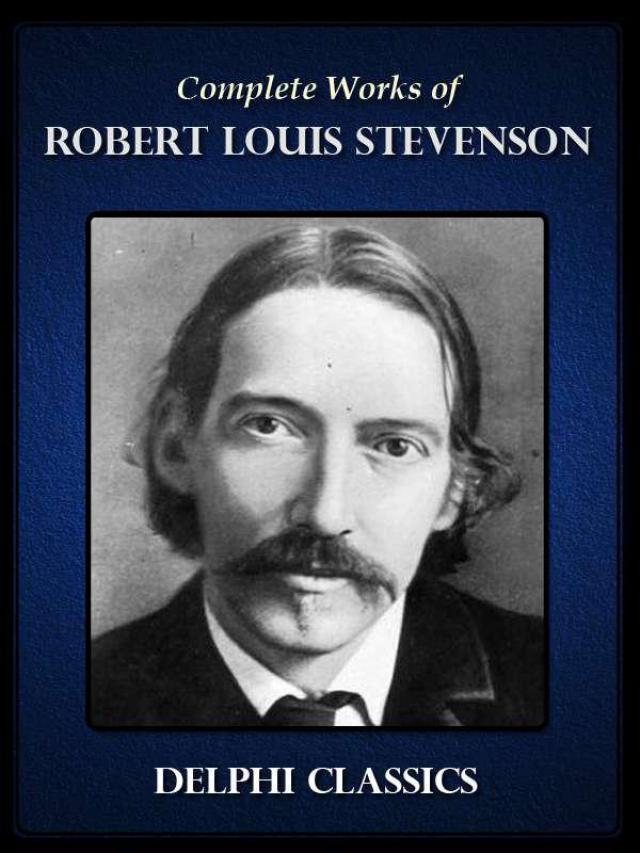


R. L. S.
To Sidney Colvin
This was the last letter I received from my friend. On the morning of his death the following month he spoke of being behindhand with his December letter and of his intention to write it next day.
[Vailima, November 1894.]
DEAR COLVIN, — Saturday there was a ball to the ship, and on Sunday Gurr had a child to be baptized. Belle was to be godmother and had to be got down; which was impossible, as the jester Euclid says. However, we had four men of very different heights take the poles of a sort of bier and carry her shoulder high down the road, till we met a trap. On the return journey on Sunday, they were led by Austin playing (?) on a bugle, and you have no idea how picturesque a business it was; the four half-naked bearers, the cane lounge at that height from the ground, and Belle in black and pretty pale reclining very like a dead warrior of yore. However she wasn’t dead yet. All the rest of the afternoon we hung 449 about and had consultations about the baptism. Just as we went in to dinner, I saw the moon rise accurately full, looking five times greater than nature, and the face that we try to decipher in its silver disk wearing an obliterated but benignant expression. The ball followed; bluejackets and officers danced indiscriminately, after their pleasant fashion; and Belle, who lay in the hotel verandah, and held a sort of reception all night, had her longest visit from one of the blue-jackets, her partner in the last ball. About one on the Sunday morning all was over, and we went to bed — I, alas! only to get up again, my room being in the verandah, where a certain solemnly absurd family conclave (all drunk) was being held until (I suppose) three. By six, I was awake, and went out on the verandah. On the east the dawn had broken, cold and pink and rust colour, and the marshes were all smoking whitely and blowing into the bay like smoke, but on the west, all was golden. The street was empty, and right over it hung the setting moon, accurately round, yellow as an apricot, but slumberous, with an effect of afternoon you would not believe if you had not seen it. Then followed a couple of hours on the verandah I would be glad to forget. By seven X. Y. had joined me, as drunk as they make ‘em. As he sat and talked to me, he smelt of the charnel house, methought. He looked so old (he is one month my senior); he spoke so silly; his poor leg is again covered with boils, which will spell death to him; and — enough. That interview has made me a teetotaller. O, it is bad to grow old. For me, it is practically hell. I do not like the consolations of age. I was born a young man; I have continued so; and before I end, a pantaloon, a driveller — enough again. But I don’t enjoy getting elderly. Belle and I got home about three in the afternoon, she having in the meantime renounced all that makes life worth living in the name of little Miss Gurr, and I seriously reflecting on renouncing the kindly bowl in earnest! Presently after arrived the news of 450 Margery Ide (the C.J.’s daughter) being seriously ill, alarmingly ill. Fanny wanted to go down; it was a difficult choice; she was not fit for it; on the other hand (and by all accounts) the patient would die if she did not get better nursing. So we made up our own minds, and F. and I set out about dusk, came to the C.J.’s in the middle of dinner, and announced our errand. I am glad to say the C.J. received her very willingly; and I came home again, leaving her behind, where she was certainly much wanted.
Nov. 4th. — You ask about St. Ives. No, there is no Burford Bridge in it, and no Boney. He is a squire of dames, and there are petticoats in the story, and damned bad ones too, and it is of a tolerable length, a hundred thousand, I believe, at least. Also, since you are curious on the point, St. Ives learned his English from a Mr. Vicary, an English lawyer, a prisoner in France. He must have had a fine gift of languages!
Things are going on here in their usual gently disheartening gait. The Treaty Officials are both good fellows whom I can’t help liking, but who will never make a hand of Samoa. — Yours ever,
R. L. Stevenson.
To Professor Meiklejohn
Congratulating an old friend of Savile Club days (see vol. xxiii. ) on his sailor son.
Vailima, Samoa, Nov. 6th, 1894.
MY DEAR MEIKLEJOHN, — Greeting! This is but a word to say how much we felicitate ourselves on having made the acquaintance of Hughie. He is having a famous good chance on board the Curaçoa, which is the best ship I have ever seen. And as for himself, he is a most engaging boy, of whom you may very well be proud, and I have no mortal manner of doubt but what you are. He comes up here very often, where he is a great favourite 451 with my ladies, and sings me “the melancholy airs of my native land” with much acceptancy. His name has recently become changed in Vailima. Beginning with the courteous “Mr. Meiklejohn,” it shaded off into the familiar “Hughie,” and finally degenerated into “the Whitrett.” I hear good reports of him abroad and ashore, and I scarce need to add my own testimony.
Hughie tells me you have gone into the publishing business, whereat I was much shocked. My own affairs with publishers are now in the most flourishing state, owing to my ingenuity in leaving them to be dealt with by a Scotch Writer to the Signet. It has produced revolutions in the book trade and my banking account. I tackled the Whitrett severely on a grammar you had published, which I had not seen and condemned out of hand and in the broadest Lallan. I even condescended on the part of that grammar which I thought to be the worst and condemned your presentation of the English verb unmercifully. It occurs to me, since you are a publisher, that the least thing you could do would be to send me a copy of that grammar to correct my estimate. But I fear I am talking too long to one of the enemy. I begin to hear in fancy the voice of Meiklejohn upraised in the Savile Club: “No quarter to publishers!” So I will ask you to present my compliments to Mrs. Meiklejohn upon her son, and to accept for yourself the warmest reminiscences of auld lang syne. — Yours sincerely,
Robert Louis Stevenson.
To Lieutenant Eeles
Vailima, Samoa, November 24, 1894.
MY DEAR EELES, — The hand, as you will perceive (and also the spelling!), is Teuila’s, but the scrannel voice is 452 what remains of Tusitala’s. First of all, for business. When you go to London you are to charter a hansom cab and proceed to the Museum. It is particular fun to do this on Sundays when the Monument is shut up. Your cabman expostulates with you, you persist. The cabman drives up in front of the closed gates and says, “I told you so, sir.” You breathe in the porter’s ears the mystic name of Colvin, and he immediately unfolds the iron barrier. You drive in, and doesn’t your cabman think you’re a swell. A lord mayor is nothing to it. Colvin’s door is the only one in the eastern gable of the building. Send in your card to him with “From R. L. S.” in the corner, and the machinery will do the rest. Henry James’s address is 34 De Vere Mansions West. I cannot remember where the place is; I cannot even remember on which side of the park. But it’s one of those big Cromwell Road-looking deserted thoroughfares out west in Kensington or Bayswater, or between the two; and anyway Colvin will be able to put you on the direct track for Henry James. I do not send formal introductions, as I have taken the liberty to prepare both of them for seeing you already.
Hoskyn is staying with us.
It is raining dismally. The Curaçoa track is hardly passable, but it must be trod to-morrow by the degenerate feet of their successor the Wallaroos. I think it a very good account of these last that we don’t think them either deformed or habitual criminals — they seem to be a kindly lot.
The doctor will give you all the gossip. I have preferred in this letter to stick to the strictly solid and necessary. With kind messages from all in the house to all in the wardroom, all in the gunroom, and (may we dare to breathe it) to him who walks abaft, believe me, my dear Eeles, yours ever,
R. L. Stevenson.
To Sir Herbert Maxwell
Vailima, Samoa, December 1, 1894.
DEAR SIR HERBERT, — Thank you very much for your long and kind letter. I shall certainly take your advice and call my cousin, the Lyon King, into council. It is certainly a very interesting subject, though I don’t suppose it can possibly lead to anything, this connection between the Stevensons and M’Gregors. Alas! your invitation is to me a mere derision. My chances of visiting Heaven are about as valid as my chances of visiting Monreith. Though I should like well to see you, shrunken into a cottage, a literary Lord of Ravenscraig. I suppose it is the inevitable doom of all those who dabble in Scotch soil; but really your fate is the more blessed. I cannot conceive anything more grateful to me, or more amusing or more picturesque, than to live in a cottage outside your own park-walls. — With renewed thanks, believe me, dear Sir Herbert, yours very truly,
Robert Louis Stevenson.
To Andrew Lang
The following refers of course to Weir of Hermiston, the chief character of which was studied from the traditions of Lord Braxfield, and on which Stevenson was working at the full height of his powers when death overtook him two days later.
Vailima, Samoa, December 1, 1894.
MY DEAR LANG, — For the portrait of Braxfield, much thanks! It is engraved from the same Raeburn portrait that I saw in ‘76 or ‘77 with so extreme a gusto that I have ever since been Braxfield’s humble servant, and am now trying, as you know, to stick him into a novel. Alas! one might as well try to stick in Napoleon. The picture shall be framed and hung up in my study. Not only as 454 a memento of you, but as a perpetual encouragement to do better with his Lordship. I have not yet received the transcripts. They must be very interesting. Do you know I picked up the other day an old Longman’s where I found an article of yours that I had missed, about Christie’s? I read it with great delight. The year ends with us pretty much as it began, among wars and rumours of wars, and a vast and splendid exhibition of official incompetence. — Yours ever,
R. L. Stevenson.
To Edmund Gosse
The next, and last, letter is to Mr. Gosse, dated also only two days before the writer’s death. It acknowledges the dedication “To Tusitala” of that gentleman’s volume of poems, In Russet and Silver, just received.
Vailima, Samoa, December 1, 1894.
I am afraid, my dear Weg, that this must be the result of bribery and corruption! The volume to which the dedication stands as preface seems to me to stand alone in your work; it is so natural, so personal, so sincere, so articulate in substance, and what you always were sure of — so rich in adornment.
Let me speak first of the dedication. I thank you for it from the heart. It is beautifully said, beautifully and kindly felt; and I should be a churl indeed if I were not grateful, and an ass if I were not proud. I remember when Symonds dedicated a book to me; I wrote and told him of “the pang of gratified vanity” with which I had read it. The pang was present again, but how much more sober and autumnal — like your volume. Let me tell you a story, or remind you of a story. In the year of grace something or other, anything between ‘76 and ‘78, I mentioned to you in my usual autobiographical and inconsiderate manner that I was hard up. You said promptly that you had a balance at your banker’s, and could make it convenient to let me have a cheque, and I 455 accepted and got the money — how much was it? — twenty or perhaps thirty pounds? I know not — but it was a great convenience. The same evening, or the next day, I fell in conversation (in my usual autobiographical and ... see above) with a denizen of the Savile Club, name now gone from me, only his figure and a dim three-quarter view of his face remaining. To him I mentioned that you had given me a loan, remarking easily that of course it didn’t matter to you. Whereupon he read me a lecture, and told me how it really stood with you financially. He was pretty serious; fearing, as I could not help perceiving, that I should take too light a view of the responsibility and the service (I was always thought too light — the irresponsible jester — you remember. O, quantum mutatus ab illo!) If I remember rightly, the money was repaid before the end of the week — or, to be more exact and a trifle pedantic, the se’nnight — but the service has never been forgotten; and I send you back this piece of ancient history, consule Planco, as a salute for your dedication, and propose that we should drink the health of the nameless one, who opened my eyes as to the true nature of what you did for me on that occasion.
But here comes my Amanuensis, so we’ll get on more swimmingly now. You will understand perhaps that what so particularly pleased me in the new volume, what seems to me to have so personal and original a note, are the middle-aged pieces in the beginning. The whole of them, I may say, though I must own an especial liking to —
“I yearn not for the fighting fate,
That holds and hath achieved;
I live to watch and meditate
And dream — and be deceived.”
You take the change gallantly. Not I, I must confess. It is all very well to talk of renunciation, and of course it has to be done. But, for my part, give me a roaring toothache! I do like to be deceived and to dream, but 456 I have very little use for either watching or meditation. I was not born for age. And, curiously enough, I seem to see a contrary drift in my work from that which is so remarkable in yours. You are going on sedately travelling through your ages, decently changing with the years to the proper tune. And here am I, quite out of my true course, and with nothing in my foolish elderly head but love-stories. This must repose upon some curious distinction of temperaments. I gather from a phrase, boldly autobiographical, that you are — well, not precisely growing thin. Can that be the difference?
It is rather funny that this matter should come up just now, as I am at present engaged in treating a severe case of middle age in one of my stories — ”The Justice-Clerk.” The case is that of a woman, and I think that I am doing her justice. You will be interested, I believe, to see the difference in our treatments. Secreta Vitæ comes nearer to the case of my poor Kirstie. Come to think of it, Gosse, I believe the main distinction is that you have a family growing up around you, and I am a childless, rather bitter, very clear-eyed, blighted youth. I have, in fact, lost the path that makes it easy and natural for you to descend the hill. I am going at it straight. And where I have to go down it is a precipice.
I must not forget to give you a word of thanks for An English Village. It reminds me strongly of Keats, which is enough to say; and I was particularly pleased with the petulant sincerity of the concluding sentiment.
Well, my dear Gosse, here’s wishing you all health and prosperity, as well as to the mistress and the bairns. May you live long, since it seems as if you would continue to enjoy life. May you write many more books as good as this one — only there’s one thing impossible, you can never write another dedication that can give the same pleasure to the vanished
Tusitala.
* * *
This question is with a view to the adventures of the hero in St. Ives, who according to Stevenson’s original plan was to have been picked up from his foundered balloon by an American privateer.
As to admire The Black Arrow.
The suppressed first part of the Amateur Emigrant, written in San Francisco in 1879, which it was proposed now to condense and to some extent recast for the Edinburgh Edition.
Word omitted in MS.
I may be allowed to quote the following sentence from a letter of this gentleman written when the news of our friend’s death reached England: — ”So great was his power of winning love that though I knew him for less than a week I could have borne the loss of many a more intimate friend with less sorrow than Stevenson’s. When I saw him, last Easter, there was no suggestion of failure of strength. After all I had heard of his delicacy I was astonished at his vigour. He was up at five, and at work soon after, and at eleven o’clock at night he was dancing on the floor of the big room while I played Scotch and Irish reels on the rickety piano. He would talk to me for hours of home and old friends, but with a wonderful cheerfulness, knowing himself banished from them for life and yet brought close to them by love. I confidently counted on his living; he took keen interest in my own poor work, and it was one of my ambitions to send him a book some day which would better deserve his attention.”
Sentimental Tommy: whose chief likeness to R. L. S. was meant to be in the literary temperament and passion for the mot propre.
A proposed frontispiece for one of the volumes of the Edinburgh Edition.
Sic: query “least”?
Of The Wrecker.
Trieb, impulse.
It seemed an obvious duty to publish the speech in question through the English press, as the best proof both of Stevenson’s wise and understanding methods of dealing with his native friends, and of the affection and authority which he enjoyed among them. I have reprinted it, as a necessary supplement to this letter, in Appendix II. at end of the present volume.
Whitrett or Whitrack is Scots for a weasel: why applied to Mr. Meiklejohn I know not.
APPENDIX I
ACCOUNT OF THE DEATH AND BURIAL OF R. L. STEVENSON, BY LLOYD OSBOURNE