Complete works of robert.., p.783
Complete Works of Robert Louis Stevenson (Illustrated),
p.783


I shall now say adieu, dear Sir, having ten rugged miles before me and the horrors of a native feast and parliament without an interpreter, for to-day I go alone. — Yours ever,
R. L. S.
To Sidney Colvin
Describing a family expedition to visit Mataafa at Malie.
[Vailima] Sunday, 29th May .
How am I to overtake events? On Wednesday, as soon as my mail was finished, I had a wild whirl to look forward to. Immediately after dinner, Belle, Lloyd, and I set out on horseback, they to the club, I to Haggard’s, thence to the hotel, where I had supper ready for them. All next day we hung round Apia with our whole house-crowd in Sunday array, hoping for the mail steamer with a menagerie on board. No such luck; the ship delayed; and at last, about three, I had to send them home again, a failure of a day’s pleasuring that does not bear to be discussed. Lloyd was so sickened that he returned the same night to Vailima, Belle and I held on, sat most of the evening on the hotel verandah stricken silly with fatigue and disappointment, and genuine sorrow for our poor boys and girls, and got to bed with rather dismal appreciations of the morrow.
These were more than justified, and yet I never had a jollier day than Friday 27th. By 7.30 Belle and I had breakfast; we had scarce done before my mother was at the door on horseback, and a boy at her heels to take her not very dashing charger home again. By 8.10 we were all on the landing pier, and it was 9.20 before we had got away in a boat with two inches of green wood on the keel of her, no rudder, no mast, no sail, no boat flag, two defective rowlocks, two wretched apologies for oars, and two boys — one a Tongan half-caste, one a white lad, son of the Tonga schoolmaster, and a sailor lad — to pull us. All this was our first taste of the tender mercies of Taylor (the sesquipedalian half-caste introduced two letters back, I believe). We had scarce got round Mulinuu when Salé Taylor’s heart misgave him; he thought we had missed the tide; called a halt, and set off ashore to find canoes. Two were found; in one my mother and I were embarked with the two biscuit tins (my present to the feast), and the bag with our dry clothes, on which my mother was perched — and her cap was on the top of it — feminine hearts please sympathise; all under the guidance of Salé. In the other Belle and our guest; Tauilo, a chief-woman, the mother of my cook, were to have followed. And the boys were to have been left with the boat. But Tauilo refused. And the four, Belle, Tauilo, Frank the sailor-boy, and Jimmie the Tongan half-caste, set off in the boat across that rapidly shoaling bay of the lagoon.
How long the next scene lasted, I could never tell. Salé was always trying to steal away with our canoe and leave the other four, probably for six hours, in an empty, leaky boat, without so much as an orange or a cocoanut on board, and under the direct rays of the sun. I had at last to stop him by taking the spare paddle off the outrigger and sticking it in the ground — depth, perhaps two feet — width of the bay, say three miles. At last I bid him land me and my mother and go back for the other ladies. “The coast is so rugged,” said Salé. — ”What?” I said, 195 “all these villages and no landing-place?” — ”Such is the nature of Samoans,” said he. Well, I’ll find a landing-place, I thought; and presently I said, “Now we are going to land there.” — ”We can but try,” said the bland Salé, with resignation. Never saw a better landing-place in my life. Here the boat joined us. My mother and Salé continued in the canoe alone, and Belle and I and Tauilo set off on foot for Malie. Tauilo was about the size of both of us put together and a piece over; she used us like a nurse with children. I had started barefoot; Belle had soon to pull off her gala shoes and stockings; the mud was as deep as to our knees, and so slippery that (moving, as we did, in Indian file, between dense scratching tufts of sensitive) Belle and I had to take hands to support each other, and Tauilo was steadying Belle from the rear. You can conceive we were got up to kill, Belle in an embroidered white dress and white hat, I in a suit of Bedford cords hot from the Sydney tailors; and conceive us, below, ink-black to the knees with adhesive clay, and above, streaming with heat. I suppose it was better than three miles, but at last we made the end of Malie. I asked if we could find no water to wash our feet; and our nursemaid guided us to a pool. We sat down on the pool side, and our nursemaid washed our feet and legs for us — ladies first, I suppose out of a sudden respect to the insane European fancies: such a luxury as you can scarce imagine. I felt a new man after it. But before we got to the King’s house we were sadly muddied once more. It was 1 p.m. when we arrived, the canoe having beaten us by about five minutes, so we made fair time over our bog-holes.
But the war dances were over, and we came in time to see only the tail end (some two hours) of the food presentation. In Mataafa’s house three chairs were set for us covered with fine mats. Of course, a native house without the blinds down is like a verandah. All the green in front was surrounded with sheds, some of flapping canvas, some of green palm boughs, where (in three sides 196 of a huge oblong) the natives sat by villages in a fine glow of many-hued array. There were folks in tapa, and folks in patchwork; there was every colour of the rainbow in a spot or a cluster; there were men with their heads gilded with powdered sandal-wood, others with heads all purple, stuck full of the petals of a flower. In the midst there was a growing field of outspread food, gradually covering acres; the gifts were brought in, now by chanting deputations, now by carriers in a file; they were brandished aloft and reclaimed over, with polite sacramental exaggerations, by the official receiver. He, a stalwart, well-oiled quadragenarian, shone with sweat from his exertions, brandishing cooked pigs. At intervals, from one of the squatted villages, an orator would arise. The field was almost beyond the reach of any human speaking voice; the proceedings besides continued in the midst; yet it was possible to catch snatches of this elaborate and cut-and-dry oratory — it was possible for me, for instance, to catch the description of my gift and myself as the alii Tusitala, O le alii o malo tetele — the chief Write Information, the chief of the great Governments. Gay designation? In the house, in our three curule chairs, we sat and looked on. On our left a little group of the family. In front of us, at our feet, an ancient Talking-man, crowned with green leaves, his profile almost exactly Dante’s; Popo his name. He had worshipped idols in his youth; he had been full grown before the first missionary came hither from Tahiti; this makes him over eighty. Near by him sat his son and colleague. In the group on our left, his little grandchild sat with her legs crossed and her hands turned, the model already (at some three years old) of Samoan etiquette. Still further off to our right, Mataafa sat on the ground through all the business; and still I saw his lips moving, and the beads of his rosary slip stealthily through his hand. We had kava, and the King’s drinking was hailed by the Popos (father and son) with a singular ululation, perfectly new to my ears; it means, to the 197 expert, “Long live Tuiatua”; to the inexpert, is a mere voice of barbarous wolves. We had dinner, retired a bit behind the central pillar of the house; and, when the King was done eating, the ululation was repeated. I had my eyes on Mataafa’s face, and I saw pride and gratified ambition spring to life there and be instantly sucked in again. It was the first time, since the difference with Laupepa, that Popo and his son had openly joined him, and given him the due cry as Tuiatua — one of the eight royal names of the islands, as I hope you will know before this reaches you.
Not long after we had dined, the food-bringing was over. The gifts (carefully noted and tallied as they came in) were now announced by a humorous orator, who convulsed the audience, introducing singing notes, now on the name of the article, now on the number; six thousand odd heads of taro, three hundred and nineteen cooked pigs; and one thing that particularly caught me (by good luck), a single turtle “for the king” — le tasi mo le tupu. Then came one of the strangest sights I have yet witnessed. The two most important persons there (bar Mataafa) were Popo and his son. They rose, holding their long shod rods of talking men, passed forth from the house, broke into a strange dance, the father capering with outstretched arms and rod, the son crouching and gambolling beside him in a manner indescribable, and presently began to extend the circle of this dance among the acres of cooked food. Whatever they leaped over, whatever they called for, became theirs. To see mediæval Dante thus demean himself struck a kind of a chill of incongruity into our Philistine souls; but even in a great part of the Samoan concourse, these antique and (I understand) quite local manners awoke laughter. One of my biscuit tins and a live calf were among the spoils he claimed, but the large majority of the cooked food (having once proved his dignity) he re-presented to the king.
Then came the turn of le alii Tusitala. He would not 198 dance, but he was given — five live hens, four gourds of oil, four fine tapas, a hundred heads of taro, two cooked pigs, a cooked shark, two or three cocoanut branches strung with kava, and the turtle, who soon after breathed his last, I believe, from sunstroke. It was a royal present for “the chief of the great powers.” I should say the gifts were, on the proper signal, dragged out of the field of food by a troop of young men, all with their lava-lavas kilted almost into a loin-cloth. The art is to swoop on the food-field, pick up with unerring swiftness the right things and quantities, swoop forth again on the open, and separate, leaving the gifts in a new pile: so you may see a covey of birds in a corn-field. This reminds me of a very inhumane but beautiful passage I had forgotten in its place. The gift-giving was still in full swing, when there came a troop of some ninety men all in tapa lava-lavas of a purplish colour; they paused, and of a sudden there went up from them high into the air a flight of live chickens, which, as they came down again, were sent again into the air, for perhaps a minute, from the midst of a singular turmoil of flying arms and shouting voices; I assure you, it was very beautiful to see, but how many chickens were killed?
No sooner was my food set out than I was to be going. I had a little serious talk with Mataafa on the floor, and we went down to the boat, where we got our food aboard, such a cargo — like the Swiss Family Robinson, we said. However, a squall began, Tauilo refused to let us go, and we came back to the house for half an hour or so, when my ladies distinguished themselves by walking through a Fono (council), my mother actually taking up a position between Mataafa and Popo! It was about five when we started — turtle, pigs, taro, etc., my mother, Belle, myself, Tauilo, a portly friend of hers with the voice of an angel, and a pronunciation so delicate and true that you could follow Samoan as she sang, and the two tired boys Frank and Jimmie, with the two bad oars and the two slippery 199 rowlocks to impel the whole. Salé Taylor took the canoe and a strong Samoan to paddle him. Presently after he went inshore, and passed us a little after, with his arms folded, and two strong Samoans impelling him Apia-ward. This was too much for Belle, who hailed, taunted him, and made him return to the boat with one of the Samoans, setting Jimmie instead in the canoe. Then began our torment, Salé and the Samoan took the oars, sat on the same thwart (where they could get no swing on the boat had they tried), and deliberately ladled at the lagoon. We lay enchanted. Night fell; there was a light visible on shore; it did not move. The two women sang, Belle joining them in the hymns she has learned at family worship. Then a squall came up; we sat a while in roaring midnight under rivers of rain, and, when it blew by, there was the light again, immovable. A second squall followed, one of the worst I was ever out in; we could scarce catch our breath in the cold, dashing deluge. When it went, we were so cold that the water in the bottom of the boat (which I was then baling) seemed like a warm footbath in comparison, and Belle and I, who were still barefoot, were quite restored by laving in it.
All this time I had kept my temper, and refrained as far as might be from any interference, for I saw (in our friend’s mulish humour) he always contrived to twist it to our disadvantage. But now came the acute point. Young Frank now took an oar. He was a little fellow, near as frail as myself, and very short; if he weighed nine stone, it was the outside; but his blood was up. He took stroke, moved the big Samoan forward to bow, and set to work to pull him round in fine style. Instantly, a kind of race competition — almost race hatred — sprang up. We jeered the Samoan. Salé declared it was the trim of the boat; “if this lady was aft” (Tauilo’s portly friend) “he would row round Frank.” We insisted on her coming aft, and Frank still rowed round the Samoan. When the Samoan caught a crab (the thing was continual with 200 these wretched oars and rowlocks), we shouted and jeered; when Frank caught one, Salé and the Samoan jeered and yelled. But anyway the boat moved, and presently we got up with Mulinuu, where I finally lost my temper, when I found that Salé proposed to go ashore and make a visit — in fact, we all three did. It is not worth while going into, but I must give you one snatch of the subsequent conversation as we pulled round Apia bay. “This Samoan,” said Salé, “received seven German bullets in the field of Fangalii.” “I am delighted to hear it,” said Belle. “His brother was killed there,” pursued Salé; and Belle, prompt as an echo, “Then there are no more of the family? how delightful!” Salé was sufficiently surprised to change the subject; he began to praise Frank’s rowing with insufferable condescension: “But it is after all not to be wondered at,” said he, “because he has been for some time a sailor. My good man, is it three or five years that you have been to sea?” And Frank, in a defiant shout: “Two!” Whereupon, so high did the ill-feeling run, that we three clapped and applauded and shouted, so that the President (whose house we were then passing) doubtless started at the sounds. It was nine when we got to the hotel; at first no food was to be found, but we skirmished up some bread and cheese and beer and brandy; and (having changed our wet clothes for the rather less wet in our bags) supped on the verandah.
On Saturday, 28th, I was wakened about 6.30, long past my usual hour, by a benevolent passer-by. My turtle lay on the verandah at my door, and the man woke me to tell me it was dead, as it had been when we put it on board the day before. All morning I ran the gauntlet of men and women coming up to me: “Mr. Stevenson, your turtle is dead.” I gave half of it to the hotel keeper, so that his cook should cut it up; and we got a damaged shell, and two splendid meals, beefsteak one day and soup the next. The horses came for us about 9.30. It was waterspouting; we were drenched before we got out of 201 the town; the road was a fine going Highland trout stream; it thundered deep and frequent, and my mother’s horse would not better on a walk. At last she took pity on us, and very nobly proposed that Belle and I should ride ahead. We were mighty glad to do so, for we were cold. Presently, I said I should ride back for my mother, but it thundered again; Belle is afraid of thunder, and I decided to see her through the forest before I returned for my other hen — I may say, my other wet hen. About the middle of the wood, where it is roughest and steepest, we met three pack-horses with barrels of lime-juice. I piloted Belle past these — it is not very easy in such a road — and then passed them again myself, to pilot my mother. This effected, it began to thunder again, so I rode on hard after Belle. When I caught up with her, she was singing Samoan hymns to support her terrors! We were all back, changed, and at table by lunch time, 11 A.M. Nor have any of us been the worse for it sin-syne. That is pretty good for a woman of my mother’s age and an invalid of my standing; above all, as Tauilo was laid up with a bad cold, probably increased by rage.
Friday, 3rd June. — On Wednesday the club could not be held, and I must ride down town and to and fro all afternoon delivering messages, then dined and rode up by the young moon. I had plenty news when I got back; there is great talk in town of my deportation: it is thought they have written home to Downing Street requesting my removal, which leaves me not much alarmed; what I do rather expect is that H. J. Moors and I may be haled up before the C. J. to stand a trial for lèse-majesty. Well, we’ll try and live it through.
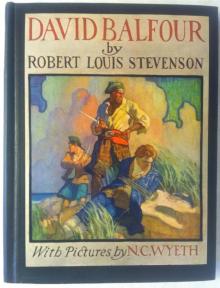
The rest of my history since Monday has been unadulterated David Balfour. In season and out of season, night and day, David and his innocent harem — let me be just, he never has more than the two — are on my mind. Think of David Balfour with a pair of fair ladies — very nice ones too — hanging round him. I really believe David 202 is as good a character as anybody has a right to ask for in a novel. I have finished drafting Chapter XX. to-day, and feel it all ready to froth when the spigot is turned.
O, I forgot — and do forget. What did I mean? A waft of cloud has fallen on my mind, and I will write no more.
Wednesday, I believe, 8th June. — Lots of David, and lots of David, and the devil any other news. Yesterday we were startled by great guns firing a salute, and to-day Whitmee (missionary) rode up to lunch, and we learned it was the Curaçoa come in, the ship (according to rumour) in which I was to be deported. I went down to meet my fate, and the captain is to dine with me Saturday, so I guess I am not going this voyage. Even with the particularity with which I write to you, how much of my life goes unexpressed; my troubles with a madman by the name of — — , a genuine living lunatic, I believe, and jolly dangerous; my troubles about poor — — , all these have dropped out; yet for moments they were very instant, and one of them is always present with me.
I have finished copying Chapter XXI. of David — ”solus cum sola; we travel together.” Chapter XXII., “Solus cum sola; we keep house together,” is already drafted. To the end of XXI. makes more than 150 pages of my manuscript — damn this hair — and I only designed the book to run to about 200; but when you introduce the female sect, a book does run away with you. I am very curious to see what you will think of my two girls. My own opinion is quite clear; I am in love with both. I foresee a few pleasant years of spiritual flirtations. The creator (if I may name myself, for the sake of argument, by such a name) is essentially unfaithful. For the duration of the two chapters in which I dealt with Miss Grant, I totally forgot my heroine, and even — but this is a flat secret — tried to win away David. I think I must try some day to marry Miss Grant. I’m blest if I don’t think I’ve got that hair out! which seems triumph enough; so I conclude.