Complete works of robert.., p.736
Complete Works of Robert Louis Stevenson (Illustrated),
p.736


The Henleys are gone, and two plays practically done. I hope they may produce some of the ready. — I am, ever affectionate son,
R. L. S.
To Andrew Chatto
During the earlier Bournemouth days were firmly established Stevenson’s cordial relations with the several English publishers Cassell & Co., Chatto & Windus, and Longmans, and a little later with C. Scribner’s Sons in America.
Wensleydale, Bournemouth, October 3, 1884.
DEAR MR. CHATTO, — I have an offer of £25 for Otto from America. I do not know if you mean to have the American rights; from the nature of the contract, I think 111 not; but if you understood that you were to sell the sheets, I will either hand over the bargain to you, or finish it myself and hand you over the money if you are pleased with the amount. You see, I leave this quite in your hands. To parody an old Scotch story of servant and master: if you don’t know that you have a good author, I know that I have a good publisher. Your fair, open, and handsome dealings are a good point in my life, and do more for my crazy health than has yet been done by any doctor. — Very truly yours,
Robert Louis Stevenson.
To W. E. Henley
There is no certain clue to the date of the following; neither has it been possible to make sure what was the enclosure mentioned. The special illness referred to seems to be that of the preceding May at Hyères.
[Wensleydale, Bournemouth, October 1884?]
DEAR BOY, — I trust this finds you well; it leaves me so-so. The weather is so cold that I must stick to bed, which is rotten and tedious, but can’t be helped.
I find in the blotting book the enclosed, which I wrote to you the eve of my blood. Is it not strange? That night, when I naturally thought I was coopered, the thought of it was much in my mind; I thought it had gone; and I thought what a strange prophecy I had made in jest, and how it was indeed like to be the end of many letters. But I have written a good few since, and the spell is broken. I am just as pleased, for I earnestly desire to live. This pleasant middle age into whose port we are steering is quite to my fancy. I would cast anchor here, and go ashore for twenty years and see the manners of the place. Youth was a great time, but somewhat fussy. Now in middle age (bar lucre) all seems mighty placid. It likes me; I spy a little bright café in one corner of the port, in front of which I now propose we should sit down. 112 There is just enough of the bustle of the harbour and no more; and the ships are close in, regarding us with stern-windows — the ships that bring deals from Norway and parrots from the Indies. Let us sit down here for twenty years, with a packet of tobacco and a drink, and talk of art and women. By-and-by, the whole city will sink, and the ships too, and the table, and we also; but we shall have sat for twenty years and had a fine talk; and by that time, who knows? exhausted the subject.
I send you a book which (or I am mistook) will please you; it pleased me. But I do desire a book of adventure — a romance — and no man will get or write me one. Dumas I have read and re-read too often; Scott, too and I am short. I want to hear swords clash. I want a book to begin in a good way; a book, I guess, like Treasure Island, alas! which I have never read, and cannot though I live to ninety. I would God that some one else had written it! By all that I can learn, it is the very book for my complaint. I like the way I hear it opens; and they tell me John Silver is good fun. And to me it is, and must ever be, a dream unrealised, a book unwritten. O my sighings after romance, or even Skeltery, and O! the weary age which will produce me neither!
CHAPTER I
The night was damp and cloudy, the ways foul. The single horseman, cloaked and booted, who pursued his way across Willesden Common, had not met a traveller, when the sound of wheels — —
CHAPTER I
“Yes, sir,” said the old pilot, “she must have dropped into the bay a little afore dawn. A queer craft she looks.”
“She shows no colours,” returned the young gentleman musingly.
“They’re a-lowering of a quarter-boat, Mr. Mark,” resumed the old salt. “We shall soon know more of her.” 113
“Ay,” replied the young gentleman called Mark, “and here, Mr. Seadrift, comes your sweet daughter Nancy tripping down the cliff.”
“God bless her kind heart, sir,” ejaculated old Seadrift.
CHAPTER I
The notary, Jean Rossignol, had been summoned to the top of a great house in the Isle St. Louis to make a will; and now, his duties finished, wrapped in a warm roquelaure and with a lantern swinging from one hand, he issued from the mansion on his homeward way. Little did he think what strange adventures were to befall him! — —
That is how stories should begin. And I am offered HUSKS instead.
What should be:
What is:
The Filibuster’s Cache.
Aunt Anne’s Tea Cosy.
Jerry Abershaw.
Mrs. Brierly’s Niece.
Blood Money: A Tale.
Society: A Novel.
R. L. S.
To the Rev. Professor Lewis Campbell
In reply to a gift of books, including the correspondent’s well-known translation of Sophocles.
[Wensleydale, Bournemouth, November 1884.]
MY DEAR CAMPBELL, — The books came duly to hand. My wife has occupied the translation ever since, nor have I yet been able to dislodge her. As for the primer, I have read it with a very strange result: that I find no fault. If you knew how, dogmatic and pugnacious, I stand warden on the literary art, you would the more appreciate your success and my — well, I will own it — disappointment. For I love to put people right (or wrong) about 114 the arts. But what you say of Tragedy and of Sophocles very amply satisfies me; it is well felt and well said; a little less technically than it is my weakness to desire to see it put, but clear and adequate. You are very right to express your admiration for the resource displayed in Œdipus King; it is a miracle. Would it not have been well to mention Voltaire’s interesting onslaught, a thing which gives the best lesson of the difference of neighbour arts? — since all his criticisms, which had been fatal to a narrative, do not amount among them to exhibit one flaw in this masterpiece of drama. For the drama, it is perfect; though such a fable in a romance might make the reader crack his sides, so imperfect, so ethereally slight is the verisimilitude required of these conventional, rigid, and egg-dancing arts.
I was sorry to see no more of you; but shall conclude by hoping for better luck next time. My wife begs to be remembered to both of you. — Yours sincerely,
Robert Louis Stevenson.
To W. E. Henley
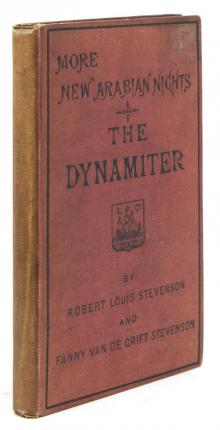
The “Arabs” mentioned below are the stories comprised in the volume More New Arabian Nights: The Dynamiter, written by Stevenson and his wife in collaboration.
Wensleydale, Bournemouth, November 1884.
DEAR HENLEY, — We are all to pieces in health, and heavily handicapped with Arabs. I have a dreadful cough, whose attacks leave me ætat. 90. I never let up on the Arabs, all the same, and rarely get less than eight pages out of hand, though hardly able to come downstairs for twittering knees.
I shall put in — — ’s letter. He says so little of his circumstances that I am in an impossibility to give him advice more specific than a copybook. Give him my love, however, and tell him it is the mark of the parochial 115 gentleman who has never travelled to find all wrong in a foreign land. Let him hold on, and he will find one country as good as another; and in the meanwhile let him resist the fatal British tendency to communicate his dissatisfaction with a country to its inhabitants. ‘Tis a good idea, but it somehow fails to please. In a fortnight, if I can keep my spirit in the box at all, I should be nearly through this Arabian desert; so can tackle something fresh. — Yours ever,
R. L. S.
To W. H. Low
It was some twenty months since the plan of publishing the Child’s Garden in the first instance as a picture-book had been mooted (see above, p, foll.). But it had never taken effect, and in the following March the volume appeared without illustrations in England, and also, I believe, in America.
Bonallie Towers, Branksome Park, Bournemouth,
Hants, England, First week in November, I guess, 1884.
MY DEAR LOW, — Now, look here, the above is my address for three months, I hope; continue, on your part, if you please, to write to Edinburgh, which is safe; but if Mrs. Low thinks of coming to England, she might take a run down from London (four hours from Waterloo, main line) and stay a day or two with us among the pines. If not, I hope it will be only a pleasure deferred till you can join her.
My Children’s Verses will be published here in a volume called A Child’s Garden. The sheets are in hand; I will see if I cannot send you the lot, so that you might have a bit of a start. In that case I would do nothing to publish in the States, and you might try an illustrated edition there; which, if the book went fairly over here, might, when ready, be imported. But of this more fully ere long. You will see some verses of mine in the last Magazine of Art, with pictures by a young lady; rather pretty, I 116 think. If we find a market for Phasellulus loquitur, we can try another. I hope it isn’t necessary to put the verse into that rustic printing. I am Philistine enough to prefer clean printer’s type; indeed, I can form no idea of the verses thus transcribed by the incult and tottering hand of the draughtsman, nor gather any impression beyond one of weariness to the eyes. Yet the other day, in the Century, I saw it imputed as a crime to Vedder that he had not thus travestied Omar Khayyàm. We live in a rum age of music without airs, stories without incident, pictures without beauty, American wood engravings that should have been etchings, and dry-point etchings that ought to have been mezzotints. I think of giving ‘em literature without words; and I believe if you were to try invisible illustration, it would enjoy a considerable vogue. So long as an artist is on his head, is painting with a flute, or writes with an etcher’s needle, or conducts the orchestra with a meat-axe, all is well; and plaudits shower along with roses. But any plain man who tries to follow the obtrusive canons of his art, is but a commonplace figure. To hell with him is the motto, or at least not that; for he will have his reward, but he will never be thought a person of parts.
January 3, 1885. — And here has this been lying near two months. I have failed to get together a preliminary copy of the Child’s Verses for you, in spite of doughty efforts; but yesterday I sent you the first sheet of the definitive edition, and shall continue to send the others as they come. If you can, and care to, work them — why so, well. If not, I send you fodder. But the time presses; for though I will delay a little over the proofs, and though it is even possible they may delay the English issue until Easter, it will certainly not be later. Therefore perpend, and do not get caught out. Of course, if you can do pictures, it will be a great pleasure to me to see our names joined; and more than that, a great advantage, as I dare say you may be able to make a bargain for some 117 share a little less spectral than the common for the poor author. But this is all as you shall choose; I give you carte blanche to do or not to do. — Yours most sincerely,
Robert Louis Stevenson.
O, Sargent has been and painted my portrait; a very nice fellow he is, and is supposed to have done well; it is a poetical but very chicken-boned figure-head, as thus represented.
R. L. S.Go on.
P.P.S. — Your picture came; and let me thank you for it very much. I am so hunted I had near forgotten. I find it very graceful; and I mean to have it framed.
To Sir Walter Simpson
Bonallie Towers, Branksome Park, Bournemouth [first week of November 1884].
MY DEAR SIMPSON, — At last, after divers adventures here we are: not Pommery and Greno as you see, “but jist plain auld Bonellie, no very faur frae Jenniper Green,” as I might say if I were writing to Charles. I hope now to receive a good bundle from you ere long; and I will try to be both prompt and practical in response. I hope to hear your boy is better: ah, that’s where it bites, I know, that is where the childless man rejoices; although, to confess fully, my whole philosophy of life renounces these renunciations; I am persuaded we gain nothing in the least comparable to what we lose, by holding back the hand from any province of life; the intrigue, the imbroglio, such as it is, was made for the plunger and not for the teetotaller. And anyway I hope your news is good.
I have nearly finished Lawson’s most lively pamphlet. It is very clear and interesting. For myself, I am in our house — a home of our own, in a most lovely situation, among forest trees, where I hope you will come and see 118 us and find me in a repaired and more comfortable condition — greatly pleased with it — rather hard-up, verging on the dead-broke — and full tilt at hammering up some New Arabians for the pot.
I wonder what you do without regular habits of work. I am capable of only two theories of existence: the industrious worker’s, the spreester’s; all between seems blank to me. We grow too old, and I, at least, am too much deteriorated, for the last; and the first becomes a bedrock necessary. My father is in a gloomy state and has the yellow flag at the peak, or the fore, or wherever it should be; and he has just emptied some melancholy vials on me; I am also, by way of change, spitting blood. This somewhat clouds the termination of my note. — Yours ever affectionately,
Robert Louis Stevenson.
To Thomas Stevenson
About this time Mr. Stevenson was in some hesitation as to letting himself be proposed for the office of President of the Royal Society of Edinburgh.
Bonallie Towers, Bournemouth, November 1884.
MY DEAR FATHER, — I have no hesitation in recommending you to let your name go up; please yourself about an address; though I think, if we could meet, we could arrange something suitable. What you propose would be well enough in a way, but so modest as to suggest a whine. From that point of view it would be better to change a little; but this, whether we meet or not, we must discuss. Tait, Chrystal, the Royal Society, and I, all think you amply deserve this honour and far more; it is not the True Blue to call this serious compliment a “trial”; you should be glad of this recognition. As for resigning, that is easy enough if found necessary; but to refuse would be husky and unsatisfactory. Sic subs.
R. L. S.
My cold is still very heavy; but I carry it well. Fanny 119 is very very much out of sorts, principally through perpetual misery with me. I fear I have been a little in the dumps, which, as you know, sir, is a very great sin. I must try to be more cheerful; but my cough is so severe that I have sometimes most exhausting nights and very peevish wakenings. However, this shall be remedied, and last night I was distinctly better than the night before. There is, my dear Mr. Stevenson (so I moralise blandly as we sit together on the devil’s garden-wall), no more abominable sin than this gloom, this plaguy peevishness; why (say I) what matters it if we be a little uncomfortable — that is no reason for mangling our unhappy wives. And then I turn and girn on the unfortunate Cassandra. — Your fellow culprit,
R. L. S.
To Thomas Stevenson
Mr. Stevenson, the elder, had read the play of Admiral Guinea, written in September by his son and Mr. Henley in collaboration, and had protested, with his usual vehemence of feeling and expression, against the stage confrontation of profane blackguardry in the person of Pew with evangelical piety in that of the reformed slaving captain who gives his name to the piece.
Bonallie Towers, Branksome Park, Bournemouth (The three B’s) [November 5, 1884].
MY DEAR FATHER, — Allow me to say, in a strictly Pickwickian sense, that you are a silly fellow. I am pained indeed, but how should I be offended? I think you exaggerate; I cannot forget that you had the same impression of the Deacon; and yet, when you saw it played, were less revolted than you looked for; and I will still hope that the Admiral also is not so bad as you suppose. There is one point, however, where I differ from you very frankly. Religion is in the world; I do not think you are the man to deny the importance of its rôle; and I have long decided not to leave it on one side in art. The opposition of the Admiral and Mr. Pew is not, to my eyes, either horrible or irreverent; but it may 120 be, and it probably is, very ill done: what then? This is a failure; better luck next time; more power to the elbow, more discretion, more wisdom in the design, and the old defeat becomes the scene of the new victory. Concern yourself about no failure; they do not cost lives as in engineering; they are the pierres perdues of successes. Fame is (truly) a vapour; do not think of it; if the writer means well and tries hard, no failure will injure him, whether with God or man.
I wish I could hear a brighter account of yourself; but I am inclined to acquit the Admiral of having a share in the responsibility. My very heavy cold is, I hope, drawing off; and the change to this charming house in the forest will, I hope, complete my re-establishment. — With love to all, believe me, your ever affectionate
Robert Louis Stevenson.
To W. E. Henley
Bonallie Towers, Bournemouth, November 11, 1884.
DEAR BOY, — I have been nearly smashed altogether; fever and chills, with really very considerable suffering; and to my deep gloom and some fear about the future, work has had to stop. There was no way out of it; yesterday and to-day nothing would come, it was a mere waste of tissue, productive of spoiled paper.
I hope it will not last long; for the bum-baily is panting at my rump, and when I turn a scared eye across my shoulder, I behold his talons quivering above my frock-coat tails.
Gosse has writ to offer me £40 for a Christmas number ghost story for the Pall Mall: eight thousand words. I have, with some conditions, accepted; I pray Heaven I may be able to do it. But I am not sure that my incapacity to work is wholly due to illness; I believe the morphine 121 I have been taking for my bray may have a hand in it. It moderates the bray, but, I think, sews up the donkey.