Complete works of robert.., p.695
Complete Works of Robert Louis Stevenson (Illustrated),
p.695
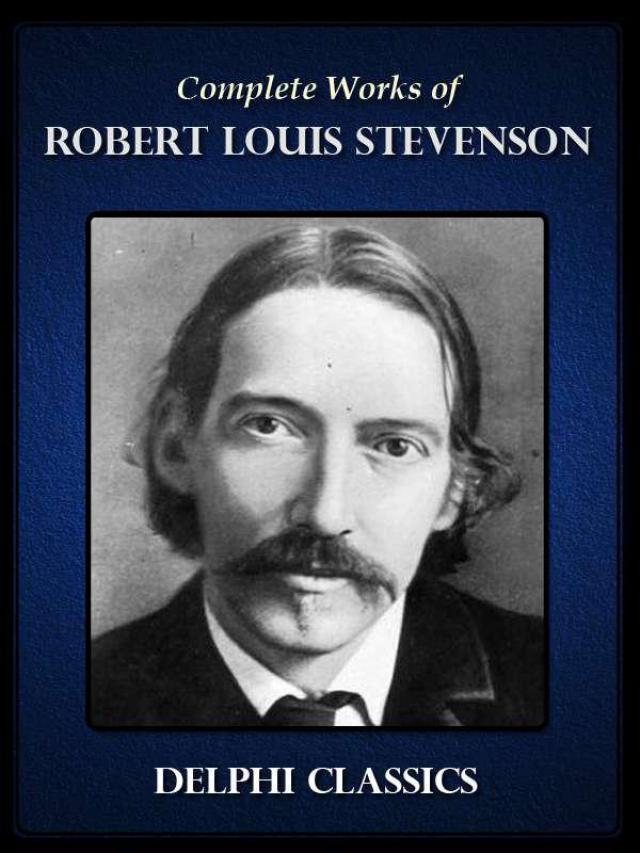


R. L. Stevenson.
P.S. — The snake was about a yard long, but harmless, and now, he says, quite tame.
To Mrs. Thomas Stevenson
Hotel Landsberg, Frankfurt, Monday, 29th July 1872.
... Last night I met with rather an amusing adventurette. Seeing a church door open, I went in, and was led by most importunate finger-bills up a long stair to the top of the tower. The father smoking at the door, the mother and the three daughters received me as if I was a friend of the family and had come in for an evening visit. The youngest daughter (about thirteen, I suppose, and a pretty little girl) had been learning English at the school, and was anxious to play it off upon a real, veritable Englander; so we had a long talk, and I was shown 39 photographs, etc., Marie and I talking, and the others looking on with evident delight at having such a linguist in the family. As all my remarks were duly translated and communicated to the rest, it was quite a good German lesson. There was only one contretemps during the whole interview — the arrival of another visitor, in the shape (surely) the last of God’s creatures, a wood-worm of the most unnatural and hideous appearance, with one great striped horn sticking out of his nose like a boltsprit. If there are many wood-worms in Germany, I shall come home. The most courageous men in the world must be entomologists. I had rather be a lion-tamer.
To-day I got rather a curiosity — Lieder und Balladen von Robert Burns, translated by one Silbergleit, and not so ill done either. Armed with which, I had a swim in the Main, and then bread and cheese and Bavarian beer in a sort of café, or at least the German substitute for a café; but what a falling off after the heavenly forenoons in Brussels!
I have bought a meerschaum out of local sentiment, and am now very low and nervous about the bargain, having paid dearer than I should in England, and got a worse article, if I can form a judgment.
Do write some more, somebody. To-morrow I expect I shall go into lodgings, as this hotel work makes the money disappear like butter in a furnace. — Meanwhile believe me, ever your affectionate son,
R. L. Stevenson.
To Mrs. Thomas Stevenson
Hotel Landsberg, Thursday, 1st August 1872.
... Yesterday I walked to Eckenheim, a village a little way out of Frankfurt, and turned into the alehouse. In the room, which was just such as it would have been in Scotland, were the landlady, two neighbours, and an old peasant eating raw sausage at the far end. I soon 40 got into conversation; and was astonished when the landlady, having asked whether I were an Englishman, and received an answer in the affirmative, proceeded to inquire further whether I were not also a Scotchman. It turned out that a Scotch doctor — a professor — a poet — who wrote books — gross wie das — had come nearly every day out of Frankfurt to the Eckenheimer Wirthschaft, and had left behind him a most savoury memory in the hearts of all its customers. One man ran out to find his name for me, and returned with the news that it was Cobie (Scobie, I suspect); and during his absence the rest were pouring into my ears the fame and acquirements of my countryman. He was, in some undecipherable manner, connected with the Queen of England and one of the Princesses. He had been in Turkey, and had there married a wife of immense wealth. They could find apparently no measure adequate to express the size of his books. In one way or another, he had amassed a princely fortune, and had apparently only one sorrow, his daughter to wit, who had absconded into a Kloster, with a considerable slice of the mother’s Geld. I told them we had no Klosters in Scotland, with a certain feeling of superiority. No more had they, I was told — ”Hier ist unser Kloster!” and the speaker motioned with both arms round the taproom. Although the first torrent was exhausted, yet the Doctor came up again in all sorts of ways, and with or without occasion, throughout the whole interview; as, for example, when one man, taking his pipe out of his mouth and shaking his head, remarked àpropos of nothing and with almost defiant conviction, “Er war ein feiner Mann, der Herr Doctor,” and was answered by another with “Yaw, yaw, und trank immer rothen Wein.”
Setting aside the Doctor, who had evidently turned the brains of the entire village, they were intelligent people. One thing in particular struck me, their honesty in admitting that here they spoke bad German, and advising me to go to Coburg or Leipsic for German. — ”Sie sprechen da 41 rein” (clean), said one; and they all nodded their heads together like as many mandarins, and repeated rein, so rein in chorus.
Of course we got upon Scotland. The hostess said, “Die Schottländer trinken gern Schnapps,” which may be freely translated, “Scotchmen are horrid fond of whisky.” It was impossible, of course, to combat such a truism; and so I proceeded to explain the construction of toddy, interrupted by a cry of horror when I mentioned the hot water; and thence, as I find is always the case, to the most ghastly romancing about Scottish scenery and manners, the Highland dress, and everything national or local that I could lay my hands upon. Now that I have got my German Burns, I lean a good deal upon him for opening a conversation, and read a few translations to every yawning audience that I can gather. I am grown most insufferably national, you see. I fancy it is a punishment for my want of it at ordinary times. Now, what do you think, there was a waiter in this very hotel, but, alas! he is now gone, who sang (from morning to night, as my informant said with a shrug at the recollection) what but ‘s ist lange her, the German version of Auld Lang Syne; so you see, madame, the finest lyric ever written will make its way out of whatsoever corner of patois it found its birth in.
“Mein Herz ist im Hochland, mein Herz ist nicht hier,
Mein Herz ist im Hochland im grünen Revier.
Im grünen Reviere zu jagen das Reh;
Mein Herz ist im Hochland, wo immer ich geh.”
I don’t think I need translate that for you.
There is one thing that burthens me a good deal in my patriotic garrulage, and that is the black ignorance in which I grope about everything, as, for example, when I gave yesterday a full and, I fancy, a startlingly incorrect account of Scotch education to a very stolid German on a garden bench: he sat and perspired under it, however, with much composure. I am generally glad enough 42 to fall back again, after these political interludes, upon Burns, toddy, and the Highlands.
I go every night to the theatre, except when there is no opera. I cannot stand a play yet; but I am already very much improved, and can understand a good deal of what goes on.
Friday, August 2, 1872. — In the evening, at the theatre, I had a great laugh. Lord Allcash in Fra Diavolo, with his white hat, red guide-books, and bad German, was the pièce-de-résistance from a humorous point of view; and I had the satisfaction of knowing that in my own small way I could minister the same amusement whenever I chose to open my mouth.
I am just going off to do some German with Simpson. — Your affectionate son,
R. L. Stevenson.
To Thomas Stevenson
Frankfurt, Rosengasse 13, August 4, 1872.
MY DEAR FATHER, — You will perceive by the head of this page that we have at last got into lodgings, and powerfully mean ones too. If I were to call the street anything but shady, I should be boasting. The people sit at their doors in shirt-sleeves, smoking as they do in Seven Dials of a Sunday.
Last night we went to bed about ten, for the first time householders in Germany — real Teutons, with no deception, spring, or false bottom. About half-past one there began such a trumpeting, shouting, pealing of bells, and scurrying hither and thither of feet as woke every person in Frankfurt out of their first sleep with a vague sort of apprehension that the last day was at hand. The whole street was alive, and we could hear people talking in their rooms, or crying to passers-by from their windows, all around us. At last I made out what a man was saying 43 in the next room. It was a fire in Sachsenhausen, he said (Sachsenhausen is the suburb on the other side of the Main), and he wound up with one of the most tremendous falsehoods on record, “Hier alles ruht — here all is still.” If it can be said to be still in an engine factory, or in the stomach of a volcano when it is meditating an eruption, he might have been justified in what he said, but not otherwise. The tumult continued unabated for near an hour; but as one grew used to it, it gradually resolved itself into three bells, answering each other at short intervals across the town, a man shouting at ever shorter intervals and with superhuman energy, “Feuer — im Sachsenhausen,” and the almost continuous winding of all manner of bugles and trumpets, sometimes in stirring flourishes, and sometimes in mere tuneless wails. Occasionally there was another rush of feet past the window, and once there was a mighty drumming, down between us and the river, as though the soldiery were turning out to keep the peace. This was all we had of the fire, except a great cloud, all flushed red with the glare, above the roofs on the other side of the Gasse; but it was quite enough to put me entirely off my sleep and make me keenly alive to three or four gentlemen who were strolling leisurely about my person, and every here and there leaving me somewhat as a keepsake.... However, everything has its compensation, and when day came at last, and the sparrows awoke with trills and carol-ets, the dawn seemed to fall on me like a sleeping draught. I went to the window and saw the sparrows about the eaves, and a great troop of doves go strolling up the paven Gasse, seeking what they may devour. And so to sleep, despite fleas and fire-alarms, and clocks chiming the hours out of neighbouring houses at all sorts of odd times and with the most charming want of unanimity.
We have got settled down in Frankfurt, and like the place very much. Simpson and I seem to get on very well together. We suit each other capitally; and it is 44 an awful joke to be living (two would-be advocates, and one a baronet) in this supremely mean abode.
The abode is, however, a great improvement on the hotel, and I think we shall grow quite fond of it. — Ever your affectionate son,
R. L. Stevenson.
To Mrs. Thomas Stevenson
13 Rosengasse, Frankfurt, Tuesday Morning, August 1872.
... Last night I was at the theatre and heard Die Judin (La Juive), and was thereby terribly excited. At last, in the middle of the fifth act, which was perfectly beastly, I had to slope. I could stand even seeing the cauldron with the sham fire beneath, and the two hateful executioners in red; but when at last the girl’s courage breaks down, and, grasping her father’s arm, she cries out — O so shudderfully! — I thought it high time to be out of that galère, and so I do not know yet whether it ends well or ill; but if I ever afterwards find that they do carry things to the extremity, I shall think more meanly of my species. It was raining and cold outside, so I went into a Bierhalle, and sat and brooded over a Schnitt (half-glass) for nearly an hour. An opera is far more real than real life to me. It seems as if stage illusion, and particularly this hardest to swallow and most conventional illusion of them all — an opera — would never stale upon me. I wish that life was an opera. I should like to live in one; but I don’t know in what quarter of the globe I shall find a society so constituted. Besides, it would soon pall: imagine asking for three-kreuzer cigars in recitative, or giving the washerwoman the inventory of your dirty clothes in a sustained and flourishous aria.
I am in a right good mood this morning to sit here and write to you; but not to give you news. There is a great stir of life, in a quiet, almost country fashion, all about us here. Some one is hammering a beef-steak in the 45 rez-de-chaussée: there is a great clink of pitchers and noise of the pump-handle at the public well in the little square-kin round the corner. The children, all seemingly within a month, and certainly none above five, that always go halting and stumbling up and down the roadway, are ordinarily very quiet, and sit sedately puddling in the gutter, trying, I suppose, poor little devils! to understand their Muttersprache; but they, too, make themselves heard from time to time in little incomprehensible antiphonies, about the drift that comes down to them by their rivers from the strange lands higher up the Gasse. Above all, there is here such a twittering of canaries (I can see twelve out of our window), and such continual visitation of grey doves and big-nosed sparrows, as make our little bye-street into a perfect aviary.
I look across the Gasse at our opposite neighbour, as he dandles his baby about, and occasionally takes a spoonful or two of some pale slimy nastiness that looks like dead porridge, if you can take the conception. These two are his only occupations. All day long you can hear him singing over the brat when he is not eating; or see him eating when he is not keeping baby. Besides which, there comes into his house a continual round of visitors that puts me in mind of the luncheon hour at home. As he has thus no ostensible avocation, we have named him “the W.S.” to give a flavour of respectability to the street.
Enough of the Gasse. The weather is here much colder. It rained a good deal yesterday; and though it is fair and sunshiny again to-day, and we can still sit, of course, with our windows open, yet there is no more excuse for the siesta; and the bathe in the river, except for cleanliness, is no longer a necessity of life. The Main is very swift. In one part of the baths it is next door to impossible to swim against it, and I suspect that, out in the open, it would be quite impossible. — Adieu, my dear mother, and believe me, ever your affectionate son,
Robert Louis Stevenson
(Rentier).
To Charles Baxter
On the way home with Sir Walter Simpson from Germany. The L.J.R. herein mentioned was a short-lived Essay Club of only six members; its meetings were held in a public-house in Advocate’s Close; the meaning of its initials (as recently divulged by Mr. Baxter) was Liberty, Justice, Reverence; no doubt understood by the members in some fresh and esoteric sense of their own.
Boulogne Sur Mer, Wednesday, 3rd or 4th September 1872.
Blame me not that this epistle
Is the first you have from me.
Idleness has held me fettered,
But at last the times are bettered
And once more I wet my whistle
Here, in France beside the sea.
All the green and idle weather
I have had in sun and shower,
Such an easy warm subsistence,
Such an indolent existence
I should find it hard to sever
Day from day and hour from hour.
Many a tract-provided ranter
May upbraid me, dark and sour,
Many a bland Utilitarian
Or excited Millenarian,
— ”Pereunt et imputantur
You must speak to every hour.”
But (the very term’s deceptive)
You at least, my friend, will see,
That in sunny grassy meadows
Trailed across by moving shadows
To be actively receptive
Is as much as man can be.
He that all the winter grapples
Difficulties, thrust and ward —
Needs to cheer him thro’ his duty
Memories of sun and beauty
Orchards with the russet apples
Lying scattered on the sward.
Many such I keep in prison,
Keep them here at heart unseen,
Till my muse again rehearses
Long years hence, and in my verses
You shall meet them rearisen
Ever comely, ever green.
You know how they never perish,
How, in time of later art,
Memories consecrate and sweeten
These defaced and tempest-beaten
Flowers of former years we cherish,
Half a life, against our heart.
Most, those love-fruits withered greenly,
Those frail, sickly amourettes,
How they brighten with the distance
Take new strength and new existence
Till we see them sitting queenly
Crowned and courted by regrets!
All that loveliest and best is,
Aureole-fashion round their head,
They that looked in life but plainly,
How they stir our spirits vainly
When they come to us Alcestis-
like returning from the dead!
Not the old love but another,
Bright she comes at Memory’s call
Our forgotten vows reviving
To a newer, livelier living,
As the dead child to the mother
Seems the fairest child of all.
Thus our Goethe, sacred master,
Travelling backward thro’ his youth,
Surely wandered wrong in trying
To renew the old, undying
Loves that cling in memory faster
Than they ever lived in truth.
So; en voilà assez de mauvais vers. Let us finish with a word or two in honest prose, tho’ indeed I shall so soon be back again and, if you be in town as I hope, so soon get linked again down the Lothian road by a cigar or two and a liquor, that it is perhaps scarce worth the postage to send my letter on before me. I have just been long enough away to be satisfied and even anxious to get home again and talk the matter over with my friends. I shall have plenty to tell you; and principally plenty that I do not care to write; and I daresay, you, too, will have a lot of gossip. What about Ferrier? Is the L.J.R. think you to go naked and unashamed this winter? He with his charming idiosyncrasy was in my eyes the vine-leaf that preserved our self-respect. All the rest of us are such shadows, compared to his full-flavoured personality; but I must not spoil my own début. I am trenching upon one of the essayettes which I propose to introduce as a novelty this year before that august assembly. For we must not let it die. It is a sickly baby, but what with nursing, and pap, and the like, I do not see why it should not have a stout manhood after all, and perhaps a green old age. Eh! when we are old (if we ever should be) that too will be one of those cherished memories I 49 have been so rhapsodizing over. We must consecrate our room. We must make it a museum of bright recollections; so that we may go back there white-headed, and say “Vixi.” After all, new countries, sun, music, and all the rest can never take down our gusty, rainy, smoky, grim old city out of the first place that it has been making for itself in the bottom of my soul, by all pleasant and hard things that have befallen me for these past twenty years or so. My heart is buried there — say, in Advocate’s Close!