Complete works of robert.., p.718
Complete Works of Robert Louis Stevenson (Illustrated),
p.718
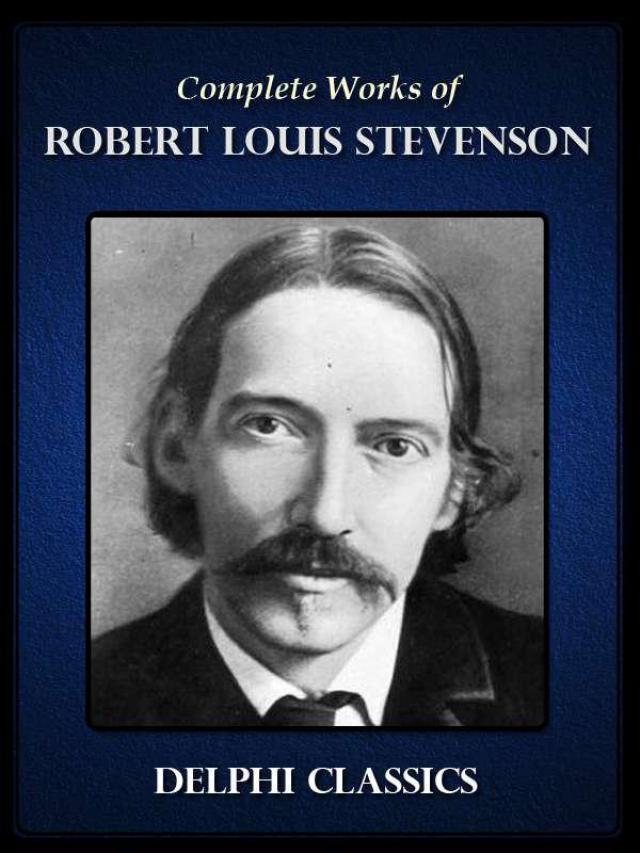


R. L. S.
* * *
Engraisser, grow fat.
Pall Mall Gazette.
Here follows a long calculation of ways and means.
Addison’s.
In reference to the father’s estrangement at this time, Sir James Dewar, an old friend of the elder Stevenson, tells a story which would have touched R. L. S. infinitely had he heard it. Sir James (then Professor) Dewar and Mr. Thomas Stevenson were engaged together on some official scientific work near Duns in Berwickshire. “Spending the evening together,” writes Sir James, “at an hotel in Berwick-on-Tweed, the two, after a long day’s work, fell into close fireside talk over their toddy, and Mr. Stevenson opened his heart upon what was to him a very sore grievance. He spoke with anger and dismay of his son’s journey and intentions, his desertion of the old firm, and taking to the devious and barren paths of literature. The Professor took up the cudgels in the son’s defence, and at last, by way of ending the argument, half jocularly offered to wager that in ten years from that moment R. L. S. would be earning a bigger income than the old firm had ever commanded. To his surprise, the father became furious, and repulsed all attempts at reconciliation. But six and a half years later, Mr. Stevenson, broken in health, came to London to seek medical advice, and although so feeble that he had to be lifted out and into his cab, called at the Royal Institute to see the Professor. He said: “I am here to consult a doctor, but I couldna be in London without coming to shake your hand and confess that you were richt after a’ about Louis, and I was wrang.” The frail old frame shook with emotion, and he muttered, “I ken this is my last visit to the south.” A few weeks later he was dead.
VI
ALPINE WINTERS AND HIGHLAND SUMMERS
August 1880-October 1882
After spending the months of June and July 1880 in the rough Californian mountain quarters described in the Silverado Squatters, Stevenson took passage with his wife and young stepson from New York on the 7th of August, and arrived on the 17th at Liverpool, where his parents and I were waiting to meet him. Of her new family, the Mrs. Robert Louis Stevenson brought thus strangely and from far into their midst made an immediate conquest. To her husband’s especial happiness, there sprang up between her and his father the closest possible affection and confidence. Parents and friends — if it is permissible to one of the latter to say as much — rejoiced to recognise in Stevenson’s wife a character as strong, interesting, and romantic almost as his own; an inseparable sharer of all his thoughts and staunch companion of all his adventures; the most open-hearted of friends to all who loved him; the most shrewd and stimulating critic of his work; and in sickness, despite her own precarious health, the most devoted and most efficient of nurses.
From Liverpool the Stevenson party went on to make a stay in Scotland, first at Edinburgh, and afterwards for a few weeks at Strathpeffer, resting at Blair Athol on the 280 way. It was now, in his thirtieth year, among the woods of Tummelside and under the shoulder of Ben Wyvis, that Stevenson acknowledged for the first time the full power and beauty of the Highland scenery, which in youth, with his longings fixed ever upon the South, he had been accustomed to think too bleak and desolate. In the history of the country and its clans, on the other hand, and especially of their political and social transformation during the eighteenth century, he had been always keenly interested. In conversations with Principal Tulloch at Strathpeffer this interest was now revived, and he resolved to attempt a book on the subject, his father undertaking to keep him supplied with books and authorities; for it had quickly become apparent that he could not winter in Scotland. The state of his health continued to be very threatening. He suffered from acute chronic catarrh, accompanied by disquieting lung symptoms and great weakness; and was told accordingly that he must go for the winter, and probably for several succeeding winters, to the mountain valley of Davos in Switzerland, which within the last few years had been coming into repute as a place of recovery, or at least of arrested mischief, for lung patients. Thither he and his wife and stepson travelled accordingly at the end of October. Nor must another member of the party be forgotten, a black thoroughbred Skye terrier, the gift of Sir Walter Simpson. This creature was named, after his giver, Walter — a name subsequently corrupted into Wattie, Woggie, Wogg, Woggin, Bogie, Bogue, and a number of other affectionate diminutives which will be found occurring often enough in the following pages. He was a remarkably pretty, engaging, excitable, ill-behaved little specimen of his race, the occasion of infinite anxiety and 281 laughing care to his devoted master and mistress until his death six years later.
The Davos of 1880, approached by an eight-hours’ laborious drive up the valley of the Prättigau, was a very different place from the extended and embellished Davos of to-day, with its railway, its modern shops, its electric lighting, and its crowd of winter visitors bent on outdoor and indoor entertainment. The Stevensons’ quarters for the first winter were at the Hotel Belvedere, then a mere nucleus of the huge establishment it has since become. Besides the usual society of an invalid hotel, with its mingled tragedies and comedies, they had there the great advantage of the presence, in a neighbouring house, of an accomplished man of letters and one of the most charming of companions, John Addington Symonds, with his family. Mr. Symonds, whose health had been desperate before he tried the place, was a living testimony to its virtues, and was at this time engaged in building the chalet which became his home until he died fourteen years later. During Stevenson’s first season at Davos, though his mind was full of literary enterprises, he was too ill to do much actual work. For the Highland history he read much, but composed little or nothing, and eventually this history went to swell the long list of his unwritten books. He saw through the press his first volume of collected essays, Virginibus Puerisque, which came out early in 1881; wrote the essays Samuel Pepys and The Morality of the Profession of Letters, for the Cornhill and the Fortnightly Review respectively, and sent to the Pall Mall Gazette the papers on the life and climate of Davos, posthumously reprinted in Essays of Travel. Beyond this, he only amused himself with verses, some of them afterwards published in Underwoods. Leaving the Alps at the 282 end of April 1881, he returned, after a short stay in France (at Fontainebleau, Paris, and St. Germain), to his family in Edinburgh. Thence the whole party again went to the Highlands, this time to Pitlochry and Braemar.
During the summer Stevenson heard of the intended retirement of Professor Æneas Mackay from the chair of History and Constitutional Law at Edinburgh University. He determined, with the encouragement of the outgoing professor and of several of his literary friends, to become a candidate for the post, which had to be filled by the Faculty of Advocates from among their own number. The duties were limited to the delivery of a short course of lectures in the summer term, and Stevenson thought that he might be equal to them, and might prove, though certainly a new, yet perhaps a stimulating, type of professor. But knowing the nature of his public reputation, especially in Edinburgh, where the recollection of his daft student days was as yet stronger than the impression made by his recent performances in literature, he was well aware that his candidature must seem paradoxical, and stood little chance of success. The election took place in the late autumn of the same year, and he was defeated, receiving only three votes.
At Pitlochry Stevenson was for a while able to enjoy his life and to work well, writing two of the strongest of his short stories of Scottish life and superstition, Thrawn Janet and The Merry Men, originally designed to form part of a volume to be written by himself and his wife in collaboration. At Braemar he made a beginning of the nursery verses which afterwards grew into the volume called The Child’s Garden, and conceived and half executed the fortunate project of Treasure Island, the book which was destined first to make him famous. But one of the 283 most inclement of Scottish summers had before long undone all the good gained in the previous winter at Davos, and in the autumn of the year 1881 he repaired thither again.
This time his quarters were in a small chalet belonging to the proprietors of the Buol Hotel, the Chalet am Stein, or Chalet Buol, in the near neighbourhood of the Symonds’s house. The beginning of his second stay was darkened by the serious illness of his wife; nevertheless the winter was one of much greater literary activity than the last. A Life of Hazlitt was projected, and studies were made for it, but for various reasons the project was never carried out. Treasure Island was finished; the greater part of the Silverado Squatters written; so were the essays Talk and Talkers, A Gossip on Romance, and several other of his best papers for magazines. By way of whim and pastime he occupied himself, to his own and his stepson’s delight, with a little set of woodcuts and verses printed by the latter at his toy press — ”The Davos Press,” as they called it — as well as with mimic campaigns carried on between the man and boy with armies of lead soldiers in the spacious loft which filled the upper floor of the chalet. For the first and almost the only time in his life there awoke in him during these winters in Davos the spirit of lampoon; and he poured forth sets of verses, not without touches of a Swiftean fire, against commercial frauds in general, and those of certain local tradesmen in particular, as well as others in memory of a defunct publican of Edinburgh who had been one of his butts in youth (Casparidea and Brashiana, both unpublished: see p, 15, 38 in vol. 24 of the present edition). Finally, much revived in health by the beneficent air of the Alpine valley, he left it again in mid-spring of 1882, to return 284 once more to Scotland, and to be once more thrown back to, or below, the point whence he had started. After a short excursion from Edinburgh into the Appin country, where he made inquiries on the spot into the traditions concerning the murder of Campbell of Glenure, his three resting-places in Scotland during this summer were Stobo Manse near Peebles, Lochearnhead, and Kingussie. At Stobo the dampness of the season and the place quickly threw him again into a very low state of health, from which three subsequent weeks of brilliant sunshine in Speyside did but little to restore him. In spite of this renewed breakdown, when autumn came he would not face the idea of returning for a third season to Davos. He had himself felt deeply the austerity and monotony of the white Alpine world in winter; and though he had unquestionably gained in health there, his wife on her part had suffered much. So he made up his mind once again to try the Mediterranean coast of France, and Davos knew him no more.
To Sidney Colvin
I forget what were the two sets of verses (apparently satirical) here mentioned. The volume of essays must be Virginibus Puerisque, published the following spring; but it is dedicated in prose to W. E. Henley.
Ben Wyvis Hotel, Strathpeffer [July 1880].
MY DEAR COLVIN, — One or two words. We are here: all goes exceeding well with the wife and with the parents. Near here is a valley; birch woods, heather, and a stream; I have lain down and died; no country, no place, was ever for a moment so delightful to my soul. And I have been a Scotchman all my life, and denied my native land! Away with your gardens of roses, indeed! 285 Give me the cool breath of Rogie waterfall, henceforth and for ever, world without end.
I enclose two poems of, I think, a high order. One is my dedication for my essays; it was occasioned by that delicious article in the Spectator. The other requires no explanation; c’est tout bonnement un petit chef d’œuvre de grâce, de délicatesse, et de bon sens humanitaire. Celui qui ne s’en sent pas touché jusqu’aux larmes — celui-là n’a pas vécu. I wish both poems back, as I am copyless: but they might return via Henley.
My father desires me still to withdraw the Emigrant. Whatever may be the pecuniary loss, he is willing to bear it; and the gain to my reputation will be considerable.
I am writing against time and the post runner. But you know what kind messages we both send to you. May you have as good a time as possible so far from Rogie!
R. L. S.
To Charles Baxter
A further stay at Strathpeffer led to disenchantment, not with outdoor nature but with human nature as there represented, and he relieves his feelings as follows: —
Ben Wyvis Hotel, Strathpeffer, July 1880.
MY DEAR CHERLS, — I am well but have a little over-tired myself which is disgusting. This is a heathenish place near delightful places, but inhabited, alas! by a wholly bestial crowd.
ON SOME GHOSTLY COMPANIONS AT A SPA
I had an evil day when I
To Strathpeffer drew anigh,
For there I found no human soul,
But Ogres occupied the whole.
They had at first a human air
In coats and flannel underwear.
They rose and walked upon their feet
And filled their bellies full of meat,
Then wiped their lips when they had done —
But they were ogres every one.
Each issuing from his secret bower
I marked them in the morning hour.
By limp and totter, list and droop,
I singled each one from the group.
Detected ogres, from my sight
Depart to your congenial night
From these fair vales: from this fair day
Fleet, spectres, on your downward way,
Like changing figures in a dream
To Muttonhole and Pittenweem!
Or, as by harmony divine
The devils quartered in the swine,
If any baser place exist
In God’s great registration list —
Some den with wallow and a trough —
Find it, ye ogres, and be off!
Yours, R. L. S.
To Isobel Strong
Further letters from Scotland during these months are lacking. The next was written, in answer to an inquiry from his stepdaughter at San Francisco, on the second day after his arrival at Davos.
Hotel Belvedere, Davos, November 1880.
No my che-ild — not Kamschatka this trip, only the top of the Alps, or thereby; up in a little valley in a wilderness of snowy mountains; the Rhine not far from us, quite a little highland river; eternal snow-peaks on every hand. Yes; just this once I should like to go to the Vienna gardens with the family and hear Tweedledee and drink something and see Germans — though God knows we have seen Germans enough this while back. Naturally some in the Customs House on the Alsatian frontier, who would have made one die from laughing in 287 a theatre, and provoked a smile from us even in that dismal juncture. To see them, big, blond, sham-Englishmen, but with an unqualifiable air of not quite fighting the sham through, diving into old women’s bags and going into paroxysms of arithmetic in white chalk, three or four of them (in full uniform) in full cry upon a single sum, with their brows bent and a kind of arithmetical agony upon their mugs. Madam, the diversion of cock-fighting has been much commended, but it was not a circumstance to that Custom House. They only opened one of our things: a basket. But when they met from within the intelligent gaze of Woggs, they all lay down and died. Woggs is a fine dog....
God bless you! May coins fall into your coffee and the finest wines and wittles lie smilingly about your path, with a kind of dissolving view of fine scenery by way of background; and may all speak well of you — and me too for that matter — and generally all things be ordered unto you totally regardless of expense and with a view to nothing in the world but enjoyment, edification, and a portly and honoured age. — Your dear papa,
R. L. S.
To A. G. Dew-Smith
This, from the same place and about the same date, is addressed by way of thanks to a friend at Cambridge, the late Mr. A. G. Dew-Smith, who had sent him a present of a box of cigarettes. Mr. Dew-Smith, a man of fine artistic tastes and mechanical genius, with a silken, somewhat foreign, urbanity of bearing, was the original, so far as concerns manner and way of speech, of Attwater in the Ebb-Tide.
[Hotel Belvedere, Davos, November 1880].
Figure me to yourself, I pray —
A man of my peculiar cut —
Apart from dancing and deray,
Into an Alpine valley shut;
Shut in a kind of damned Hotel,
Discountenanced by God and man;
The food? — Sir, you would do as well
To cram your belly full of bran.
The company? Alas, the day
That I should dwell with such a crew,
With devil anything to say,
Nor any one to say it to!
The place? Although they call it Platz,
I will be bold and state my view;
It’s not a place at all — and that’s
The bottom verity, my Dew.
There are, as I will not deny,
Innumerable inns; a road;
Several Alps indifferent high;
The snow’s inviolable abode;
Eleven English parsons, all
Entirely inoffensive; four
True human beings — what I call
Human — the deuce a cipher more;