Complete works of robert.., p.853
Complete Works of Robert Louis Stevenson (Illustrated),
p.853
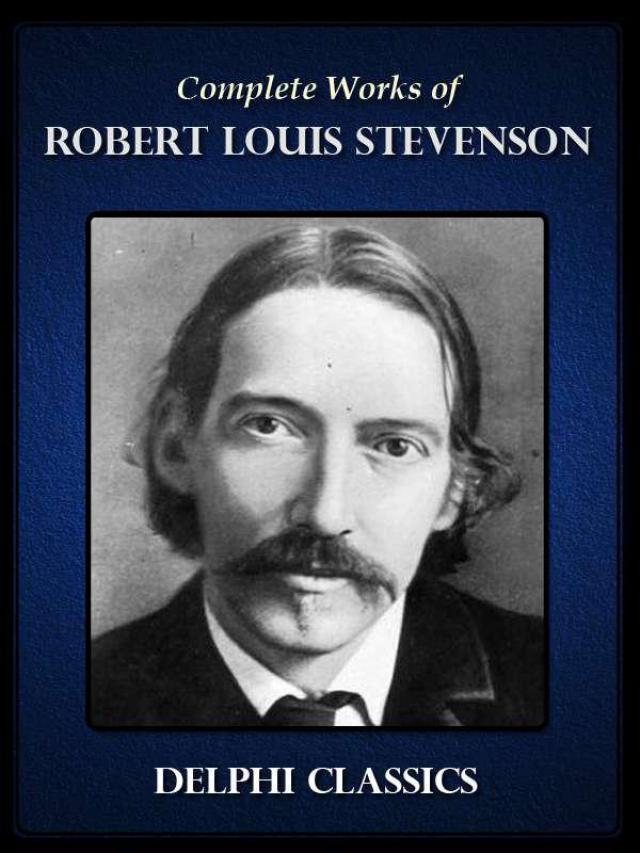


Some time previous to all this he had written in a letter: “Leslie Stephen, who was down here to lecture, called on me, and took me up to see a poor fellow, a poet who writes for him, and who has been eighteen months in our Infirmary, and may be for all I know eighteen months more. Stephen and I sat on a couple of chairs, and the poor fellow sat up in his bed with his hair and beard all tangled, and talked as cheerfully as if he had been in a king’s palace of blue air.”
This was William Ernest Henley, and his brave determination to live and work, though he knew he must ever remain in a maimed condition, roused Stevenson’s sincere admiration. With his usual impetuous generosity, he brought him books and other comforts to make his prolonged stay in the infirmary less wearisome and a warm friendship sprang up between them.
As Henley grew stronger they planned to work together and write plays. Stevenson had done nothing of the kind since he was nineteen. Now they chose to use the same plot that he had experimented with at that time. It was the story of the notorious Deacon Brodie of Edinburgh, which both considered contained good material for a play.
“A great man in his day was the Deacon; well seen in good society, crafty with his hands as a cabinet-maker, and one who could sing a song with taste. Many a citizen was proud to welcome the Deacon to supper, and dismiss him with regret ... who would have been vastly disconcerted had he known how soon, and in what guise his visitor returned. Many stories are told of this redoubtable Edinburgh burgher.... A friend of Brodie’s ... told him of a projected visit to the country, and afterwards detained by some affairs, put it off and stayed the night in town. The good man had lain some time awake; it was far on in the small hours by the Tron bell; when suddenly there came a crack, a jar, a faint light. Softly he clambered out of bed and up to a false window which looked upon another room, and there, by the glimmer of a thieves’ lantern, was his good friend the Deacon in a mask.”
At length after a certain robbery in one of the government offices the Deacon was suspected. He escaped to Holland, but was arrested in Amsterdam as he was about to start for America. He was brought back to Edinburgh, was tried and convicted and hanged on the second of October, 1788, at the west end of the Tolbooth, which was the famous old Edinburgh prison known as the Heart of Midlothian.
Edinburgh Castle
This story of Brodie had always interested Stevenson since he had heard it as a child, and a cabinet made by the clever Deacon himself formed part of the furniture of his nursery.
“Deacon Brodie” and other plays were finished and produced, but never proved successful. Indeed, the money came in but slowly from any of his writings and, aside from the critics, it was many a long day before he was appreciated by the people of his own city and country. They refused to believe that “that daft laddie Stevenson,” who had so often shocked them by his eccentric ways and scorn of conventions, could do anything worth while. So by far his happiest times were spent out of Scotland, principally in London, where a membership in the Savile Club added to his enjoyment. Here he met several interesting men, among them Edmund William Gosse and Sidney Colvin, both writers and literary critics, with whom he became very intimate.
“My experience of Stevenson,” writes Mr. Gosse, “during these first years was confined to London upon which he would make sudden piratical descents, staying a few days or weeks and melting into thin air again. He was much at my house, and it must be told that my wife and I, as young married people, had possessed ourselves of a house too large for our slender means immediately to furnish. The one person who thoroughly approved of our great bare absurd drawing room was Louis, who very earnestly dealt with us on the immorality of chairs and tables, and desired us to sit always, as he delighted to sit, upon hassocks on the floor. Nevertheless, as armchairs and settees straggled into existence, he handsomely consented to use them, although never in the usual way, but with his legs thrown sidewise over the arms of them, or the head of a sofa treated as a perch. In particular, a certain shelf with cupboards below, attached to a bookcase, is worn with the person of Stevenson, who would spend half an evening, while passionately discussing some question ... leaping sidewise in a seated posture to the length of this shelf and back again.
“... These were the days when he most frequented the Savile Club, and the lightest and most vivacious part of him there came to the surface. He might spend the morning in work or business, and would then come to the club for luncheon. If he were so fortunate as to find a congenial companion disengaged, or to induce them to throw over their engagements, he would lead him off to the smoking-room, and there spend an afternoon in the highest spirits and the most brilliant and audacious talk.
“He was simply bubbling with quips and jests. I am anxious that his laughter-loving mood should not be forgotten, because later on it was partly, but I think never wholly quenched, by ill health, responsibility and advance of years.
“His private thoughts and prospects must often have been of the gloomiest, but he seems to have borne his unhappiness with a courage as high as he ever afterwards displayed.”
Sidney Colvin he met some time previous while visiting relatives in England, and their friendship was renewed when they met again in London; a friendship which lasted throughout their lives and which even the distance of two seas failed to obliterate. They kept up a lively correspondence and Mr. Colvin aided him with the publication of his writings while he was absent from his own country. After his death, according to Stevenson’s wishes, Mr. Colvin edited a large collection of his letters and in the notes which he added paid his friend many splendid tributes which show him to be a fair critic as well as an ardent admirer. “He had only to speak,” he says, “in order to be recognized in the first minute for a witty and charming gentleman, and within the first five minutes for a master spirit and man of genius.”
Louis’s long absences from home often troubled his mother and caused her to complain when writing. In one answer to her about this time he said:
“You must not be vexed at my absences, you must understand I shall be a nomad, more or less, until my days be done. You don’t know how much I used to long for it in the old days; how I used to go and look at the trains leaving, and wish to go with them. And now, you know, that I have a little more that is solid under my feet, you must take my nomadic habit as a part of me. Just wait till I am in swing and you will see that I shall pass more of my life with you than elsewhere; only take me as I am and give me time. I must be a bit of a vagabond.”
For all so little of his writing was ever done in his own country, nevertheless he turned to Scotland again and again for the setting of his stories and the subject of his essays. Although he often spoke harshly of Edinburgh when at home, he paid her many loving tributes in writing of her in a foreign land: “The quaint grey-castled city where the bells clash of a Sunday, and the wind squalls, and the salt showers fly and beat.... I do not even know if I desire to live there, but let me hear in some far land a kindred voice sing out ‘Oh, why left I my hame?’ and it seems at once as if no beauty under the kind heavens, and no society of the wise and good, can repay me for my absence from my own country. And although I think I would rather die elsewhere, yet in my heart of hearts I long to be buried among good Scotch clods. I will say it fairly, it grows on me with every year; there are no stars so lovely as the Edinburgh street lamps. When I forget thee, Auld Reekie, may my right hand forget its cunning.”
CHAPTER V
AMATEUR EMIGRANT
“Hope went before them
And the world was wide.”
In the summer of 1879 R.L.S. was once more seized with the desire to roam and to roam farther than ever before. California had been beckoning to him for some time, and in August he suddenly made up his mind, and with scarcely a word of farewell to his family and friends he embarked on the steamship Devonia, bound for New York.
Partly for the sake of economy, for he determined to pay his own way on this venture, and partly because he was anxious to experience emigrant life, he engaged passage in the second cabin, which in those days differed very little from the steerage. The main advantages were a trifle better food and a cabin to himself with a table where he could write.
In his usual way he soon made acquaintance with his fellow passengers and did them many a friendly turn. They took him for one of themselves and showed little curiosity as to where he came from, who he was, or where he was going. He says: “The sailors called me ‘mate,’ the officers addressed me as ‘my man,’ my comrades accepted me without hesitation for a person of their own character and experience. One, a mason himself, believed I was a mason, several, among these at least one of the seamen, judged me to be a petty officer in the American navy; and I was so often set down for a practical engineer that at last I had not the heart to deny it.”
The emigrants were from many countries, though the majority were Scotch and Irish bound for the new world with the hope of meeting with better fortune than they had had in the old, and they whiled away the days at sea in their several ways, making the best of their discomforts and cheering one another when they grew lonely or homesick for those they had left behind.
When the weather was good their spirits rose and there were many rounds of singing and story-telling as they sat clustered together like bees under the lee of the deck-house, and in all of these Stevenson joined heartily.
“We were indeed a musical ship’s company,” he says, “and cheered our way into exile with the fiddle, the accordion, and the songs of all nations, good, bad or indifferent — Scottish, English, Irish, Russian or Norse — the songs were received with generous applause. Once or twice, a recitation, very spiritedly rendered in a powerful Scotch accent, varied the proceedings; and once we sought in vain to dance a quadrille, eight men of us together, to the music of the violin. The performers were humorous, frisky fellows, who loved to cut capers in private life; but as soon as they were arranged for the dance, they conducted themselves like so many mutes at a funeral. I have never seen decorum pushed so far; and as this was not expected, the quadrille was soon whistled off, and the dancers departed.
“But the impulse to sing was strong, and triumphed over modesty and even the inclemencies of the sea and sky. On one rough Saturday night, we got together by the main deck-house, in a place sheltered from the wind and rain. Some clinging to the ladder which led to the hurricane-deck and the rest knitting arms or taking hands, we made a ring to support the women in the violent lurching of the ship, and when we were thus disposed, sang to our hearts’ content.
“There was a single chess-board and a single pack of cards. Sometimes as many as twenty of us would be playing dominoes for love. There were feats of dexterity, puzzles for the intelligence and a regular daily competition to guess the vessel’s progress; at twelve o’clock when the result was published in the wheel house, came to be a moment of considerable interest.... We had beside, romps in plenty. Puss in the Corner, which we rebaptized, in more manly style, Devil and Four Corners, was my favorite game; but there were many who preferred another, the humor of which was to box a person’s ears until he found out who cuffed him.”
The voyage, which lasted ten days, was uneventful except for some rough weather when Stevenson found his cabin most stuffy and uncomfortable. He was not really ill, however, and spent much of the time finishing a tale called “The Story of a Lie,” while his table played “Bob Jerry with the ink bottle.” On his arrival in New York the story was sent back to London with the following letter to Sidney Colvin:
“On Board S.S. Devonia an hour or two out of New York, Aug., 1879.
“My dear Colvin:
“I have finished my story. The handwriting is not good because of the ship’s misconduct; thirty-one pages in ten days at sea is not bad. I am not very well; bad food, bad air and hard work have brought me down. But the spirits keep good. The voyage has been most interesting and will make, if not a series of Pall Mall articles, at least the first part of a new book. The last weight on me has been trying to keep notes for this purpose. Indeed I have worked like a horse and am tired as a donkey. If I should have to push on far by rail, I shall bring nothing but my fine bones to port.
“Goodbye to you all. I suppose it is now late afternoon with you all across the seas. What shall I find over here? I dare not wonder. — Ever yours R.L.S.”
As California was the goal he aimed for, in spite of his fatigue after ten days of poor living and the sea, he determined to push on immediately in an emigrant train bound for the Pacific coast.
On reaching port he and a man named Jones, with whom he had had more in common than with any of his other fellow passengers, landed together.
“Jones and I issued into West Street, sitting on some straw in the bottom of an open baggage wagon. It rained miraculously, and from that moment till on the following night I left New York, there was scarce a lull, and no cessation of the downpour....
“It took but a few moments, though it cost a good deal of money, to be rattled along West Street to our destination: Reunion House, No. 10 West Street, ‘kept by one Mitchell.’
“Here I was at last in America and was soon out upon the New York streets, spying for things foreign....
“The following day I had a thousand and one things to do; only the day to do them in and a journey across the continent before me in the evening.... It rained with potent fury; every now and then I had to get under cover for a while in order, so to speak, to give my mackintosh a rest; for under this continued drenching it began to grow damp on the inside. I went to banks, post-offices, railway offices, restaurants, publishers, book sellers and money changers.
“I was so wet when I got back to Mitchell’s toward evening, that I had simply to divest myself of my shoes, socks and trousers, and leave them behind for the benefit of New York City. No fire could have dried them ere I had to start; and to pack them in their present condition was to spread ruin among my other possessions. With a heavy heart I said farewell to them as they lay a pulp in the middle of a pool upon the floor of Mitchell’s kitchen. I wonder if they are dry by now.”
That night he joined a party of emigrants bound for the West, the weight of his baggage much increased by the result of his day’s purchases — Bancroft’s “History of the United States” in six fat volumes. So in less than twenty-four hours after landing on one coast he was on his way to the other.
If at times he had been uncomfortable on the steamer he was ten times more so on the train. It is hard to realise in these days of easy travelling what the discomforts of riding in the emigrant trains were; crowded together in badly lighted, badly ventilated cars, with stiff wooden benches on either side, which were most uncomfortable to sit on and next to impossible to lie down upon. Meals were taken as best they might when they stopped at way stations while some bought milk and eggs and made a shift to cook themselves a meal or brew a cup of tea on the stove at the end of the car.
Over a week of this sort of slow travelling through the heat of the plains was enough to tax the strength and courage of the most robust man, let alone one in as delicate health as Stevenson at that time, and it is a wonder he ever lived through it. Indeed, he was ill but kept cheerful in spite of all, and was interested in the country and the sights along the way. His own discomforts seemed to dwindle when he contrasted them with those the pioneers endured travelling that same direction twenty years before; crawling along in ox-carts with their cattle and family possessions; suffering hunger, thirst, and infinite weariness, and living in daily terror of attack from the Indians.
He made note of all he saw and the doings of his fellow emigrants, to be used later on. Letters to Henley and Colvin en route are interesting.
“In the Emigrant Train from New York to San Francisco, Aug., 1879.
Dear Colvin, — I am in the cars between Pittsburg and Chicago, just now bowling through Ohio. I am taking charge of a kid, whose mother is asleep, with one eye while I write you this with the other. I reached N.Y. Sunday night, and by five o’clock Monday was underway for the West. — It is now about ten on Wednesday morning, so I have already been forty hours in the cars. It is impossible to lie down in them, which must end by being very wearying....
“No man is any use until he has dared everything; I feel just now as if I had, and so might become a man. ‘If ye have faith like a grain of mustard seed.’ That is so true! Just now I have faith as big as a cigar case, I will not say die, and I do not fear man nor fortune. — R.L.S.”
“Crossing Nebraska, Saturday, Aug. 23, 1879.
“My Dear Henley, — I am sitting on the top of the cars with a mill party from Missouri going west for his health. Desolate flat prairie upon all hands.... When we stop, which we do often, for emigrants and freight travel together, the kine first, the man after, the whole plain is heard singing with cicadae. This is a pause, as you may see from the writing. What happened to the old pedestrian emigrants; what was the tedium suffered by the Indians and trappers of our youth, the imagination trembles to conceive. This is now Saturday, 23rd, and I have been steadily travelling since I parted from you at St. Pancras. It is a strange vicissitude from the Savile Club to this; I sleep with a man from Pennsylvania who has been in the Navy Yard, and mess with him and the Missouri bird already alluded to. We have a tin wash-bowl among four, I wear nothing but a shirt and a pair of trousers and never button my shirt. When I land for a meal, I pass my coat and feel dressed. This life is to last until Friday, Saturday or Sunday next. It is a strange affair to be an emigrant, as I hope you shall see in a future work. I wonder if this will be legible; my present station on the wagon roof, though airy, compared to the cars, is both dirty and insecure. I can see the track straight before and straight behind me to either horizon....