Complete works of robert.., p.810
Complete Works of Robert Louis Stevenson (Illustrated),
p.810
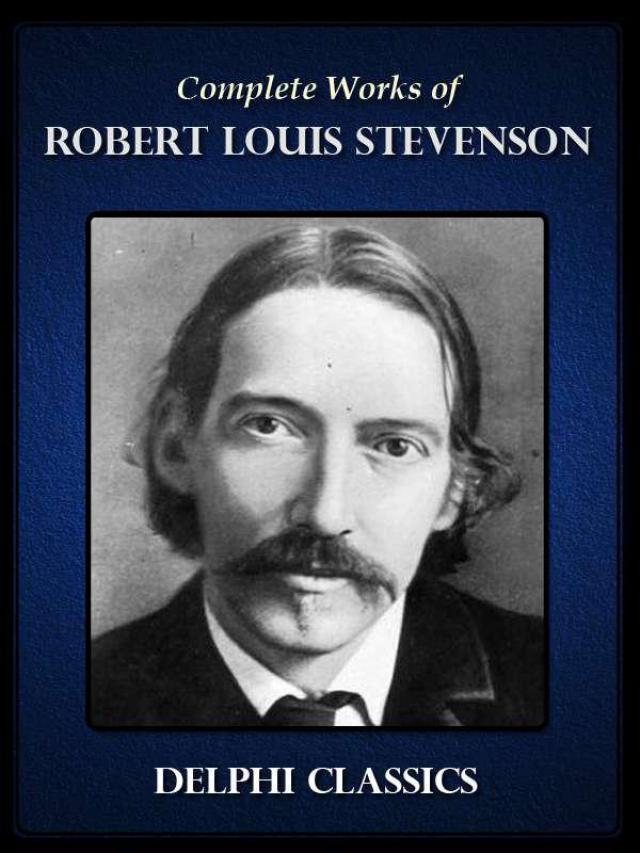


Balfour, Stevenson’s cousin and first biographer
CONTENTS
PREFACE
VOLUME I
CHAPTER I
HIS ANCESTORS
CHAPTER II
HIS PARENTS
CHAPTER III
INFANCY AND CHILDHOOD — 1850-59
CHAPTER IV
BOYHOOD — 1859-1867
CHAPTER V
STUDENT DAYS — 1867-73
CHAPTER VI
LIFE AT FIVE-AND-TWENTY — 1873-76
CHAPTER VII
TRANSITION — 1876-79
CHAPTER VIII
CALIFORNIA — 1879-80
CHAPTER IX
DAVOS AND THE HIGHLANDS — 1880-82
CHAPTER X
THE RIVIERA — 1882-84
VOLUME II
CHAPTER XI
BOURNEMOUTH — 1884-87
CHAPTER XII
THE UNITED STATES — 1887-88
CHAPTER XIII
SOUTH SEA CRUISES — THE EASTERN PACIFIC, JUNE, l888 — JUNE, 1889
CHAPTER XIV
SOUTH SEA CRUISES — THE CENTRAL PACIFIC, JUNE, 1889 — APRIL, 1891
CHAPTER XV
VAILIMA — 1891-94
CHAPTER XVI
THE END — 1894
CHAPTER XVII
R. L. S.
PREFACE
This book is intended to supplement the volumes of Stevenson’s Letters already published. Originally it was to have been written by Mr. Colvin, and to have appeared simultaneously with the two volumes of correspondence, so admirably edited by him; but when health and opportunity unfortunately failed him, Mrs. Stevenson requested me to undertake the task. The reason for this selection was that during the last two years and a half of my cousin’s life, I had on his invitation made Vailima my home and the point of departure for my journeys; and, apart from the members of his own family, had been throughout that period the only one of his intimate friends in contact with every side of his life.
In Stevenson’s case, if anywhere, the rule holds, that all biography would be autobiography if it could, and I have availed myself as far as possible of the writings in which he has referred to himself and his past experience. To bring together the passing allusions to himself scattered widely throughout his works was an obvious duty; at the same time my longer quotations, except in two or three manifest and necessary instances, have been taken almost entirely from the material which was hitherto either unpublished or issued only in the limited Edinburgh Edition. Whenever I found any passage in his manuscripts or ephemeral work bearing upon his life or development, I employed it no less readily than I should have used a letter or a hasty note, and in exactly the same fashion, regarding it as a piece of direct evidence from the best possible source. Such use of documents, I need hardly point out, differs entirely from challenging admiration for the literary form of immature or unfinished compositions. Where so much taste and discretion have been shown in preparing the final edition of his works, I should be the last to transgress the bounds imposed upon publication.
Since autobiography is wont to deal at some length with the first memories of its author, there seemed no occasion unduly to restrain this tendency in the case of the singer and interpreter of childhood, whose account of his early years is not only interesting in itself, but also of additional value for its illustration of his poems and essays. Again, in the representation of his adolescence, it must be remembered that he never wholly ceased to be a boy, that much that belonged to him in early youth remained with him in after-life, and that enthusiasms and generous impulses would sweep in and carry him away till the end.
Much of course he did outgrow, and that almost entirely his worse part. I feel that I should have done him a very ill service if I had refrained from showing the faults of the immaturity from which the character and genius of his manhood emerged. He had many failings, but few or none that made his friends think worse of him or love him any the less. To be the writer that he was, amounted to a great exploit and service to humanity; to become the man that in the end he became, seems to me an achievement equally great, an example no less eloquent.
Many persons, both friends and strangers to me, have rendered my task far easier than I could have hoped. There is hardly one of Stevenson’s intimate friends but has helped me in a greater or less degree, and if I were here to repeat my thanks to all to whom I am indebted for information, I should have to record more than sixty names. Those to whom we owe most are often those whom formally we thank the least; and to Mrs. Stevenson and Mr. Lloyd Osbourne I can never express my indebtedness for their suggestions and their knowledge, their confidence, their patience, and their encouragement. But, of course, for everything that is here printed I alone am responsible.
The references to Stevenson’s writings are necessarily to the pages of the Edinburgh Edition, as being the most complete collection of his works.
THE LIFE OF ROBERT LOUIS STEVENSON
VOLUME I
CHAPTER I
HIS ANCESTORS
‘The ascendant hand is what I feel most strongly; I am bound in and in with my forbears. . . . We are all nobly born; fortunate those who know it; blessed those who remember.’ — R. L. S., Letters, ii. 230.
‘The sights and thoughts of my youth pursue me; and I see like a vision the youth of my father, and of his father, and the whole stream of lives flowing down there far in the north, with the sound of laughter and tears, to cast me out in the end, as by a sudden freshet, on these ultimate islands. And I admire and bow my head before the romance of destiny.’ — R. L. S., Dedication of Catriona.
‘It is the chief recommendation of long pedigrees,’ as Stevenson once wrote, ‘that we can follow back the careers of our component parts and be reminded of our ante-natal lives.’1 But the threads are many and tangled, and it is hard to distinguish for more than a generation or two the transmission of the characteristics that meet in any individual of our own day. The qualities that would be required by other ages and for other pursuits are often unperceived, and the same man might scarce be recognised could he renew his life in three several centuries, and be set to a different task in each. Moreover, when any one has been dead for a hundred years, it is seldom that anything is remembered of him but his name and his occupation; he has become no more than a link in a pedigree, and the personal disposition is forgotten which made him loved or feared, together with the powers that gained him success or the weaknesses that brought about his failure. Therefore it is no unusual
1 Memories and Portraits, p. 162.
circumstance that, while we can trace the line of Stevenson’s ancestors on either side for two and four hundred years respectively, our knowledge of them, in any real sense of the word, begins only at the end of the eighteenth century. After that date we have four portraits, drawn in part by his own hand, together with the materials for another sketch; in these may be discerned some of the traits and faculties which went to make up a personality so unusual, so fascinating, and so deeply loved.
The record of his father’s people opens in 1675 with the birth of a son, Robert, to James Stevenson, ‘presumably a tenant farmer’ of Nether Carsewell in the parish of Neilston, some ten miles to the south-west of Glasgow. Robert’s son, a maltster in Glasgow, had ten children, among whom were Hugh, born 1749, and Alan, born June 1752.
‘ With these two brothers my story begins,’ their descendant wrote in A Family of Engineers,.1 ‘Their deaths were simultaneous; their lives unusually brief and full. Tradition whispered me in childhood they were the owners of an islet near St. Kitts; and it is certain they had risen to be at the head of considerable interests in the West Indies, which Hugh managed abroad and Alan at home,’ almost before they had reached the years of manhood. In 1774 Alan was summoned to the West Indies by Hugh. * An agent had proved unfaithful on a serious scale; and it used to be told me in my childhood how the brothers pursued him from one island to another in an open boat, were exposed to the pernicious dews of the tropics, and simultaneously struck down. The dates and places of their deaths would seem to 1 Except where it is otherwise stated, the quotations in this chapter and most of the facts about his father’s people are drawn from the unfinished fragment of A Family of Engineers, printed in the volume of Biography in the Edinburgh Edition of Stevenson’s works.
indicate a more scattered and prolonged pursuit.’ At all events,’ in something like the course of post, both were called away, the one twenty-five, the other twenty-two.’
Alan left behind him a wife and one child, aged two, the future engineer of the Bell Rock, who was also destined to be the grandfather of Robert Louis Stevenson. The widow was daughter of David Lillie, a Glasgow builder, several times Deacon of the Wrights, but had lost her father only a month before her husband’s death, and for the time, at any rate, mother and son were almost destitute. She was, however,’ a young woman of strong sense, well fitted to contend with poverty, and of a pious disposition, which it is like that these misfortunes heated. Like so many other widowed Scotswomen, she vowed her son should wag his head in a pulpit; but her means were inadequate to her ambition.’ He made no great figure at the schools in Edinburgh to which she could afford to send him; but before he was fifteen there occurred an event ‘which changed his own destiny and moulded that of his descendants — the second marriage of his mother.’
The new husband was a merchant burgess of Edinburgh of the name of Thomas Smith,’ a widower of thirty-three with children, who is described as ‘ a man ardent, passionate, practical, designed for affairs, and prospering in them far beyond the average.’ He was, among other things, a shipowner and under-writer; but chiefly he ‘founded a solid business in lamps and oils, and was the sole proprietor of a concern called the Greenside Company’s Works — ”a multifarious concern of tinsmiths, coppersmiths, brassfounders, blacksmiths, and japanners.”‘ Consequently, in August 1786, less than a year before his second marriage, ‘having designed a system of oil lights to take the place of the primitive coal fires before in use, he was dubbed engineer to the newly-formed Board of Northern Lighthouses.’
The profession was a new one, just beginning to grow in the hands of its first practitioners; in it Robert Stevenson found his vocation and so entered with great zest into the pursuits of his stepfather. ‘The public usefulness of the service would appeal to his judgment, the perpetual need for fresh expedients stimulate his ingenuity. And there was another attraction which, in the younger man at least, appealed to, and perhaps first aroused a profound and enduring sentiment of romance; I mean the attraction of the life. The seas into which his labours carried the new engineer were still scarce charted, the coasts still dark; his way on shore was often far beyond the convenience of any road, the isles in which he must sojourn were still partly savage. He must toss much in boats; he must often adventure on horseback by the dubious bridle-track through unfrequented wildernesses; he must sometimes plant his lighthouse in the very camp of wreckers; and he was continually enforced to the vicissitudes of outdoor life. The joy of my grandfather in this career was strong as the love of woman. It lasted him through youth and manhood, it burned strong in age, and at the approach of death his last yearning was to renew these loved experiences. Snared by these interests, the boy seems to have become at once the eager confidant and adviser of his new connection; the Church, if he had ever entertained the prospect very warmly, faded from his view; and at the age of nineteen I find him already in a post of some authority, superintending the construction of the lighthouse on the isle of Little Cumbrae in the Firth of Clyde. The change of aim seems to have caused or been accompanied by a change of character. It sounds absurd to couple the name of my grandfather with the word indolence; but the lad who had been destined from the cradle to the Church, and who had attained the age of fifteen without acquiring more than a moderate knowledge of Latin, was at least no unusual student. From the day of his charge at Little Cumbrae he steps before us what he remained until the end — a man of the most zealous industry, greedy of occupation, greedy of knowledge, a stern husband of time, a reader, a writer, unflagging in his task of self-improvement. Thenceforward his summers were spent directing works and ruling workmen, now in uninhabited, now in half-savage islands; his winters were set apart, first at the Ander- sonian Institution, then at the University of Edinburgh, to improve himself in mathematics, chemistry, natural history, agriculture, moral philosophy, and logic.’
His mother’s marriage made a great change also in his domestic life: an only child hitherto, he had become a member of a large family, for his stepfather had already five children. However, the perilous experiment of bringing together two families for once succeeded. Mr. Smith’s two eldest daughters, Jean and Janet, fervent in piety, unwearied in kind deeds, were well qualified both to appreciate and to attract the stepmother,’ just as her son found immediate favour in the eyes of her husband. Either family, it seems, had been composed of two elements; and in the united household ‘ not only were the women extremely pious, but the men were in reality a trifle worldly. Religious the latter both were; conscious, like all Scots, of the fragility and unreality of that scene in which we play our uncomprehended parts; like all Scots, realising daily and hourly the sense of another will than ours, and a perpetual direction in the affairs of life. But the current of their endeavours flowed in a more obvious channel. They had got on so far, to get on further was their next ambition — to gather wealth, to rise in society, to leave their descendants higher than themselves, to be (in some sense) among the founders of families. Scott was in the same town nourishing similar dreams. But in the eyes of the women these dreams would be foolish and idolatrous.’
The connection thus established was destined yet further to affect the life of the young man, and this contrast in the household was still to be perpetuated. 4 By an extraordinary arrangement, in which it is hard not to suspect the managing hand of a mother, Jean Smith became the wife of Robert Stevenson. The marriage of a man of twenty-seven and a girl of twenty, who have lived for twelve years as brother and sister, is difficult to conceive. It took place, however, and thus in 1799 the family was still further cemented by the union of a representative of the male or worldly element with that of the female and devout ‘ This essential difference remained unabridged, yet never diminished the strength of their relation. My grandfather pursued his design of advancing in the world with some measure of success; rose to distinction in his calling, grew to be the familiar of members of Parliament, judges of the Court of Session, and “ landed gentlemen”; learned a ready address, had a flow of interesting conversation, and when he was referred to as “a highly respectable bourgeois” resented the description. My grandmother remained to the end devout and unambitious, occupied with her Bible, her children, and her house; easily shocked, and associating largely with a clique of godly parasites. . . .
‘ The cook was a godly woman, the butcher a Christian man, and the table suffered. The scene has been often described to me of my grandfather sawing with darkened countenance at some indissoluble joint — ” Preserve me, my dear, what kind of a reedy, stringy beast is this? “ — of the joint removed, the pudding substituted and uncovered; and of my grandmother’s anxious glance and hasty, deprecatory comment, “ Just mismanaged!” Yet with the invincible obstinacy of soft natures, she would adhere to the godly woman and the Christian man, or find others of the same kidney to replace them.’
Readers of Weir of Hermiston will recognise in this picture the original of Mrs. Weir in all her piety, gentleness, and incompetence, yet in real life ‘ husband and sons all entertained for this pious, tender soul the same chivalrous and moved affection. I have spoken with one who remembered her,5 her grandson continues,’ and who had been the intimate and equal of her sons, and I found this witness had been struck, as I had been, with a sense of disproportion between the warmth of the adoration felt and the nature of the woman, whether as described or observed/
It is no part of my purpose to follow the professional life of Robert Stevenson, which was, moreover, written by his son David. In 1807 he was appointed sole engineer to the Board of Northern Lights, and in the same year began his great work at the Bell Rock, the first lighthouse ever erected far from land upon a reef deeply submerged at every tide.1 He built twenty lighthouses in all, and introduced many inventions and improvements in the systems of lighting. He did not resign his post until his powers began to fail in 1843, and he died in 1850, four months before the birth of the most famous of his grandsons.
‘ He began to ail early in that year, and chafed for the period of the annual voyage, which was his medicine and delight. In vain his sons dissuaded him from the adventure. The day approached, the obstinate old gentleman was found in his room, furtively packing a portmanteau, and the truth had to be told him ere he would desist — that he was stricken with a malignant malady, and that before the yacht should have completed her circuit of the lights must himself have started on a more distant cruise. My father has more than once told me of the scene with emotion. The old man was intrepid; he had faced death before with a firm countenance; and I do not suppose he was much dashed at the nearness of our common destiny. But there was something else that would cut him to the quick — the loss of 1 The Eddystone was scarcely covered at high tide, whereas the Bell Rock was twelve feet below water at such times.
the cruise, the end of all his cruising; the knowledge that he had looked his last on Sumburgh, and the wild crags of Skye, and that Sound of Mull, with the praise of which his letters were so often occupied; that he was never again to hear the surf break in Clashcarnock; never again to see lighthouse after lighthouse (all younger than himself, and the more part of his own device) open in the hour of dusk their flowers of fire, or the topaz and the ruby interchange on the summit of the Bell Rock. To a life of so much activity and danger, a life’s work of so much interest and essential beauty, here came a long farewell.’1