

In joy still felt the au.., p.1
In Joy Still Felt: The Autobiography of Isaac Asimov, 1954-1978,
p.1
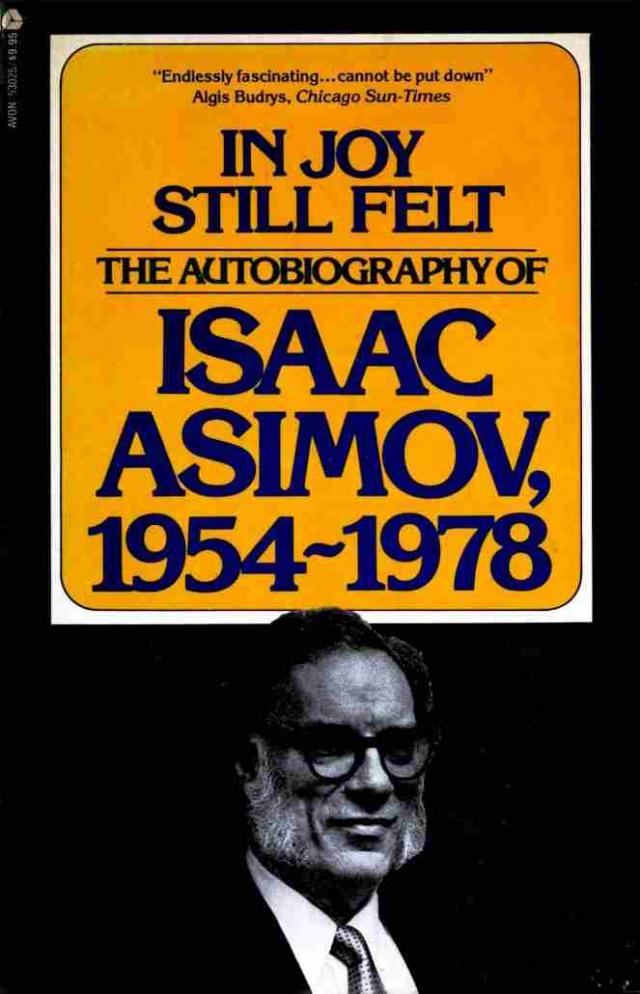


In Joy Still Felt
The Autobiography of Isaac Asimov, 1954−1978
Isaac Asimov
AVON
PUBLISHERS OF BARD, CAMELOT AND DISCUS BOOKS
The lyrics from “Fight Fiercely, Harvard,” © 1953 by Tom Lehrer, and “The Subway Song” by Tom Lehrer are reprinted by permission of the author.
AVON BOOKS
A division of
The Hearst Corporation
959 Eighth Avenue
New York, New York 10019
© 1980 by Isaac Asimov
Published by arrangement with Doubleday and Company, Inc. Library of Congress Catalog Card Number: 79–3685 ISBN: 0–380–53025–2
Cover photography © by Alex Golfryd
Cover design by Robert Aulicino
Contents
Introduction
Part I – Collision—and Out
1 Pregnancy Again
2 Robyn
3 House-hunting
4 West Newton
5 Hiatus at School
6 New Department Head
7 Keefer
8 Job at Stake
9 Full-time Writer
10 One More Battle
Part II – The Book Race
11 Peace
12 Guide to Science
13 Back with Doubleday
14 A Book for Each Year
15 Over the Top
16 Far over the Top
17 A Multiplicity of Books
18 World Book Year Book
19 Biographical Encyclopedia
20 Hugo and History
Part III – Endlessly Broadening
21 Changes of Editors
22 Fantastic Voyage I
23 Fantastic Voyage II
24 Second Hugo and Special Issue
25 “You Are the Field”
26 Asimovian Immodesties
27 Guide to Shakespeare
28 Approaching the Hundredth
29 Farewell to My Father
30 Two Books for Each Year
Part IV – Breakup and Rebirth
31 Back to New York
32 The Sensuous Dirty Old Man
33 The Gods Themselves
34 My Thyroid
35 Janet’s Breast
36 Breadloaf and Statendam
37 Eclipse Cruise—Alone
Part V – Ageless Love and Aging Heart
38 Second Marriage
39 Great Britain
40 Park Ten
41 Murder at the ABA
42 Three Books for Each Year
43 Isaac Asimov’s Science Fiction Magazine
44 Autobiography
45 Coronary
46 Recovery
Catalog of Books – Isaac Asimov
Introduction
I suppose it is quite unlikely that you will be buying this book unless you have already bought and read the autobiographical book that preceded it, In Memory Yet Green (Doubleday, 1979). Presumably, having read it, you found yourself interested and are curious to see what happens next, so that you now have this volume, In Joy Still Felt.
There is, however, no law of nature to this effect. You may not have read the first volume; you may not be able to get it on short notice; and you may wish, nevertheless, to read this second volume.
To take account of this possibility, I would like to supply a short synopsis of the first volume so that you don’t have to start absolutely cold. (If you have indeed read the first volume, you can, of course, skip this introduction.)
I was born in Russia on January 2, 1920, the oldest child of two middle-class Jews. My father was Judah Asimov; my mother Anna Rachel Asimov, née Berman.
Considering that Russia had just gone through a world war and a revolution, my parents did not suffer unduly, but horror tales reached the outside world. My mother had an older half brother, Joseph Berman, in the United States. He wrote to find out how we were doing and offered to sponsor our emigration to the United States.
My parents decided to take advantage of the offer and in February 1923 they arrived in New York with myself and my younger sister. They found a small apartment in Brooklyn and settled down to an attempt to make a living.
I flourished in the new environment, taught myself to read at the age of five, entered the first grade before I was six, and was quickly pushed ahead by teachers who discovered I was unusually bright.
My father, meanwhile, unable to do much at ordinary jobs for which he lacked both experience and English, bought a candy store in 1926, and from that moment on, my life revolved about that candy store. It was open seven days a week and eighteen hours a day, so my father and mother had to take turns running it, and I had to pitch in, too.
Nevertheless, life progressed. My father became an American citizen in September 1928, and I became one automatically in consequence. I even gained a new sibling when my brother Stanley was born on July 25, 1929. By that time we had sold the candy store and bought a second, better one, but the stock market crashed that fall and like everyone else we found ourselves hanging on precariously. We never went hungry, but life was an adventure of counting pennies.
My schooling continued apace. I entered junior high school in 1930, high school in 1932, and Seth Low Junior College (a division of Columbia University) in September 1935.
Meanwhile, something new had entered my life. In 1929, I had discovered science-fiction magazines and, despite my father’s general refusal to allow me to read magazines, I persuaded him to make those an exception. I became an ardent science-fiction fan and by 1931, I was beginning my first experimental scribblings.
In 1935, my writing efforts stepped up a notch when I persuaded my father to get me an old, secondhand typewriter. For some years, though, my writing continued to be a private matter between myself and that typewriter.
On January 1, 1938, I began to keep a diary and have kept it up ever since. A lucky thing, too, for 1938 turned out to be a particularly eventful year.
For one thing, I joined a science-fiction fan group called the “Futurians.” One of its other members was Frederik Pohl.
Then, too, I finally managed to finish a story and on June 21, 1938, I actually took it in personally to Astounding Science Fiction, the leading magazine in the field. It was then that I met its editor, John W. Campbell, Jr., who was to have a greater influence on me than anyone but my father.
He rejected the story, but from then on I wrote regularly, taking in each story I wrote and accepting the rejections gladly since they were always accompanied by the most helpful discussions and letters. Finally, on October 21, 1938, I sold one of Campbell’s rejections to Amazing Stories. It was published in the March 1939 issue of that magazine.
In 1939, I obtained my Bachelor of Science degree and entered Columbia University Graduate School, majoring in chemistry. Although I continued to do well at school, and continued to work in my father’s candy store (by now he was in his fourth), I also continued to write furiously.
In 1940, I wrote the first of my positronic robots stories. Campbell rejected it, but Fred Pohl, who was now editor of two science-fiction magazines, accepted it.
In 1941, I published “Nightfall,” which brought me at once into the magic circle of top-ranking science-fiction writers, and in 1942, I published the first of my Foundation stories.
By then, though, things in the outside world were changing rapidly. World War II had started in Europe soon after I entered graduate school, and the attack on Pearl Harbor brought the United States into the war on December 7, 1941.
I had just attained my M.A. when Pearl Harbor was bombed and was continuing toward my doctorate under the guidance of Professor Charles R. Dawson. It could not last long, though. The war emergency had its demands and in May 1942 I suspended my studies in order to take a position as a chemist with the U. S. Navy Yard at Philadelphia. Also working there were two other science-fiction writers and friends of mine, Robert A. Heinlein and L. Sprague de Camp.
It was the first time I had ever left home but the trauma was eased by the fact that I was deeply in love and was planning to get married. I had met Gertrude Blugerman on February 14, 1942, and we were married on July 26 of that year.
I spent the duration of the war at the Navy Yard, but immediately after V-J Day I was drafted. I entered the Army on November 1, 1945, but didn’t stay long. Though for a few months I was as far afield as Hawaii, I was back in civilian life on July 26, 1946.
I went back to my research, obtained my Ph.D. in 1948, and accepted a post-doctorate assignment at Columbia under Robert C. Elderfield.
That only lasted a year. Then, through the influence of Professor William C. Boyd of Boston University School of Medicine (whose acquaintance I had made when he wrote me a fan letter while I was in the Army) I got a post as instructor in biochemistry at that institution. The head of the department was Professor Burnham S. Walker and I did research work on a grant administered by Professor Henry M. Lemon.
I had been writing science fiction all through the 1940s, even while I was in the Army. All my stories had sold except for one rather long one written in 1947 for Startling Stories. It had been rejected and I had retired it.
“Fred Pohl persuaded me to submit it to Doubleday & Company, Inc., as the basis of a possible book. Walt
er I. Bradbury of that publishing firm agreed to use it after satisfactory revision. It was published on January 19, 1950, under the title of Pebble in the Sky, and it was my first book.
Later that year, my robot stories were collected under the title of I, Robot and plans were made for the collection of my Foundation stories in three books. I began writing additional novels.
Nor did I confine myself to fiction. William Boyd had spent some months in Egypt and when he returned he cast about for an interesting project and suggested I join him in writing a biochemistry textbook. Burnham Walker joined also and as we got to work I discovered that it was even more fun writing nonfiction than fiction.
While the textbook was in progress, Gertrude and I became the parents of a son, David, born on August 20, 1951.
Toward the end of 1951, I attained professorial rank, becoming assistant professor of biochemistry, and the next year the textbook, Biochemistry and Human Metabolism, was published.
The textbook was not entirely satisfactory to me since I had to be continually adjusting my style to suit those of Walker and Boyd. I ached to do a bit of non-fiction on my own and after considerable difficulty managed to publish a small book for teen-agers called The Chemicals of Life in 1954.
It was at this point that the first volume of my autobiography ended. I had reached mid-life, for I was approaching my thirty-fifth birthday, halfway to threescore and ten. I had reached what seemed to be the peak of the possible—and it wasn’t enough.
In my professional career as a chemist, I had finally achieved professorial status, but my position was very low-paying and I didn’t see that I could possibly advance either in remuneration or reputation very much beyond the point I had reached.
In my professional career as a writer, I had become a first-rank science-fiction writer as early as 1941, but even after more than a decade of constant success both in magazine short stories and in hard-cover novels, my earnings as a writer were very moderate, and I didn’t see any possibility of increasing them further, or of gaining any reputation outside the constricted boundaries of science fiction.
I had, in short, reached a blank wall; a dead end.
And yet I managed to overleap the blank wall and burrow through the dead end and to reach both an income and a reputation which to me, in 1954, would have been inconceivable. The story of how I did this is contained in this second volume, which, if you wish, you may now begin.
In memory yet green, in joy still felt.
The scenes of life rise sharply into view.
We triumph, Time’s disasters are undealt,
And while all else is old, the world is new.
Anon.
Part I
–
Collision—and Out
1
Pregnancy Again
1
On July 1, 1954, my salary was still six thousand dollars per year, but it was entirely out of the school budget now and there was no obligation to teach student nurses. This was what I wanted and I was, for the time, satisfied.
My next ambition, though, was to be promoted to associate professor. It was only at the associate professor level, according to a book of university regulations that someone had given me, that tenure was obtained. With tenure, one could be fired only for cause—and cause was not easy to get. With associate professorship, therefore, I would finally have job security.
It might seem strange that I should want job security or attach any importance to it when I already made considerably more money through my writing than at my job—but it made sense. I could write with greater ease and peace if my rear were secure; if I didn’t have to spend time and nervous energy justifying my actions; if I could fulfill my teaching duties and spend all the rest of the time (some 80 per cent of the whole) doing exactly as I pleased, protected by tenure.
Then, too, what if my writing sagged, diminished, dwindled? It didn’t seem likely, but what if it did? It would be nice to have a school salary, a secure one, to fall back on.
And this struck me as important since, that July, my wife, Gertrude, was wondering if she were pregnant again. She had thought she might be in 1952 but that had proved a false alarm. Now the question arose once more.
It was conceivable, of course. After the birth of David, we had taken no particular precautions against conception. It had seemed to me that since it had taken us years to have one child, we were not likely to find lightning striking twice.
Yet Gertrude, having been through the process once, could recognize the symptoms and was finally sufficiently suspicious to undergo a test. On July 30, we had the results—positive! Another child was on the way.
It meant we were faced with a housing problem again. The coming of my son David had made the Somerville attic apartment untenable, and the coming of a new child would make the Waltham apartment untenable. That was regrettable. We had been living at 265 Lowell Street in fair contentment even longer than we had lived in Wingate Hall, and our search for a house had dwindled and faded. Even our party-line telephone, a perennial irritant, had finally been changed into a private line on April 29, 1954. Now even I, who hated change, had to admit it wouldn’t do, and our search for a house was reluctantly reactivated.
2
Copies of the second edition of Biochemistry and Human Metabolism arrived on July 6, 1954. It had taken almost as long to do the second as the first. Revising and adding was a meticulous job and the proofing and indexing had to be done all over again, as though for a brand-new book.
I was under no illusions that it would do better than the first edition, but it certainly looked better and was better, and I was already collecting references for the third edition.
3
For some months, I had been hearing occasionally from David White, a professor at the main campus of the university, that Al Capp, the famous originator of the comic strip “Li’l Abner,” had read my books and would like to meet me. I said I would be delighted to meet him, but for a while nothing happened.
Then, on July 10, 1954, Al Capp called me and invited us to dinner and to a showing of Arthur Miller’s The Crucible at an open-air theater in Wellesley.
We were flattered out of our skulls and accepted very readily. It was all perfect, too. Excellent meal and excellent company. We found Al just as pleasant and as witty as we expected he would be, and Mrs. Capp was sweet and friendly. We even enjoyed the play.
What I remember most clearly about the evening, however, was that I fell prey to the vile temptation of haughtiness. As I was heading up the stairs at play intermission to visit the men’s room, someone who was a technician at the med school and who knew me, stopped me and said, “Say, isn’t that Al Capp with you?”
“That’s right,” I said.
The technician then said, “What’s he doing with you?”
I thought that the stress on the final word indicated that a science-fiction writer represented a stratum too far below that of cartoonist to make the association anything but a mesalliance, so I said, haughtily, “He’s a fan of mine, so I thought I’d give him a chance to enjoy my company,” and went off.
It was a terrible thing to say, even though it was true, after a fashion.
4
On July 11, I drove to New York myself and the next day picked up my royalty check at Doubleday. It came to forty-four hundred dollars, the largest single royalty check I had ever received (or check of any kind). Every one of my six Doubleday books was selling reasonably well, and Brad seemed very pleased with me. And I was delighted to be pleasing him.
I also visited Horace Gold, editor of Galaxy, who had been writing to me and urging me to send him stories. I was growing increasingly reluctant to submit stories knowing it would mean I would also have to submit to a rough-tongued rejection, but I tried.
I gave him a story I had written that I called “A Hundred Million Dreams at Once,” and which was not in my usual style at all. It was about a day in the life of an old movie-producer, who, in the story, was a producer of “dreamies”—reveries transmitted directly from the dreamer’s brain to the listener’s. And it ended with some sad words about the life of a dreamer, which could be applied without alteration to the life of any artist, certainly any writer.


