

In joy still felt the au.., p.48
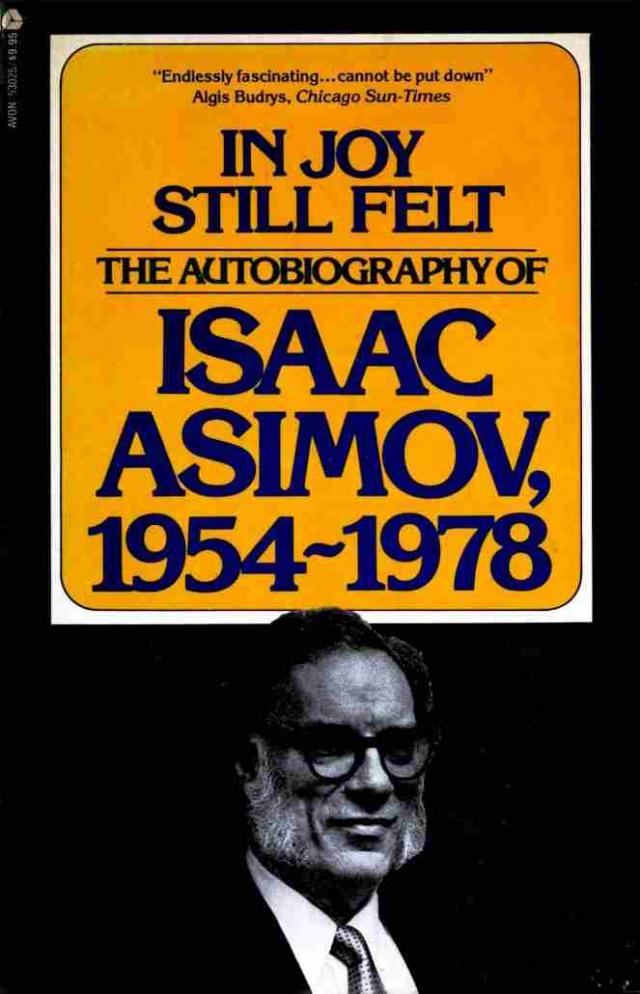
In Joy Still Felt: The Autobiography of Isaac Asimov, 1954-1978,
p.48


After the talk, I was more or less forced to bend my reluctant steps toward the stage with half a dozen excited people following me, and with a very clear picture in my mind of a notable who didn’t know me and who would favor me with a haughty stare, and with the total humiliation that would follow.
There was someone talking volubly to Kauffman as I approached, and I was in no hurry to interrupt. For my part, the conversation could be continued indefinitely till the people waiting behind me grew weary and demanded to be taken home.
Then Kauffman, lifting his eyes, waved a hand, and said in a quite matter-of-fact fashion, “Hi, Isaac,” and went on talking.
I cheered up tremendously and pushed forward in a bustling way, cut out the fellow trying to talk to Kauffman, and introduced all my friends.
I was very disappointed and rather outraged when Kauffman left his job with the Times not long afterward. I kept telling myself there was no connection.
5
We visited Robyn at her camp at the midterm break on Sunday, August 7, and it was a virtual repeat of the time we had visited David under similar circumstances. Robyn asked piteously to be allowed to come home, and we refused stonily. I had the urge to tell her that the refusal hurt me far more than it hurt her, but she wouldn’t have believed me.
When we left, it did occur to me that if something happened to her during those last four weeks, and if I had to spend the rest of my life thinking that if I had taken her home . . .
But then if I took her home and something happened to her there, I would have had to spend the rest of my life thinking that if I had left her at camp . . .
You can’t win.
6
On August 10, I was in New York and took the complete manuscript of the Old Testament portion of It’s Mentioned in the Bible to Doubleday.
I also dropped in at F & SF to get the original of the cover of the October issue of F & SF, which was to feature me. The illustrator, Ed Emshwiller, had drawn me from a photograph, and I was quite accurately pictured.
My image, like a bust, was shown on a pedestal that enclosed a large metal coil representing science, and a typewriter representing literature. In the background was a giant representation of a cell, which I supposed represented the med school.
Staring at the typewriter was a Sherlock Holmes figure who represented my science-fiction mysteries; a saluting robot, who represented my robot stories; and a beautiful, unclothed, red-headed girl, who must have represented some other aspect of my life, but I don’t know exactly what.
About the only thing I could find fault with was the fact that Ed, unable to tell the color of my eyes from a black-and-white photo and unable to remember that color from those times he had met me (at the convention in Detroit in 1959, for instance) made them brown whereas, in actual fact, they are as blue as the western skies.
I obtained the original that day, and it is still on the wall of my office.
7
I obtained a copy of the 1966 issue of the Encyclopaedia Britannica on August 16, and finally I could replace the old 1942 edition that my father had bought shortly before I had left for Philadelphia twenty-four years before.143
8
We celebrated David’s fifteenth birthday, on August 20, by putting him on the bus for a second solo trip to the Blugermans’ in New York, and for a few days both children were away from home.
We attempted to take advantage of the situation by having a little holiday of our own on our way to Robyn’s camp to bring her home. On the recommendation of the Fonoroffs, we drove to Falmouth and then drove our car onto the ferry that would take us to Martha’s Vineyard.
We had never visited it before and were delighted with it. There was only one trouble. It had never occurred to us that we ought to call ahead and make reservations in advance. It was deep in the summer season, and when we called the hotels, quite ready to pay any price, for money was no object, we found that money was also of no value when all rooms were filled.
We spent hours in a vain hunt and then, come mid-afternoon, had to make our chastened way back to the ferry slip and get a ferry back to the mainland. For a while, in fact, it seemed that we might not be able to find room on a ferry that day and we would have to spend the night sleeping in the car, but it didn’t come to that.
It ended well enough, though. We put up in a hotel in Falmouth, and it had a heated swimming pool, which Gertrude used with considerable enjoyment.
And the next day was my real holiday, for we went to Robyn’s camp and finally picked her up to take her home.
It was a joyous ride home, for she sang all the songs she had learned at camp and told us endless stories about girls we didn’t know and what she had done and said and what they had done and said. I could have listened for days on end.
About the only drawback was that Robyn had been responsible for her own bathing for eight weeks, and her own clothes-washing, and the hot-water situation had been so erratic that she must have skipped both whenever she could. The atmosphere in the car was therefore quite close and I speculated on the desirability of burning all her clothes when we got back and of having Gertrude scrub down Robyn’s little hide with a wire brush.
Actually, a lot of soap and steaming water seemed to do the trick as far as Robyn was concerned, and the clothes washer handled her clothes without actually breaking down under the strain.
The next day, David came home and the family was together again.
9
Understanding Physics arrived in its Walker & Company hardcover edition on August 26, 1966. It was in three separate volumes and looked very good indeed. They appeared no less than 3½ years after I had begun writing the first volume.
I had to consider whether to number the books in my list as a single book or as three. After all, when The Intelligent Man’s Guide to Science first appeared in 1960, it was in two volumes, yet I considered it only a single book. However, I had written the latter as a single book and had written the former as three books—and each of the three volumes of Understanding Physics was longer than my average novel or my average history; so I counted it as three books.
I had a new thing going, too. So far I had published six books of science essays from the science-fiction magazines. The first one, Only a Trillion, had been from Astounding; the next five were from F & SF. Of late, however, I had been writing science articles for a wide variety of non-science-fiction magazines, for the New York Times Magazine, Mademoiselle, Think, True, Petroleum Today, and so on and so on.
Why not a collection of this miscellany? Why not get them together between two covers for those who liked almost anything I wrote? I had suggested this to Larry Ashmead and he had agreed in his ever-amiable way, so on August 27 I began putting the articles together. The title of the new collection was Is Anyone There? It was taken from the title of one of the articles included at Larry’s suggestion.
10
The twenty-second World Science Fiction convention in 1964 had been in Oakland, California, and the twenty-third, in 1965, had been in London. I was unable to attend either, of course.
In 1966, however, the twenty-fourth World Science Fiction convention was to be held in Cleveland, as it had been in 1955 when I had been guest of honor. Then I had gone alone; this time I took the family.
We left on Thursday, September 1, stayed in Syracuse overnight, and were in Cleveland on Friday afternoon. We stayed at an old hotel and were put up in an old and terribly depressing room, with closets that were (I do not exaggerate) six inches deep.
Gertrude was furious, and it was almost like our first trip to Hilltop Lodge, twenty-three years before, when it had seemed there would be no way out but to go home.
The same lucky thing happened as at Hilltop Lodge. Then it had been Lester Weill; now, as we went down to the lobby to demand a better room or, if one did not exist, to go home, we met Harlan Ellison, bubbling over with enthusiasm and charisma.
To me he was just a little, sharp-featured guy, highly intelligent and as lively as quicksilver; but to women, somehow, he was a lot more than that. God knows what they see, but they see it. In five minutes flat, Gertrude was filled with delight and I could see that even Robyn was sparkling.
We had dinner with Harlan, and he kept us all thoroughly amused. We then attended parties till 5 a.m. and all was well. Even our closets seemed bearable.
At one of the parties, Evelyn del Rey was sitting on a windowsill and greeted me with some sardonic statement. She and I were always fencing when we met, and she was quick-witted enough to force, me to extend myself.
This time I didn’t feel like being extended. She had been Evelyn Harrison before she had been Evelyn del Rey, and she had been at the New Year’s Eve party a dozen years before. I had kissed her then, and I had never forgotten that. I thought of it now, and since we were alone in the corner—or at least since everyone was talking to someone else—I said to her on impulse,
“You know, each time I see you I remember the time at Roz Wylie’s New Year’s Eve party when I kissed you. It was the first time any girl kissed me quite like that, and it meant a lot to me. I didn’t think any girl ever would, so I’d rather not cross swords, Evelyn.”
She looked at me with her defenses all down and said, “You remember that?”
I said, “Of course.”
She said, “I didn’t think you did.”
From then on, for the rest of her life, she never fenced with me again. We were, whenever we saw each other, always warm friends.
There was no mystery to it. She had remembered and she had thought the episode had been of so little importance to me that I did not remember it, and she resented that. I have always been sorry, and annoyed at my own stupidity, that I had not made it perfectly clear long before. I could then have avoided mangling her self-esteem.
11
I met Gene Roddenberry at the convention, and we were all shown a preview of the new TV show “Star Trek.” I must say that I watched it without any notion of how important it would become to science-fiction fandom. No breath of prescience stirred within me.
12
At 1 p.m. on Sunday, September 4, someone decided that Harlan and I ought to share the stage and engage in an impromptu battle of wits. Harlan was quite eager to do so, being quite confident that he could demolish anyone, and I was quite reluctant to do so because I was quite confident of the same thing. However, I couldn’t very well back away, partly because I didn’t want to seem to be a coward and partly because everyone kept telling me that I was the only person at the convention who could keep up with Harlan-in-full-cry, and I turn soft as a grape under flattery.
Harlan is a lot more voluble than I, but a lot less flexible. He is prone to use vulgar language and cannot prevent himself from doing so. My own strategy, then, was to deliberately lead the chain of insults as close as I could to obscene implications without using a single improper word, quite sure that Harlan, in his eagerness to go me one better, would find himself stuttering over obscenities.
In the end, though, Harlan began to tell the story of an encounter between himself and Frank Sinatra, in which Harlan had stood up to that show-business despot and had come off the winner. I willingly suspended the dialog to listen, and in the end we all cheered him as the worthy representative of the science-fiction fraternity; I, loudest of all.
That was the first of a series of encounters between us at conventions. It was all in good fun and was intended as in-humor for in-people, but some of the more unsophisticated fans inevitably assumed the battle to be a serious one and Harlan and me to be the deadliest of enemies. As it happens, of course, we are buddies, and though we live three thousand miles apart, one of us frequently calls the other for advice or help, and we never fail each other. Yet I must forever assure people we are friends, and I’m sure that so must he.
13
That same evening was the award banquet and Sprague de Camp, who was guest of honor, delivered a sober and interesting speech. I myself, as usual, was on the dais, for I was to hand out the Hugos—but this was a matter of only academic interest to me for once, since I had already gained a Hugo three years before in Washington, and one was enough to establish the principle.
Yet one thing of mine was nominated. The organizers of the convention had the intention of awarding J. R. R. Tolkien a Hugo (at least I think they had the intention). Tolkien’s Lord of the Rings trilogy was out now and it had taken fandom by storm.144
The convention organizers, therefore, proposed a Hugo nomination in a new category, the “Best All-time Novel Series.” They defined a “novel series” as consisting of at least three interconnected novels, and advanced Lord of the Rings as an example of what they meant, which, to me, was a clear hint as to how they wanted the voting to go.
However, to make it look unforced, other series were nominated. These included Heinlein’s Future History series; E. E. Smith’s Lensman series; Burroughs’ Mars series; and my own Foundation series.
I felt that Tolkien was certain to win, and fairly so, and that Heinlein, Smith, and Burroughs all had enough devotees among the young fans attending the convention (and who did the voting) to give each a good shot at second place. Foundation, I honestly felt, would finish in last place, and I grieved at being the sacrificial lamb. I was reconciled to losing, but I hoped against hope that Burroughs or Smith would manage to place fifth. I would be delighted to make fourth.
When it came time to hand out that award, however, the organizer of the convention hastily whispered to me that Harlan wanted to handle the novel series item and said, in a shamefaced manner, “We had better let him. You know Harlan.”
I certainly knew that Harlan was capable of creating a giant-size fuss if he didn’t have his way, and I didn’t want him spoiling the banquet, so with what grace I could muster I gave way.
Harlan came dancing up, made a few rapid remarks that had everyone laughing, and then announced the nominees and omitted the Foundation series.
I called out from my seat, in real outrage, “Hey, Harlan, at least mention the Foundation series.”
Harlan didn’t even hear me, or at least he made no sign that he had. He reached for the envelope, tore it open, waited the inevitable heartbeat for the sake of suspense, and said, “And the winner: Isaac Asimov for the Foundation series.”
I thought it was Harlan’s idea of a joke and sat there without moving and looking rather annoyed until everyone started laughing, and I gathered I had really won. And there were Gertrude and the children beaming, and everyone still laughing and applauding, and I got up to accept my Hugo, thoroughly and utterly speechless.
I don’t think the organizers of the convention had thought anyone would take the award away from Tolkien, and it was the first indication I had had, the first really convincing indication, since the first of the Foundation series had appeared twenty-four years before, that the series was so popular. In fact, I suddenly realized that just as “Nightfall” was the most highly regarded science-fiction piece among the shorter lengths, The Foundation Trilogy was the most highly-regarded science-fiction item among the longer lengths.
That I could bear off the prize, so to speak, both long and short, seemed utterly improbable to me, yet I had done it, and I remember feeling utterly delighted that John Campbell was alive to see it. It seemed to justify the faith he had had in me when I was eighteen and when no one but Campbell himself could have seen anything at all in “Cosmic Corkscrew.”
According to my diary, “The evening was one great, gorgeous triumph! I spent hours laughing, hugging, and singing, and didn’t go to bed till 4 a.m.”
And the next day we left for home.
14
I was typing up all the articles for Is Anyone There? rather than using tearsheets, and I wasn’t finished till September 14. The book ended being 105,000 words long, half again as long as my usual essay collection.
What seemed even more important to me was that on September 15 I began my hundredth F & SF article. I had continued the series, without missing an issue, for over eight years. The hundredth essay, “Impossible, That’s All,” dealing with the speed-of-light limit to velocity, was to appear in the February 1967 F & SF.145
15
The paperback version of Fantastic Voyage came out in September and I received copies on the seventeenth. The motion picture was released at the same time, of course, and my connection with it was mistakenly assumed. Some fans wrote excitedly that my name had been left out of the list of credits, and I had to write soothing letters to them assuring them I had not been cheated.
One of the Boston movie houses encouraged misapprehension by sporting a big sign that read, “See Boston University’s own Isaac Asimov’s movie Fantastic Voyage.”
I called up the Boston offices of the movie producers rather anxiously in order to disown this and to ask them to ask the movie house to take down the sign. The producers just laughed and said that if it helped bring in customers, it was perfectly all right.
16
More important to me than the movie that month was the special Isaac Asimov issue of F & SF, the October 1966 issue.
It contained my story “The Key”146 and my poem “The Prime of Life,”147 along with the bibliography I had prepared which, though it covered ten magazine pages, was only a partial one, even for those days.
In addition it contained my 96th F & SF essay, “Portrait of the Writer as a Boy,”148 in which I described the beginning of my writing career in 1938.
This was my first piece of straight autobiographical writing of any length, but I did not consult my diary. I had the incidents clear in my memory, I thought, and, being proud of my memory, it did not occur to me to go any farther. In later years, when I did consult my diary while writing something more elaborate than an F & SF article, I was rather astonished and embarrassed to discover that my memory had played me false in several minor respects.


