

In joy still felt the au.., p.63
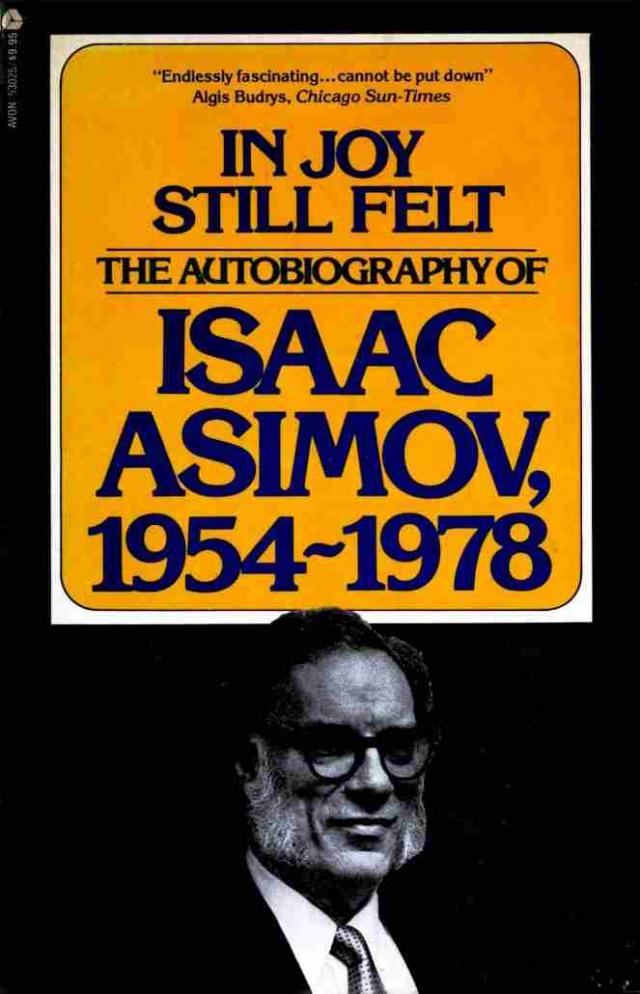
In Joy Still Felt: The Autobiography of Isaac Asimov, 1954-1978,
p.63


How badly I needed that sign that someone cared!
It didn’t take us long to unload, but when we came down, there was a ticket on my car for twenty-five dollars for illegal parking. I would have to do something about that, but meanwhile I put my car away in a garage and then . . .
What?
It was toward evening and my two rooms were empty except for the hotel furniture—a couch and some chairs in one room, two beds and two bureaus in the other. I had my typewriters and paper and manuscripts, but my library would not be there for a week, very likely, and I wasn’t sure I could type in a strange place, laden down, as I was, with the guilt and gloom of having left my wife and children. What’s more, it was the Fourth of July weekend and I couldn’t look forward to visits to the familiar environs of Doubleday, Walker, Basic Books, or any of the rest.
Then Janet said, rather hesitatingly, as though afraid she might be misinterpreted, “You know, my apartment isn’t far away and you’re perfectly welcome to spend time there over the weekend, if it gets too lonely for you out here.”
It was a good-hearted offer and I didn’t even try to pretend I was worried about being a bother to her. I accepted.
The first night in the hotel was a more frightening time than any I had spent since my second night in the Army, twenty-five years before, but on the Fourth, I took Janet at her word, and visited her as early as I dared. We walked about the neighborhood, spent some time in Central Park, and talked. The next day she drove me up to Westchester, and we visited her mother’s house (her mother was not there at the time) and drove about, sight-seeing. It was a device to help fill my mind with something other than fright.
By Monday, the sixth, the weekend was over and Janet had to go back to work (her office was in her apartment), but then so could I. I invited Larry Ashmead to dinner, then brought him to my new apartment. It was nothing much, but it was home.
It had its drawbacks. The beds were anything but comfortable, and the sound of imperfect air conditioners reverberated through the bordering alleys and made any chance of sleep marginal even with earplugs.
On July 8, I received my first mail at the Cromwell and I finally got back to work. It was impossible to work on my large projects without my library, but there was the matter of the science-fiction story for Think. Since they had rejected my story “2430 a.d.,” in which I supported Priestley’s quotation of the nightmare world of the future, I wrote “The Greatest Asset,” which looked at the other, optimistic side of the coin. I mailed that to Think on the ninth.
That day, also, I visited Walker in the morning and Judy-Lynn Benjamin in the evening. Judy-Lynn, as it happened, had an apartment within walking distance of the Cromwell.
Finally, on the tenth, the movers arrived and my furniture and library were unloaded. Naturally, it was unloaded into the middle of the rooms, with the books all in cardboard cartons so that my library was there only potentially. By Sunday, July 12, however, enough of it was unpacked and in order so that I could really get to work if I wanted to.
Fortunately, I didn’t have to plunge into deep water at once. I had the page proofs of Asimov’s Guide to Shakespeare, and that meant I would have several days of work at indexing—undemanding work that I loved.
The index was completed, for Volume I at least, on July 16, so I took it in that day to Doubleday and had lunch with Larry. That afternoon, Janet drove me out to Jones Beach, where we saw a showing of The Sound of Music in the open. In the cast was Bruce Bennetts, the handsome young son of Chaucy, Janet’s cousin.
4
On July 17, David arrived from his school to visit me, anxious, I was sure, to reassure himself that he still had a father. I showed him my Cromwell apartment, and that evening I took him with me to a meeting of the Trap Door Spiders.
It was the third meeting I had attended as guest, and this time it was Lin Carter (a prolific writer of science fiction and fantasy) who invited me. It was great and David and I both enjoyed ourselves.
Once again, I was invited to join the Trap Door Spiders and now, since I lived in New York and could easily attend meetings, there was no reason for me to refuse. I joined the club with great satisfaction.
The next day I drove David to Long Beach and we both had lunch with my mother. She was terribly glad to see me and terribly disturbed to hear the news of my separation. On the nineteenth, David returned to school.
5
By July 22, the index to the second volume of Asimov’s Guide to Shakespeare was done, but I received some upsetting news, too. Think rejected “The Greatest Asset” and, what was worse, decided to take “2430 a.d.”187 after all. It was as though “The Greatest Asset” was so bad that it made “2430 a.d.” look good by contrast.
What bothered me was this:
Whenever there is some radical change in my way of life, I always fear that it might reflect itself in my writing; that I might find myself unable to write, or, at any rate, be unable to write anything salable.
As it happened, “The Greatest Asset” was the very first piece of writing I had done in New York and it had been rejected in favor of something I had written in Newton.
I called John Campbell, therefore, and made a date with him for July 27. I saw him then and it was still like the old days. It was a new office, but Campbell was still Campbell, delighted as ever to see me. Working for him was Katherine Tarrant still.
I told him the full story of “The Greatest Asset” and asked him if, under the circumstances, he wanted to see it.
He said, in true Campbellesque fashion, “Think has its own needs and its own judgments, and I have mine. Let me see it.”
He took a week or so, and then accepted “The Greatest Asset.”188 Once more, Campbell had been of important aid to me. My first piece of writing in New York had been sold and my superstitious fears were allayed.
It helped me in my work on a number of small items—an article for the Reader’s Digest Almanac, an Introduction to a collection of old stories (nineteenth century and before) about reaching the Moon, and so on. These all sold in the end, and my regular columns for F & SF and Science Digest didn’t miss a beat. There really was nothing to worry about.
6
August 4, 1970, was the first anniversary of my father’s death, and the year had brought vast changes, but life went on.
Months before, I had suggested to Mary K. that I do a true sequel to Words of Science, one to be called More Words of Science, and I had actually done an experimental one-page essay for the book on the evening before I left Newton (the last bit of writing I did in the house) on the word “ablation.” Now, in the Cromwell, I began work in earnest, and by August 8, when I stopped to draw breath, I had done ninety-three words, each involving a one-page essay.
7
My move to New York had thrown my lecture schedule into disarray. My lawyer, Don Laventhal, had strongly advised me to stay out of Massachusetts for fear of legal complications. This meant I had to cancel some talks I had already agreed to give (notably another session at Brandeis in July and August), but whenever possible I promised to replace the canceled talk with another at a later period, which I would give without charge.
On August 9, I was able to travel on my first lecture trip to somewhere that was not in Massachusetts. Since my own car refused to start (it needed a new starter, it turned out), Janet drove me to Hartford, and that evening she and I took a tour through Mark Twain’s house in Hartford. It was like a re-creation of that happy time in New England the previous August. My heart melted with joy at the thought that I could be with Janet any time I wanted to (when she wasn’t seeing patients).
The next day I talked at the University of Hartford and it went over very well.
Being with Janet so much, finding it so easy to make her happy, finding it so easy to be happy with her—all of that meant I was falling in love with her (and she with me). Little by little, as time went on, I spent more and more of my nonworking time in her apartment until finally I moved into her apartment (to all intents and purposes) and used the Cromwell only as a working office.
8
Austin sent back the manuscript of Isaac Asimov’s Treasury of Humor on August 13. He disapproved of my arrangement, or, rather, lack of it. I had written the jokes as they occurred to me and he wanted me to divide them up into a number of categories and had even done some of the rearranging to show me what he meant.
It meant that the commentary would have to be rewritten and that would take several months, but I had to admit that the suggestion was an improvement, and I did want to put out a good book.
9
I taped a David Frost segment on August 19. It was my third with him. This time, Frost asked me at one point if I could play a musical instrument.
“No,” I said, regretfully,189 “but I’ve taught myself to tap out tunes on the piano with one finger.”
“Would you like to be able to play a piano on television?”
“Yes,” I said eagerly, for I thought they would now hook up some electronic marvel whereby I would fake fiddling with the piano keys while somehow the beautiful strains of the “Moonlight Sonata” would sound out.
Not so. During the commercial, they dragged out a piano and when the cameras went on again, Frost said, “Go ahead. Tap out a tune with one finger.”
Talk about stage fright! I managed to tap out “Dancing Cheek to Cheek” with trembling fingers and it was only after it was all over that I realized I might just as well have sung it, too. Then I could say that I had sung on television as well as played.
10
The twenty-eighth World Science Fiction convention, in 1970, was being held in Heidelberg—the first time ever in a non-English-speaking country. I couldn’t go, of course, but a kind of stay-at-home convention was being held in Toronto, and I had agreed to serve as co-guest of honor along with Anne McCaffrey.
David, having gone to St. Louis the year before, wanted very much to go to another convention. He arrived in New York on August 20, which happened to be his nineteenth birthday. He (and also Anne McCaffrey’s eighteen-year-old son) went with me to Toronto, where David had a room for himself and was on his own.
I met Judy Merril there for the first time in ten years. She had gone to Toronto some years back and meant to reside there permanently. She was a grandmother now.
It was also a pleasure to be with Anne McCaffrey and we, of course, had our usual singing contest with the usual result. I lost. We were back home on the twenty-fourth.
11
On September 4, Janet and I went to downtown New York, where, on Fourth Avenue, there were numerous secondhand bookstores. We browsed through them endlessly and I came up with a secondhand Modern Library edition of Lord Byron’s Don Juan.
I had read the first couple of cantos in college, but I had never read the whole thing (or at least the sixteen cantos Byron had written—he never finished it). It struck me that since I could rarely sleep through the night at the Cromwell, I could use the time to read Don Juan. Who knows? It might put me to sleep.
I tried it that very night, and only got through the Dedication and into a few verses of the first canto before I realized that nobody could possibly get the full flavor of the poem without understanding all the allusions Byron was constantly making to current affairs, to recent history, and to classic learning.
I remembered Martin Gardner’s recommendation, and fell into an absolute lust to annotate Don Juan.
There was no rush, of course, since I still had a great deal of work on the revision of Isaac Asimov’s Treasury of Humor and in the doing of More Words of Science.
I kept it in mind, though. Never fear.
12
September 5, 1970, was my mother’s seventy-fifth birthday. I drove out to Stanley’s place. He had brought my mother there, and all three of us drove out into the depths of Long Island to the site of my father’s grave.
Stanley had arranged for a stone to be put up there on the anniversary of the death. On one half it said “Judah Asimov, 1896–1969”; on the other side, “Anna Rachel Asimov, 1895– .”
I thought it rather grisly to have a grave waiting and the entire inscription already made with only a ghostly hand raised on high and waiting for the final chipping. It didn’t affect my mother that way, though. She simply wept and said that she was only waiting to be laid to rest at his side.
13
For the first time, on September 7, Janet and I established a social relationship, together, with someone who was primarily a friend of hers rather than of mine.
This involved Lorna Levant, the second daughter of Oscar Levant. Lorna had worked with Chaucy for a time, which was how Janet had gotten to know her. Lorna was now moving into a small apartment half a block from the Cromwell. Janet helped her move, as she had helped me two months before, and that night we took Lorna to dinner.
14
On September 10, I had lunch with Larry Ashmead and I advanced my notion of annotating Don Juan, explaining that it was the greatest comic epic in the English language, and perhaps in any language, and that its wealth of contemporary and classical allusion, which had made it all the funnier to an educated man of the 1820s, was lost on us a century and a half later.
Larry put it up to the editorial board and in due time I heard that they were willing to let me go ahead. In fact, I couldn’t help but notice on Larry’s desk a comment (handwritten) by Betty Prashker, one of the senior editors. All it said in connection with the Don Juan annotation was, “Oh let Isaac have his fun.”
Little things like that make it clear why I have always loved Doubleday.
15
I had a haircut on September 16. In itself, that was nothing unusual. I have had hundreds of professional haircuts in my lifetime. That one, however, was my last.
My sideburns were doing fine, except that there was an annoying touch of gray at their upper boundary,190 and now I let my hair grow, too. After this, my hair grew down thickly about to the middle of my neck, in waves. Left to myself I would have let it grow indefinitely, but Janet gets itchier as it grows longer and, eventually, she insists on cutting it—and is very good at it.
There continued to be no sign of baldness after the fashion of my father and brother, although I must admit that in front-center, my hair is not as thick as it once was.
16
On the evening of September 16, Janet and I had dinner at the Russian Tea Room with members of her family. Chaucy Bennetts was there and with her was her married daughter, Leslie. Leslie was twenty-one years old, tall, blond, beautiful, zaftig, and intelligent. Janet had described her to me as beautiful, and she was right. In fact, Leslie seemed to me to be a somewhat larger version of Robyn.
17
On September 18, I went down to the traffic court in the morning to discuss the matter of the twenty-five-dollar ticket I had received immediately upon my arrival in New York, eleven weeks before. I explained it had been a temporary park in an unloading zone, but that I was unloading with the permission of the hotel; that I was moving in at that very moment and couldn’t take the car to the garage till it was emptied.
The person hearing my case admitted my innocence and, in honor of that innocence, reduced the fine to ten dollars—that being the going payment for the crime of being innocent. I felt it was useless to attempt more and paid the ten dollars.
18
There was another family day on September 19. Janet drove me to her mother’s house in Westchester again, and this time her mother, Rae, was there. I had seen her at her son’s graduation, nine years before, and she remembered the occasion perfectly.
Rae was shorter than Janet, but resembled her quite a bit in facial appearance. Rae was gentle and ladylike, and felt bound to tell me that she disapproved of divorce and was sorry for Gertrude. I told her quite honestly that I disapproved of divorce, and that I was sorry for Gertrude, too, and even more for my children.
Chaucy dropped in and with her this time was her husband, Leslie.191 He was rather elderly and very quiet, a gentle soul with a heart of gold who reminded me, a bit, of Henry Blugerman.
That evening we were back in New York, and Stanley and Ruth visited. They met Janet for the first time and all four of us had a long conversation in my apartment after dinner. When we left to walk Stan and Ruth to where their car was parked, Stan lagged behind with me to say in a low voice, “Where did you find her? She’s a pearl.”
Well, I knew that.
19
I finally had the courage on September 21 to call West Newton and ask to speak to Robyn. I had seen David on two different occasions but had not seen Robyn since I had left West Newton. It had been two months since I had spoken to her.
She sounded well, and friendly, and I assured her that I would take care of her as I always had. From that time on, we remained in constant close touch.
20
Finally I received the advance copies of Asimov’s Guide to Shakespeare in two volumes, and elaborately boxed. In view of the fact that each volume was some three hundred thousand words long, I felt justified in counting each as a separate book.
They were the first books to be published while I was in New York, though, of course, they had been written in Newton.
When the remainder of my author’s copies arrived, I sent a set to Gertrude and one to Mary Blugerman. I had made a verbal agreement that separation, divorce, or whatever, I would keep sending each a copy of each of my books.


