

In joy still felt the au.., p.74
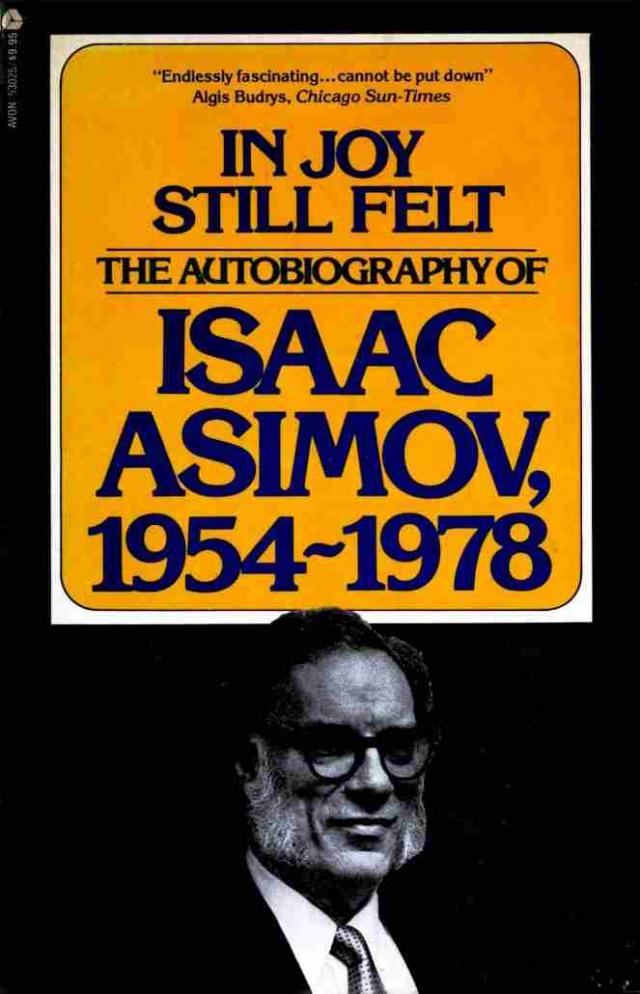
In Joy Still Felt: The Autobiography of Isaac Asimov, 1954-1978,
p.74


26
I finished Our World in Space for New York Graphic on January 14 and Please Explain for Houghton Mifflin on January 22. I therefore instantly started on the book on polar regions for Mac Talley. The title for that was, eventually, The Ends of the Earth.
27
The Vietnam War came to an end on January 24, 1973, four days after Nixon’s triumphant reinauguration. Nixon used the catch phrase “peace with honor” to describe it. To me it seemed that the very same peace could easily have been arranged at any time in the previous ten years, nor did I see how any phase of our part in that deplorable affair could be equated with “honor.”
It bothered me enormously that so much of the country considered him a hero for ending a war that he had uselessly continued for four years. What’s more, in a few weeks a number of our prisoners of war returned and were orchestrated into repeating “God bless our commander-in-chief” so that Nixon’s popularity polled at an all-time high, and I felt myself to be suffocating in frustration.229
And still the Watergate time bomb ticked, and I remained completely unaware of its importance. The Watergate burglars had, all but one, pleaded guilty, and that seemed to end it.
28
A British publishing firm, Sphere Books, was doing a series of The Best of—books, featuring various science-fiction writers, and they wanted to do a collection of my stories.
I checked with Larry Ashmead to find out if Doubleday would be willing to allow this.
Larry said, “Only if Doubleday can do an American edition.”
I said, “But Larry, all the stories have already appeared in one or another of my Doubleday collections.”
Larry had the perfect answer for this. He said, “So what?”
I went over the list of stories Sphere Books wanted to include. I took out one or two I thought I could do without; I put in one or two that were particular favorites of mine. Then I added “Minor Image” so that I could have a very recent story included that was not in any of my Doubleday collections, and on January 28, I did the Introduction for the book.
29
I had lived at the Cromwell now for nearly three years and was reasonably content. It served quite well as an office and, of course, I ate and spent much of my time at Janet’s place.
It meant making a five-block trip from one to the other, and then back, at least once a day, which was bothersome on occasion when the weather was bad, but was good exercise.
Shortly after I moved in, though, the Cromwell, for economic reasons of its own, began a changeover from a hotel to an apartment house. Changes took place, all of which were for the worse for me.
The coffeehouse in the lobby vanished and was replaced by a drugstore. There had been a maid who had come in daily to look at the dust and occasionally supply me with fresh towels and bedsheets. She vanished, too, and after that, though the apartment remained neat and orderly, the dust gradually accumulated.
Worst of all was the noise. The manned elevators were converted to self-service, and the kitchenettes in every unit were being rebuilt and upgraded. This meant banging, day in and day out, better or worse depending on which apartments were being worked on.230
On February 1, 1973, my own kitchenette was upgraded and that really drove me wild.
Family problems were also worrisome. My mother was in the hospital again—it was in-and-out with her now.
As for Robyn, she had applied to four colleges, been accepted by each one, and had decided to go to Windham College, in Vermont. I brooded at how inaccessible she would be to me, and worried about how she would survive the Vermont winters.
37
Eclipse Cruise—Alone
1
The success of the Statendam cruise had made ocean travel seem delightful to me. I was pleased when another opportunity arose.
A gentleman named Phil Sigler was organizing a cruise in which a ship would cross the Atlantic in the summer of 1975 and anchor off the African coast at a spot that would allow its passengers to observe a total eclipse of the Sun. He approached me and asked me to join as one of the notables. If I would agree to give four talks, then not only would I get a free passage for Janet and myself, but there would be a generous stipend as well.
I couldn’t resist. I agreed to go.
Since landings were planned at the Canary Islands and at Dakar, I would need a passport. (Janet had one.) By February 8, I had my passport photos and had visited the passport office to make arrangements for one. It was the first time in my life that I ever had a passport of my own—fifty years to the month after having arrived in the United States on my father’s passport.
Oddly enough, Robyn was also requiring a passport. She was going off on a skiing trip to France with a group of students. That created alarm and despondency within me, but she went and returned in perfect safety and had a good time. She celebrated her eighteenth birthday on February 19, 1973, while she was in France.
2
On February 20, I was in Larry Ashmead’s office when a group of Soviet publishers entered. They were visiting Doubleday in connection with the agreements finally being set up between the Soviet Union and the United States for the regularization of the copyright situation between the two nations.
Larry courteously introduced me and there was a noticeable stir among the Soviets. They recognized the name and I was instantly invited (through the interpreter) to visit the Soviet Union someday.
It was pleasant, fifty years after I had left the Soviet Union as a young child, to be invited back as a celebrity whose writing was well known there. Nevertheless, I knew that the likelihood of my visiting the Soviet Union was very small. As long as I didn’t fly, the logistical problems were all but insuperable.
That same day, the Statendam cruise produced another delayed effect, for I began my twelfth Black Widowers story, “Out of Sight.”231
Its background was a cruise much like the one I had been on. It dealt with a table of six people just like the one I had actually sat at, and the key incident was the spilling, by the waiter, of a cup of hot chocolate into the lap of one of the women (something that had actually happened to Janet).
Fred Dannay accepted this one, the first of my Black Widowers to be accepted after three successive failures. It appeared in the December 1973 EQMM under the title of “The Six Suspects,” though of course I used my own title in the collection.
Once I had finished “Out of Sight,” I decided I had enough Black Widowers stories for a book. I therefore wrote an overall Introduction plus Afterwords for each story, and took Tales of the Black Widowers to Doubleday.
Tales of the Black Widowers was to be a Crime Club book, so that I had finally cleared the hurdle I had stumbled over so badly with The Death Dealers fifteen years before.
It meant that Michele Tempesta was my editor for this one. She had been working in Larry’s group for some years. In fact, I had dedicated Today and Tomorrow and— to her, using a phrase that could be interpreted salaciously, if one wished. I got my advance copy on March 6, and when I pointed this out to her, she was chagrined—not at the salacity, but at not having seen it herself.
3
Ed Ferman, the editor of F & SF, joined forces with Barry Malzberg, one of the more spectacular of the new generation of science-fiction writers, to prepare a new anthology of originals. They were planning to ask certain writers to prepare stories that would carry some particular category of science fiction or other to the ultimate level. They asked me to do a robot story, and after some hesitation, I agreed.
I then had to think of a way to write what might be considered an ultimate robot story.
There had always been one aspect of the robot theme I had never had the courage to tackle, although Campbell and I had sometimes discussed it. The laws of robots refer to human beings. Robots must not harm them and they must obey them, but what, in robot eyes, is a human being? Or, as the Psalmist asks of God, “What is man that thou art mindful of him?”
So on March 6, 1973, I began a robot story entitled, “That Thou Art Mindful of Him.”232 It appeared in the anthology, which was entitled Final Stage. It also appeared in the May 1974 F & SF.
4
Although Tales of the Black Widowers was now in press, I had no intention of putting an end to the series.
I was going by train to Wilmington on March 15 to speak at the University of Delaware, and it occurred to me that I might make the time on the train pass more quickly and pleasantly if I used it to think of a plot for the thirteenth Black Widowers story.
Unfortunately I had my plot while I was still in the station and I had to pass the trip otherwise. Once I got back, I wrote it, calling it “When No Man Pursueth.”233
For the first time I put myself into one of the Black Widowers stories. Although it is based on the Trap Door Spiders, and although I am a member, none of the Black Widowers is modeled on me, although I mention myself (under my own name) on occasion, as a friend of Emmanuel Rubin (who is modeled on Lester del Rey).
In “When No Man Pursueth,” however, the guest was one Mortimer Stellar, a prolific writer of many books in many fields. I made him arrogant, vain, nasty, petty, and completely self-centered. (When Janet read the story, she was furious with me.)
Fred Dannay took the story and it eventually appeared in the March 1974 EQMM.
When the preceding Black Widowers story, “Out of Sight,” had appeared in the December 1973 issue, Dannay said in the blurb that it might be the last of the series. This meant that I received a number of indignant letters from readers who objected to my ending the series and I was glad to be able to tell them that another story had been written and was in press.
5
It was necessary to send me an advance report on the Nebula award winners for 1973 so that I could prepare the award anthology I was editing for that year. Only items in the shorter categories were to be included, but the people in charge carelessly included the winner in the novel category, too.
The winner happened to be none other than I, myself, since The Gods Themselves won the 1973 Nebula for the best novel of the year by a heavy plurality. It would have been more exciting if I had found this out at the banquet, but it was exciting enough as it was. It was the first Nebula I had ever won.
6
On the morning of April 3, 1973, I said to Janet, “I had a peculiar dream last night.”
“What was it?” said Janet, who is, of course, professionally interested in dreams.
“I dreamed,” I said, “I had prepared an anthology of all those good old stories I read when I was a kid and I was getting a chance to read them again.”
Janet said, “Why don’t you prepare such an anthology?”
I was about to say: Who would publish it? as I had done in connection with the suggestion of a jokebook four years before.
This time I didn’t. I thought: Why not?
As soon as Doubleday had opened for the day I called Larry. I pointed out that it would be a semi-autobiographical collection, like The Early Asimov, that it would deal with the decade of the 1930s (as The Early Asimov dealt with the 1940s), and that it would describe the manner in which those early stories shaped my thinking. It would be of historical interest in two ways, therefore, and would be a vital item in any science-fiction library.
Larry let himself be talked into it.
Of course, I needed the stories, but for that I had my good friend Sam Moskowitz, whose collection of science-fiction magazines was second only to that of Forrest J. Ackerman.
I called Sam and asked if by any chance he were working on an anthology of the stories of the 1930s. He said, “No. I would love to if I could find a publisher, but I can’t.”
I said, “I’ve found a publisher. Would you mind if I prepared such an anthology?”
He said, “More power to you.”
“There’s more,” I said urgently. “Sam, could you get me copies of the magazines containing a list of stories I will give you?”
Goodhearted Sam said, “Oh sure!” and in three weeks he had them, every one, with word counts and copyright information and comments on each. In two weeks more I was able to complete my commentary on the anthology, and by May 10, 1973, the book was complete. It was an enormous book, far longer than I had told Larry it would be, because it ran away with me. It ended up nearly five hundred thousand words long.
In connection with the book, I was anxious to get hold of my high-school graduation book and a copy of the literary semi-annual containing “Little Brothers,” which I had written thirty-nine years before. On April 4, therefore, I visited the Boys’ High librarian, Mrs. Dorothy Kephart, and eventually she got both items for me. I talked Doubleday into using my high-school graduation picture for the book jacket of the anthology, which I eventually called Before the Golden Age.
And while I was working on the anthology, I completed The Birth of the United States and began work on both my second collection of recycled essays, Asimov on Chemistry, for Doubleday, and on How Did We Find Out About Germs? for Walker.
7
Carl and Linda Sagan had moved from Harvard to Cornell, and on April 12 I visited Cornell and met them again. The occasion was a round-table discussion I held that night with Carl, with Thomas Gold, and with Fred Hoyle. They were three astronomers of the first magnitude, and I felt enormously out of place, but nobody seemed to mind except me.
8
What the Trap Door Spiders constantly needed were new members, and I was delighted to be the occasion for one. On April 27, Lester and I co-hosted a session (at Lester’s house, with Lester preparing a magnificent meal) and brought in Ken Franklin as my guest. I had met him on the Statendam and was sure that he would be just the sort of guest we needed. He was more. The membership loved him, one and all, and he was eventually voted in enthusiastically.
9
The Nebula awards banquet was held on April 28. The suspense was spoiled for me, of course, but as editor of that year’s Nebula anthology I was asked to give a talk.
Harlan Ellison was toastmaster and put on a magnificent show. He pointed out everyone in the audience and did the Don Rickles bit, insulting each one brilliantly. Naturally, each insultee could hardly wait for his turn and was terribly afraid Harlan would skip him or her or might be too gentle.
In only one place did Harlan rouse resentment. He referred to an editor of the female persuasion as an “editress.” The young woman objected vehemently. Harlan might have apologized good-naturedly and proceeded, but that wouldn’t be Harlan; he chose to stand his ground and fight.
Since I am a feminist, I felt Harlan was in the wrong, and when he finally introduced me, with the appropriate insults, I rose and said:
“Harlan’s quarrel over the use of ‘editress’ reminds me that the basic word is almost always used for the male sex, and the derived word for the female, so that we have ‘princess,’ ‘actress,’ ‘aviatrix,’ ‘mistress,’ and even ‘Jewess’ and ‘Negress.’ However, there are occasionally words used for the female in its basic form and for the male in derived form. These are not well known so I will give you an example, thus: ‘Harlan is a yentor.’ ”234
The place rocked, Harlan laughed harder than anyone, and my disappointment at knowing in advance I had won the Nebula was made up for.
10
Now at last the Watergate affair was coming unraveled. On March 19, 1973, one of the men involved in the burglary, James McCord, wrote to Judge Sirica of the involvement of White House people in the Watergate break-in, and the New York Times finally began to run Watergate material.
I read it all with amusement but couldn’t believe that it would do anything but pinprick Nixon.
My feelings changed on April 30, when I was so curious to hear what Nixon would say concerning Watergate that I forced myself to listen to him and to look at him on television for, I believe, the first time since his phoney “Checkers” speech twenty-one years before.
When he was through with this speech, in which he announced the resignation of his top flunkies, H. R. Haldeman and J. D. Ehrlichman, I knew we had him. It seemed to me Nixon would never have let Haldeman and Ehrlichman go except to save the one person he loved more than everything else in the world put together—himself. That meant that if the investigation continued persistently enough, it would find at the center of the web, not this underling or that, but Nixon himself.
From that point on, I took to combing the Times from cover to cover every morning, skipping only the column by Nixon’s minion William Safire. I sometimes bought the New York Post so that I could read additional commentary. I listened to every news report on the radio.
I read and listened with greater attention and fascination than in even the darkest days of World War II. Thus my diary entry for May 11, 1973, says, “Up at six to finger-lick the day’s news on Watergate.”
I could find no one else as hooked on Watergate as I was, except for Judy-Lynn. Almost every day, she called me or I called her and we would talk about the day’s developments in Watergate. We weren’t very coherent and mostly we laughed hysterically.
Once, in the course of a speech to the Dutch Treat Club, I heard Gore Vidal speak of “needing my Watergate-fix” every morning, and I knew exactly what he meant.
11
At the annual Mystery Writers of America award banquet on May 4, I met Frederic Dannay for, I believe, only the second time. Although I had sold him stories, he ran the magazine from Westchester and it was Eleanor Sullivan with whom I dealt directly.


