

In joy still felt the au.., p.91
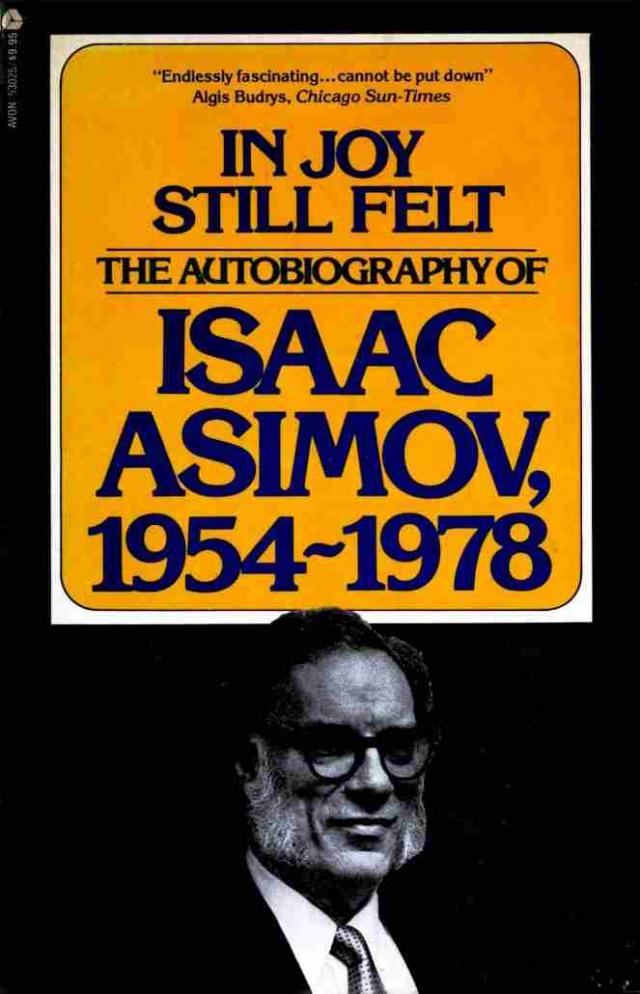
In Joy Still Felt: The Autobiography of Isaac Asimov, 1954-1978,
p.91


It didn’t work that way. I received two orders from people who called the hospital itself to place their orders. Merrill Panitt of TV Guide, for instance, called me to express his condolences and then suggested that as long as I was in the hospital and had a TV set at my bed, I might as well watch some daytime television and write an article about it.
That I did, and it appeared in the October 1–7, 1977, issue of the magazine. (There was one article in which I discussed my coronary, as I had warned Paul I would.)
15
By June 8, I had finished the revision of the entire manuscript of the autobiography as far as I had gone, and after that I grew restless. Fortunately, I didn’t have to remain restless long. On Friday, June 10, I left the hospital.
I was 176 pounds in weight when I got home, 7 pounds less than I weighed at the time of my first attack. I kept at my diet rigidly and by the end of July I had reached 163 and had lost 20 pounds.
16
I spent the next two weeks under house arrest. I went down to the lobby to get my mail now and then, and once, on June 15, when Robyn was leaving, after having driven to New York and stayed with us a couple of days, I actually stepped outside to watch her drive away. Except for that, the various walls of the apartment were my limit.
However, I kept working on my autobiography, on my F & SF essays (I didn’t miss a beat there), and on other assignments.
17
The third issue of IASFM, Fall 1977, came out on June 16. Originally, Joel had only been prepared to subsidize three issues, but reports on the first issue were so heartening that George was going right on purchasing stories for additional issues.
The third issue had a letter column to which I added comments in reply to individual letters (another task), and it was clear from those letters that my face on each issue had outworn its welcome. I was smiling on the third issue, but it was a farewell smile. More conventional science-fiction covers were planned thereafter.
Inside the third issue, my story “Good Taste” was included.
18
Finally, on June 23, I visited Paul’s office and had an electrocardiogram again, and it showed my heart was healing satisfactorily. Paul said I could resume my normal life with some discretion. I was to walk a lot, exercise, keep my weight down—and, most of all, not let myself get into a rat race of deadlines.
46
Recovery
1
On Monday, June 27, Robyn left for Europe. She was going to tour it for eight weeks with a school group and visit half a dozen countries. Mary O’Conor was to be with her.
On that same day, I finally went to Doubleday as my first business trip since the hospitalization. On July 3, we visited the Balks, and that was my first social call since the hospitalization.
I felt perfectly normal except that when I walked, especially after a meal, or under tension, I sometimes had mild epigastric distress. It meant, I suppose, that I was somewhat anginal, but not sufficiently so to prevent a normal life or to force me to take medication.
I decided, at this time, to stop work on the first draft of the autobiography and put what I had already done into final copy.
2
On July 8, we left the city for the first time since the hospitalization. It was to take care of a seminar at the Institute of Man and Science for the sixth year in a row. The strain would not be heavy, however. Everyone was careful to avoid loading me too heavily, and Janet accompanied me on constant walks.
This year, instead of one seminar, there were two in succession, the first to be chaired by Ben Bova and the second by me. Apparently, however, the splitup did not work out. The attendance shrank and the total of those attending both did not equal the number attending a single seminar in past years.
Terri Rapoport, who was leaving the institute to return to school, was quite depressed over this and, indeed, it did seem that the law of diminishing returns had set in. There was a serious question as to whether the sixth annual seminar ought not be the last.
While at the institute, I wrote my thirtieth Black Widowers story, “The Next Day.” Fred Dannay accepted it and slated it for 1978 publication. I was now halfway toward a third Black Widowers collection.
3
Just before we left for home on July 14, we heard that there had been an all-night blackout in New York City, with riots and looting in many sections. For a while we hesitated, wondering if we ought not stay at a motel, since, if the power was off, we might arrive at Park Ten’s lobby, but we could not get to the top floor.
A call to New York, however, proved that the power was back on at Park Ten, and we returned.
4
If we had had an unusually cold January, we now had an unusually hot July.
Fawcett Publications had raffled off a dinner with me on a Channel 13 auction, and I had postponed the original date because of the coronary and had finally settled on July 19. When that day came, the temperature outside went to 102.
Nevertheless the date was kept. It was at the beautiful and air-conditioned restaurant at the top of the World Trade Center (which we now visited for the first time), and we sat looking down upon the world as though we were in an airplane. To be sure, circumstance deprived us of much of a feeling of power. What if, in all this heat, the power should fail again? Would we be stranded in the skyscraper airplane?
Well, the couple who had bid the winning amount were each young, attractive, and intelligent, the food was good, and Greg Mowery of Fawcett publicity handled everything flawlessly. And the power remained firmly in place.
5
Three young women whom I had met at “Star Trek” conventions were anxious to take me to see Star Wars as a coronary-recovery present.292 Janet, who was pointedly not included in the invitation, good-naturedly said I ought to go, and I set July 21 as the day.
Here my luck was even worse, however, for on July 21, the temperature went to 104, the second hottest day in the New York Weather Bureau’s history. Nevertheless, we went. The theater was air conditioned, after all; I was surrounded by youthful pulchritude; and the movie was entertaining.
Afterward, we all had dinner at Sardi’s, and except for my frustration at finding that the impecunious young women wouldn’t allow me to pick up the tab for the evening, all went perfectly.
6
On July 26, I obtained the August 1977 Reader’s Digest, which had the Collier interview in it. It was entitled, “Asimov, the Human Writing Machine,” and again, as in the case of the People interview, only kind things were said about me. In addition, Reader’s Digest reprinted the Time essay I had written on a low-energy America.
While the glow of this still lingered, the Walkers asked me to drop by on July 29. The Collapsing Universe had done extremely well in every respect, and Sam and Beth Walker and Dick Winslow all joined me in a champagne toast on the balcony overlooking Fifth Avenue, while I was handed a check that was higher than any other check I had ever received that wasn’t from Doubleday.
7
John and Maureen Jeppson arrived in New York on July 31, and with them were their children, Patti and Johnny. It was my first chance to meet the niece and nephew I had gained when I married Janet. They were attractive, pleasant youngsters, and I was delighted with them.
8
By August 3, I had five hundred pages of autobiography manuscript in final form, and since I was soon to be heading away on another trip, I wanted them out of the house. I took it in to Doubleday for safekeeping and handed in two boxes, one containing the original and one a carbon, to Cathleen.
“Guard them with your life, Cathleen,” I said.
“Absolutely,” she said. And at that very moment, whistles began to blow outside her office door. It was, we all thought, a fire drill.
I accompanied her down the stairs to the landing where we usually waited for the all-clear (I had been involved in fire drills before), but we were told to keep on walking. It was not a fire drill but a bomb scare (one of a whole group of them in midtown Manhattan on that day), and the building was being evacuated. I tried to go back for my manuscript, but nobody would let me.
Down and down we went. Cathleen made me stop every fifth floor and rest, although I didn’t want to. Pat LoBrutto, a young man who had replaced Sharon Jarvis as science-fiction editor when the latter left for greener fields, helped Cathleen bully me.
I kept saying, “I don’t want you two to hang around. Go on ahead. After all, if it’s a real bomb and you linger with me you may be trapped in the rubble along with me.”
They wouldn’t trust me, however, to go through the ordeal properly and insisted on supervising my downward climb. It was forty-two stories altogether.
When we were finally out on the street, everyone else was there too, of course. It was Sam Vaughan’s birthday and I said to him, “Sam, arranging this celebration of your birthday is nice, but you shouldn’t have bothered. I’ve just brought in the first box of my autobiography, and now it’s up there being looted.”
“How much have you brought in?” he asked.
“Five hundred pages,” I said.
“Then why worry? That’s only the first two chapters, right?”
How’s that for sympathy?
Meanwhile, Cathleen said firmly that I was to go straight to the doctor for an examination. Though the streets were a madhouse of policemen and emergency vehicles, she ran out and dragged back a taxi by the scruff of its neck. I had no choice but to go.
I caught Howard Gorfinkel at his lunch, and he ran the EKG while still chewing.
“Your EKG,” he said, ‘”looks better than last week’s. Maybe you should walk down forty-two flights every day.”
Never mind! Once was enough. My calf muscles were sore for three days, and everyone at Doubleday was limping. One young woman was on crutches for a while.
9
On August 6, 1977, Janet was fifty-one years old, and we were getting ready to board the QE2 again. What we were to do was to make the transatlantic crossing to Southampton, wait through the one-day layover, and then make the return trip. I was to give two talks each way.
As we were getting ready, Otto Penzler, one of the two greatest mystery buffs in the nation (his friend Chris Steinbrunner was the other, and we had met both at Mystery Writers’ of America functions and at the “Dead of Winter” shindig a half year before), had come up with an idea. He wanted me to write a limerick (a clean one) for each of the fifty-six Sherlock Holmes short stories and four Sherlock Holmes novels in order of publication. He ran a small publishing firm, Mysterious Press, which would then put out the book in time for the next Baker Street Irregulars banquet.
I was delighted because it would be just the thing to keep me busy on the cruise and, to make it easier for me, Otto gave me a book that contained commentary on each of the sixty stories in order of publication. These could jog my memory as to the contents.
10
We got on the QE2 on August 8 and I argued them into letting me have a typewriter so that I could type my limericks after I had constructed them. By the time we arrived in Southampton on the evening of August 13, I was better than half done with my limericks.
It had originally been our notion that we could stay on the QE2 while it laid over at Southampton, but that proved impossible since the ship was literally shut down on that day.
At 9:00 a.m. on Sunday, August 14, therefore, we were at the Polygon Hotel in Southampton and were on our own.
It turned out well. We took a taxi to nearby Winchester and enjoyed the cathedral and saw the large statue of King Alfred (of which I had a small replica given me by Alfred University when I received my degree of Doctor of Letters six years before).
Then we went to Portsmouth, where we toured through Horatio Nelson’s old flagship, the Victory, and were horrified at the low ceilings below-decks and, worse yet, at the tales of floggings. (Janet, of course, promptly fell in love with Nelson, who had been no taller than Harlan Ellison, apparently.)
Back to Southampton, then, where I underwent several interviews, took a nap, had an excellent dinner, and then went on a walk through neighborhood parks—clean, quiet, well-laid-out. On the whole, the twenty-four hours in England were the best part of the trip—something we had certainly not anticipated.
We were back on the QE2 on the morning of the fifteenth, and the return trip was even pleasanter than the trip coming. Movie comedian Dom DeLuise was onboard ship and had the cabin right next to ours, though we didn’t see much of each other. Lisa Drew, a Doubleday editor, gave two talks, which I attended and admired.
As for myself, I finished my sixty Sherlockian limericks on August 16, and was sorry that Conan Doyle had not written more Holmes stories.
We were home on August 20 (David’s twenty-sixth birthday), and I promptly put all the limericks into final copy. Otto Penzler arrived the next day to pick them up. I wanted to call them Polmes for Holmes but Otto winced visibly at the suggestion and eventually insisted on Asimov’s Sherlockian Limericks.
11
The fourth issue of IASFM had been published while I was off on the QE2. It was the Winter 1977 issue and was the first to have a traditional science-fiction scene on the cover, featuring an unearthly flying reptile. My face had not disappeared altogether, however. Small, but clear, it was in the “o” of “Asimov” in the title.
This issue contained “The Missing Item,” my Black Widowers story.
12
A sadder note was struck by two deaths during my trip.
One was that of a Trap Door Spiders colleague, Edgar Lawrence, who had first invited me to the Baker Street Irregulars as his guest, and who had not survived to see my Sherlockian book, which had, in a way, become possible through my growing interest in such things through the BSI.
The other was that of Ray Palmer on August 15, 1977, at the age of sixty-seven. It had been Palmer who had sent me my first check for sixty-four dollars for “Marooned Off Vesta” thirty-nine years before. In all the time that had elapsed since, I had never met him face to face.
13
Robyn called me from London on the afternoon of August 22. She had completed her eight-week tour of Europe and had cathedrals and museums running out of her ears. Right now, she was dreadfully anxious to get back to the United States, but there was difficulty in getting a plane off the ground because of job actions at London’s airport. She seemed quite good-humored about it.
She called me a second time in the evening, by which time she had been sitting up, quite uncomfortably, all night long at the airport—and there was still no sign of their plane. She was distinctly edgy and I did my best to soothe her.
At 8:15 a.m. on the twenty-third, she called a third time, and now she was hysterical. She wanted me to call the airport and “lean on them.” I didn’t see what good that could possibly do, but I had to give her the feeling she was doing something.
“Give me the number, Robyn,” I said, “and I’ll see what I can do.”
She was halfway through her instructions when I heard a loudspeaker in the distance. Robyn called out excitedly, “That’s my plane,” and hung up.
At 6:15 p.m. she called from Kennedy Airport and at 11:00 p.m. she called from her dormitory room in Boston. She was home, and I heaved an enormous sigh of relief. I hadn’t had to put my power to the test by calling London’s airport and leaning on them. I did not have to destroy a young woman’s faith in the omnipotence of good old Dad.
14
F. Marrott Sinex retired from his post as head of the Biochemistry Department at the med school on August 31, 1977, having served twenty years. Our initial unpleasantness was long forgotten.
Succeeding to the post and, therefore, my new boss in a way, was Carl Franzblau, whom I remembered as a young and capable instructor. I was pleased.
15
On August 30, I saw Jerome Agel, an entrepreneur who managed books for busy people who did not want to do all the work involved but who did not mind putting their name on as author.
What he wanted to do was to produce a book called Isaac Asimov’s Book of Facts. The facts were to be culled by researchers who would use my books, among others, as sources.
I said that I would not consent to be listed as author of a book I did not prepare, but if the “fantastic facts” were sent to me and if I were allowed to accept, rewrite, and reject—and add some of my own—then I would be willing to have the book appear as “edited by Isaac Asimov.”
We agreed on that.
16
On September 1, I took in the second batch of five hundred pages of final copy of my autobiography to Cathleen, and wondered wistfully what was happening in Miami Beach.
The thirty-fifth World Science Fiction convention was getting under way there and, considering my coronary, I had not thought it wise to repeat the arduous round-trip train journey.
But then, on September 4, Barbara Bova called from Miami to tell me that “The Bicentennial Man” had won the Hugo as best novelette of the year. It was the only story which, in 1977, took both the Nebula and the Hugo.
17
Larry Ashmead, having been at Simon and Schuster for twenty-two months, suddenly made another change and, as of September 1, 1977, became executive editor at Lippincott. He was working under Ed Burlingame now, who had edited my Understanding Physics and The Universe.


