

In joy still felt the au.., p.61
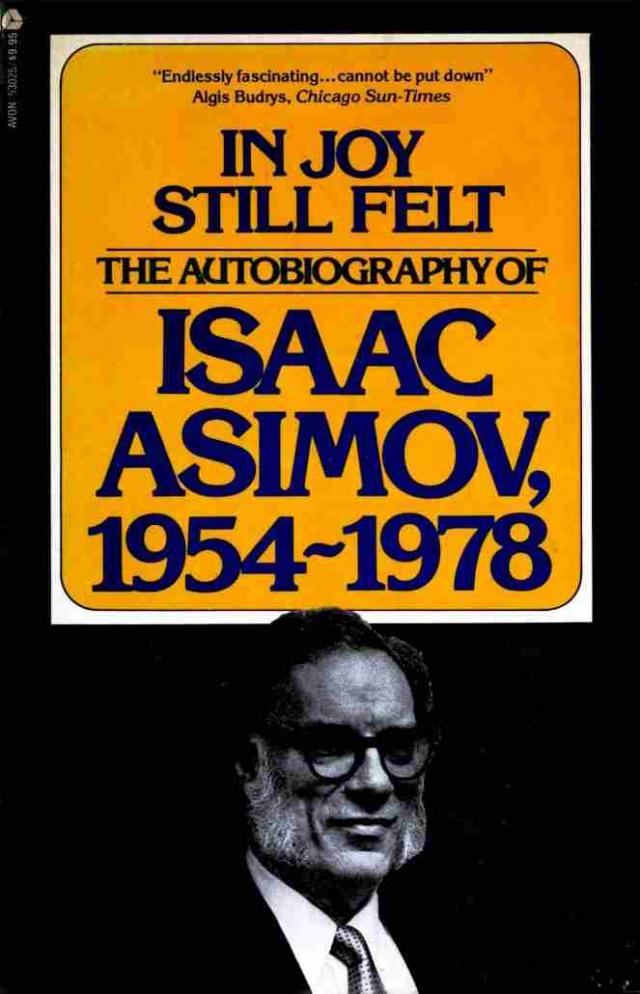
In Joy Still Felt: The Autobiography of Isaac Asimov, 1954-1978,
p.61


Afterward, the Houghton Mifflin contingent took Gertrude, Robyn, and me to a magnificent Locke-Ober dinner, which I had trouble eating in view of how well I had done myself on the mountains of hors d’oeuvres at the cocktail party.182
3
I finally completed the revision of Asimov’s Biographical Encyclopedia of Science and Technology after having worked on it, on and off, for nearly a year. That was October 18.
My pleasure that day was muted, however, by the appearance of Israel Shenker’s interview with me on the first page, second section, of the New York Times. That sounds great, but it was based on the July 28 interview when I was waiting for my typewriters to be fixed. As a result, my complaints about IBM were featured.
This disturbed me, for I had no real complaints about IBM. That July 28 had been the only time when a repairman hadn’t been at work double-quick, and the reason for the delay in that case was understandable. I fired off a letter to the Times explaining this, but they never printed it.
The next day, however (a Sunday!), I got a very perturbed phone call from the regional director of IBM asking me what had gone wrong, and why I had been so disturbed. I explained and sent him the carbon of my letter to the Times and I’m sure he felt better as a result.
I had not learned at that time (nor have I learned since) to be cautious of what I say to reporters.
4
On October 23, I was on Boston’s local TV outlet of the Columbia Broadcasting System to be interviewed in connection with Opus 100. Sam Levenson was also present and I met him for the first time.
Meeting him had significance to me. My style of speaking and my kind of humor were often compared, by those who heard me, to this or that Jewish comedian—Jackie Mason, for instance. More frequently mentioned than everyone else put together, however, was Sam Levenson. I wasn’t entirely overwhelmed with the comparison, though; I like to think I’m one of a kind.
Sam Levenson seemed to be having an off day that time. At least he told a joke that got no laugh at all and he was visibly irked. Since I was writing my book on humor at the time, I was quite certain I saw where he had made the mistake, though, of course, I didn’t say anything.
We were on together, and the conversation turned to the Moon landing. Levenson said to me, “You’ve heard of the Israeli astronauts, of course?”
That was my cue to say “No” so that Levenson could tell the joke, but still thinking of his mistake in the earlier joke and unwilling to hear him mangle another, I said, “Yes, I heard it,” in a flat, declaratory way that signaled the end of that topic.
Annoyed, he said, “All right, then, you tell it.” The ball was suddenly and unexpectedly in my court. (Served me right, of course.)
I said:
“An Israeli and an American were discussing the recent landing on the Moon by Armstrong and Aldrin. The Israeli said, ‘That was all very well, but not very spectacular. We Israelis are going to launch an expedition that will place astronauts on the Sun.’
“The American said, ‘Are you crazy? On the Sun? How will the astronauts withstand the light? the heat? the radiation?’
“The Israeli said, ‘Don’t be a fool. We’ll send them at night.’ ”
It got a perfectly satisfactory laugh.
5
A gentleman named Jules Power was after me to do a TV special, something that so far had been completely outside my purview. He insisted, however, on showing me the films of insect (and other) microphotography which would make up the special. I thought they were very beautiful and effective and allowed myself to be persuaded. On October 24, I began the job.
It wasn’t difficult from the standpoint of sheer writing, but it was humiliating. In television, the picture comes first, and the writer is its slave.
So though I did the job and the special (“The Invisible World”) was eventually on television, was replayed several times, and earned me a satisfactory amount, I did not enjoy it and did not look for ways to repeat the experience.
6
Toward the end of the month of October, Robyn came back from school with a coal-black kitten, which she said she had rescued, by main force, from other kids who were “torturing it.”183
Gertrude and I had not had a cat since Putschikl of sainted memory, twenty-one years before, and, given David’s allergy to cats, it didn’t seem we could ever have one. But David was away at his school and we could keep it a little while anyway, so Gertrude and I both fell all over ourselves to pat the little thing and feed it and make much of it.
The kitten was grateful and adopted us at once and we were perfectly willing to be adopted. By November 5, I took it to the vet and had him examined and given the necessary shots, so it was clear we intended to keep him.
Robyn named him “Satan,” and that name he kept. I thought that a thoroughly black cat (even the vibrissae were black) would be uninteresting, but that proved not to be so. In the end, we found black to be so beautiful that we were sorry for people who owned cats whose pristine blackness was in any way interrupted.
(When David visited, we had to keep him supplied with antihistamines, and the cat had to be kept away from him and from his room as much as possible.)
7
On November 10, I finally finished Asimov’s Guide to Shakespeare, just one and a half years after I had begun writing the first experimental section on Richard II. It was six hundred thousand words long and I knew it would have to be published in two volumes. I planned to have one volume treat of the plays with some connection to English history, from King Lear to Henry VIII and the other treat of all the remaining plays.
Then the next day I wrote ABC’s of the Ocean, all of it in one day.
8
One other piece of writing obtruded itself.
I have always been a mystery fan since the days of “The Shadow” back in the 1930s, and I read Ellery Queen’s Mystery Magazine regularly.
EQMM routinely ran stories by never-before-published writers, and I always read them with chagrin since it bothered me that they managed to make it while I never did. The few times I had submitted stories to EQMM (the last time was “What’s in a Name?,” fourteen years before) I was rejected.
When reading the new issue on November 12, 1969, I got very pettish, sat down, and dashed off a fifteen-hundred-word short story I called “As Chemist to Chemist” and had it in the mail two hours after I had begun.
It was a delightful story in my opinion, but even so I was astonished when only a week later I got my notice of acceptance. It appeared eventually in the May 1970 EQMM under the title of “A Problem in Numbers.”
Like The Death Dealers, “As Chemist to Chemist” was a straight mystery in which all the characters were chemists and in which the solution hinged on chemistry. I still hadn’t made the break from science fiction altogether.
9
On November 13, I went to New York to take in Asimov’s Guide to Shakespeare and the revised Biographical Encyclopedia to Doubleday, and ABC’s of the Ocean to Walker & Company.
I then drove on to Philadelphia the next day to attend the Philcon, the regional science-fiction convention of the Philadelphia fans, which is held every November.
On the evening of November 15, as I got out of the elevator at my floor, quite late at night, a large, plump, comfortable-looking, and attractive woman got out of the other elevator and gave me a very warm “Hello.”
I was feeling happy, as I usually do at conventions, and gave her just as warm a “Hello” in return.
She said, “Would you like company?”
This time I was a sophisticated man of the world and I knew at once that I was dealing with a prostitute. I was no longer the babe-in-the-woods I was the year before.
I said, pleasantly, “I would love company, but my wife, is in my room there.”
She said, “Oh heck, why did you bring her?”
I said, “If I had known I was going to meet you, I wouldn’t have.”
She seemed pleased, and I went on to my wifeless room, perfectly content with the way I had handled it.
10
I still had “Waterclap” in first draft. The rejection by the movie studio did not bother me and it had been waiting for six weeks only because I had other things to do. On November 26, however, I finally revised it and began to put it in final form.
The next time I was in New York, on December 3, I submitted it to Galaxy, which now had a new editor. Fred Pohl had been replaced by Ejlar Jakobsson, though Judy-Lynn remained as managing editor.
Jakobsson read it, liked it, and accepted it at once. It eventually appeared in the May 1970 If.184
11
In a way, some acceptances are worse than rejections.
A newspaper syndicate asked me to do an article on how one goes about writing a hundred books. (A hundred books makes you much more of a curiosity than ninety-nine does.)
But how do I describe the method? I do it because I love to write and I know how to write, and how can I transfer either the love or the ability from my brain into another?
I proceeded, therefore, to write a humorous article entitled “How to Write a Hundred Books Without Really Trying.” The syndicate took the article with minimal hesitation, paid me generously—and then never published it.
Having paid for it, they were within their rights not to publish, but that irritated me more than a rejection would have. With a rejection, I might have sold it elsewhere; this way it was simply buried, and unavailable for subsidiary use such as inclusion in a collection.
12
Robyn was now old enough to have a boyfriend, a shy young man of her own age who apparently was never called anything but “Junior.” And she still retained the ability to volley back the conversational bail with strength to spare.
One day she came back from school all excited. She jumped up and down and said, “Guess what, Dad? Guess what?”
I said, without looking up from the book I was reading, “You’re pregnant.”
And my fourteen-year-old daughter calmed down at once, assumed a world-weary pose, and said, “No, I’m not. Junior and I take precautions.”
Once again, I was wiped out.
13
In the last week of the year, I attended the AAAS meetings, which were being held in Boston. I gave two talks, one on science fiction and one on the origin of life, both on December 27. It pleased me that both my fictional and nonfictional aspects should thus be recognized.
14
When the year 1969 ended, my publishing mark for the year was eight:
95. Photosynthesis (Basic Books)
96. The Shaping of England (Houghton Mifflin)
97. Twentieth Century Discovery (Doubleday)
98. Nightfall and Other Stories (Doubleday)
99. Asimov’s Guide to the Bible: The New Testament (Doubleday)
100. Opus 100 (Houghton Mifflin)
101. ABC’s of Space (Walker)
102. Great Ideas of Science (Houghton Mifflin)
15
The year 1970 opened in very unpleasant fashion with the least happy New Year’s Eve party I ever attended. The host was a lawyer whom I had always found rather obnoxious. On this occasion, he told a long, involved story about how he had frustrated a streetcar conductor who had tried to get him to put out his cigarette.
When he was all through, I said, “I think your behavior was disgusting. It would have been an act of common decency for a lawyer to obey the law and to put out his cigarette.”
Well, that settled the direction of the conversation for the next two hours, during which I stubbornly stuck to my guns and made, I believe, a lifelong enemy. I say “I believe” because I never saw him again and therefore can’t tell for sure.
16
I may have been a little on edge because I knew that on the next day, January 2, 1970, I would be fifty years old. Nevertheless, I did not take my fiftieth birthday with nearly the tragic upset with which I had greeted my fortieth, ten years before.
In fact, I was rather in a good humor that day. It was cold but sunny. Gertrude, herself in a good humor, made me an excellent breakfast and we all looked forward to a birthday dinner with the Houghton Mifflin group. This had been arranged at the cocktail party for Opus 100 back in October, and Austin had been reminding me of it periodically ever since.
We showed up with both children (David was home on vacation) and had an excellent dinner. Just before we ordered dessert, Austin said, “Listen, let’s not order dessert here. I know a great place in the neighborhood that has special desserts.”
I was enjoying myself greatly and I had no desire to move, but Austin was the host and Gertrude said at once, “That’s a great idea!” I couldn’t oppose it, therefore.
I got up reluctantly and we all moved out into the cold. I hadn’t the faintest idea where he was taking us, especially since we moved into the nearby Boston-Sheraton Hotel, which I knew well, and which had no place, to my knowledge, that featured marvelous desserts.
Austin led us beyond its street-level restaurants and up to the third floor. Could there possibly be a hidden patisserie or something on the third floor that was known only to the cognoscenti?
Then Austin opened a door and the first thing I saw was a hugely magnified photograph of my own smiling countenance, and just beyond it I spied Larry Ashmead—in the flesh.
I stopped dead in my tracks with my mouth open and slowly looked about. It was another surprise party, this time organized by Judy-Lynn Benjamin. She had been to the October cocktail party and had arranged it all with Austin, which was why he had been feverishly reminding me of the birthday dinner.
It was my third surprise birthday party and the third time I had been taken utterly by surprise.
The del Reys were there, as was the onetime Futurian, Dick Wilson. Carl and Linda Sagan were there, also Marvin and Gloria Minsky (so that Carl did not fail to point out that I had in the same room with me the two men I conceded were more intelligent than I was). The NESFA group was there, too.
All handed me small presents of inconsequential nature and humorous significance. This included a photograph of Raquel Welch in dishabille sent me by Harlan Ellison, with an inscription on it (purportedly by Raquel) to the effect that she was sending me the photo because she would do anything for Harlan.
Lester del Rey made a little speech in which he assured me that fifty was the beginning of the end and that from there on in everything was downhill (he was fifty-five).
As for Judy-Lynn, she bustled about supervising everything and was delighted in the extreme that all had gone so well. She kept saying, “Caught you by surprise, eh, Asimov?”
17
I completed Constantinople on January 16. It was a long time writing, much longer than usual for my histories, because so much of my time was spent on the Ginn science series sections. All through 1969, I had kept working on them, never with pleasure.
18
My new Doubleday book, The Solar System and Back, had been set for publication, quite deliberately, on January 19. That was the twentieth anniversary of the publication of my first book, Pebble in the Sky. As it happened, The Solar System and Back was my fortieth Doubleday book, so that the firm had been putting out an average of two books a year by me over those two decades.
Not to be outdone by Houghton Mifflin, Doubleday was going to give a cocktail party in honor of the occasion. Gertrude and I drove to New York on January 19 for the purpose, leaving Robyn home alone, as we now tended to do regularly.
It was a very successful occasion. Larry Ashmead came to our hotel room to escort us to the party. Stanley and Ruth were there, having brought my mother with them. Judy-Lynn was there, of course, and Wendy Weil, the Silverbergs, and so on. The del Reys were not there. They had left, or were about to leave, on an extended vacation down South.
The next day was not so good. After an early-morning stint on the “Today” show in connection with the new book, I hurried back to the hotel, stepped on a manhole cover that was covered by a thin, slick, and invisible layer of ice, and went flying.
I came down hard, and badly banged my left knee. For a while, as I lay there, I thought I had broken it. The only way to test the matter was to try to struggle to my feet, and I found I could manage. I limped, with great difficulty, the five blocks back to the hotel, but I knew I could not have managed that at all if there had been even a hairline fracture.
I therefore (limping steadily) went through all the functions of the day, including two newspaper interviews, a segment of “The David Frost Show,” and an after-dinner speech.
On January 21, we drove home, where I began a new history. I returned to ancient times and decided to do one centered about the ancient Hebrew peoples. I called it The Land of Canaan.
19
Then came shocking news. On January 29, Robert Silverberg called me. The del Reys, in their travels in the South, were in a bad automobile accident in Virginia the day before. Lester had been hurt but was in good shape. Evelyn, however, had been killed!
It was a dreadful blow. Those of my friends and relatives who, in recent years, had died, had died of disease. But now a young woman (she was only forty-four) had died in a violent accident. What’s more, she was a woman with whom I had grown to feel warm friendship over the past few years, whom I considered had given me inspirational help at a crucial moment, and whom I had last seen at my fiftieth-birthday party less than four weeks before and now would never see again.


