

In joy still felt the au.., p.94
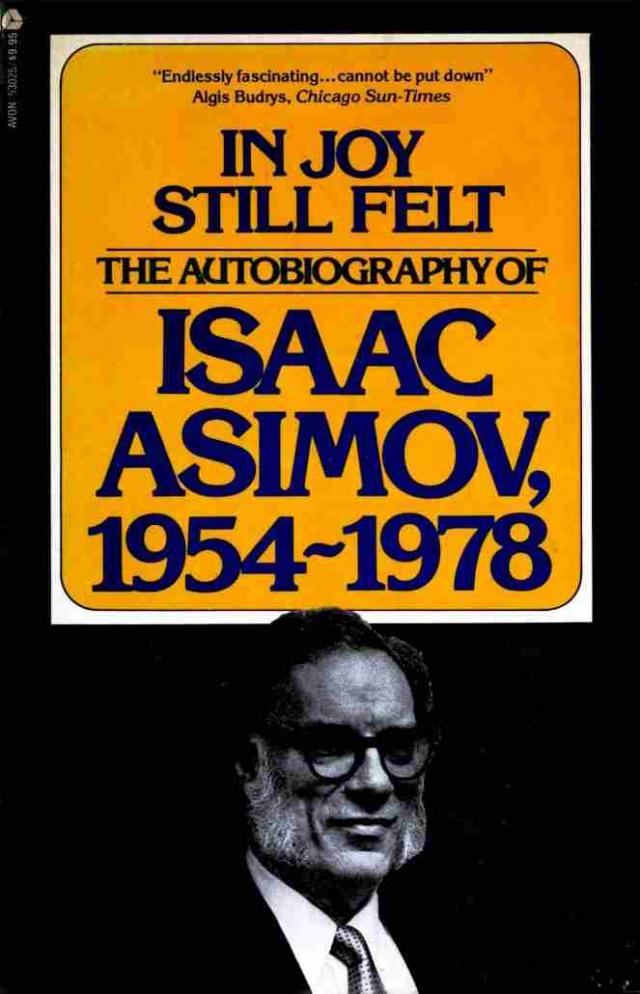
In Joy Still Felt: The Autobiography of Isaac Asimov, 1954-1978,
p.94


[←3]
See Asimov’s Mysteries (Doubleday, 1968).
[←4]
I always read my stories after they appear in print, even today. In the early days, when less of my material was flooding the market, I even reread my books when they appeared in paperback.
[←5]
Eventually we made up. Nowadays, Ace does a number of my books, and I am very satisfied with them. You can bet they don’t fool around with either titles or contents.
[←6]
In In Memory Yet Green, I listed my published books each year including all ten that had been published between 1950 and 1953 inclusive. For the record, I am continuing the practice in this volume beginning with 1954 and Book #11.
[←7]
See Only a Trillion (Abelard-Schuman, 1957).
[←8]
See Earth Is Room Enough.
[←9]
See The Rest of the Robots.
[←10]
See Only a Trillion.
[←11]
There were faults on both sides, to be sure, but I am not an impartial witness, and it would not be fair to Gertrude to have me discuss her faults when she has no soapbox on which to stage a rebuttal. Her good points were numerous and she was, in many ways, an excellent wife. I’ll discuss my own faults only, those that I can see— and there may be many I stubbornly refuse to see.
[←12]
See Earth Is Room Enough.
[←13]
See Only a Trillion.
[←14]
See Asimov’s Mysteries.
[←15]
See Opus 100 (Houghton Mifflin, 1969).
[←16]
See Earth Is Room Enough.
[←17]
See Earth Is Room Enough.
[←18]
See Earth Is Room Enough.
[←19]
See Earth Is Room Enough.
[←20]
Which is true, I suppose, since you can’t impair zero efficiency.
[←21]
See Asimov’s Mysteries.
[←22]
See Only a Trillion.
[←23]
See Asimov’s Mysteries.
[←24]
See Earth is Room Enough.
[←25]
See Nine Tomorrows (Doubleday, 1959).
[←26]
See Only a Trillion.
[←27]
See The Rest of the Robots.
[←28]
See Earth Is Room Enough.
[←29]
See Buy Jupiter and Other Stories.
[←30]
I have this story from her, for I don’t remember it at all.
[←31]
Clarke and I are remarkably similar in our appeal. Anyone who likes his books seems sure to like mine, and vice versa.
[←32]
See Is Anyone There? (Doubleday, 1967).
[←33]
See Earth Is Room Enough.
[←34]
See Earth Is Room Enough.
[←35]
See Nightfall and Other Stories.
[←36]
See Asimov’s Mysteries.
[←37]
See The Rest of the Robots.
[←38]
Actually, as the years passed, it did not correct itself and we discovered that Lewis’s original diagnosis was correct. Nevertheless, we are still told that it can be treated but is not dangerous.
[←39]
We never had a tree, or celebrated Christmas—or Chanukah, for that matter—in any way before David was about two. Then we had a tree to amuse him. After the children were old enough to be sufficiently worldly wise to find Christmas presents to be just as good without any frills, we discontinued the tree.
[←40]
See Nine Tomorrows.
[←41]
For all of them, see Only a Trillion.
[←42]
Once again, of course, human advance would make nonsense out of my story, but in this case, at least, not till a couple of years after publication.
[←43]
In later years, when we bought additional bookcases, Gertrude sanded, stained, and varnished them herself, doing just as excellent a job.
[←44]
I made the mistake of binding foreign soft-cover editions of my novels, too, which caused a great proliferation of volumes that I couldn’t read. Eventually, I stopped that and restricted my bound volumes to material in the English language only—out even so I remained insufficiently selective and they overproliferated.
[←45]
After Sinex had taken over his duties, a member of the department—not I—was asked if Sinex were in. The person questioned listened for a moment, then said, “He’s not anywhere in the building. I’d hear him if he were.”
[←46]
See Buy Jupiter and Other Stories.
[←47]
See Buy Jupiter and Other Stories.
[←48]
See Nine Tomorrows.
[←49]
See Only a Trillion.
[←50]
See Asimov’s Mysteries.
[←51]
I was sympathetic. I could well remember my own stays at resorts when I was a little older than David was then and my own objections to resort-hotel food.
[←52]
See Asimov’s Mysteries.
[←53]
See Nine Tomorrows.
[←54]
See Science Past—Science Future (Doubleday, 1975).
[←55]
As in “What’s in a Name?,” the new novel had a chemistry department as the scene and chemists as characters.
[←56]
I did not record the conversations I had in connection with my quarrels with Keefer, but I have an excellent memory, and while I can’t say my quotations are word for word, they are essentially accurate even in fine detail.
[←57]
This proved a gross underestimate.
[←58]
Perhaps an overestimate, but I had no intention of pulling punches.
[←59]
See The Rest of the Robots.
[←60]
See Nightfall and Other Stories.
[←61]
See Nine Tomorrows.
[←62]
See Is Anyone There? (Doubleday, 1967).
[←63]
Till now, I have listed the appearance of all my magazine fiction, and I shall continue to do so. I will not, however, bother to list all my magazine nonfiction—there are too many. I will mention only those that come up naturally in the narration.
[←64]
In order to make certain that no one detect any similarities in the book to anyone at the medical school, I set the scene firmly in my memory of the Columbia graduate chemistry department and wrote the characters with specific Columbia faculty members in mind—at least as far as appearance was concerned, not personality or character.
[←65]
See Nine Tomorrows.
[←66]
See Nine Tomorrows.
[←67]
See Buy Jupiter and Other Stories.
[←68]
See Asimov’s Mysteries.
[←69]
See Nine Tomorrows.
[←70]
See Buy Jupiter and Other Stories.
[←71]
See Nightfall and Other Stories.
[←72]
That same June 30, I had dinner with a woman named Lillian Asimow from the West Coast. She and her husband, Morris, could trace his ancestry back to Petrovichi. Despite the difference in spelling, he had to be a distant cousin of mine.
[←73]
Indeed, the time was to come when I would write a good book (I think) on telescopes.
[←74]
She is still, even today, rarely without a slab of gum in her mouth, but she very rightly says that this is better than a cigarette.
[←75]
See Nine Tomorrows.
[←76]
And in the outside world there was a brief war scare over a civil war in Lebanon. President Eisenhower sent in troops, and the situation quickly quieted down. The United States could still play policeman of the world—but not for much longer.
[←77]
See Fact and Fancy (Doubleday, 1962).
[←78]
See Buy Jupiter and Other Stories.
[←79]
See Asimov’s Mysteries.
[←80]
See Nightfall and Other Stories.
[←81]
See Is Anyone There? (Doubleday, 1967).
[←82]
When she did tell me, years later, I refused to believe it until she showed me the book I had signed. She also told me how amazed she was at how different I was at the banquet, and I, of course, explained about the kidney stone and about the difference the presence or absence makes.
[←83]
I don’t. I feel the rest of the audience senses it is left out and reacts adversely. I always focus on no one but look over the heads of the audience and vary the direction in which I look.
[←84]
I had reached about this point in my first draft of the autobiography when I told my good friend Ben Bova that I was trying to include every one of my extraordinary acts of stupidity, and he nodded wisely and said, “That’s why the autobiography is so long.” It is good to have a friend. One can never rely on enemies for these home truths.
[←85]
Years later, when Austin was urging me to write some book or other, I reminded him of the time he had told me to write less, and he said, “Well, I was wrong. For some reason, your books support each other, and the more you write, the more they sell. But it’s still good advice for most people.”
[←86]
Yes, I know. I could have learned anyway, but I never wanted to.
[←87]
See Is Anyone There?
[←88]
Bob is a tall, lean fellow, who is quiet, soft-spoken, and looks rather like an absentminded accountant, but he is very possibly the funniest man in science fiction. He’s not particularly ready with a quick upward jab of the verbal knife, as Harlan Ellison is at all times, or as I am if caught off-guard, but give him time and he can build up enough in the way of dry comedy to inundate anyone.
[←89]
Vonts is Yiddish for “bedbug.” He said it, not I.
[←90]
There were even periods when we sent each other postcards telling each other our plans for future columns so we would not overlap. It wouldn’t have mattered if we had, though, since our styles were so different.
[←91]
There is the occasional joker who hands me a blank check. I just sign it along with everything else, but when the joker gets it back he finds I have signed it “Harlan Ellison.”
[←92]
Stan and I are on terms of the utmost affection, but there is a kind of genial give-and-take between us.
[←93]
My favorite example is this: The Greeks viewed the universe as having been created out of chaos. Chaos was not nothingness but consisted of all the matter of the universe mixed together in random fashion. Chaos was disorder. The creation of the universe was then not the creation of matter, but the imposing of order upon disorder. The ordered universe is “cosmos.” Therefore anything that imposed order upon disorder is “cosmetics,” and from this we get a notion of what it is that women do when they use makeup.
[←94]
True is true, though. I can’t say that Svirsky’s changes were all bad. He introduced some modifications in my discussion of the tetrahedral carbon atom that actually represented an improvement on what I had done. That, of course, I kept in. I don’t quarrel with good stuff just because it isn’t mine.
[←95]
See Opus 100 (Houghton Mifflin, 1960).
[←96]
Eisenhower was retiring from his second term with undiminished popularity, and he could have had a third nomination and election for the asking had not the Republicans of the Eightieth Congress, in a fit of retroactive fury against F.D.R., initiated the Twenty-second Amendment, limiting Presidents to two terms—a biter-bit piece of business that did not fail to move me to sardonic amusement.
[←97]
He was right. Eventually, the permanent incisor showed up and all was well.
[←98]
It was later expanded into a novel that I didn’t like as well, and made into a movie called Charly.
[←99]
Ben insists that she is of Sicilian extraction, though I have difficulty in making out the distinction.
[←100]
I don’t resent it. I have the same penchant.
[←101]
Cele rewrote the final three paragraphs of the story, and did a much better job than I had, so I let hers stand.
[←102]
See Fact and Fancy (Doubleday, 1962).
[←103]
Actually, I had a fraction of a story published in the interval. Cele had the idea of doing a round-robin story. Poul Anderson was to write the first part, ending it in a real mess; I was to take up the task and do the second part, ending it in a real mess; then Bob Sheckley, Murray Leinster and Bob Bloch would carry on. The whole story was called “The Covenant," and it appeared in the July 1960 Fantastic. I think any one of the five authors could have written a better story if he had done it all himself.
[←104]
See Nightfall and Other Stories.
[←105]
See Fact and Fancy.
[←106]
On that same day, anti-Castro Cubans, encouraged by the United States, invaded the Bay of Pigs in Cuba, and the fiasco that resulted held the United States up to ridicule before the world.
[←107]
Every time I met an important scientist who was a reader of mine, I was inordinately delighted. I suppose that no matter how brave a face I put upon it, there was always a little bit of shame within me that I had abandoned science for writing, and I needed the assurance, endlessly repeated, that my fellow scientists accepted my writing.
[←108]
See Nightfall and Other Stories.
[←109]
Janet’s father, John Rufus Jeppson, had died on November 2, 1958, at the age of sixty-two—just half a year before I had met Janet at the MWA dinner.
[←110]
That must have been immediately after he wrote me the letter about my carbon-14 article in the JCE.
[←111]
I still didn’t like the book.
[←112]
Robyn warns me that I am making myself sound like a silly, doting father, but my defense is that I am a silly, doting father.
[←113]
Actually, my editors are my friends.
[←114]
Beginning with the thirteenth convention at Cleveland in 1955—the one at which I had been guest of honor—the Hugo awards had become the feature and high point of every convention.
[←115]
See Nightfall and Other Stories.
[←116]
See Asimov’s Mysteries.
[←117]
I would have been very pleased if Think had taken the piece and if I could have told myself that even a fever did not affect my writing skill. Unfortunately, they sent it back for revision. After revision, however, they took it, and it eventually appeared in the April 1962 Think. See Is Anyone There?


