

In joy still felt the au.., p.53
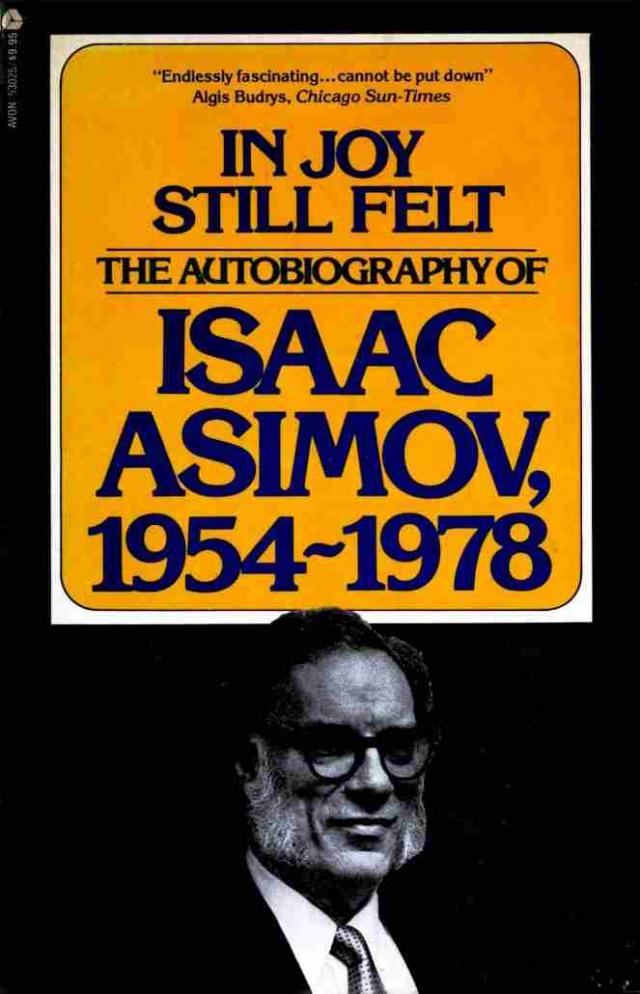
In Joy Still Felt: The Autobiography of Isaac Asimov, 1954-1978,
p.53


“That’s right. I’m Isaac Asimov.”
It stirred her up a bit, and that made two bits of childishness on my part in one evening.
14
On November 14, 1967, I was in Philadelphia, where I gave a talk to a branch of B’nai Brith. At 8:00 a.m. on the fifteenth, I was on the road, and by 1:30 p.m., I was back in Newton. It took me 5½ hours to negotiate that 300-mile trip.
David had to go to the eye doctor for a routine examination. The eye doctor was in Brookline, the adjacent town. We left at 3:30 p.m., and just as I pulled away from the garage, flakes of snow began to fall. It turned into freezing rain, and the pace of traffic slowed, while its density increased. I was within half a mile of the eye doctor when I decided there was no way in which I could make it, and I maneuvered the car into a homeward path.
I was too late!
The homeward rush hour was beginning, and no one was prepared for so early a sleetfall. Minor accidents spread like the bubonic plague; cars stalled; long lines of traffic stalled.
I did as everyone else was doing, which was to turn out into any street that seemed open—any street—hoping that some way might be found that would take me home.
I found myself in areas that were completely unfamiliar. I was inching down streets that might have been in Fargo, North Dakota, for any recognizable landmark I could see. At one time I slid helplessly down an incline while the car at the bottom tried frantically to get out of the way—and then I had to try frantically myself as the car behind me came slipping and sliding down upon me.
I managed. At no time did I make contact with any other car.
At no time, however, was it possible for me to stop anywhere and find a telephone on which to call home and announce we were alive. And the ice was becoming covered by wet snow, which made the going still harder.
Eventually I drove the car into a deserted filling station to get off the road, stepped out, had David do the same, locked the car, and began trying the houses in search of a private phone. It took several attempts to find someone who would answer a doorbell and allow strangers to come in. Finally, we found the apartment of a Mr. and Mrs. Francis Nolan.
They allowed us in, had us take off our wet shoes, and supplied us with slippers. I used their phone to call Gertrude and assure her we were well (she had already been calling the police and the hospitals). The Nolans then fed us soup, gave us the best seats in the living room, and insisted we relax and watch television.
When the traffic finally died down, their oldest son went out with us and, together with some friends who were at the Good Samaritan work of directing and helping cars, they pushed me out of the filling station, onto the road, and pointed me toward Washington Street.
It still wasn’t easy driving, but the lines of cars were gone and I was home, quite exhausted, at 9:30 p.m. It might have taken me 5½ hours to do 300 miles earlier in the day, but in the evening it had taken me 6 hours to cover 21 miles.
Six days later I returned to the Nolans, and with me were some signed books and a quart bottle of the most expensive whiskey I could find (I have no way of judging whiskey but by the price) as a thank offering.
15
A year and a half earlier, Marion K. Sanders of Harper’s had asked for an article on the origin of the universe. It appeared in the March 1967 Harper’s as “Over the Edge of the Universe,” and eventually I put it into one of my own collections under the title “The Birth and Death of the Universe.”158
I had liked the article when I wrote it, and it was pleasant to have it in as prestigious a magazine as Harper’s, but the most delightful spinoff came on November 21, 1967. On that day I learned that it had won for me the Westinghouse-AAAS prize for science writing, a prize that was to be delivered a month later at the annual meeting of the AAAS.
And meanwhile, having completed The Dark Ages, which dealt primarily with what would later become France, Germany, and Italy, I took up the history of Britain in the same period and called it The Shaping of England.
16
My Bible book was in press now and it was clear that my working title It’s Mentioned in the Bible would not do.
On December 4, Larry phoned to ask if I would mind if it were called An Intelligent Man’s Guide to the Bible. I reacted enthusiastically. I thought it was an excellent idea since I felt that it would in that way borrow luster from An Intelligent Man’s Guide to Science and, if the Bible book did well, to lend luster as well.
“However, Larry,” I said, “I think we had better check with Basic Books and make sure they don’t mind.”
It turned out to be a good thing we did. I was sure Arthur Rosenthal wouldn’t mind, but he did. In fact, he reacted with quite uncharacteristic anger and even threatened a lawsuit.
I was chagrined and said, “Never mind, Larry. I have a better title. Presumably, science is accessible only to the intelligent man, but the Bible is, or should be, accessible to everyone. Let’s call it Everyman’s Guide to the Bible.”
Larry agreed but then, some time later, he got back to me with the news that the sales staff had argued that Random House had a line of Everyman books and that Doubleday didn’t want to give the impression that the book was published by Random House.
He said, “The salesmen want to have it Asimov’s Guide to the Bible. They say Asimov’s Biographical Encyclopedia of Science and Technology is doing very well, so we ought to keep that formula.”
I said, weakly, “But I’m a scientist and therefore have a right to put my name on a collection of science biographies. Wouldn’t it be presumptuous of me to put my name on a book about the Bible?”
But Larry said, “If you’re presumptuous enough to write a book on the Bible, be presumptuous enough to put your name on it.”
That was it. The book would be Asimov’s Guide to the Bible. It was to be the third book to have my name in the title, and this one embarrassed me. If it had not been for Arthur Rosenthal’s surprising intransigence, it wouldn’t have happened. There are limits to my “charming Asimovian immodesties.”
I eventually asked Arthur what his objection had been, since both books were, after all, by me. Arthur said it would have given rise to confusion as to publishers so that orders, being sent to the wrong publisher, would be lost. And since Doubleday was the larger publisher and the more closely associated with me, Basic Books would have been hurt the more badly.
17
I could not forget my dead book Words from Greek History. To be sure, I had converted it into The Greeks, but in the process I had lost my treatment of the words.
It occurred to me that I could try again and do one-page essays this time, as I had done in the cases of Words in Science and Words on the Map. Nor need I confine the words to those involving Greek history. I could use words that referred to any age and any area. I could then call it simply Words from History.
I began that book on December 17.
18
The AAAS meetings for 1967 were being held in New York, which was fortunate because I was required to show up in person for the Westinghouse Prize.
I got that prize on December 27, complete with a reception and a banquet that all the prize winners attended. On accepting the prize I said, dryly, that it was customary for all winners to suffer unaccustomed attacks of modesty and to ascribe the victory to chance acquaintances and various strangers. I hoped, therefore, that the audience wouldn’t mind too much if I shyly admitted that I had worked hard for the prize and deserved much of the credit myself.
I didn’t get much in the way of laughter. I think the audience was too puzzled by my outlandish attitude to laugh.
Henry Blugerman was the only family member to be present, and I was intensely pleased to have him there. I didn’t know how many more times I would see him.
Janet Jeppson was at the convention, too, and I persuaded her to join myself, Carl Sagan, and Linda for dinner on December 30. It worked out very well and was the pleasantest part of the convention. The next morning I took the train for home.
19
The year 1967 saw eight books published:
79. The Moon (Follett)
80. Environments Out There (Abelard-Schuman)
81. The Roman Empire (Houghton Mifflin)
82. Through a Glass, Clearly (New English Library)
83. Is Anyone There? (Doubleday)
84. To the Ends of the Universe (Walker)
85. Mars (Follett)
86. The Egyptians (Houghton Mifflin)
20
I turned forty-eight on January 2, 1968. I was so old by now that I scarcely noted the change in age from one year to the next.
It was a bad winter in other ways. The sleetstorm on November 15 had been the harbinger for considerable nasty snow, and a wet snowstorm that had struck Boston while I had been in New York at the AAAS meeting caused the roof to ice up under the shingles. Water began to leak into the house.
Beginning with January 10, we had to keep every pot and pan in the house on various timbers in the eaves in order to catch the drops and keep them from getting into the house proper. To get into the eaves we had to enter from my rooms in the attic and progress carefully, in stoop-shouldered fashion, to place the containers, then, when they were sufficiently full, to retrieve them (without spilling them), empty them, and replace them.
Robyn was a godsend at this time. Since she was the smallest in the family and the most agile, she could maneuver in the cramped space much more easily than could anyone else. Sure-footedly she kept up a running fight against the melting ice, and was cheerful enough about it to keep up everyone’s spirits.159
It was Gertrude who made the key suggestion—which was to turn off the heat upstairs. Of course! I didn’t mind low temperatures and I could always work in a sweater. Off went the heat, and the leaking slowed down to a trickle within a matter of an hour. Come spring we reshingled the roof.
All this inevitably slowed me down, but I did manage to finish Photosynthesis on January 13. I had worked on it, on and off, for eight months, and it bad not been an easy book to write, but to this day I think it the best possible book on the subject that could have been written for popular consumption.
21
On January 18, 1968, I received my author’s copies of the Walker & Company edition of The Death Dealers. Finally, after ten years, my ill-fated book had found a hard-cover home. I didn’t count it as a new book, of course, even though I had persuaded Walker to give it my title and call it A Whiff of Death in its new life. After all, except for the title and for a very few minor changes to keep the book from smelling too strongly of the 1950s, it was exactly what it had been.
This time it was no failure. Walker & Company eventually sold out at least two printings, arranged for a new paperback, and managed a number of foreign editions.
22
My book Twentieth Century Discovery met with a sudden reverse, on the other hand.
Janet Finney of Random House sent it back on February 5 with a request for changes, saying that she had marked the places she thought might be cut. Since the book was not unduly long, I wondered what places she could be referring to. I found out soon enough.
In every chapter, she had indicated the deletion of any paragraph that referred to work done before 1900.
This was impossible. She could only have made the request because she knew nothing about science. One cannot deal with any aspect of science by starting cold at some arbitrary date. There has to be some indication of the state of the art at the time, and this must involve some brief reference to events that came before.
I might have argued about this, but I didn’t. My experience with Svirsky had forever sensitized me to any heavy-handed or unreasonable demands for cutting. I phoned Janet Finney and explained that the changes requested were so extensive that it was clear that the book was not publishable. I was therefore withdrawing it from consideration.
Miss Finney accepted that with clear relief—as though I had done the unexpected, but gentlemanly, thing.
23
On February 5, the same day on which the bad news from Random House had arrived, Gertrude and I went to see the stage show Plaza Suite with George C. Scott and Maureen Stapleton. We loved it and Gertrude wanted very much to meet Mr. Scott. In the intermission she suggested that I make my way back to the dressing room and ask to see him, using my name as a passport.
I refused with honor. “What good will my name do?”
“Maybe he’s a science-fiction fan,” said Gertrude.
But I shook my head. I refused to try to ride my name into the man’s dressing room, and Gertrude was disappointed.
After the play we went into a restaurant just a few yards from the theater for a late-night snack, and as we were finishing the waitress said to us in tones of great excitement, “George C. Scott and Maureen Stapleton from the play next door are eating here.”
I gave up. I know when the Fates are conspiring against me. I said to Gertrude, “Okay, let’s go back there. I’ll ask for an autograph, and if he knows me, I’ll introduce you.”
We walked to the rear of the restaurant where not only Scott and Stapleton were sitting, but about a dozen other people as well, all of them, presumably, involved with the play. As we approached, they looked at us rather stonily; they were clearly not overwhelmed with delight at having their privacy invaded.
I held out my Playbill uneasily and said, “Mr. Scott, I wonder if you and Miss Stapleton would care to let me have your autographs. My name is I-saac A-si-mov.”
I pronounced my name with exaggerated care so that they would have no chance of hiding behind a misunderstanding. Scott and Stapleton, however, remained utterly unmoved and signed the Playbill in bored resignation. I knew that to introduce Gertrude would have all the effect of sound in a vacuum.
And then one of the young men arose from his seat at the table and cried out, “Gertie!”
Gertrude stared for a moment and cried out in her turn, “Natie!”
It was her Cousin Nathan, whom I had never met. They hugged each other, talked rapidly, asked after each other’s immediate family. Nathan introduced her all around and Scott and Stapleton shook hands with her and smiled graciously, while I stood in the background shifting from foot to foot.
It didn’t last long, but the chance of being husband to a celebrity gave me a useful lesson in humility.
24
On February 15 I went to New York and dropped in on Mac Talley who had, by now, established a new firm, Weybright and Talley, with his father-in-law. Naturally, he wanted a book from me and was full of ideas, but I already had a book for him. I asked him to look over Twentieth Century Discovery.
I then went on to Doubleday, where Larry Ashmead astonished me.
He told me that they were experimenting with different designs for the book jacket of Asimov’s Guide to the Bible, and in one case they used a selection from the book in an oval on the back.
With clear embarrassment, Larry said, “The only thing, Isaac, is that I don’t like the quotation. I think it is poorly written.”
I was as embarrassed as he. Larry had never disliked anything I had written. He had always praised everything I had done, even when I myself was uncertain as to its merits. For something of mine to be so bad as to force an unkind word out of him must mean that it was bad beyond belief.
“May I see it, Larry?” I said.
He took me to the Art Department and showed me the cover. I read through the passage and said, with infinite relief, “This isn’t me, Larry.”
“It’s not from the book?” said Larry, stunned.
“No, this must be some material that was just lying around, and they included it just to get a general idea of how the cover would look.” We asked, and that was indeed what had happened.
Larry flushed and tried to apologize for having thought me capable of such bad writing.
But I was triumphant and said so. “Listen, Larry,” I said, “I didn’t trust your opinion of me. I thought that even if I wrote something bad you would say it was good. But now you found something bad you thought was mine and you told me so. From now on if you say something of mine is good, I will believe you.”
25
Henry was in the hospital again. I visited him on Friday, February 16. His memory seemed to be fuzzy, but except for that he seemed fairly well. I told him I’d be going home on Sunday and that Gertrude would be in on Monday to see him.
I did go home on Sunday, but, alas, there was no Monday for Henry. Even as Gertrude was packing for the trip, Henry died of a stroke at 8:45 p.m. on February 18, 1968, about a month before his seventy-third birthday.
It was Gertrude who answered the phone call from John, and I knew from her gasp what had happened. Afterward she sat with her head against the wall, crying softly, and I held her hand and wondered, in vain, how I could possibly console her.
What bothered me most was that it was I, not she, who had seen Henry shortly before he died.
It was the first death in our immediate families.
Gertrude had, of course, planned to go by bus, but that would no longer do. In the morning, I drove her to the airport and she and David took the shuttle plane to New York (the first plane trip for either, though they, and Robyn too, had taken a little ride in a helicopter once).
I did not let Robyn go. It was her thirteenth birthday and I wanted her to celebrate it outside the shadow of death.
I took her out for a fancy dinner and did my best to make the evening pleasant for her. The next day, the twentieth, I drove her to New York and we attended the funeral on the twenty-first.


