

In joy still felt the au.., p.52
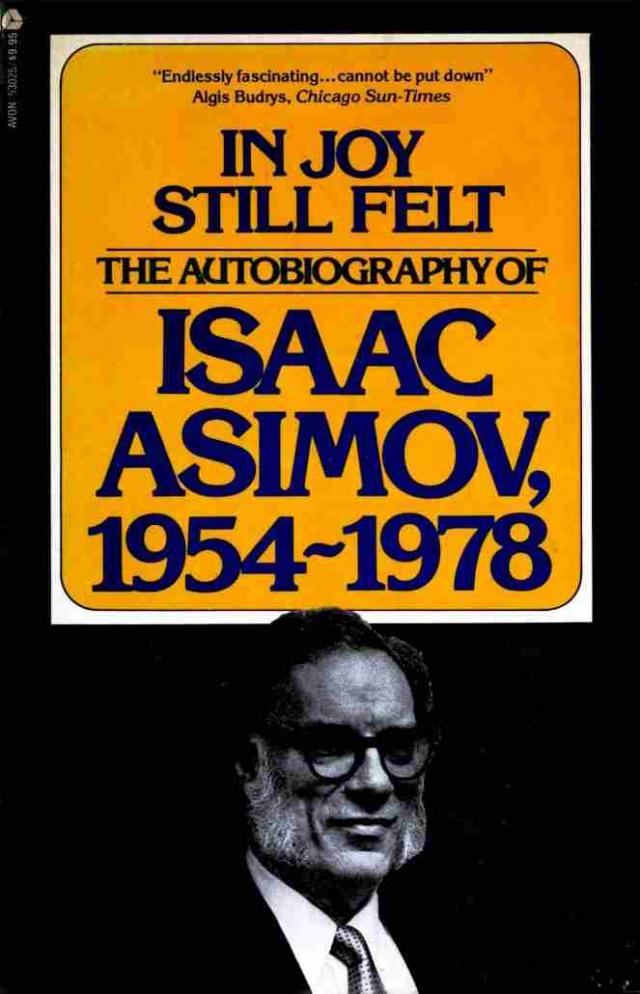
In Joy Still Felt: The Autobiography of Isaac Asimov, 1954-1978,
p.52


I then went on (remembering another item I had noticed), “The quotation is only first in the hard-cover, of course. In the soft-cover it is on page 441 and under. . .”
Tim could stand no more. He leaned across the table, seized my lapel, bunched it, drew me toward him, and said loudly, “Asimov, to choose a phrase at random—you’re a prick.”
I couldn’t have done it for any other quotation in the book, and it was sheerest luck that Tim had picked on it.
2
After dinner on July 11, Robyn, whose cast had been removed nearly six weeks before and who had since then been running and jumping in an ecstasy of freedom, tripped on our lawn and sprained the same ankle.
Ordinarily, we’d have thought nothing of it, but I dared not take a chance under the circumstances, and insisted on putting her in the car and taking her to the hospital.
She wept bitterly and said she didn’t want a cast again.
I reassured her. “It’s nothing, Robyn,” I said. “We’re just going to make sure and then he’ll bandage it and you’ll just limp for a day or two and you’ll be as good as new.”
I remained as cheerful as I could manage while the X rays were taken, and then I joined the doctor who was studying the results.
“Well?” I said, anxiously.
The doctor said, “I can’t be certain. I can’t tell whether the mark is just what was left by the old fracture or whether she has opened it again.”
“What do we do then?”
“In a case like this, the only thing we can do is play it safe. The cast goes back on.”
I said, “I can’t tell her that.”
“You’ll have to,” said the doctor, quite coldly. “Do it now and I’ll get the materials ready.”
I walked into the room where Robyn was waiting with tear-streaked cheeks. I was under the impression I appeared cheerful, but Robyn took one look at my face and broke into a loud wail. I could take no more. I ran to her and put my arms around her and when the doctor came in, we were both clinging to each other and both crying.
The doctor said, impatiently, “Come on, now,” and on went the cast. He said, “We’ll only keep it on a couple of weeks, and then we’ll take another look.”
I took Robyn home in such a mingled state of shock and despair that I could only sit down at the typewriter and, one after the other, turn out three F & SF essays on the metals. They were “The First Metal,” “The Seventh Metal,” and “The Predicted Metal,” my 110th to 112th essays in the series. They appeared in the January, February, and March 1968 F & SF.155
I also began a new history book on July 22. Having done five books on ancient history now, I felt the need to move into medieval times, and started one on the aftermath of the fall of the western provinces of the Roman Empire. I eventually called it The Dark Ages.
Robyn’s cast was still on when, on July 26, Gertrude and I celebrated our silver wedding anniversary. Then, on the twenty-eighth, we visited the hospital again. The cast was removed, the X rays were taken again, and the cast was not replaced. That was the day of the real celebration.
3
It was a little annoying to have so many people thinking that Fantastic Voyage was made from my novel, when, in actual fact, the electronic media seemed utterly uninterested in anything I had written.
There had been the abortive sale of “Evidence” to Orson Welles twenty years before, but that had been less than nothing.
On August 11, 1967, came a more substantial nibble. I received a letter from John Mantley, the producer of the long-running and very successful television show “Gunsmoke.” He was interested in my robot stories.
I no longer had to worry about such things personally. Doubleday controlled the subsidiary rights to all my robot stories, thanks to I, Robot and The Rest of the Robots, and I merely referred Mantley to them.
There followed a liberal education in the glacial speed with which Hollywood moved. It took a couple of years before a contract could be worked out and option money could be paid.
4
On August 14, I drove the family to Craigville Inn on Cape Cod. A writers’ conference was being held there and I had been invited to give some talks and to enjoy a week on the Cape with my family. We accepted gladly.
To my surprise, I met Jack Rubinson there. It was he who had introduced me to the Futurians twenty-nine years before. He was Jack Robins now and had changed so little that I had no trouble recognizing him. With him was his wife, a talkative woman whom I had never met before and who wrote humorous confession stories. I don’t think much of the genre and, from my conversation with Mrs. Robins, I couldn’t believe she would turn out anything worthwhile.
I was wrong. She read one or two of her stories at the conference and they were really funny. I enjoyed them.
David celebrated his sixteenth birthday on August 20 at the inn, and the next day we went home.
5
The twenty-fifth World Science Fiction convention was being held in New York in 1967. It was the first time the convention had been held in that city since 1956 (the convention at which I had met Janet Jeppson for the first time and during which I had been tortured by a kidney stone).
Now, in 1967, it had been five years since I had had a troublesome kidney stone, and I was the proud owner of two Hugos and was virtually an elder statesman in the field.
On September 1 I took the family to New York, and that evening we had dinner with Gene Roddenberry and his wife. Since the children watched “Star Trek” with fascination (and so did I), they were fearfully impressed at my easy cameraderie with Gene.
Not everything about the convention was friendly, however. Harlan Ellison had written a “Man From U.N.C.L.E.” segment in which a character was alleged by Judy Merril to be modeled on herself in a defamatory way. During the convention, Judy had Harlan served with a summons in preparation to suing him, and I spent some time going from one to the other, trying to get Harlan to apologize or Judy to reconsider.
It was a case of shuttle diplomacy years before Henry Kissinger made it famous. His only trouble was that my effort did not succeed. Neither would bend.
On the night of September 3, we and Henry Blugerman, too,156 had dinner with the de Camps. It was quite a sedate affair, and as we left, I saw a bunch of my convention buddies (including Lester del Rey, Fred Pohl, and so on) seated at a long table and just getting ready to begin theirs.
For a moment I was inclined to regret my own family involvement and to wish I were with the group. It turned out just as well. Although our dinner had passed without incident, the group could not get service, and when the salads came, after long delay, they were the wrong ones. Lester del Rey, unable to get his salad changed, lost his temper and scaled it across the restaurant as though it were a Frisbee, and then all left.
The next night, the Hugo awards banquet was even more of a shambles in some ways. Harlan Ellison was master of ceremonies (rather to my chagrin, for I felt that I had a stranglehold on that post any time I was there), and he did not conduct it properly. He was very witty and funny, but he kept the stage interminably and made it a Harlan evening, which was not what it was supposed to be.
Taking their cue from him, those whom he finally allowed to speak, also went on forever. Sam Moskowitz got up and stolidly insisted on a ten-minute eulogization of an award-winning fan, ignoring the restlessness of the audience. Finally, when Lester del Rey arose to make his guest of honor speech, there was no time left and he could only say a few words.
The next day we went home, stopping at Windsor Place first to greet my mother on her seventy-second birthday.
6
On September 11, 1967, David entered high school and Robyn entered junior high.
The new freshman class started at the med school that day as well, under a new system whereby they didn’t take separate subjects so much as a generalized hash. That meant that I didn’t give my “traditional” first lecture of the biochemistry course at the beginning of the spring semester. I gave it at the very beginning of the year. It went over with great success.
That afternoon, the med school was giving a reception in honor of the new president, Christ-Janer. Ordinarily, I would not have attended, but I happened to be at the school, thanks to my morning lecture, and I had met Christ-Janer about six weeks before and had liked him. So why not?
All the students had been invited but, by and large, it was the eager and unsophisticated freshmen who attended. Since I was the only faculty member they had yet met, a number of them clustered about me and told me what a good lecture it was.
“Yes,” I said, expansively (and let myself be overwhelmed with the desire to commit a “charming Asimovian immodesty”), “and you fellows think all the lectures will be that good. Well, it will take you about six weeks to wake up to the fact that mine will be the only good lecture you’ll get, and by that time it will be too late for you to get your money back.”
There was dutiful laughter at that and some more praise for my lecture.
Just then the dean passed and I called him over, nudged the young man who had been most lavish in his praises, and said, “Tell the dean what my lecture was like this morning.”
The young man said, “It was great, Dean. Terrific!”
“And Dr. Asimov says,” came the clear voice of a young woman from the rear, “that it’s the only good lecture we’ll get and that by the time we find that out it will be too late to get our money back.”
There was a rather awed silence and I felt myself turning a distinct brick-red. I said, in a rather choked voice, “You shouldn’t have said that, young woman.”
“I didn’t,” she said artlessly. “You did.”
The dean took me off the hook by saying, matter-of-factly, “I think Dr. Asimov is right,” and passed on.
But then it was too late for the administration to do anything to me anyway, short of my committing some heinous crime.157
7
The very next day, my Asimovian immodesties hit me over the head again. Boston TV station WHDH sent a crew over to photograph me in my office for a sort of “the writing machine at work” program.
As it happened, on the door of my office I had a collection of funny cards I had picked up here and there, cards that read “Genius at work,” or “Just treat me as you would any other genius,” or “It’s hard to be humble when you’re as great as I am,” and so on.
Since no one but the closest personal friends ever visited me in my attic, it was obvious that it was just a private joke. It wasn’t till the interview was over that I realized the cameras were focusing on the cards one by one.
“Hey,” I said, “don’t photograph those.”
“Just for laughs among ourselves,” said the head interviewer, soothingly.
But when the program was shown some days later, those cards flashed on the screen one after the other throughout the introductory remarks.
8
On September 14, 1967, I actually began to put typewriter to paper on the first section of what I was scheduled to do for the Ginn science series—a year and a half after I had formally agreed to work on the project.
I began with a heavy heart. The Ginn & Company people continued to talk in terms of millions of dollars, but I grew to believe that less and less.
9
I met David Gerrold for the first time on September 17. He was only twenty-three years old, tall, skinny, boyish, beaky-nosed. He was entering science fiction by way of “Star Trek” and had done The Trouble with Tribbles, probably the most popular single show in the series. He was one of the new generation of TV-SF writers who knew not the magazines.
10
On October 17, I took in the completed manuscript of The Dark Ages to Houghton Mifflin, and two days later I drove to New York and took Twentieth Century Discovery to Janet Finney at Random House.
11
I continued to review books occasionally, a job I always detested but sometimes found it difficult to refuse—especially if it were the New York Times that asked me to do the reviewing.
On October 24, I reviewed a book called The Way Things Work for them. It was the translation of a German book and I was impressed by it.
As usual when I was given enough space to spread myself, I tried to make the review a more or less independent essay that might be interesting in itself as well as informative about the book. I think, on the whole, that this was the best review I ever turned out. It appeared on page 3 of the Sunday Book Review Section of the November 19, 1967, Times.
As it happened, the book did surprisingly well; better, in fact, than the publishers had expected. I found this out when, in an interview with a New York Post book columnist, the editor of the book said something to the effect that “after Asimov’s review of the book in the Times, sales took off.”
I’m always glad to help a deserving book, but I was just human enough to wish that a book reviewer as effective as myself could be found to write about my books. (Actually, when I first started my stint with Hornbook, I was handed a Paul French book to review. I hesitated for a moment—just a moment—and then disqualified myself.)
After that, I grew more reluctant than ever to review books. I did not want that particular position of power—or to find out that I really didn’t have it, either.
But thereafter I began to receive sets of galleys, more and more frequently, with an editorial request for some comment that might be used in publicity. I refused these (or ignored them) as often as I could, but sometimes either the author or the editor was someone I could not refuse. Then, too, the book itself sometimes managed to get me spontaneously enthusiastic. It happens then that I may, eventually, break the record for the number of different books that carry approving statements by a particular author.
I cannot honestly say that my approval helps the books, but apparently the editors think so, because requests still come in every week.
It’s a matter of perverse Asimovian immodesty on my part that my own books rarely have approving comments on them from other people. I won’t have it, you see, though sometimes editors, less proud than I am, slip them in without consulting me.
12
John and Peg Campbell were in Cambridge, and I visited them on October 26. Peg’s daughter, Jane, was also present, along with her husband and son.
John might be a grandfather now, but he never changed. I never saw him without finding the years drop away. I was a teen-ager again, listening to him lecture once more. With the years, I grew a little more amused, a little less awed, but only a little.
Among other subjects that day, we talked about Wayne Batteau and his research on the physiology of hearing. (It was Wayne’s wife, Blanca, who shared birthdays with me, and both of them helped me celebrate my fortieth, seven years before.) The next day I discovered that even as we had been talking, Wayne had died of a heart attack in Hawaii. He was fifty-one years old.
I attended a memorial service for him on October 50, the first since that for Ben Benson, eight years before, and thought, rather woefully, that, provided I continued to survive, these occasions would become more and more common, until they would grow to dominate my life.
13
I usually enjoyed myself at meetings of the Boston Authors’ Club, but November to was one occasion when I did not. I had gone with Gertrude and some guests because it was the annual banquet and the club put its most elegant foot forward that day.
At the last minute I was asked to sit at the head table, and I deserted Gertrude and my guests to do so. That was bad. I don’t generally succumb to self-importance in that particular way, but I do fall short of perfection now and then, and on this occasion I could not resist—or, at any rate, I did not.
Retribution struck at once, for it was an Asimovian immodesty that was in no way “charming.” I was placed at the end of the head table where there wasn’t really room for me, and the woman already at the end resented the crowding. At least she looked at me with disfavor and, for the most part thereafter, ignored me. She clearly didn’t know who I was and as clearly didn’t care.
I sat there, therefore, essentially alone, twiddling my fork, watching Gertrude and my guests enjoying themselves at their table, and feeling like an incredible ass. It was only my sense of justice (which kept telling me that I was getting exactly what I deserved) that kept me from feeling even worse.
Eventually, the woman at my left, feeling perhaps that she couldn’t ignore me completely, turned to me and said, with very much the air of one throwing a bone to a dog, “And what do you do?”
“Write,” I said, briefly.
She looked at me with disdain and said, “Since you’re a member of the club I can guess that much. What do you write?”
I stubbornly refused to unbend. “Anything,” I said. “You name it. I write it.”
She wasn’t going to play guessing games. She sniffed audibly and turned to her neighbor on the other side. After a few moments, I heard her say she was thinking of giving up smoking. She said, “You remember those boulders of cigarette smoke lying around the lung vacuoles in the movie Fantastic Voyage—.”
I said quickly, “You named it. I wrote it.”
She turned. “What?”
“You mentioned Fantastic Voyage. I wrote the book,” I said, haughtily. (It was the only time I ever implied that the movie had been made from my book.)
“You wrote Fantastic Voyage?”


