

In joy still felt the au.., p.85
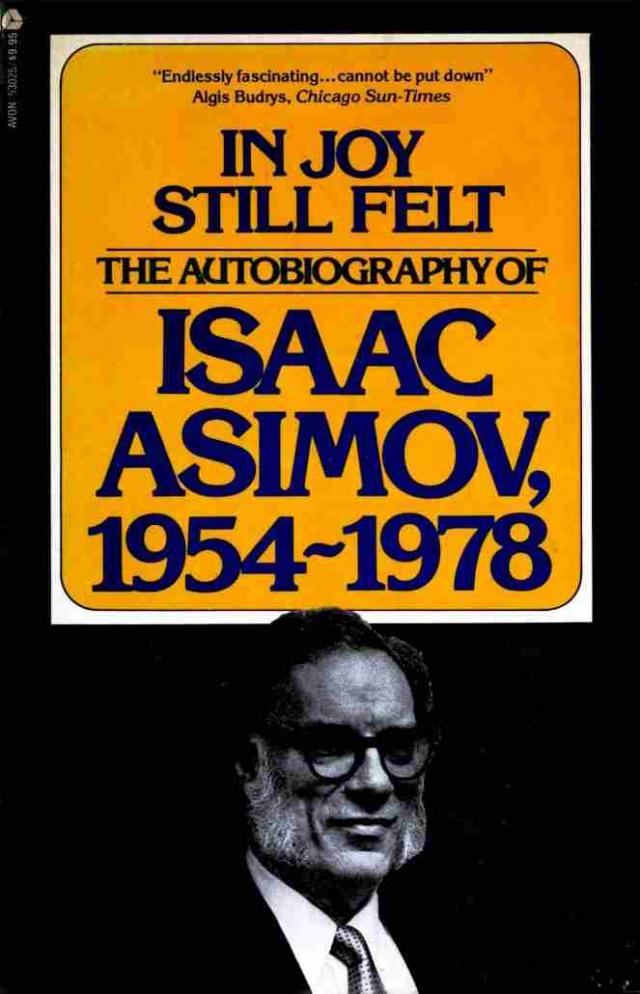
In Joy Still Felt: The Autobiography of Isaac Asimov, 1954-1978,
p.85


Constructing limericks gave me pleasure, and before long I found I had a hundred more. On November 13, therefore, I began to put together More Lecherous Limericks.
Neither I nor the Walkers had any real hopes it would do better than the first book, but the Walkers were good-natured enough to go along with me, and they told me, with what grace they could muster, that they would keep on putting out the books as long as I kept coming in with batches of a hundred.
13
Since we had had the bad news about Rae, Janet had been calling her every day and visiting her just about weekly. Rae held up remarkably well, however. Though she was failing, little by little, she remained sharp, cheerful, and was always a delight to be with.
On November 16, she celebrated her seventy-ninth birthday. We went to New Rochelle and took her to lunch, along with Chaucy, Les, and Leslie. Rae was with us all again at Chaucy’s house on Thanksgiving.
14
For a long time, Amazing Stories had been the least regarded of the science-fiction magazines, but it was the first and the oldest. It was six years older than Analog, and had held on against all buffetings while dozens of other magazines had come and gone.
Now Amazing was going to celebrate fifty years of continuous publication and they planned to put out a special golden anniversary issue. I was asked to contribute a story and, of course, I agreed. I did not forget that it had been to Amazing that I had made my first sale.
On November 22, I wrote an eighteen-hundred-word story called “Birth of a Notion,”278 which dealt specifically with Hugo Gernsback and the founding of Amazing. It was accepted and eventually appeared in the June 1976 issue of the magazine.
15
We had an anniversary, too. November 30, 1975, was our second wedding anniversary. Since it fell on a Sunday, we had the Balks to an elaborate buffet brunch at a restaurant just off Lincoln Center. We were an old married couple now, Janet and I.
16
On December 4, I gave a talk at Tufts University in the Boston area, and David came in to attend. He enjoyed it as much as he used to in the days when I lived in Newton. He had gained considerable weight, however (much as I had done when I was his age), but I saw no reason why he should repeat my mistakes, and I spent some time urging him to reduce.
17
I had written enough science-fiction stories for another collection, and as soon as I returned from Boston I plunged into work. There was no question in my mind that, of the stories I was going to include, “The Bicentennial Man” was not only the longest, but was by far the strongest. I therefore called the collection, The Bicentennial Man and Other Stories.
On December 10, I took in the manuscript to Sharon Jarvis, the pretty young woman who had been editing Doubleday’s science-fiction books since Diane Cleaver had left a couple of years earlier.
18
Caedmon Records was getting deeper into science fiction, and was persuading well-known names to read well-known science-fiction stories. They had bought the recording rights to the Foundation Trilogy, and on December 10 I went to their offices to hear William Shatner read the first section, which was to be marketed as Foundation.
And on December 13, I finally completed The Golden Door.
19
We left for Rae’s house on December 24. We were to have the usual feast at Chaucy’s, but it was Janet’s plan to stay over and spend part of Christmas itself with her mother. Janet was certain it would be their last Christmas together.
While Janet and Rae were talking in the evening, I spent my time studying Rae’s bookcases. I saw Gone with the Wind there, as I had seen it there every time I had looked. I had never read it; I would scorn to read it, certain as I was that it was a foolish book.
This time, simply out of curiosity, I opened it to look at the first page, for I had actually never even opened the book to look inside.
I read that first page, turned it automatically to read the second, and realized by the time I was on page five that I was hooked. I kept on reading (with shame and horror at my own fascination with it), waiting for a chance to break away, and never found one.
I went to bed late, under bitter protest, waited till Janet had fallen asleep, then crept out of bed and into the bathroom. I stayed up all night reading. I continued reading the next day and didn’t stop till I was finished. It took me fifteen hours of nearly continuous reading to finish the book, and when I was done I was angry. I wanted more!
Nothing like that had happened to me with any book since I was a teen-ager.
20
I ended 1975 with eleven books published:
159. Of Matters Great and Small (Doubleday)
160. The Solar System (Follett)
161. Our Federal Union (Houghton Mifflin)
162. How Did We Find Out About Comets? (Walker)
163. Science Past—Science Future (Doubleday)
164. Buy Jupiter and Other Stories (Doubleday)
165. Eyes on the Universe (Houghton Mifflin)
166. Lecherous Limericks (Walker)
167. The Heavenly Host (Walker)
168. The Ends of the Earth (Weybright & Talley)
169. How Did We Find Out About Energy? (Walker)
21
On January 2, 1976, Janet and I celebrated my fifty-sixth birthday at a restaurant with Stan and Ruth and Lester and Judy-Lynn and a special birthday cake that Janet had quietly asked to have delivered to the table.
It was also time to start thinking of The Hugo Winners, Volume III, for which I took in the signed contract to Sharon Jarvis that very birthday. Only five years had passed since the second volume had appeared, but enough stories had accumulated to allow a third volume every bit as large as the second.
22
On January 3, Janet and I were at a party at the apartment of Eleanor Sullivan of EQMM. She lived in Stuyvesant Town, and her apartment was a precise duplicate of the one I had lived in twenty-eight years before. It was an exercise in nostalgia.
23
Alan R. Bechtold of Topeka, Kansas, had plunged into semiprofessional publishing. He wanted to put out little pamphlets containing an individual science-fiction story specially written for the series. It would appear under the imprint of Apocalypse Press and would consist of a strictly limited edition, with each copy signed by the author. It was to be sold only at science-fiction conventions.
He wanted a story from me and offered a price comparable to that paid by the science-fiction magazines. After the edition was sold out the story would be mine to do with as I pleased.
I was interested and agreed. On January 5, I began writing a story called Good Taste, which I set against a background of orbiting space settlements. As it turned out, I liked it very much. So did Bechtold, and the pamphlet eventually appeared (and I counted it among the number of my books).
Good Taste was the second in Bechtold’s series. The first contained some very short items that were too recondite for my understanding. The third was to be a story by Harlan Ellison, but apparently it never showed up. Soon thereafter, Apocalypse Press came to an end, with my story not only second, but the last as well.
24
John Bartholomew Tucker was still after his adult-conversation show. Twice, he had taped the audio only; now he wanted to do video as well. On January 6, I went down to a television studio, where Broun and Rusher were also present, and once again we went through a question-and-answer session, trying to be as witty as possible. (I was asked what I would do if someone gave me a billion dollars. I said I would take it right over to the Internal Revenue Service and say, “Here! Now never bother me again!”)
It was my notion that this was still only a demonstration piece designed to interest sponsors. Tucker, however, decided to allow the experimental run-through to appear on television later in the year, after an inexpert cutting that left us referring to statements that had been cut out. The program, called “Talking Heads,” sank quietly and disappeared.
25
At the Baker Street Irregulars banquet on January 9, I received the honor of an investiture. This meant I was given a cognomen that consisted of some notable phrase that appeared somewhere in the sacred writings. Mine was “The Remarkable Worm,” which represented one of the cases that Watson mentions but never wrote up. Whether it was thought to be particularly descriptive of me, no one said.
26
The New York branch of the Printers’ Union has a banquet annually at a time near Benjamin Franklin’s birthday (Franklin being the patron saint of American printers).
On that occasion, they always put out some small book containing Frankliniana, and for the occasion of the 1976 banquet, which was held on January 20, they put out a little collection of the Franklin pieces I had done for The Saturday Evening Post.
Janet and I were at the banquet,279 and I received copies of the booklet, as did everyone else present.
The booklet was beautifully done, but it contained only three of the four stories, the first, second, and fourth. I do not know why they left out the third. They used the Post’s titles, of course, so that the booklet was entitled “The Dream,” “Benjamin’s Dream,” and “Benjamin’s Bicentennial Blast.”
It was a private printing, not available for sale. On the other hand, the booklet contained three stories that had not been collected elsewhere and was longer than some of my children’s books. After some hesitation, I numbered the booklet on my list of books. Later on in the year, though, when an even more beautiful little booklet was put out (with my permission) as a Christmas keepsake, and contained only “Benjamin’s Bicentennial Blast,” I drew the line and did not include it on my list of books.
27
In the first two months of 1976, there were three separate “Star Trek” conventions. I attended all three, or at least portions of them. The second was the most spectacular in some ways and, on January 23, as part of that second, I was on a panel with several writers, and we all tried to define science fiction.
Two of the other members of the panel were Harlan Ellison and Barry Malzberg. They (together with Robert Silverberg, who was not on the panel) had grown disillusioned with science fiction and were threatening to write no more of it. Harlan even argued that the name itself was mischievous and helped keep us all in a disregarded “ghetto.” He wanted it called “speculative fiction.”
Against this, I maintained the conservative view. I liked science fiction, I wanted to keep the name. I saw no reason why a science-fiction writer should feel he was in a ghetto. I pointed out that despite my thorough identification with science fiction, I could write anything else I wanted to write and be treated seriously.
Harlan retorted. “You’re not a science-fiction writer. You’re an Isaac Asimov.”
I tried to return to the convention the next day, which was Saturday, but the organizers had sold two or three times as many tickets as they had room for people. On Saturday, all the ticket holders had shown up and there simply was no room for them.
I walked in, unsuspectingly, and found myself trapped in a mass of crystallized humanity (with children crying in disappointment and parents looking harassed and furious). I tried to get out and it took me half an hour to do so.
Meanwhile, Harlan Ellison, since he was in town for the convention, had agreed to attend a meeting that night and read a couple of stories. He had asked me to introduce him, and I was glad to do so and to listen to his reading thereafter. He’s a terrific reader, simply marvelous. I was green with envy as I listened.
28
Seventeen wanted a science-fiction story with a Tricentennial motif. I agreed and, on January 27, 1976, began a story I called “To Tell at a Glance.” It was a spy story with a background similar to that in “Good Taste.”
It was eighty-three hundred words long and I thought it was very clever, but what I think scarcely counts. Seventeen wanted so thoroughgoing a revision that I preferred to consider it a rejection. I made some halfhearted efforts to find another home for it, failed, and retired it.
29
Apparently, the impromptu talk I had given on the QE2’s “Cruise to Nowhere,” two years before, had made it plain to the Cunard management that they could rely on me to amuse the passengers.
William North of Cunard, who had met me on that cruise, and who was a very pleasant, silver-haired, round-faced gentleman, asked me if I would go along on an eleven-day Caribbean cruise and give some talks in the process. “Absolutely,” I said.
We boarded the ship on January 31, and it was almost inevitable, now, that I would proceed to write a Black Widowers story. I did this, now, almost every time I was away from my office for any length of time.
My idea for this one, my twenty-sixth, originated from the Trap Door Spiders dinner that Lester and I had co-hosted on January 23. My accountant, Alex Zupnick, had been my guest, and he fascinated the membership with his information on tax accountancy. (That’s something that hits home to everyone.) I called my story “The Family Man,” and it eventually appeared in the November 1976 EQMM under the title of “A Case of Income-tax Fraud.”
The QE2 stopped at any number of islands, but Janet and I refrained from going on any of the formal tours. It was our pleasure to wander about on our own in the immediate neighborhood of the point to which the ship, or a launch, took us. In this way we visited Martinique, Curaçao, and so on. On February 8, we were anchored off the port city of Caracas, Venezuela, and got off only long enough to feel the soil (or, rather, concrete) of South America under our feet. It was the first time either one of us had set foot on that continent.
The most exciting stop was Barbados, on February 6. The harbor was deep enough for the QE2 to come right up to shore, which meant we could get off the ship and onto shore without trusting ourselves to a motor launch (which suited me well).
I was slated to give a talk to the Astronomical Society on the island. Waiting for us onshore, therefore, was a handsome young Barbadian, with an automobile, who took us on a thorough tour of the island. This included a pleasant buffet luncheon at its fanciest hotel and a visit to a delightful botanical garden. It was the best day of the trip.
On the evening of February 10, we left the last island and headed for home. That meant two solid days onboard ship, and that was when the passengers had to be amused. I gave one talk on the eleventh, one on the twelfth, and early on the thirteenth we were home. Janet and I were quite literally the first ones off the ship.
30
In less than a week, it was going to be Robyn’s twenty-first birthday. I hadn’t been with her on a single one of her birthdays since she was fifteen, and I had made definite arrangements with her to come to New York so that we could celebrate her twenty-first in a big way.
I had had a small superstitious twinge that something might happen to me on the cruise that would prevent it, but nothing had, so I called her right away to assure her I was all right and to tell her how much I was looking forward to the birthday.
I rattled on at a great rate about the cruise and, particularly, about Barbados, when it finally dawned on me that she was not responding properly.
I stopped short. “Robyn,” I said, “is something wrong?”
She burst into tears and, despite my entreaties, was unable to explain why she was crying for quite a while. I grew more and more panicky and finally she could choke it out. It was an agonizing story, but far from as bad as it might have been.
Robyn’s classmates had been as anxious to celebrate her birthday as I was, so they had arranged a pre-birthday party in her dormitory room on February 6—the very day I was so happy on Barbados.
It went well until some Boston College football players decided to crash the party.
Robyn advanced to ask them to leave. (She knows no fear—certainly not of boys, since as a beautiful girl she has always been accustomed to having boys grin ingratiatingly and do whatever they were told to do.)
Robyn, who is five feet, two inches tall, proceeded to get angry with the ringleader, who was six feet, three inches of brawn and who wore three-inch platform heels.
In the fracas that followed, Robyn was thrown to the ground and sprained her right knee so badly that she found herself unable to walk. An X ray, taken the next day, showed that nothing was broken, but she had torn a ligament and would have to stay on crutches for some weeks.
She was not fully mobile and she would not be able to come to New York—and that was why she was crying. For a full week she had been brooding over the necessity of telling me this and facing my disappointment.
What could I do? Disappointed I might be, but that was as nothing compared to my distress over what had happened. My impulse was to ask, in exasperation, why on Earth she had tried to fight with a football bruiser, but what good would that have done? I spent my time telling her that we would make up for it after her knee was better and to put it all down to misfortune and forget it.
Robyn had not been able to forget it, however. Laboring under a strong sense of injustice, she had brought charges against the football players before the college administration, and had applied to George Michaels for help.
Had I been reachable by phone and had she consulted me I would have advised against it. I could have told her that the football players, after all, like any of their brother anthropoids, were acting with only what rationality they possessed and were not deliberately trying to hurt her. And to expect the officials of Boston College to take action against football players, when football was the college’s chief claim to academic excellence, was asking a lot of college nature.


