

In joy still felt the au.., p.33
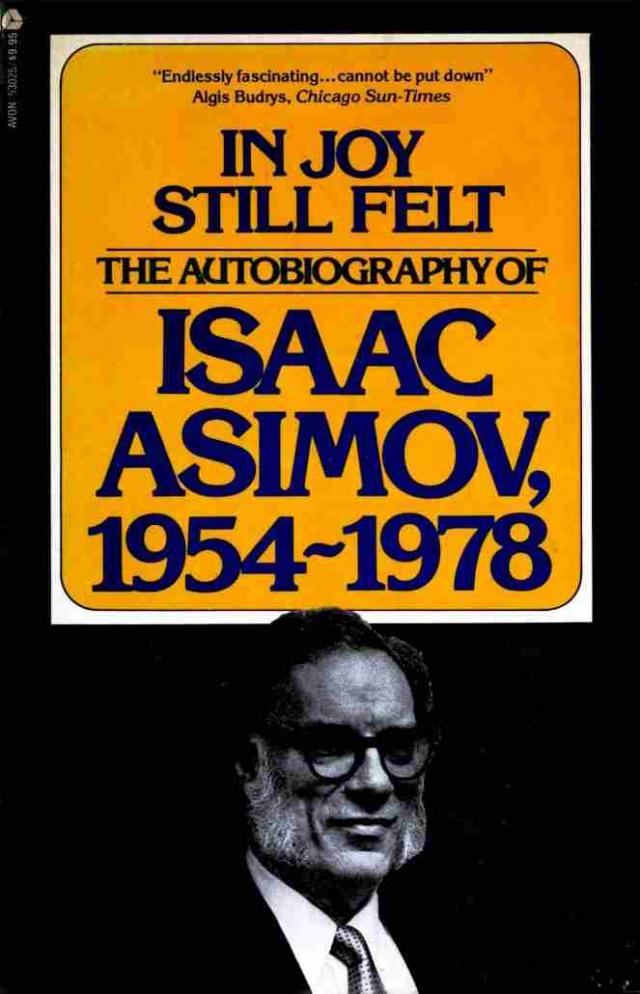
In Joy Still Felt: The Autobiography of Isaac Asimov, 1954-1978,
p.33


There was a pattern that I was following more and more, by the way. I had no concern about finishing one book before beginning another.
Although I had barely started The Human Brain, for instance, I was pushed off in another direction once my copies of Words in Genesis appeared on February 8. I at once began Words from the Exodus, in which I took the second, third, fourth, and fifth books of the Bible as my source material. And all the time I continued writing biographies for Tom Sloane.
The multiplicity of tasks didn’t confuse me. I switched from book to book freely and never allowed myself to get tired of any one of them. It became not unusual for me to have as many as five or six books going in one stage or another, while writing shorter pieces in between.
It was the juggler’s rhythm and I loved it.
9
We had a party for Robyn’s seventh birthday on February 19, and I celebrated, if that’s the word I want, by driving my car to school through a snowstorm (I was giving a small class on library use at the med school) and managed to scratch and dent my car slightly trying to park in an icy parking lot.121 Robyn had her party, however.
10
Ever since I had visited Gloria Saltzberg two months before, she had been urging me to join Mensa. I didn’t object to that. I liked Gloria and I liked the members I had met. I did object to the IQ tests, however.
In the first place, I don’t really believe in IQ tests; I don’t think they prove very much. Second, I felt that considering my accomplishments, my intelligence might well be taken for granted and that an IQ test was superfluous.
Gloria, on the other hand, said that passing the test was a necessary formality, and why should I hang back? Surely, if she had passed it, I could do it standing on my head.
On thinking it over, I decided that my real hangup was the possibility of failure. I was afraid of the humiliation of turning out to be not bright enough for Mensa. Since it was also humiliating to be hanging back out of fear of failure, I applied for entrance to Mensa.
I received my copy of the test soon enough and, on the evening of February 27, 1962, went to Gloria’s, opened it there, and, under her supervision, took the test.
It was not an easy test, and certainly no pushover. I did make it, though. The score, which I received on March 10, gave me an indicated IQ of 161, whatever that means, and thereafter I was a member of Mensa.
11
Gertrude went to New York on her own on March 13, leaving me behind with the children, and this time I was determined to have no teeth knocked out. I never let the children out of my sight.
When Gertrude got back on March 16, she was in a state of delight. She had had perfect weather. She had had a good time. And she had made a daring purchase of nothing less than a mink stole, which had set us back six hundred dollars.
It didn’t bother me, since we had the money. I was delighted, in fact, that Gertrude reached that state of trust in my earning power to buy the stole even without consulting me. Between that stole and my own renting of a tuxedo, we were edging up into the middle-middle class.
12
My advance copy of Fact and Fancy had come through on March 9. It was my second collection of science essays (Only a Trillion had been the first), but the first collection of my continuing series of F & SF essays.
Naturally, I promptly put together a second collection of seventeen F & SF essays, which I entitled View from a Height.
On March 30, I visited Walter Bradbury at Harper’s. He looked in much better shape than he had when I had last seen him at Holt, and he suggested a book on the genetic code. This was much in the news now. Ever since Watson and Crick had worked out the double-helix structure of the nucleic-acid molecule, geneticists had been successfully working out the detailed chemistry of the mechanism of inheritance.
Mac Talley had already suggested a book on the subject, and I had turned down the suggestion on the ground that news was breaking so quickly in that subject that I would be out of date before I was finished. A second, independent suggestion, however, set me to thinking.
One of the virtues of The Wellsprings of Life, after all, had been that I was able to bring The Chemicals of Life (in which I hadn’t even mentioned nucleic acids) up to date.
Now if I did a book on the genetic code, I could bring The Wellsprings of Life up to date, for its last chapter, on nucleic acids, was now woefully inadequate.
So I told Brad I would do it, but I also told him that Mac had suggested it first and that he would have to have the paperback refusal. Brad agreed to that. Eventually I called Mac and said I would do the book on the genetic code, and I was all set.
13
Another task that was in the works involved Cliff Simak. He had been put in charge of a science page at his newspaper, and it was his intention to get series of four to six articles on particular subjects written by those of his science-fiction colleagues who had scientific credentials—myself, Willy Ley, Robert Silverberg, and so on. As long as Simak was running the page, I wrote article series whenever he asked me to (they amounted to seven altogether, one a year between 1962 and 1968). When Simak retired, so did I—from that task.
14
I had an unusual experience on April 7, 1962. The University of Omaha had asked me to lecture for them, and before I had a chance to refuse out of hand, they explained they meant a lecture by phone.
The phone company would set up a loudspeaker arrangement; I was to keep my phone open at a particular time; I was to be there waiting; they would call; I would give my lecture, be able to hear audience response, be able to answer questions, and so on.
It was an intriguing notion and it occurred to me that I might make my influence felt anywhere in the nation without having to travel a step or, for that matter, without having to do more than sit in my easy chair in my underwear.
On April 7, therefore, I did it—and found I hated it. There was simply no use doing a lecture that wasn’t live. I had to see the audience, sense it surrounding me, get the response in full. Talking a lecture into a phone, I decided, was like typing while wearing boxing gloves, or making love while wearing a tuxedo.
I rejected all further such invitations whenever I possibly could.
Then on April 13, it came time to give a lecture to the biochemistry class. I was now giving one lecture a year (“It proves I’m still there,” I would say). Of course, I was now a stranger to the class and they to me, and under those circumstances I knew I had a cold audience.
While that might not matter to the academic lecturer in general, it mattered to me. If I didn’t warm them up somehow, I wouldn’t get the kind of response that would make it possible for me to enjoy a lecture.
Generally, since my lectures are off the cuff, I don’t remember the particular strategies I use to warm up an audience, but I happen to have a record of my opening paragraph on this occasion:
I began: “Once a year the department carefully selects a strategic moment when it is considered safe to entrust me with a lecture. Yesterday you had a biochemistry examination, and this afternoon you will have a physiology examination. Outside it is a dull, gray, miserably rainy day, and to top it off it is Friday the thirteenth—so here I am.”
There was a roar of laughter and no trouble thereafter. The lecture was on trace components of the diet, not something that was apt to stir the blood unduly, but a warm audience will laugh at any of my little jokes, and when I ended, I received the applause I always consider to be my just due.
15
Mac Talley admitted that The Genetic Code ought to take precedence over The Human Brain because of the timely nature of the former.
Too timely. Neither in college, nor in graduate school, nor even in the days of the med school had I learned about the genetic code, for the very good reason that it didn’t exist in those days. In our wretched biochemistry text, we didn’t as much as have “genetic code” in the index, not even in the 1957 edition.
It meant I had to educate myself before I could educate the readers, but it’s all right. I enjoy the process.
My method of self-education was, of course, entirely through the printed word. I did not seek to interview leaders in the field of genetic research, not even those who were well within my reach. Nor did I seek to attend lectures on the subject.
What I did do was to get recent texts on the subject, read journals, newspapers, and magazines dealing with the matter—and, in particular, pore over Scientific American. It meant gathering a great deal, placing it all in decent order, wringing out the fat, smoothing out the lean, and putting it all into clear and simple words.
I think that is what I do. Actually, I don’t watch myself do it.
And whatever it is I do, I never wait until it is done before I start writing. I start at once and do my research as I write. I could never have the patience to delay the writing end of it, since it is the writing I live for. Nothing else.
16
I was having eye trouble. Nothing serious; I was just getting old. The lens of my eye was having trouble thickening itself for close vision, and in a normal eye that meant I would have become farsighted and would need special reading glasses.
I was nearsighted to begin with, so my “presbyopia” (as it is called from the Greek for “old eyes”) merely produced normal vision for me at close distances, but made me farsighted if I persisted in wearing my glasses.
I had to remove my glasses to type, then when I ate, finally at all times that I was indoors, except when I was watching television. And I only needed my glasses outdoors when I was driving—or when I wanted to make sure I could recognize people at a distance.
The usual solution to such problems is to wear bifocals, but I held off stubbornly. The bottom half of the bifocals would have to be plate glass, and I decided it was easier to remove my glasses when I had to.
I am often accused of resisting bifocals because that would represent an unseemly admission of age. Well, who am I to argue? Maybe that’s right.
17
On April 27, I rented a tuxedo again in preparation for our automobile trip to West Virginia for the meeting of the World Book Year Book board.
The only other members of the board foolish enough to show up were Red Smith, who handled sports, and Lawrence Cremin, who handled education. What’s more, since the editor-in-chief of World Book had died on Saturday, even as we were leaving home, the session was aborted and the World Book officials were leaving at noon the next day. It was a complete fiasco.
There was one unnecessary business session the next morning, and we left as early as we could on May 2.
I was never again able to take the World Book job seriously. It seemed to me to be too apt to degenerate into corporate folly. Were it not that I couldn’t quite bring myself to leave a dollar-a-word task, I would have quit by letter the instant I had gotten home.
18
Eight years before, I had suggested an anthology of science fiction short-shorts to Groff Conklin. Groff had agreed enthusiastically, and together we selected fifty of them. We had agreed that I would write the Introduction and he would do the paperwork. What we hadn’t worked out was who was to do the publishing and, as a matter of fact, we could find no one who wanted to undertake the task.
The book was retired until Collier Books began buying everything in sight. I quickly suggested to Groff that he try them, and it worked. On May 5, 1962, the contract came through from Collier Books. Fifty Short Science-fiction Tales would be my second anthology and my fourth collaboration (after the two texts and Races and People).
19
On May 8, I ordered new glasses with a slightly weaker prescription that was going to ease my presbyopia a little. For the first time I chose thick black frames, and when I put them on I found something I knew at once I would never abandon.
From that day onward, every set of glasses I have had has had thick black frames, and they have become a trademark as my face became better known. If I ever changed the frames, or had a picture taken without glasses, I would be unrecognizable.
20
The galleys for The Search for the Elements arrived, and on May 11, 1962, I began to go through them. I found myself simply unable to believe my eyes.
I thought I could understand Svirsky’s actions in the case of The Intelligent Man’s Guide to Science, however much I might angrily disagree with them. That book had been twice as long as he had asked, and he might have felt justified in editing it heavily.
That reason did not exist in the case of The Search for the Elements, and he edited it just as heavily. In some places, he simply rewrote.
I went through the book, trying to undo the damage, and it was eventually published, but it was quite clear to me that I would never, never do business with Svirsky again, not if he could guarantee making me a millionaire. I formally abandoned the notion of the science encyclopedia for young people that had till then labored along with a desultory kind of life, and from then on when he suggested I do some book or other, the answer was a flat “No.” On one occasion, he lost his temper and scolded me over the phone, but I stuck firmly to that “No.”
I learned my lesson. I have made it clear to editors ever since that I was amenable to the cutting, changing, adding, and patching of books—but that I, and no one else, would do that cutting, changing, adding, and patching, assuming I agreed with the reasons advanced for it.
I may say that I have had no trouble since. My manuscripts are freely and thoroughly copy edited, but I get to look at the copy-edited manuscript and it is my privilege to change anything back if I want to, right or wrong.
Furthermore, editors may indicate in margins what they think ought to be cut or made clear, but then I decide whether or how to do it. My favorite memory is one of Larry Ashmead writing in the margin of one of my manuscripts: “I don’t understand this paragraph.” I wrote under it, “I do.” That ended the discussion.122
Any editor will tell you that I am co-operative and easy to work with, but no editor will ever pull a Svirsky on me again. I’d sooner quit writing.
21
I finished The Genetic Code on May 14, 1962.
In it, I had developed what I considered an original system for indicating the structure of organic compounds, using zigzag lines and polygons. It was the simplest possible system for organic molecular structure. It was dramatic and easy to understand for nonchemists, and at the same time gave the full and accurate details of the structure (at least where considerations of resonance and electron orbitals are not involved, and they are involved only in advanced organic chemistry).
Some years later, a paper that appeared in one of the learned journals advanced this same notation. I wrote a polite letter to the author (who lived in the Boston area) pointing out the existence of the use of the notation in The Genetic Code and disclaiming any desire to quarrel over priority. He replied very politely, acknowledging my priority just the same.
One disappointment in connection with the book, however, was that I couldn’t do it for Brad after all. Harper was unwilling to make the necessary deal with New American Library, and I couldn’t help but feel that since Mac has asked me to do the book before Brad had, I had to go along with Mac. Brad understood.
Then came another disappointment when Mac had trouble finding a hard-cover publisher for the book. W. W. Norton, whom Talley tried first, rejected it on the ground that it was “written down”—which wounded me, for I do not write down.
22
In the spring of 1962, I won the Publication Merit Award, which was handed out by Boston University at fixed intervals. I had never heard of it until I was told on May 10, 1962, that I had won it, and that it carried with it a prize of five hundred dollars.
On May 23, I showed up at President Case’s office to receive the award.
I valued it as one more vindication of my stand against Keefer.
Another kind of vindication came on June 3.
Columbia’s miscellaneous groupings had long since been gathered together under the umbrella of the School of General Studies, and I, as an old university undergraduate, was now a titular alumnus of General Studies. As such, I was selected as alumnus of the year for 1962.
I had to grin. Columbia’s undergraduate second-class citizen was an alumnus of the year.
Of course, I didn’t consider myself an alumnus of General Studies. I considered myself an alumnus of Columbia College, whether I was recognized as such or not. Still, I went to the dinner to hear myself praised and to accept a Steuben owl as my award.
23
Gertrude and I attended a cookout on June 10, 1962. It was intended for various Newton mothers who had served with the Cub Scout organization. Gertrude had been a den mother and had served conscientiously, and I went along as prince consort.
The people involved were members of Newton’s more comfortably placed society and I didn’t feel at home with them. The main activities seemed to be smoking and drinking, and since we didn’t drink (and I didn’t even smoke), we felt out of place.
One woman, who looked more than somewhat sozzled and who had a drink in one hand and a cigarette in the other, looked at my empty hands with hostility and said, “What’s the matter with you? Don’t you drink?”
“I’m afraid not, ma’am,” I said with smiling friendliness.


