

In joy still felt the au.., p.15
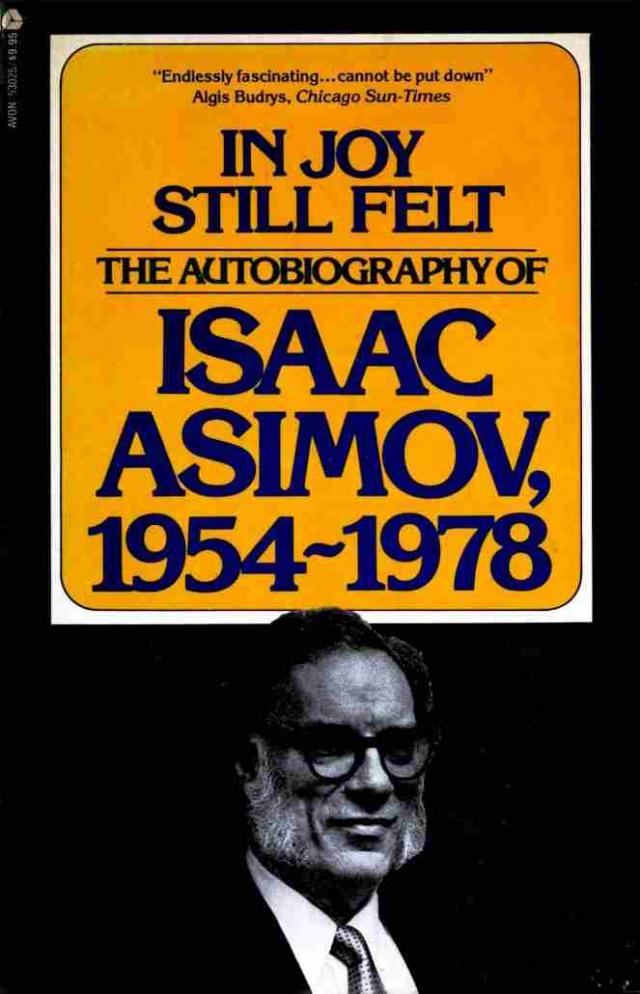
In Joy Still Felt: The Autobiography of Isaac Asimov, 1954-1978,
p.15


My father would not accept money. I piled the books and the bookcase into the car and took them back with me. At last I had a copy of the encylopaedia and could find out how it came out. It was a most useful addition to my reference library.
5
My ninth teaching semester (my first under Sinex) began toward the end of January, and I knew it would be my last as a full member of the department.
In this last of my teaching classes was one John R. Jeppson. I wasn’t particularly aware of it; I didn’t notice. He, however, was the brother of Janet Jeppson, the young psychiatrist whom I had casually offended at the New York science-fiction convention over a year before. (Of course, I didn’t remember that. I didn’t even know I had offended her at the time.)
John, as I discovered later, discussed his course work with Janet (they were the children of a successful ophthalmologist in New Rochelle, New York, so medicine was a not-unnatural career for both of them) and apparently had much good to say of me. This helped change Janet’s mind about me so that when the time came, she was willing to forget the unfortunate occurrence at the convention and give me another chance.
6
On January 31, 1958, I learned that the Thomas Alva Edison Foundation was awarding me a scroll plus $250 for Building Blocks of the Universe. The money was nice but the scroll was nicer.
After all, I had rather vauntingly announced at the top of my voice to the med school powers that I intended to be the best science writer in the world, and I couldn’t very well become that without winning a few awards on the way. This was my first.
7
Brad called on February 4 to tell me that even though Doubleday was going to do Nine Tomorrows he wanted me to clean up “I’m in Marsport Without Hilda.” The story dealt with three men who were apparently drugged and completely out of touch with the real world—but one of them was faking. The question was which one. The hero finally solved the problem by describing a session he had had with a woman and then seizing the one who understood him sufficiently well to develop an erection. I very carefully did not detail the hero’s sexual description, nor did I specifically state there was an erection. Brad sternly said that the implication was clear enough, however, and I was to clean it up.
I did so, but felt rather humiliated, for I was, and am, proud of the decency of my stories.
In fact, when I wrote The End of Eternity and let the hero go to bed with the heroine, Brad wrote in the margin: “At last. A bedroom scene in Asimov.” When Gertrude saw that, she insisted on reading the chapter. She read and read and then said, “Well, where’s the bedroom scene?” and I said, rather annoyed, “You just passed it.”
Some time later, I read one of Sprague de Camp’s wonderful historical novels, The Dragon of the Ishtar Gate, and read his description of an orgy, which included details far worse than anything in “I’m in Marsport Without Hilda.” Yet Sprague’s book was published by Doubleday.
I called up Brad indignantly and asked why Sprague could do so much and I couldn’t even do a little. And Brad, utterly unrepentant, said, “Isaac, your books are so proper that librarians are confident enough to buy them without reading them, and we don’t want to do anything to upset them.”
Nevertheless, years later, when another collection of mine was to appear and there was some desire to include “I’m in Marsport Without Hilda,” I balked and said, “I don’t want to use the bowdlerized version.”
By then, the progress of explicit sex in literature had reached the point where even the “unexpurgated” version read like decency itself—and in it went.68 The tampered-with version in Nine Tomorrows will never appear anywhere else, if I have any say about it.
But the day after Brad had confirmed the sale of Nine Tomorrows, Larry Shaw admitted he didn’t have the money to buy “The Ugly Little Boy” after all, and that was the last and anchor piece in Nine Tomorrows. It was a disappointment.
There were some minor disappointments, too. The April 1958 Super-Science came out with “All the Troubles of the World,”69 and on the cover my first name was spelled “Issac.” I protested, of course.
And Lillian McClintock had left her editorial position with Abelard-Schuman. I didn’t like the intensity of her editing but I am always upset when I lose an editor. Abelard-Schuman offered a high rate of editorial replacement, and that was another source of discomfort there.
8
On February 7, 1958, I took the train to Baltimore in order to give a talk the next morning at the University of Maryland School of Medicine. There the inviting professor made me comfortable with an excellent chicken dinner at his home, and then took me to the Lord Baltimore Hotel, where I was to spend the night. I must admit that the pampering I get when I am a guest lecturer is as pleasant as the fee.
I was reading the New York Times at breakfast the next morning (just before my talk, which was scheduled for 9 a.m. on the eighth), and when I got to the obituary page, I noted, with wry amusement, that some fellow with the look-alike name of Henry Kuttner had died. My first thought was that I would write a letter to Hank and pretend I thought he had died—except that when I read the obituary I found he had. It did not occur to me till then that science-fiction writers of my own generation were mortal—or that if they were, they rated space in the New York Times. Hank had died of a heart attack, and he was only forty-three.
Fortunately, I had finished breakfast or I wouldn’t have been able to eat any more.
But the show must go on. I had to leave for my morning talk, a walking distance away. I was reasonably dressed for midwinter, but when I came to the door of the hotel I could see passersby walking in coats, scarves, and gloves, and with heads bent low.
I said in alarm to the doorman, “Cold day?”
“Bitter,” he said, eying my coat. “Better warm up.”
I didn’t want to freeze, so I buttoned every button I could find, upended my collar, sank my head down as far as it would go, buried my hands deep in my pockets, then signaled the doorman to open the door.
I stepped out into springlike weather. I doubt that the temperature was lower than twenty-nine, and we don’t call that cold in Boston. Indignantly, I yanked my hands out of my pockets, turned down my collar, unbuttoned every coat button I could find, and walked leisurely to the University of Maryland School of Medicine, enjoying the balmy weather. More than one Baltimorean must have thought me crazy.
9
When it came time to parcel out the lectures for the teaching semester, Sinex asked me which lectures I wanted.
I said, with conscious haughtiness, that if everyone else would select the lectures they thought they would shine in, I would take whatever was left over. If I thought that the rest of the department would chivalrously refuse to take advantage of me, I was wrong. They all grabbed vigorously and I was left with the sickest collection of no-chance lectures I had ever seen. Served me right!
My first lecture was on February 11, 1958, and the subject was heme—the iron-containing compound that was the cutting edge, so to speak, of hemoglobin. It was the heme that picked up the oxygen in the lungs and gave it up in the cells.
It was straight chemistry and therefore bound to be unpopular with medical students, who never believe that chemistry has anything to do with medicine and always think of it, impatiently, as a college course that, by rights, should be over and done with.
I did pretty well, but Sinex did not attend that lecture.
The next day, February 12, I was to lecture again, this time on abnormal hemoglobins, a subject with medical applications that could be made highly dramatic, if skillfully developed—and Sinex walked in to attend.
I had a clear alternative. I could deliver a perfectly competent, perfectly ordinary lecture, and let things go at that. Or I could put on a show, tear passions to tatters, and demonstrate that I was indeed the best lecturer (or, at any rate, the most spectacular) in the school. That would demonstrate me to be no liar, but I knew well it might not endear me to Sinex. You get no points for being better than the boss.
So was I going to play it safe and not outshine the chairman? Would Hotspur? Would D’Artagnan? Would Cyrano?
I wasn’t aiming low for anybody, that’s all. I took a deep breath and delivered the best class lecture of my life, and when I finished at a dramatic peak as the bell sounded (I always kept my eye on the clock and paced myself carefully), the class rose joyfully out of their seats as one student and gave me a wild standing ovation.
It was customary for students to applaud each instructor on the occasion of his last lecture of the semester, but this was only my second lecture. And it wasn’t the customary polite applause that wavered into silence halfway on its trip to the podium. It all but broke the windows, and I stood there grinning and bowing like an actor—which, in my way, I am, of course.
It was a silly piece of braggadocio and lost me any sympathy Sinex might have felt for me, but I didn’t care (feeling he had very little sympathy for me anyway) because the whole thing felt good.
10
Life, however, is in a conspiracy to keep me from going too far off my head with triumph. Things tend to balance.
That same evening, I drove out to North Leominster, Massachusetts, to give a talk to a group who gathered at a Catholic church. Like a good boy, I arrived half an hour early, as Harry Walker (who had arranged the talk) told me always to do, so that those responsible for the talk should not get heart attacks waiting.
The trouble was that I was not treated royally, as I had been in Baltimore. I was put in one of the parish rooms, with no human being for company, and nothing to read but devotional literature.
When they came to get me, then, I was in no lighthearted mood. The topic I was to discuss was the recent satellites (the United States had put up its first successful satellite two weeks before, on January 31) and their importance to us. What I didn’t know was that Harry Walker had sold me to the fellow who organized the group on the basis of my being the world’s funniest person. He had never heard of me otherwise.
The audience settled down to listen to Bob Hope, and I began a sober lecture on the significance of space exploration. After I had talked about twenty minutes, the chairman of the program walked up to the desk and deposited a slip of paper on it. For one panicky moment I thought it was a message of catastrophe from home—but there were only two words on it: “Be funny.”
I stopped dead and said, “I’m afraid we’ve got our wires crossed here. I was under the impression I was to deliver a serious speech. I have just been ordered to be funny. I will stop now. I will not collect any fee.” And I began to walk off the stage.
The audience shouted, “Go on. Go on.”
The chairman, looking sick, also waved me back.
I resumed my talk, finished it, collected a check for a hundred dollars to mail to Harry Walker, and along with it that night I wrote a letter explaining that I would do the talks I had agreed to do, but that aside from that I had rather not use an agent.
I wanted to be invited to talk only by those groups who knew of me and knew what to expect. I didn’t want to be “sold” to strangers.
11
Williams & Wilkins, which published our textbook, also put out Stedman’s Medical Dictionary. This was not the standard in the field, but it was a respectable second best. The publishers were planning a new edition and wanted to give it a complete overhaul. For that purpose they wanted a number of authorities to look over every definition and change it, if necessary—to say nothing of adding new definitions and dropping outdated ones.
They asked me to be their authority on biochemistry. It was an offer that tickled my vanity, but I knew that the level of work would never be compensated for by any payment they could make me. Therefore, I vacillated. I told them there was a good chance that by the end of the semester I might be without academic affiliation, and what credibility would I have as an authority if I did not have a medical school connection?
On February 15, 1958, I received a letter from Eleanor Cochrane, who was in charge of the project, saying that she would be glad to have me on the editorial board with or without academic affiliation.
That was so flattering, so clear an indication that I was loved for myself alone, that I accepted. The result was several years of hard, nitpicking work to put first the nineteenth and then the twentieth edition of the dictionary into shape.
It was a terrible punishment for being so easily flattered, but I did get one small satisfaction out of it, aside from the payments and the free copies of each edition I worked on. The editorial board was listed on the title page in alphabetical order, and my name was therefore first. In many reviews, the book was listed as having been written “by Isaac Asimov et al.” It was a credit I didn’t deserve, but I enjoyed it anyway.
12
We had a little party for Robyn on her third birthday on February 19, 1958. When David was her age, Gertrude was pregnant, but there was no pregnancy this time. We had all the children we wanted, and there would be no more.
13
On February 26, 1958, I sent off the manuscript of Lucky Starr and the Rings of Saturn to Doubleday. I had been working on the adventures of Lucky Starr for seven years now and had done six books for a total of nearly a quarter-million words. The Lucky Stan opus was about the length of the Foundation series.
It was not my thought to end it. I liked Lucky Starr and his shrimp sidekick, Bigman Jones, and the books were, on the whole, easy to write. I even knew what the seventh book in the series was going to be. It was going to be Lucky Starr and the Snows of Pluto.
It was, however, never written. My shift to nonfiction was well under way, and I was to write no more Lucky Starr novels. There were to be six and no more.
14
I did a bit of ghostwriting. One bit. The only one of my life.
Fred Whipple had been asked to contribute to a series called “Adventures of the Mind,” which was being run by The Saturday Evening Post. He asked me, on March 5, to write an article from notes he had prepared, in return for five hundred dollars, explaining that it would have to appear under his name only.
I would have refused, but for two reasons. First, I was very fond of Fred, and second, I did have a sneaking desire to have my words appear in The Saturday Evening Post, even if no one knew they were mine. So I wrote the article “Eyes on Space,” about telescopes and their importance, and eventually it appeared in the August 16, 1958, issue of The Saturday Evening Post under the title of “The Exploration of Space.”
I had little daydreams of people writing letters to the magazine to say how well it was written, or of people praising it in my hearing, or of Fred winning some sort of prize with it. Nothing of the sort happened, however. As far as I know, the article sank without even producing a ripple.
15
Dr. Sinex, after a visit to Washington, informed me on March 10 that he thought my salary could be picked up by the government in some way, and said he would speak to Keefer about it.
I shrugged. It was pleasant that Sinex was trying to find some viable compromise, but I wasn’t interested in government money and had no intention of going back to the yearly-renewal rat race. Nevertheless, I let it go. I didn’t think that Keefer would agree, and I wanted the onus of inflexibility to be on him.
I was right. On the twelfth, Sinex informed me that Keefer was “totally against everything” (that is, everything that meant Asimov’s survival as a member of the medical school) and that a written notification of termination of appointment was in the works.
It looked bad for me. It looked as though I would have my bluff called and that I would have to institute legal proceedings. (I didn’t even have a lawyer—or know one.)
16
On March 18, 1958, I had to drive to Hazelton, Pennsylvania, to fulfill a talk commitment that had been arranged by Harry Walker before the North Leominster disaster. I followed the route recommended by the AAA, but their maps are two-dimensional and they didn’t tell me that the last twenty-five miles would be over twisting mountain roads.
My pronounced acrophobia spoiled the pleasure of looking over the left side of my car at pretty countryside stretching out half a mile below. I dropped the car’s speed to a cautious walk and watched with wonder and envy the natives of the region zoom past me with one hand on the wheel and the other stifling a yawn as they wiggled along the road.
Fortunately, I made a description of my drive the introductory section of my talk at Hazelton and got the audience into a very good humor as they laughed at the tale of the unsophisticated coastal native caught in the mountains.
The next day, I drove to Swarthmore through a light snowstorm that was irritating but not serious, since it melted as it touched the ground. On the way I visited my old fan-friend, Milton Rothman, and his wife, and by the time I parked in the Swarthmore College parking lot (outside Philadelphia) the snow was just beginning to remain on the ground.
I still wasn’t worried. The local weather forecast was for an accumulation of but one or two inches, with temperatures reaching forty-five later in the day. And the next day would be the vernal equinox besides—the first day of spring.
I woke on that vernal equinox to find the forecast was a bitter lie. There was something like one or two feet of snow on the ground, rather than inches, and it was very wet, very heavy snow, the sloppiest weather imaginable. It was, indeed, the worst late-winter snowstorm in Philadelphia’s recent history.
I was to speak at a 9 a.m. convocation, which all students were compelled to attend. I was warned by the vice president that many students resented compulsory attendance at this quasi-religious function (Swarthmore was a Quaker school) and ostentatiously read newspapers during the speaker’s talk. It wasn’t intended as a personal insult, I was assured.


