

In joy still felt the au.., p.95
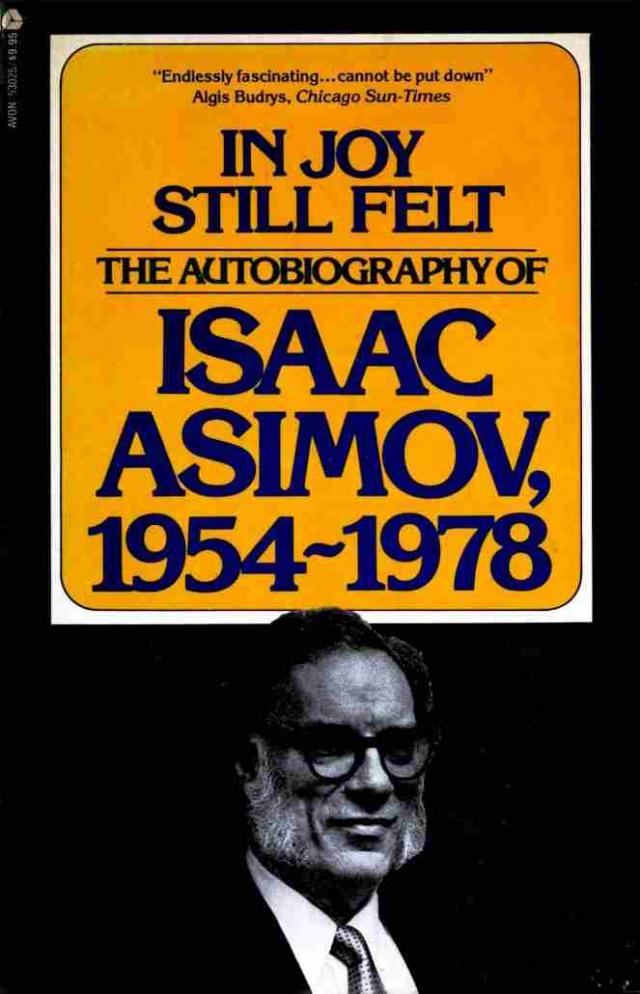
In Joy Still Felt: The Autobiography of Isaac Asimov, 1954-1978,
p.95


[←118]
See View from a Height (Doubleday, 1963).
[←119]
Hong Yee-chiu, in after years, was the first person to make use of the term “quasar” as a shortened version of “quasistellar source.”
[←120]
Of course, in the interim, they had obtained the four Gnome Press books, which meant that Doubleday had published twenty of my books out of a total of, up to that point, forty-three.
[←121]
The next day, John H. Glenn orbited the Earth three times as the first American astronaut in orbit, and he didn’t dent his vehicle.
[←122]
An editor is, of course, privileged to reject a book of mine. I don’t mind that at all.
[←123]
I remember her best on a later occasion after I had discussed lasers in one of my reviews of the year. She told me that she had never heard of lasers till she read about them in my article, and within months everyone was talking about them. She wondered how I could be clever enough to see their importance so early. I said I wondered how she knew what to do with a dollar once she had earned it.
[←124]
They included James “Scotty” Reston and Alistaire Cooke, by the way, whom I met for the first time in the course of this junket.
[←125]
It may be that this is another reason I spend nearly all day every day at the typewriter. Only by keeping a workweek something like that of my father in the candy-store can I make myself feel I am earning my income and am justified in accepting it.
[←126]
See The Early Asimov.
[←127]
That was a besetting fear of mine—that something might go wrong with a typewriter and that days and weeks and months might pass before I got it fixed. In actual fact, hardly anything ever went wrong with it, and almost always, when something did, IBM rushed repairmen to the house within hours in response to the absolute panic in my voice.
[←128]
Once, during a conversation, Carl jokingly reminded me that I had already admitted he was more intelligent than I was. “Yes,” I said, “more intelligent—but I never said you were more talented.” I may have to revise that. He has written few books compared to me, but two of them, The Cosmic Connection and The Dragons of Eden, have been best sellers and, unlike most best sellers, worthily so.
[←129]
See Is Anyone There?
[←130]
See Of Time and Space and Other Things (Doubleday, 1965).
[←131]
See Nightfall and Other Stories.
[←132]
See Of Time and Space and Other Things.
[←133]
See Is Anyone There?
[←134]
See Of Time and Space and Other Things.
[←135]
See Of Time and Space and Other Things.
[←136]
See Buy Jupiter and Other Stories.
[←137]
At about this time, I conducted a very successful experiment, by the way. I took the entire family to Merriewoode—the resort on the island at which Gertrude, Henry, and I had stayed some years before—and left them there from July 24 to August 7. This gave me two weeks of bachelor existence in which I could work steadily and undisturbed on my various projects. That was more of a vacation for me, by far, than if I had gone to Merriewoode with the family.
[←138]
And it still is, to this day.
[←139]
I called it my “spome talk” and gave it on numerous occasions afterward.
[←140]
Oddly enough, I was rather annoyed. Isaac is not a common name, and in the science-fiction world any reference to “Isaac” is a reference to me. I had gone to a lot of trouble to hang onto the name, and I hated having another Isaac who was a writer, and I particularly hated having him share the issue with me.
[←141]
This is not unusual for me. In The Neutrino, I laid the foundations so carefully that it was not till exactly half the book was done that I could begin a chapter entitled “Enter the Neutrino.’’ When Brad went over the manuscript he wrote in the margin at this point, “At last!”
[←142]
And so we did. It has sold steadily in hard-cover ever since, and the coming of a soft-cover edition, as I predicted, made no difference whatever in sales.
[←143]
I got the 1966 issue when I was forty-six. By an odd coincidence, my father had obtained the 1942 issue when he was forty-six.
[←144]
It had taken me by storm, too. Since it came out I have read it, and The Hobbit, four times and have liked the books better each time.
[←145]
See Science, Numbers, and I (Doubleday, 1968).
[←146]
See Asimov’s Mysteries.
[←147]
See The Bicentennial Man and Other Stories (Doubleday, 1976).
[←148]
See Science, Numbers, and I.
[←149]
See Asimov’s Mysteries.
[←150]
See Nightfall and Other Stories.
[←151]
Actually, Austin Olney had asked me even earlier if I had ever thought of doing one, but I don’t remember the occasion and apparently did not make mention of it in my diary. Then, too, later on, Paul Nadan of Crown Publishers actually offered me a contract to do so, even though I had never written anything for Crown.
[←152]
Adding to the gloom of May was the gathering crisis in the Middle East. The Arab states were assuming a threatening posture, and Israel seemed to be without a friend in the world except for the United States. Although I was not, and am not, a Zionist, I wasn’t quite ready to see Israel destroyed, and I worried about that. Then in the first week of June, Israel launched a pre-emptive offensive and smashed Egypt, Syria, and Jordan in what came to be called the “Six-day War.” The world situation thus improved as my personal affairs did.
[←153]
See Buy Jupiter and Other Stories.
[←154]
He was younger than I was by a number of years and it took me aback to find I had reached the time in life when I was older than my college president.
[←155]
See The Solar System and Back (Doubleday, 1970).
[←156]
Things had not worked well with Henry after all. The initial euphoria after his operation gave way to gloom when it turned out that the cancer had metastasized and was inoperable. He was undergoing X-ray treatment, but things looked dark.
[←157]
A British professor once told me that anyone with tenure at a British university could be fired summarily for one of only two reasons. “These are,” he said, “first, gross immorality on the office furniture—I think it’s all right on the floor—and second, and worse” (here he paused impressively), “pinching the tea-things.”
[←158]
See Is Anyone There?
[←159]
Robyn was old enough now to earn money as a baby-sitter for other, younger children.
[←160]
See Buy Jupiter and Other Stories.
[←161]
It did quite well, though, both in trade sales and subsidiary sales, and Doubleday made a nice profit on it, so that Larry’s judgment was justified.
[←162]
See Opus 100 (Houghton Mifflin, 1969).
[←163]
I did not go in to see the film, of course, and had no desire to. To this day I have not seen a pornographic film. I prefer my pornography in three dimensions and with myself and a woman as the only actors and spectators. That’s just a personal predilection, of course. Others can do as they please.
[←164]
When they explained this to me, I pointed out that they needn’t worry about their money lasting. If it did not, I would take over their expenses myself. And, of course, my father instantly stiffened and said, as I had heard him say countless times when I was an adolescent, “God forbid I should ever have to come to my children for money.” And he never had to.
[←165]
See Science, Numbers, and I.
[←166]
While we were waiting to go on the ferry for the return ride, Harry Schwartz and I whiled away the time talking. We had nearly made it onto a ferry when the guards signaled it was full and we would have to wait for the next one. Then the word went out that there was room for one more car, but only a compact, and a Volkswagen pulled out from behind us and got on. Harry said, “Don’t worry. God will get him for that.”
[←167]
In fact, looking back on it now, I don’t remember the second summer in camp at all. Were it not for my diary record, I would have been willing to swear under oath that she had only been at summer camp once. It shows the importance of a diary to keep your life from slipping away into me mists of forgetfulness.
[←168]
I included the Apocrypha so that I could deal with I and II Maccabees, which are valuable historical documents well worth annotating.
[←169]
See The Bicentennial Man and Other Stories.
[←170]
I eventually saw photographs of her when she was young and in show business, and in my eyes she looked quite like Maureen O’Hara—better, if anything.
[←171]
Of course, Seth Low Junior College did not have a Phi Beta Kappa chapter and Columbia College wouldn’t consider me for one since I was an outer barbarian.
[←172]
We left Robyn behind on her own, but we had done that on our earlier trip to Binghamton, and it was quite plain that she could manage perfectly well.
[←173]
It was Stanley’s fortieth birthday, a sober thought considering that I could remember the day of his birth quite clearly.
[←174]
Some years before, I heard Shelley Berman do a comic routine on “The Ed Sullivan Show.” He played his own father, whose accent, intonations, idioms, personality, and retail store were exactly like my own father’s. It made me feel queer, and when the routine was over I called my father long distance.
My father answered and I said, “Hello, Pappa. It’s Isaac. Did you hear Shelley Berman on the TV just now?’’
“Yes,” said my father, and nothing more.
Rather at a loss for words, I waited, then finally said, “I heard him, too, so—so—so I thought I’d call and ask how you are.”
There was another pause, and my mother said, “He’s fine.”
I was astonished. “Mammal” I said, “what are you doing on the phone? Where’s Pappa?”
My mother said, “He’s in the corner, crying. What did you say to him?”
So much for my father and his stoicism.
[←175]
It was on this occasion that I finally apologized to Stanley for having thrown his rubber ball over the roof thirty-two years before, and found that he didn’t remember the incident at all.
[←176]
Afterward, I gave an informal talk (without fee) in the lounge for those who cared to spend additional time exercising their eardrums, and included some words on my father then.
[←177]
That wasn’t really a lie. I had come to what was, for me, a satisfactory answer to the question many years before, and since then I hadn’t given it much thought.
[←178]
I’m not using his real name, obviously, but his real name was just as Anglo-Saxon, I assure you.
[←179]
See Today and Tomorrow and— (Doubleday, 1973).
[←180]
When Gertrude returned, she had Lee Gould with her, the girl who was with us on the original blind date, twenty-seven years before. Lee was now separated from Joe.
[←181]
On that same day the New York Mets won the 1969 World Series. I was by no means any longer a baseball fan, but the Mets did rouse in my heart a small echo of the vast love for the Giants that had existed there three decades before, and I felt it was an appropriate concatenation of events.
[←182]
Not long after that, Houghton Mifflin and Doubleday ran a joint advertisement in the Sunday Times Book Review Section pushing Opus 100 and Doubleday’s new book The Solar System and Back. I was told it was the first time in history that two competing publishing houses had published a joint advertisement and that it came about only because I was so personally popular with both houses.
[←183]
Later on, we grilled Robyn thoroughly and discovered that by “torturing it” she had meant that the kids at school were fighting each other for the privilege of playing with the kitten and were trying to snatch it from each other.
[←184]
See The Bicentennial Man and Other Stories.
[←185]
Robyn was also annoyed with me. She had been watching the show at Junior’s house, with his family and, she explained to me with Victorian hauteur, she had been extremely embarrassed by my crass behavior.
[←186]
Also on this day, I took poor Satan to the vet to be castrated. The difficulty was that he was beginning to spray his home territory to warn off competing cats, and the odor warned us off.
[←187]
See Buy Jupiter and Other Stories.
[←188]
See Buy Jupiter and Other Stories.
[←189]
I often say there are two things I regret not having learned as a youngster: how to speak Russian, and how to play some musical instrument.
[←190]
That gray did not go away, but spread until, eventually, my sideburns were nearly all white a few years later.
[←191]
The same name for father and daughter is undoubtedly a cause of great confusion. Chaucy’s original name was Shirley, like her father’s, and she had changed it, in part to avoid the confusion—then went on to inflict it on her daughter. I’ve never quite understood that.
[←192]
Janet didn’t smoke and was as opposed to smoking as I was. I had had enough cigarette smoke at home for a lifetime, and once in the Cromwell I refused to allow anyone to smoke within the premises of my apartment. I persuaded Janet to forbid smoking in her office, too. Some of her patients were petulant about it, but they all gave in.
[←193]
One of the Trap Door Spiders is Roper Shamhart, an Episcopalian minister. Some years later, he was telling us about the Washington Cathedral as the Vatican of American Episcopalianism and of his visit there on one occasion.
“Did you ever preach from its high pulpit?’’ I asked.
“Of course not,” said Roper.
“I did,” I said.
I was going to let it go there, but Roper insisted rather strenuously on an explanation, and I had to give it. I feared he might brain me with his crucifix if I did not.
[←194]
That morning I said to Janet thoughtfully, “This is the 165th anniversary of the Battle of Austerlitz—and nobody cares.” For some reason, she thought this was a very funny thing to say, and kept quoting it to everyone.
[←195]
I inadvertently left out one of the 1970 winners, so that the second volume contained only fourteen stories.
[←196]
That has become a tradition. My birthday wouldn't be one without Judy-Lynn and Lester.
[←197]
I used it, popped the gumball into my mouth, and promptly cracked off a piece of my lower left first molar.
[←198]
Sometimes, recognition can be useful. Once, in Washington, I ran for a taxi and my hand came to rest on its door handle just as the hand of a competing runner did. The young man who owned the other hand said, “Why, it’s Dr. Asimov.” I said, “Yes, it is, and surely you won’t take the taxi away from me.” His hand dropped from the door handle as though it were red-hot. It was a shame to pull rank like that, but I needed the taxi.


