

In joy still felt the au.., p.36
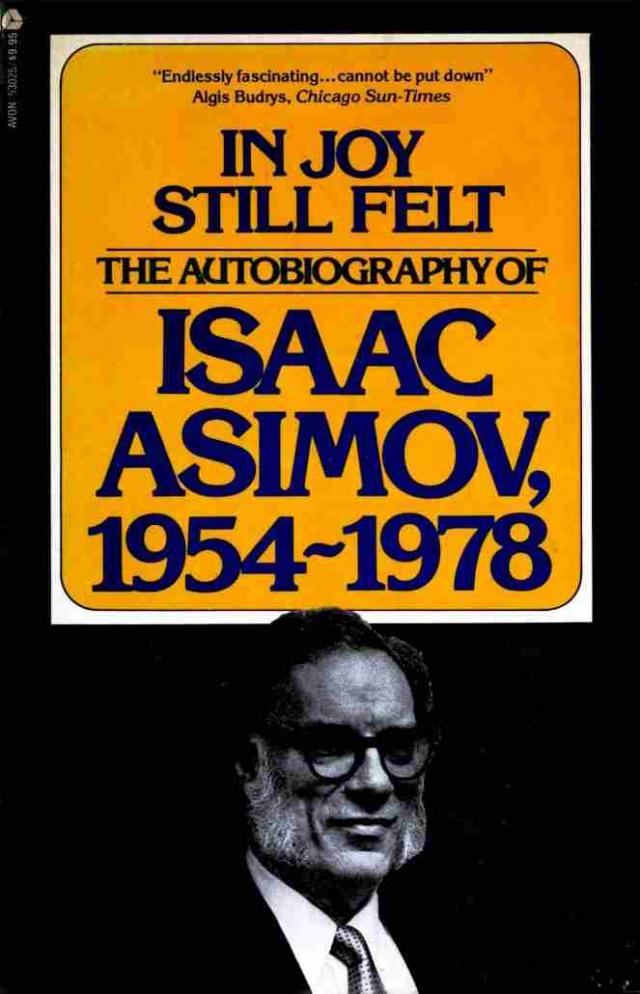
In Joy Still Felt: The Autobiography of Isaac Asimov, 1954-1978,
p.36


By the end of 1962, however, it was finally clear to me that, barring extraordinary events, I need be concerned about financial security no longer. I had started from scratch at the age of eighteen and, as my forty-third birthday neared, I had reached the level of a good living and should, it seemed to me, continue so.
It was no overnight success, heaven knows, but it was solid enough to show no signs of prospective failure provided I kept on plugging.
From this point on, therefore, I will no longer specify my income from year to year (except where some particular payment has an effect on my life), since it is no longer anything but incidental.
I will, however, continue to list my books from year to year.
19
Biographical Encyclopedia
1
My forty-third birthday on January 2, 1963, was another that passed almost unnoticed.
Though both The Human Brain and The Kite That Won the Revolution were out of the way, I was, fortunately, not without tasks to do. There were the science biographies, and these continued on and on. Every estimate I made as to how many biographies I would end with had proved too low, and now I was actually getting over the nine-hundred mark.
2
The Kite That Won the Revolution ran into trouble. Sterling North, who edited the series for which the book was intended, went over it and gave it the Svirsky treatment. I received the hacked-up manuscript on January 15.
I was horrified and wondered what I should do. On the one hand, I was dealing with Austin Olney and did not wish to anger or offend him. On the other hand, I could not and would not ever again sit still for the Svirsky treatment.
Finally, the latter won out. I visited Austin and told him I would have to have the manuscript back. North’s series was a success and North was a good writer and North had improved my book—but it was no longer my book, and rather than have it published in North’s version, I would dump the manuscript. It didn’t matter, I said, I had other books. Naturally, I would return the advance.
Austin wouldn’t hear of it. He said that Houghton Mifflin would publish the book independently and not as part of the series, and that I need not make any changes that I didn’t want to make.
In the end it was published my way and not as part of the series (even though Sterling North called me and screamed at me in a high-pitched voice—his voice was even higher than John McCarthy’s).
The Kite That Won the Revolution did only moderately well, unfortunately, and I’m quite convinced that it would have done better with North’s changes and as part of North’s series, but that doesn’t matter. There’s no law that says my books have to do well, but I have a private law that says they have to be mine. And I was proud of The Kite That Won the Revolution, which made little money, just as I was ashamed of The Intelligent Man’s Guide to Science, which made a lot of money.
3
Don Bensen, a writer, anthologist, and editor, whom I bad met now and then, had put together a collection of five stories from the old Unknown and had written to me asking for an Introduction. I had agreed readily, of course, and in a fit of delicious nostalgia for the magazine that had died twenty years before, I mentioned my story “Author! Author!,” with which I had finally made Unknown only to have it die before the story could be published.
On January 18 I received an excited letter from Bensen. The Introduction was fine, but could I dig up the manuscript of “Author! Author!”? I promptly found it. I had started the story just twenty years and five days earlier, but the days when I allowed old manuscripts to be lost had long since departed.
I read it over and found that despite its then-topical references to wartime conditions (rationing, the OPA, and so on) it was still moderately humorous. I warned Don of its being out of date, but he said he didn’t care. I therefore had Gertrude retype it for me and sent it off to him with a warning that the magazine people actually owned it.
Campbell very kindly arranged to release the story to Don. Don then paid me $200 for it, which was $50 more than I received the first time around (nor did Campbell suggest that I return the original $150).
Eventually, a new anthology, The Unknown Five, appeared, also edited by Don Bensen, and the lead story was “Author! Author!”126 By the time it appeared, twenty-two years had elapsed since it was written. This was the longest interval between writing and first publication that anything of mine had ever endured.
4
On January 23, my advance copy of The Human Body came along, and I admired it greatly. It was easily the most beautiful book (from the design and illustration standpoint) that I had yet published.
On that same day I put a new electric typewriter into use. It was an IBM Selectric, with a little “walnut” that carried the type and that moved from one side of the page to the other. No longer did the whole carriage move, and I considered that that was an enormous improvement. I don’t know that the Selectric was any quieter than the old machine, but it seemed quieter because there was less massive motion.
Yet I felt guilty. Whatever a cowboy is supposed to feel for his horse, I feel for my typewriters. In my diary I say, “I feel like a traitor to my good old machine that gave me six years of sterling service and on which I wrote The Wellsprings of Life, Life and Energy, The Intelligent Man’s Guide to Science, The Human Body, and many others.”
And it had indeed been an excellent machine. In six years of constant use, it required nothing but an occasional cleaning, plus the replacement of one minor part.
I didn’t trade it, but set it up in my second room as a spare in case anything went wrong with the new typewriter.127 As it turned out, however, the old typewriter with its moving carriage, was not an adequate backup. Once I got used to the Selectric, the moving carriage was a psychological hazard I couldn’t endure.
5
On January 23, 1963, the freshman class at the med school gathered for its first biochemistry lecture, and I gave it. For the next few years, in fact, the first lecture was assigned to me. I always spread myself and the poor freshmen invariably reacted with great excitement, thinking that was the way it would be from then on.
It never was, of course, and it made the ensuing lectures by others seem all the worse. Sometimes I felt guilty over doing that, but then I remembered that I had not voluntarily removed myself from the course, that I had told Keefer I was the best teacher in the school. The fault was not mine! (I had to repeat that to myself over and over.)
Sinex generally let me pick my own subject for the first lecture. On this occasion I spoke on stereoisomerism, because it lent itself to some dramatic science history, something I was quite up on because of my science biographies.
6
I had my first personal experience with plagiarism on January 29. An English professor from the University of Rhode Island sent me a story submitted to her by one of her freshman students and purporting to be an original. Fortunately, she knew enough about my work to have heard of the Three Laws of Robotics, so she sent it to me for an opinion.
It didn’t require long for me to reach an opinion. It was a word-for-word copy of my story “Galley Slave.”
I was cynical enough not to be appalled by the plagiarism in itself. I suspected that many youngsters faced with the necessity of producing a story and feeling the task to be impossible get the bright idea of copying someone else’s story.
What did appall me was that the foolish freshman was so naïve as to think he could pass off as his own an extraordinarily complex story, intricately plotted, written by someone who, at the time, had labored for twenty hard years improving his craft. Even if the teacher had not recognized the source of the story, she would surely have spotted the impossibility of the student’s having written it.
I sent back the story, explaining that it was mine, word for word, and said that undoubtedly she would feel the student must be disciplined for attempting plagiarism, but if so, I would prefer that she not inform me of what was done. She didn’t. To this day I don’t know what happened to the student (perhaps nothing at all).
7
Except for work on the indexes (a name index and a subject index, keyed to the number of the biography rather than the page) the science biographies were coming to an end. The book was between three and four times as long as Tom Sloane had suggested it be.
I had spent a year and a half on it—but of course it wasn’t a solid year and a half. I had written four other books in that interval, including the difficult The Human Brain.
I worried about what Tom Sloane was going to say when he saw what I had done; I hadn’t warned him en route, of course, for fear he would stop me. I wasn’t afraid of being Svirskied because I wouldn’t allow it. I was afraid, however, of being politely handed back the manuscript. I still wouldn’t have been sorry I had written it because I had enjoyed it, but I would be sorry not to have it published as written, for I thought it was a great book.
By February 14, I had separated all the pages into three copies; an original and two carbons. One carbon was for myself, of course. The original filled six boxes of the kind that ordinarily held a ream of typing paper, and each carbon filled four more boxes. It meant that eventually I would have to manhandle ten boxes to Doubleday.
As usual I had to start something else before being quite finished. There was Mac Talley’s Asimov’s Science Shelf. He had wanted me to start with chemistry, but I had had enough chemistry in the textbooks and I wanted to do physics because I didn’t know the subject well enough and I welcomed a chance to get to know it better.
I therefore began what I was eventually to call Understanding Physics on February 17, 1963.
8
Robyn was eight years old on February 19, 1963. I was aware all through her seventh year that she was at the age of Alice in “Wonderland” and in “Through the Looking Glass,” and that she looked exactly like the Alice in the Tenniel illustrations. That wasn’t just a father’s fond pride, either. Others remarked on it too, quite independently. I hated to see the year pass.
On that birthday day, I met astronomer Carl Sagan, then of Harvard, and had lunch with him. We had already corresponded and I had received some of his papers. He was an ardent science-fiction reader.
I visualized him as an elderly person (the stereotype of the astronomer at his telescope), but what I found him to be was a twenty-seven-year-old, handsome young man; tall, dark, articulate, and absolutely incredibly intelligent.
I had to add him to Marvin Minsky and thereafter I would say that there were two people whom I would readily admit were more intelligent than I was.128 We have been very good friends ever since.
9
Our house had developed a new embarrassment.
The driveway was slightly bowl-shaped and, at the bottom of the bowl, was a drain. The drain was connected by a horizontal pipe to the sewer across the street. It was not a well-designed drain, for the builder (who had built the house six years before we moved in and who had been its first occupant) had undoubtedly jerry-rigged it.
That pipe would naturally get leaves in it in the fall, plus assorted debris. That wouldn’t do real damage ordinarily, because the rains would wash it all through, more or less, into the sewer. In a really cold winter, however, the water in the drain would freeze, trap the debris, narrow the passageway, freeze further until the pipe was solid, and nothing would go through.
The winter of 1962–63 supplied us with the necessary freezing rain interspersed with intense cold, and by mid-January we had no drain. Further cold rain meant the accumulation of water in the bowl of the driveway. Since the wisdom of the builder had seen to it that the house end of the driveway was lower than the curb end, the water backed into the garage and, if there was enough of it, into the basement. That meant endless mopping and endless attempts to devise methods to drain the driveway into the roadway.
Naturally, under the circumstances, the heavens opened and we had nothing but cold rain through February and March. We had a purgatorial winter and it was not till the end of March that we finally managed to free the drain and flush it out with hot water.
10
I went to Newark, New Jersey, to attend a meeting of Sam Moskowitz’s Eastern Science Fiction Association on March 3, 1963. John Campbell was guest of honor, so I couldn’t miss that one.
Randall Garrett was there and finally I was able to clear up the misunderstanding between us and we were friends again, thank goodness.
He had a very pretty, rather plump girl with him. I remarked on her prettiness and Randall said, “I knew she was my kind of girl when I said to her, ‘How do you come to have such beautiful brown eyes, dear?’ and she held her hand up to the level of her forehead and said, ‘Because I’m full of shit up to here.’ “
Everyone took his turn in making a short speech praising Campbell, and I had my turn. I went over some of the familiar stories of our early relationship and at one point I said, “John Campbell was the first to recognize my ability.” I then paused, thought a moment, and said, “No, I was the first, but Campbell was the second.”
That got the laugh I wanted, but I wasn’t telling the truth, of course. Campbell was the first.
I told of Campbell’s inspiring “Nightfall” and of his building up the Foundation stories from my initial idea for a short story, and I particularly emphasized his role in working out the Three Laws of Robotics and of his refusal to take credit for them, saying that they were implicit in my stories.
Randall, in his speech, came up with what I have always considered the perfect conclusion. “Isaac says John made them up and John says Isaac did, and I say they’re both right. The laws were invented in symbiotic co-operation.”
I think that’s it. Campbell and I, in those first three years of my writing career—the crucial and formative ones—were a symbiotic organism.
There was a slide show of old Astounding covers (even the name of the magazine was gone now) that had me nearly weeping with nostalgia. Then Campbell talked for half an hour and it was over.
11
On March 5, I received bound galleys of L. Sprague de Camp’s new book The Ancient Engineers from the New York Times, which wanted me to review it.
I’m a sucker for Sprague’s nonfiction, and if I were completely ethical I would have refused the job, for I am not impartial about Sprague and can’t be. I didn’t refuse it, however, and I just loved the book. I thought, and still think, it is the best book that Sprague ever wrote.
I eventually composed my review, praising it to the skies, and the Times told me they planned to give it front-page exposure in their Sunday Book Review section. This pleased me enormously, for it was bound to help sales of the book—perhaps, I thought excitedly, even put it on the best-seller list. Then, too, from the more selfish point of view, I had no objection to seeing my deathless prose so prominently displayed, even if that prose were devoted to praising another’s book.
The only trouble was that a newspaper strike closed down the New York morning papers just about the time the review was to appear. By the time it was settled, many weeks later, there was an enormous backlog of reviews to be taken care of and my review was printed well toward the back. If it did Sprague any good, it could only have been to a minimal extent.
12
I lunched with Austin Olney, and with an editor of adult books, David Harris, at Locke-Ober’s on March 7, to celebrate the official publication date of The Human Body. Some three thousand copies were already sold, and the advance had been paid off.
I always plump for small advances, by the way. A large advance is good because it guarantees the possession of a large amount of money. If the book does not sell well enough to pay off the advance, the author is, in theory, supposed to return the balance, but no publisher ever asks for it. The author therefore makes more money than he would otherwise make—and gains publisher ill will which, in my opinion, is a bad tradeoff. (Of course, you may be in debt and need the money of a large advance at once, and you may decide to tackle the publisher’s ill will when you get to it.)
I, however, was not in debt, and never was, and much preferred an advance so chosen that it was paid off out of advance sales by publication date. My later royalties were then that much the greater and I gained the publisher’s good will as well.
13
Finally, on March 28, 1963, I took in the 10 boxes of science biographies. I had done something like 970 biographies.
I made my arrangements in Tim Seldes’ office and he, not being directly involved, was very amused. Having set up the six boxes of the original in plain view, I went to get Tom Sloane.
“Tom,” I said, “I’ve got the science biographies in Tim’s office. I would have brought it directly to you, Tom, but I wanted to break the news to you first that it got away from me and it’s a little longer than you wanted it to be. I’ve got the original and the carbon, Tom, and it’s in several boxes and—”
By that time we were in Tim’s office and Tom saw the six boxes. His mouth fell open and he said, “A little longer?”
“Well, yes, Tom,” I said. “It’s got to be that way because I didn’t arrange it alphabetically the way you wanted me to. In science, it makes more sense to arrange the biographies chronologically, and in order to make it a clear and good story, I had to include a lot of scientists.”
“Okay,” said Tom, being philosophical, “so we’ll work with the longer version. Which of these boxes are the original and which the carbon?”
Having pushed him along that far, I broke the rest of the news.


