

In joy still felt the au.., p.10
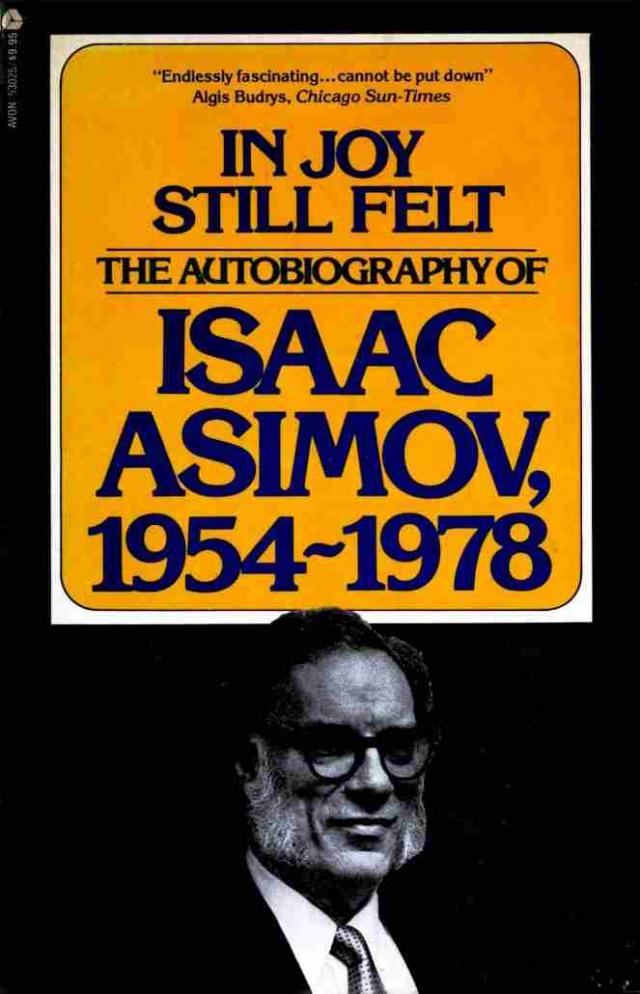
In Joy Still Felt: The Autobiography of Isaac Asimov, 1954-1978,
p.10


I overcame the hesitation. I ordered one and paid for it with my own money, for I couldn’t bring myself to use public money for a typewriter that I would use for my own needs almost all the time. I bought a special typewriter stand, and on December 8, 1956, the typewriter, an IBM Electric, arrived.
It was a nice, whopping standard-size model, and for the first time in eighteen years, I did not have a portable. It had a wide carriage so that I could insert my typewriter sheets the broad way and prepare tables if I had to.
It took a while to get used to the feel of an electric typewriter. I had to learn to stroke the keys more easily and to avoid fiddling with them while thinking. Once I got the hang of it, though, I found I could—quite literally—type all day without getting tired.
Of course, I kept my manual typewriter as a backup, but that proved a useless precaution. I hadn’t been using an electric typewriter long before I was completely spoiled. When I tried to return to the manual temporarily, I found I could not bear to push at the keys or to return the carriage by hand.
Nevertheless, the manual remained. Gertrude could use it if she wished, and someday the children might learn to type on it.
I celebrated the arrival of the electric typewriter by beginning a story called “Profession” on the very next day, December 9; the story dealt with the mechanized education of the future and its consequences.
7
By this time Robyn was twenty-two months old and she was speaking very clearly. On December 18, when Gertrude was about to diaper her, Robyn avoided her and said, quite definitely, “I want Daddy to do this.”
I had little time to congratulate myself, however, for on December 23, we had a terrible fright. We were giving her a bath in the tub and she, not feeling she needed one, I suppose, was crying desperately. We noticed that when she forced her breath out in a wail, a swelling the size of a golf ball appeared under her left ear.
We called Lewis, the pediatrician, and he said it was an enlarged vein, which might require treatment, but which was not dangerous. On the twenty-seventh, we went to Children’s Hospital, where we were told it was a pulmonary hernia and that the tip of Robyn’s lung poked up past the shoulder into the neck region. He advised us to do nothing, that such a condition always corrected itself—so we let it go.38
Between the twenty-third and the twenty-seventh, between discovering the condition and being soothed, we were absolutely afraid to do anything to cross Robyn in any way, for we didn’t want her to cry and, perhaps, pop the vein and die. Robyn, sensing the situation with the unerring instinct of the 2-year-old, behaved with unusual naughtiness, and poor David couldn’t understand why she was getting away with it. His experience as a 5½-year-old had long convinced him that we never let either kid get away with anything.
Of course, that interval included Christmas, and we fixed up a rather small tree gloomily.39 On Christmas Eve, Robyn casually pulled the tree over and David was overjoyed. Now (I knew he was thinking) this rotten kid is going to be bounced off the wall.
He walked into the kitchen and reported gleefully, “Robyn has just knocked over the tree.”
But there was nothing I could do to Robyn, and I was sufficiently beside myself with worry and tension to explode on any safe target. “So what are you so happy about?” I said, and gave him a juicy one on his behind.
Poor kid! I apologized later and tried to make it up to him, but it took him a long time to get over his self-righteous sense of undeserved victimization.
8
But if the year ended with this terrible scare, there was nothing to complain of as far as my writing was concerned. In 1956, I had published three books:
17. Lucky Starr and the Big Sun of Mercury (Doubleday)
18. Chemistry and Human Health (McGraw-Hill)
19. Inside the Atom (Abelard-Schuman)
Already I had a multiplicity of publishers. Of the nineteen books, ten had been published by Doubleday, four by Gnome, three by Abelard-Schuman, one by Williams & Wilkins, and one by McGraw-Hill.
This was not my doing. I would cheerfully have published everything with Doubleday, which paid far more copiously and far more promptly than anyone else. Brad had, however, specifically rejected the Gnome Press books before I turned to Marty and had also disclaimed interest in my nonfiction.
As for my literary earnings, they came, for 1956, to the unbelievable sum of just over $16,600, nearly twice what I had made the year before and half again as much as my previous record, in 1954. By now I realized why $10,000 wasn’t necessarily the maximum. As my backlist of books grew, each continued to earn something both in sales and in subsidiary rights, and this was added to the earnings of my current writings.
Under those conditions, I didn’t dare estimate what a reasonable maximum earning power might be, but each time the figure expanded I felt that surely I would never be able to do that again. In 1956 (as in 1954) I felt that I might perhaps have hit my best year and be looking back upon it as a receding peak forever after.
My school earnings were $6,250, so that my writing was now bringing me in nearly three times as much as my teaching was, and this was important, for it strengthened my will and prepared me for any struggle that lay ahead with Keefer.
My total income for 1956 came to nearly $23,000.
9
There was every sign that my literary prosperity would continue into the new year of 1957. The Naked Sun came out very early in the new year. In fact, I received an advance copy on December 20, 1956.
More satisfying, somehow, was that I had gotten a letter from Horace Gold, pleading once more for stories. He enclosed two letters from fans who specifically asked for more stories by me, and one of them berated poor Horace for letting The Naked Sun go to Campbell.
Gertrude advised against sending anything to Horace because of his penchant for insulting demands for revision, but I am not immune to flattery. I had finished “Profession” on January 6, 1957, and I sent it to Horace.
Gertrude was right. On January 15, 1957, the story came back with, by all odds, the most insulting rejection letter I ever got—quite needlessly insulting. An editor can say a story is bad without implying that the author is so used to selling his stories without any effort that he is too lazy to make them good anymore. The best way to get across the flavor of his letter is to quote a piece of verse I wrote nearly a year later, entitled “Rejection Slips.”40
The poem—a satire, of course—gave three sample rejection slips. The first, subtitled “Learned,” was a pastiche of the kind of letters I got from Campbell, which often couldn’t be easily understood. (I was thinking of his request for a revision of “The Abnormality of Being Normal,” which I had taken for a flat rejection.) The third was subtitled “Kindly” and was the kind of letter Tony Boucher wrote, that was so full of praise and sweetness you hardly noticed that the manuscript had been returned. The second one, however, was subtitled “Gruff” and I wrote it with Horace’s letter on “Profession” in mind. It went:
Dear Ike, I was prepared
(And, boy, I really cared)
To swallow almost anything you wrote.
But, Ike, you’re just plain shot,
Your writing’s gone to pot,
There’s nothing left but hack and mental bloat.
Take back this piece of junk;
It smelled; it reeked; it stunk;
Just glancing through it once was deadly rough.
But Ike, boy, by and by.
Just try another try.
I need some yarns and, kid, I love your stuff.
As you see, I was capable of making fun of the rejection a year later, but when I received it I was furious and my instant decision was the natural one that any writer would make under the circumstances. I was determined never to submit anything more to Horace.
It wasn’t as though “Profession” was that bad. I knew it was a good story. In fact, I mailed it to Campbell at once, and before the end of the month, I had his check for $840 in hand—21,000 words at $.04 a word.
By January 17, 1957, we had had seven snowstorms and cold snaps in which the temperature went as low as −12°F in Boston and very likely lower by a few degrees in Newton. (On the coldest day, when the milkman showed up, he looked so darned cold that I got out of the house, walked down to the curb, and took the milk from him to save him the trip. As it happened, I was in my shirt sleeves. Actually, this wasn’t too quixotic, for there was no wind at all and I was only out for a minute or so, not long enough for the natural heat of my clothing to vanish altogether. The milkman stared and said, “Are you crazy?” I grinned and said, “No, Russian.”)
The walks on either side of the house iced up. Water leaked around the main door, froze, and warped the wood, so that for the rest of the winter we could not open it and had to use the back door.
Then, on January 17, I got my first set of snow tires ever. My comment in my diary for January 17 was, “I got my snow tires on finally, first I ever owned. I dare say there will be no more snow now.”
I was right. The snowstorms stopped as though chopped off with an ax. I’m not paranoid; I don’t really think the universe is run entirely in order to spite me. But sometimes I waver.
10
My eighth teaching semester began on January 21, 1957, and three days later I received a copy of the March 1939 Amazing from Forrie Ackerman. It was the one that contained my first story, “Marooned off Vesta.” It was eighteen years since that magazine had first appeared, alive, on the stands. I had been a professional writer, how, for nearly half my life.
Also on the twenty-fourth, I received a request to lecture to the Carbon Club at Harvard. (It was the undergraduate chemistry club.) It wasn’t so long before that I would have agreed without thought. Now, Wotiz’s ten dollars had spoiled me. Therefore, I asked a fee. Nor was I such a fool as to ask for a mere ten dollars; I asked for fifteen.
The Carbon Club accepted that gleefully and I gave the talk, most successfully, on February 25. I felt very guilty about pocketing the fifteen dollars.
11
On January 30, 1957, I began the cardiovascular book at last, or, at least, the preliminary book on blood, which I was calling The Living River.
Less pleasant was the fact that Gertrude had been suffering from aches in her shoulders. As I recall, she felt them first after she had been pottering about the lawn the previous summer, trying to dig up dandelions. On February 8, the pains were diagnosed as rheumatoid arthritis. Mary Blugerman had long been arthritic, and apparently the tendency to it was inherited.
12
I continued to be on the lookout for misspellings of my name and made every attempt to get after the misspellers. Since the most frequent misspelling was to place a “z” in my last name, my plaintive request was often “Spell my name with an ‘s.’ ”
Larry Shaw, being the recipient of one such letter, replied (perhaps with a touch of waspishness) that I ought to write a story entitled “Spell my Name with an ‘S.’ “
Why not? When, on February 11, 1957, Fred Pohl asked me, by mail, to write a story for him, I began one with just such a title. It was a semifantasy in which the history of the world was changed simply because a physicist by the name of Zebatinsky was induced to change his name to Sebatinsky.
Meanwhile, the March 1957 Astounding appeared with my article “Planets Have an Air About Them,” and others followed in rapid succession. The April, May, and July issues of Astounding each contained a science article by me.41
As these articles appeared, I could feel the desire to undertake a monthly science column in Astounding, rather similar to the one Willy Ley was doing for Galaxy. I never broached this possibility to Campbell who, I knew, preferred to have various writers compete for a place in the magazine.
The thought remained in my mind, however.
13
I had discovered, as surely almost everyone discovers, in the course of my life that few things told confidentially remain confidential. For that reason, I have tried never to say anything confidentially that might rebound upon me uncomfortably if it were not kept confidential. That is not always possible, and in one case I lost a friend.
At some time in 1956, on one of his periodic visits to MIT, John Campbell told me that Randall Garrett was engaged to his stepdaughter. Randall was writing regularly for Campbell now and his stories suited the Campbell philosophy right down the middle. Campbell was delighted at the prospective marriage.
We were in an automobile at the time; it was nighttime; it was dark; he couldn’t see my face.
My silence didn’t seem appropriate, however, and Campbell said, “What’s the matter, Isaac? Don’t you approve?”
I was in a quandary. Randall and I had had wild and essentially innocent fun at several conventions and I greatly admired his somewhat erratic brilliance. To mention just one of its aspects, his ability to write comic-verse parodies far exceeded mine. On the other hand, the fact was that I owed everything in my writing career to Campbell, so how could I remain silent?
Finally, I said, “I don’t think I approve, actually. Randall is a brilliant fellow, generous and kind to a fault, but I don’t know if he would be right for your daughter.”
I wouldn’t have said that if Campbell hadn’t asked me flatly, and if I hadn’t found myself unable to deliver the lie direct.
Eventually, the engagement broke up, but, I rather think, not because of what I had said.
Campbell had many pseudopsychiatric ideas, and one of them was that quarrels ought to be tape-recorded and listened to in cold blood afterward so that each side could hear exactly what was said on both sides and, what was more important, the exact tone in which everything was said.
I think there may be something to be said for that idea, but Campbell went rather too far, I think. He recorded many arguments and played them back not only to the people involved but to others, too, I think. I know that once, when I visited his home, he played one such tape, to my intense embarrassment. He wanted to use the tape to point out exactly at which moment Randall had proved the engagement to be an undesirable one. He overbore my suggestion that it was not really any of my business, because there was a psychological point he wanted to make that he considered important. I could do nothing but maintain a frozen silence.
On February 21, 1957, Campbell called me to say that Randall had “guessed” (Campbell’s word) that I had said some uncomplimentary things about him, and he felt he ought to warn me about that. I didn’t see how Randall could guess it, and I could only suppose that in the heat of debate, Campbell had told him that I had given my friend an unfavorable reference.
I regretted that now, but it was too late to do so. Some years passed in which Randall and I were estranged, and I always felt it was my fault.
14
But if old friendships break, new friendships arise.
I received a letter, dated January 21, 1957, from Austin Olney, head of the Juvenile Division of Houghton Mifflin Company, a publishing firm based in Boston. He had read my science fiction and knew of my interest, science fictionally at least, in computers. (In fact, the handwritten postscript to the letter was, “I am a long-term Asimov fan, myself.”)
Houghton Mifflin was planning to put out an American edition of a book on computers called Thinking by Machine, written by Pierre de Latil. Olney sent me a copy of the British edition and asked my opinion of it.
On February 27, I visited Houghton Mifflin for the first time, met Olney, and had lunch with him at Locke-Ober’s. We discussed Thinking by Machine, and the next day I received a letter from him asking me to write an Introduction to it.
I did, and that was the beginning of a close friendship.
15
Robyn’s second birthday came on February 19, 1957, and March 12 was the first anniversary of our move into the West Newton house.
Both passed quietly, and in the case of the house we were in no mood to celebrate. Even its advantages seemed to have their disadvantageous side effects. We were quite close to excellent schools, which was good—and bad.
Our street, you see, was a funnel leading from the Warren Junior High School out to the various places where the students lived, and much of the student body walked along it when school was let out. They yelled and shouted (and also smoked and screamed obscenities to prove their adulthood) and tended to gather on our lawn. It was almost as bad in the morning, when they were going to school.
We were uneasy over collections of teen-age children, and neither of us knew quite how to handle them. We wished that our house was located about ten miles away from any school.
16
We were told by the kindergarten nurse, on March 28, that David was nearsighted and would need glasses. It did not come as any shock to me. Everyone in my family was nearsighted and wore glasses. In fact, my sister’s eyes and my brother’s were worse than mine.
As it turned out David’s eyes were more astigmatic than nearsighted, but that’s only a detail. The fact is that he had to begin wearing glasses at the age of six.
The real surprise is that Robyn has never developed a need for glasses. I doubt that she can see a straight 20/20, but she has always seen well enough without glasses, and could pass the driver’s eyesight test without them.
17
I received a rather humble letter from Horace in mid-March, which I decided was a sufficient apology for his offensive one rejecting “Profession.” He asked for more stories, implying that he would either accept or reject and, if the latter, he would do it without any insulting embroidery.


