

In joy still felt the au.., p.96
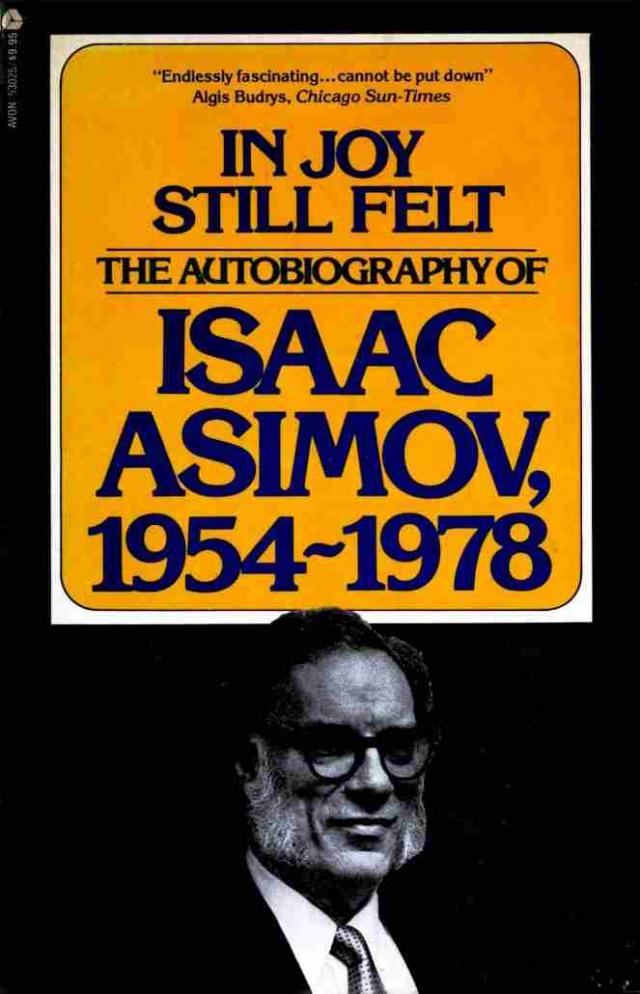
In Joy Still Felt: The Autobiography of Isaac Asimov, 1954-1978,
p.96


[←199]
Naturally, the resemblance would only be in appearance and mannerisms. I must admit that I never actually asked their permission to be taken in vain, but once it was done they raised no objections—though, as nearly as I could make out, they restrained their enthusiasm.
[←200]
See Tales of the Black Widowers (Doubleday, 1974).
[←201]
See Buy Jupiter and Other Stories.
[←202]
Judy-Lynn, who knew that I was totally eager to see her many Lester, convinced as I was it would mean happiness for both, confessed later that she was strongly tempted to pull one more let’s-have-fun-with-Isaac trip by interrupting the ceremony to say it was all a gag arranged to fool me. She said that the pleasure of seeing me drop to the floor in a faint was something she could deny herself only through the certainty that her mother would drop to the floor in a companion faint.
[←203]
In her diary, she went on and on about the beauty of the snowfall, and I guess that’s the difference between us-and one reason I love her.
[←204]
David, whose birth had prevented my planned return the year after that occasion, turned twenty years old while I was at Breadloaf this time.
[←205]
See Today and Tomorrow and—
[←206]
See Today and Tomorrow and—
[←207]
See The Tragedy of the Moon (Doubleday, 1973).
[←208]
I have never pretended I don’t understand my importance in the history of science fiction.
[←209]
See The Best of Isaac Asimov (Sphere Books, 1973).
[←210]
See Tales of the Black Widowers.
[←211]
There was a question as to what to call the new edition. We couldn’t very well call it The New New Intelligent Man’s Guide to Science. Rosenthal, after all the fuss he had made about Doubleday using The Intelligent Man’s Guide to the Bible, now backtracked and used the Doubleday formula. He decided to call the book Asimov’s Guide to Science. Doubleday, fortunately, was more good-natured about it than Rosenthal had been in connection with the Bible book.
[←212]
That morning I read of the death of Chester Keefer the day before, at the age of seventy-four. My struggle with him, now fifteen years in the past, no longer stirred me, however, and I read the obituary with detachment.
[←213]
See Tales of the Black Widowers.
[←214]
See The Tragedy of the Moon.
[←215]
See Tales of the Black Widowers.
[←216]
See Buy Jupiter and Other Stories.
[←217]
See Tales of the Black Widowers.
[←218]
The day after this arduous task of mine, five burglars slipped into the national Democratic headquarters at the Watergate apartment complex in Washington and were caught. No quiver of premonition came to me as to the importance of this (as it seemed) utterly trivial event.
[←219]
Despite her name, she was a woman, and a charming one at that. She had interviewed me on the radio once in Boston, nearly twenty years before, and it was for that reason she had thought of me in connection with the seminar and invited me.
[←220]
See The Tragedy of the Moon.
[←221]
See Tales of the Black Widowers.
[←222]
See Tales of the Black Widowers.
[←223]
See The Tragedy of the Moon.
[←224]
See Tales of the Black Widowers.
[←225]
See Tales of the Black Widowers.
[←226]
See The Tragedy of the Moon (Doubleday, 1973).
[←227]
See Tales of the Black Widowers.
[←228]
See The Tragedy of the Moon.
[←229]
On January 22, 1973, two days before the cease-fire announcement, Lyndon Johnson died, as though he could not survive the war be had so mistakenly escalated.
[←230]
At one point, I approached the honest workingman who was banging away just outside my apartment and said, petulantly, “How long will this take you?” He looked me up and down and said, “How long did it take Michelangelo to do the Sistine Chapel?” I burst into laughter and didn’t mind his banging after that.
[←231]
See Tales of the Black Widowers.
[←232]
See The Bicentennial Man and Other Stories.
[←233]
See More Tales of the Black Widowers (Doubleday, 1976).
[←234]
To those of you who are innocent of New Yorkese, I must tell you that yente is a Yiddish word meaning a scolding, shrewish woman.
[←235]
Science fiction was such a small and disregarded field when I began, but through the years it has gained me entry everywhere.
[←236]
See Buy Jupiter and Other Stories.
[←237]
See More Tales of the Black Widowers.
[←238]
See Science Past—Science Future.
[←239]
By a fortunate chance, Janet had once recommended Esserman to her.
[←240]
The Armstrong youngster said he was thinking of entente, but I told him that was French and “alfalfa” was much better.
[←241]
See More Tales of the Black Widowers.
[←242]
For both, see Of Matters Great and Small (Doubleday, 1975).
[←243]
See More Tales of the Black Widowers.
[←244]
See More Tales of the Black Widowers.
[←245]
On future similar occasions I therefore tried to work into the conversation, as early as possible, the fact that she was a psychiatrist.
[←246]
See Of Matters Great and Small.
[←247]
See Science Past—Science Future (Doubleday, 1975).
[←248]
See More Tales of the Black Widowers.
[←249]
See Science Past—Science Future.
[←250]
See The Bicentennial Man and Other Stories.
[←251]
See Of Matters Great and Small.
[←252]
See More Tales of the Black Widowers.
[←253]
See More Tales of the Black Widowers.
[←254]
See The Planet That Wasn’t (Doubleday, 1976).
[←255]
See The Planet That Wasn't.
[←256]
There was an equine concomitant one rarely hears described in connection with gallant men parading on beautiful horses. The boulevard was bled with fresh horse manure.
[←257]
See Adding a Dimension.
[←258]
See The Key Word and Other Stories (Walker, 1977).
[←259]
See More Tales of the Black Widowers.
[←260]
See Today and Tomorrow and—.
[←261]
Prism, alas, ceased publication before Janet’s article could be published. Eventually, however, Janet managed to sell it a second time (this time without my intervention in any way) to Medical Dimensions, where it finally appeared in the May 1977 issue under the title “A Learning Experience.”
[←262]
See The Planet That Wasn’t (Doubleday, 1976).
[←263]
Cosmopolitan holds the record. They asked me for two articles, and rejected both.
[←264]
See The Bicentennial Man and Other Stories.
[←265]
See More Tales of the Black Widowers.
[←266]
See More Tales of the Black Widowers.
[←267]
See More Tales of the Black Widowers.
[←268]
See The Bicentennial Man and Other Stories.
[←269]
See The Beginning and the End (Doubleday, 1977).
[←270]
See The Bicentennial Man and Other Stories.
[←271]
She was referring to “Feminine Intuition,” which I had written six years before.
[←272]
It was on this day that Rod Serling died during open-heart surgery, at the age of fifty, less than a year after we had both received honorary degrees from Alfred.
[←273]
When she finished the biography, she came to me in tears, saying, “Jefferson just died?” I put my arms around her and said, “There, there, he’s eighty-three years old and went quietly.”
[←274]
He went on to do it without me and it became the phenomenally successful Close Encounters of the Third Kind. I have no regrets.
[←275]
See The Bicentennial Man and Other Stories.
[←276]
See The Bicentennial Man and Other Stories.
[←277]
See The Bicentennial Man and Other Stories.
[←278]
See The Bicentennial Man and Other Stories.
[←279]
Senator Jacob Javits and Mayor Abe Beame each made a cameo appearance and each sat in the seat next to mine.
[←280]
The next day, a young woman asked me who I voted for and I said, “Udall.” She said, “But I wasn’t running.” I stared in puzzlement till I realized that “Udall” was pronounced “You, doll.” I was quite chagrined at my slowness in comprehension.
[←281]
Chaucy would not join us. She said it would be Rae’s last Mother’s Day and she should be with her daughter only. We pointed out that Chaucy had always behaved like a daughter to Rae, but Chaucy was adamant.
[←282]
If anything more were needed to make the Bicentennial Day one of triumph, it was the news that came later that evening that Israel had organized a commando raid that had rescued a hundred or so hostages being held by terrorists in the Ugandan capital of Entebbe. The terrorists were killed and the airport was shot up. How I enjoyed the discomfiture of that bloody tyrant and comic-opera clown, Idi Amin of Uganda.
[←283]
In the great world outside, the Democratic national convention nominated Jimmy Carter for President and Fritz Mondale for Vice President.
[←284]
See The Key Word and Other Stories.
[←285]
Meanwhile, Ford had narrowly defeated Ronald Reagan for the Republican nomination for the presidency. Senator Robert Dole was nominated for the vice presidency. Dole terrified me. He seemed to have the venom of Nixon and McCarthy.
[←286]
Lester del Rey suggested that he change his name altogether, but I thought that was going too far.
[←287]
The next day, Jimmy Carter was inaugurated the thirty-ninth President of the United States.
[←288]
The New York Times ran a photograph, a few days later, showing a panoramic view of the audience at one of the talks, with Janet and me in the front row and with one of the dummies on the other side of me. I was identified as “Isaac Asimov seated next to the dummy” and Janet pointed out that there was a certain ambiguity there but I assured her everyone would know which of my neighbors was the dummy.
[←289]
Mary Blugerman had, however, called me the day before. She was eighty-two years old now, but her voice was strong and she sounded as sharp as ever.
[←290]
He was, of course, chagrined at having misdiagnosed the condition, especially as he knew that there wasn’t a chance in Hades I’d ever let him forget it. He would say to me afterward, “Who told you to have the pain in the epigastric region?”
[←291]
George Scithers substituted for a talk I had been scheduled to give at Brown University.
[←292]
I had been invited to attend a preview, but that had been just before my hospitalization, and I hadn’t felt well enough to go.
Isaac Asimov, In Joy Still Felt: The Autobiography of Isaac Asimov, 1954-1978


