

In joy still felt the au.., p.82
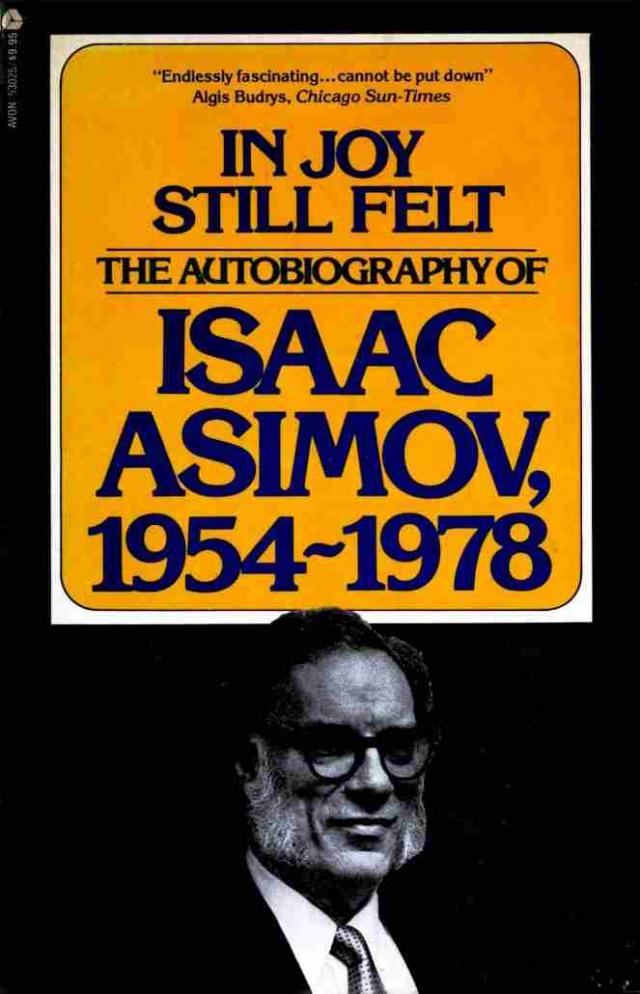
In Joy Still Felt: The Autobiography of Isaac Asimov, 1954-1978,
p.82


A young violinist named Biddle
Played exceedingly well on the fiddle.
Yet ’twixt women and art
’Twas the girls won his heart
Hands down—and hands up—and hands middle.
I then delivered my short speech and departed amid a good round of applause.
After I left, however, some stern enthusiast in the audience rose to object to my “sexist remarks” and there was some discussion of that. And the New York Times, having failed to acknowledge the existence of the best talk given at the AAAS two days before, did manage to devote some space to this mighty imbroglio.
By now I had twenty-one limericks of my own construction in my collection. I had taken them to Sam Walker and told him that when I had a hundred I planned to try to get them published. Since he had done my Sensuous Dirty Old Man, I thought he might want to do my limerick book as well. He agreed to do it.
24
At this time, I also had ten Black Widowers stories toward my second collection, and only one of them had not been placed in a magazine. I needed two more, and I decided to write those two and to deliberately refrain from submitting them to any magazine. I would then have three previously unpublished stories in the second collection, as I had had in the first.
The first of this final pair was “The Unabridged”266 (my twenty-third Black Widowers story), which I completed on February 3. As for the second, that had a somewhat complicated background.
Several of the Baker Street Irregulars were planning a collection of Sherlockian articles in honor of Julian Wolff, the leader of the organization. Banesh Hoffman asked me to write one. I felt impelled to do so because one of the requirements for membership in the BSI was the preparation of a piece of Sherlockiana, however trivial, and I had not done this.
My problem, though, was that I couldn’t think of anything to write about. Banesh suggested that I write something about the evil Professor Moriarty’s great treatise Dynamics of an Asteroid, something that (according to the sacred writings) contained mathematics so rarefied that hardly anyone could understand it.
That was right up my alley. Conan Doyle knew nothing about astronomy and had, I was sure, invented that title on a venture. Beginning with the title and the year in which it had supposedly appeared, and dealing with the astronomical situation as it then existed, I easily worked out what the treatise must have dealt with, given Moriarty’s evil nature.
I called my Sherlockian article “Dynamics of an Asteroid” and it eventually appeared in a collection called Beyond Baker Street, a copy of which I received in May 1976.
Having finished “Dynamics of an Asteroid” on February 5, I immediately began another version of the same thing, nearly four times as long, which would be my twenty-fourth Black Widowers story. I called it “The Ultimate Crime,”267 and now having twelve stories for my second collection, More Tales of the Black Widowers, I took it in to Doubleday on February 10.
At the same time I began a large book, Alternate Sources of Energy, for Houghton Mifflin.
And on February 19, 1975, Robyn was twenty years old and I no longer had teen-age children.
25
My limerick writing continued with amazing speed, and by Robyn’s birthday I had my hundred. A hundred limericks do not take up much room, of course, so it was my intention to add a sizable Introduction and then place commentary after each limerick. In the commentary I discussed how I came to construct the limerick, alternate readings—anything I wished, actually.
The commentary occasionally involved Janet’s role in criticizing or improving the limerick, and when Janet read what I had written, she said, “Oh my, I’ll be driven out of town by my colleagues and family if this is published.”
I said, hastily, “I’ll eliminate all references to you, then.”
“Don’t you dare,” said Janet at once.
Then, since I consistently referred to her as “my wife, the doctor” in the commentaries, I offered to dedicate the book to “my wife, the doctor,” and she agreed to that, too.
On February 25, I took the manuscript to Walker, and it was decided to call it Lecherous Limericks.
26
Over in Boston, Alma Hill had died some weeks before. She had been the moving spirit behind the Boston chapter of the Interplanetary Exploration Society, fifteen years earlier.
Closer to home, Hans Stefan Santesson had died at the age of sixty-one. I remembered him best as the man who told me someone wanted to meet me and led me to a broadly smiling Janet Jeppson at the Mystery Writers’ of America dinner back on May 1, 1959. I attended his funeral on February 26, 1975.
27
For years, Janet had been a faithful attendee of symphonic performances at the Philharmonic, and had been particularly fond of the oboist, Harold Gomberg. She always came back from such performances burbling about what Harold had done and the way in which he looked at his reeds or scratched his head.
At a party at Lucy Jarvis’s some months before I had met Margaret Gomberg, Harold’s wife. I introduced myself and promptly told her of Janet’s infatuation with her husband’s oboe playing. It turned out that her husband enjoyed science fiction, so there was a reciprocal attraction between our families.
Margaret, an intelligent, no-nonsense woman, arranged a meeting, which was easy since we lived within walking distance of each other. On February 28, 1975, we had dinner with the Gombergs, and Janet met her idol. She found him as pleasant and as unpretentious as could be imagined and an interesting amateur artist as well. She eventually bought one of his paintings and put it up in our apartment.
28
On March 2, I finally began “The Bicentennial Man.” It seemed to me that to avoid the actual 1976 Bicentennial, I would need another kind of bicentennial, and I chose to deal with a two-hundredth birthday. That would mean either a man with an elongated life span or a robot, and I chose a robot. Why, then, the “man” in the title? I decided to write about a robot who wanted to be a man and who attained that goal on the two-hundredth anniversary of its construction.
My vague original notion was to make it a somewhat humorous story, but once again, as in the case of The Gods Themselves, the thing got away from me. It was a seventy-five-hundred-word story that had been commissioned, but I had no way of stopping it before fifteen thousand words though I dug in my heels as hard as I could. For another, it turned into a moving story that had me almost in tears when I finished.268
I completed it on March 14, and mailed off one copy to Naomi Gordon, and another to Forrie Ackerman, who was working with her on the anthology. Both were enthusiastic.
29
Janet was discovering some of the woes of being a writer. Her book The Second Experiment had been published, and before long the British and French rights had been sold and Fawcett agreed to put out a paperback version.
On the other hand, there were some nasty reviews in some of the fan magazines, written by lower-echelon writers who apparently were chafed that Mrs. Isaac Asimov had managed to have a novel published. I had in no way helped her with either the writing of the book nor with the selling of it, but one reviewer in particular made it pretty plain that he believed I had put pressure on publishers to get Janet’s novel into print.
This was ridiculous, first, because no such pressure had been applied, and second, because no such pressure would have been successful. If pressure from me could get my wife’s book published, why could it not prevent some of my own books from being rejected?
I was dying to write a letter blasting the idiot, but I remembered my experience with Henry Bott twenty-two years before, and I knew it would be counterproductive.
Fortunately, Ben Bova, of his own accord, wrote a firm letter, pointing out that the novel had been submitted to him, that no pressure had been applied, that the novel had been rejected by him, and that the Bova–Asimov friendship had continued without a ripple of unpleasantness despite that fact.
What bothered me most about the reviewer’s snide accusation was that at Janet’s express insistence, the book had been published under her maiden name with no mention anywhere of the identity of her husband so that there not even be the appearance of her trying to take advantage of the relationship.
30
Even as I was finishing “The Bicentennial Man,” moving time arrived. Through the first half of March, our new apartment in Park Ten was being cleaned, painted, and refurbished. We kept moving things that the movers wouldn’t handle—such as the avocado tree under which we had gotten married a year and a half before. Janet and Bart Behr, between them, moved the plant over the two-block separation of the apartments. We arranged for a telephone transfer and then, on March 18, 1975, the bulk of the moving was done professionally, and we arranged to sublet the remainder of our lease to our old apartment to Bart.
For a week I continued to work at the Cromwell and then, on March 25, my office was moved into Park Ten as well. I thus left the Cromwell after 4¾ years of occupancy.
With all its discomforts, my period at the Cromwell represented the only time in my life when I lived the equivalent of a bachelor existence, and when I had rooms of my own over which I was absolute master and total disposer. It was an odd feeling, which I rather liked.
Moving into Park Ten would have its conveniences—an office to which I did not have to travel, in which I could work all hours, one that could be kept clean and shipshape—but I was sure there would be times when I would miss the independence of the Cromwell.
31
I was in the Boston area on April 5 on speaking engagements, and I seized the opportunity to take Robyn to a large restaurant. We had to wait for a seat, but that didn’t matter. I was delighted to be sitting next to Robyn, who was looking spectacular and who was finishing her freshman year in good health this time, whether we were at a table or not.
Then my name was called out over the loudspeaker system and I was led to my seat. In no time at all the hostess was at my table. My name had been heard and the cashier wanted a signature, while the hostess wanted one also for her daughter. I signed everything graciously, pleased to be able to show Robyn how famous her father was.
Then, as I noticed the hostess glancing curiously at my very young and very beautiful date, I thought I’d better allay any misapprehensions by saying, “And this is my daughter, Robyn.”
The hostess went through the greetings, but when she left, Robyn said mischievously, “She didn’t believe you, Dad.”
32
On April 9, I finished the expansion of “The Heavenly Host,” and it was ready to be delivered to Walker.
I also began Animals of the Bible, a juvenile for Doubleday that I had contracted for sixteen months earlier. The delay was, of course, occasioned by the artist. It had taken that long merely to get the preliminary sketches I could work from.
41
Murder at the ABA
1
John Bartholomew Tucker, a local talk-show host, had an idea for an adult-conversation panel, one in which panelists and guests would compete in the brilliance with which they would deal with off-the-cuff fantasies. He said he got the idea from a time when I was a guest of his and I had dealt brilliantly (he said) with a question, sprung upon me without warning, concerning whom I would invite to a dinner party if I had all the human beings who ever lived to choose from.
We taped a show on April 14, 1975 (just the audio portion, since the video would not contribute much), and I didn’t think it went at all well. I did get a chance to meet Heywood Hale Broun, the sports commentator, who was a fellow panelist.
He had a mordant and biting wit that somehow didn’t hurt—sparks of light that contained no heat. I was able to top him only once when he said, in rueful self-satire, “I look in the mirror and say: Where is that eager, handsome youth so determined to set the world on fire?”
“Here I am. Woody,” I said at once.
The taping was intended to be a display to prospective sponsors and television networks, who were expected to fall over themselves to take the program. The expectations were not fulfilled.
2
I talked at the University of Maryland on April 16, and then went down to Washington for something more unusual. It came about thus:
For three years, Doubleday had joined with the Smithsonian Institution in sponsoring high-level talks on various aspects of exploration. I was slated to give the fourteenth talk in the series, one that was to be devoted to space exploration. Since these talks were published by Doubleday in collected form, it meant I would have to write the talk.
I had done this the previous January and had called it “The Moon as Threshold.”269 It was clear, though, that I couldn’t read it, since it was twelve thousand words long. It was my plan, however, to read only portions and to give summaries of the material between the portions.
On April 17, 1975, I appeared at the Smithsonian Institution for the purpose. There had been a posh dinner first, with everyone in formal dress, with a number of Doubleday people present, including Sam Vaughan and Larry Ashmead, with even a couple of congressmen present.
I was moderately uncomfortable at being surrounded by so glittering a throng, and not exactly delighted at having to deliver my talk in a tuxedo, an unprecedented and hampering situation for me.
I walked up to the podium, placed the manuscript before me, stared (rather daunted) at the impressive assemblage, shifted my gaze firmly to the air a few feet above the audience, and began to talk. As usual, the sound of my own voice had a tranquilizing effect, and I continued, with brisk animation, for an hour.
Afterward, Sam Vaughan said to me, “That was a pretty impressive trick you played on us, Isaac.”
I was surprised. “What trick, Sam?”
“Come on, Isaac. Don’t tell me you didn’t do it on purpose. You put a thick sheaf of papers down on the podium, then rattled off your speech without glancing down at them once.”
It was true. I had completely forgotten about reading any of my manuscript.
3
On April 22, I taped three segments of the “Today” show with Barbara Walters, for airing on three different mornings. Along with me were several others, including Gerard O’Neill, who had now become famous, thanks to his idea for space settlements, and Alvin Toffler, who had hit the jackpot with his book Future Shock.
What I remember most clearly about that show did not appear on television. While the cameras were being reloaded between the second and third segments, Barbara Walters kept prodding me about the number of my books. She asked me if I didn’t have the impulse to do something other than write: if I didn’t want to take vacations, go fishing, take long walks, sleep in the sun. Firmly I answered “No” to all these things. I was content to write.
In desperation, she finally said, “What if the doctors told you that you only had six months to live. What would you do then?”
I said, calmly, “Type faster!”
4
At the Nebula awards banquet on April 26, a new “Grand Masters award” was instituted, and the first recipient was, inevitably, Robert A. Heinlein.
Bob was there to accept it, of course. He was going on sixty-eight now, had suffered considerable bad health in recent years, and looked rickety, but one could still see clearly in his face the handsome young man I had first met a third of a century before.
5
On May 2, 1975, Robyn finished her freshman year at college at last, and I heaved a large sigh of relief.
A completion of lesser import came on May 8, when my two rooms at Park Ten were finally put in complete order.
Then, on May 20, I completed Animals of the Bible, having found it a short but not very enjoyable chore. I have yet to enjoy a collaboration.
I eased matters by promptly beginning a second book in my astronomy series for Chaucy: Alpha Centauri: The Nearest Star.
6
In Europe, someone had written a mystery about the Frankfurt Book Fair called Murder at Frankfurt. This inspired Larry Ashmead to wonder if a book entitled Murder at the ABA (that is, the American Booksellers Association) might not be written on this side of the Atlantic.
He automatically thought of me—he always does—and put it up to me earlier in the spring. I was attracted. I had written two dozen straight-mystery short stories and I felt I was ready to write a straight-mystery novel, with neither science nor science fiction in it.
I said, “Let me think about it, Larry,” and then promptly forgot about it. About a month later, a contract arrived, and I stared at it in puzzlement for quite a while before I dimly remembered Larry’s suggestion. Then I signed it.
As it happened, the ABA was meeting in New York to celebrate its seventy-fifth anniversary, and it was the first time in twenty-five years that it was meeting there. Larry said that this was my chance to attend the convention, without any need for traveling, and that I could, in this way, gather local color.
I said I had to attend anyway since I was slated for an autograph mission, but Larry said, firmly, “Attend all four days.”
This introduced a slight complication. The convention was to be held over the Memorial Day weekend, and it opened on Sunday, May 25. On that day, however, I was scheduled to give a commencement address at the University of Connecticut. I couldn’t very well get out of giving the address so, after some thought, I decided I would cheat and miss the opening day.
But then William Morris, secretary of the Dutch Treat Club, and a lexicographer with whom I had worked on the American Heritage Dictionary, phoned and asked me if I would be at the convention at 4:20 p.m. on Sunday to help him push a book.


