

In joy still felt the au.., p.92
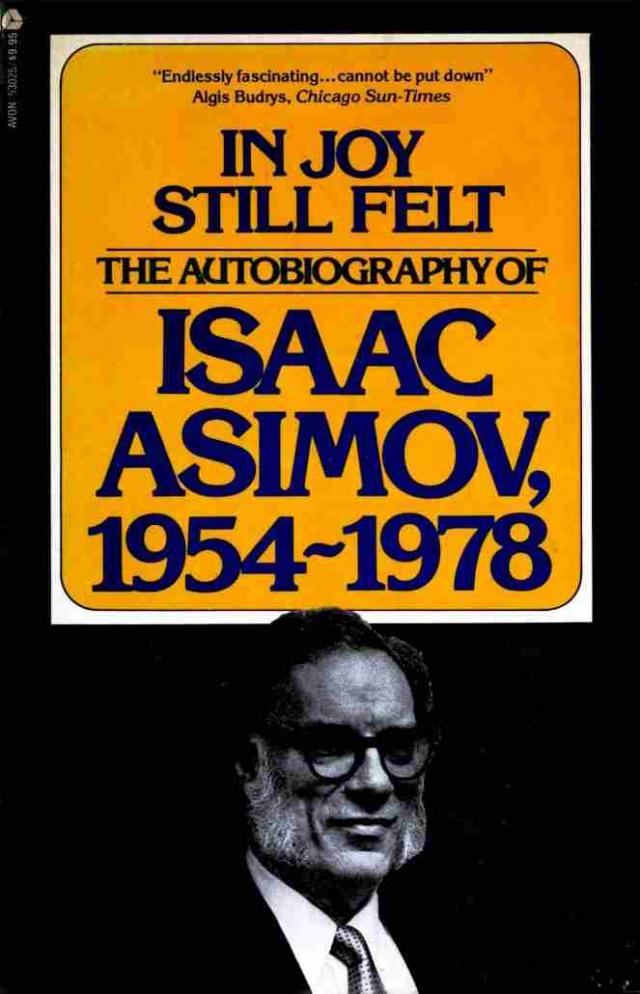
In Joy Still Felt: The Autobiography of Isaac Asimov, 1954-1978,
p.92


Apparently, though, Simon and Schuster did not want him to take my A Choice of Catastrophes along with him. Since I had refused to accept an advance until such time as I could give written notice that I had begun the book, I had the option of not doing it at all, if I couldn’t do it for Larry.
18
My autobiography was taking virtually all my time. By early September I had been working on it for six months, leaving almost everything else to one side, except for various short pieces that had to be done.
On September 13, though, I desisted long enough to begin How Did We Find Out About Earthquakes?, my twelfth in the series for Walker. I delivered it on the twenty-sixth.
19
On September 16, Lester and I co-hosted a Trap Door Spiders dinner, and Paul Esserman was my guest. Paul was very impressed with the Spiders and they were equally impressed with him. Naturally, I introduced him as the man who had misdiagnosed my coronary, but everyone took that in good part, even (I was relieved to see) Paul.
20
On September 20, I undertook my first strictly-business speaking engagement since my hospitalization. The arrangement was, however, that I be taken there and back by limousine. It was also the first trip out of the city alone since my hospitalization.
That evening I had dinner with the Bovas at Barbara’s place in West Hartford. (She maintained a house there while Ben had an apartment in Manhattan, and they more or less alternated weekends at the two places.)
I gave my talk on the morning of September 21, my first paid talk in four months, and I was relieved to find I could still do it.
21
On September 28 and 29 I made a swing through eastern Pennsylvania, speaking at Reading and at Chester. That went well, but we still had occasional long trips to make—long trips that had been scheduled prior to my coronary. One of them was for a talk at James Madison University in Harrisonburg, Virginia, and Janet approached that one with considerable trepidation.
We left on October 5, and got to Harrisonburg before noon on the next day. There was no trouble at all, though Janet insisted on doing most of the driving.
The trip back was excellent. We stopped off at the Luray Caverns, which, nearly a decade before, I had visited with Gertrude and the children. After that it was back along the Skyline Drive. We were home on the eighth, quite satisfied with the trip.
22
There was a voice from the past on October 10, when Charles D. Hornig, who had bought such early stories of mine as “Ring Around the Sun” and “Magnificent Possession,” dropped by.
He had read The Early Asimov, in which I said I had never met him, and he thought it was time to correct that. Rather embarrassed, I explained that my closer readings of my diaries for the autobiography had revealed that I had indeed met him once, thirty-eight years ago. I agreed it was high time for a second meeting, though.
23
I discovered on October 11 that Diana Jones had resigned as editor of American Way. In her place was Walt Damtoft, a newcomer. Of the four employees of the magazine when I first started my articles three years before, only one, Priscilla Wilson, was left.
24
A third box of five hundred manuscript pages of final copy of my autobiography was taken in to Cathleen on October 19, and I swore to her that there would be only one more box.
25
Naturally, I had let John Ciardi know that I, too, was a published poet, having produced several volumes of verse. They were limericks, to, be sure, but verse, nevertheless.
As I suspected, Ciardi had not been able to resist the challenge, and eventually I received Xerox copies of 144 limericks that he had constructed and was going to publish with W. W. Norton under the title A Gross of Limericks. Since his limericks were as lecherous as mine, the play on “gross” is obvious.
Ciardi suggested I might want to contribute another gross for the same book (the title would then be Limericks: Too Gross), and I was willing. About half a year earlier, in fact, I had begun to put together my fourth volume of limericks, but this had been overtaken and sent into suspended animation by my autobiography.
I pulled them out on October 20 and retyped them (without Introduction or commentaries), then added some I had intended for a fifth volume and constructed those that were still lacking. In doing so, I produced one of my all-time favorites as the 144th and last limerick of the group. I entitled it John Ciardi and I (I had titles for all mine, although Ciardi lacked titles for his), and this is how it went:
There is something about satyriasis
That arouses psychiatrists’ biases,
But we’re both of us pleased
We’re in this way diseased
As the damsel who’s waiting to try us is.
I took in my batch of limericks to Eric Swenson of W. W. Norton on the twenty-fourth.
26
On October 31, Janet and I drove the car westward in leisurely fashion, and by the next day had reached Pittsburgh. (This was another precoronary engagement.)
On the morning of November 2, I spoke at a town hall meeting and experienced, to my surprise, a new low in introductions. I thought I had encountered all possible kinds of bad introductions, but I was wrong.
The woman introducing me began by directing latecomers to the front, where seats were still to be found. “There are seats in the front,” she intoned over and over, waving her arms to show them. Then, having played the inappropriate role of usher, she began a routinely uninspired introduction.
At its conclusion, the audience broke into the conventional applause and the introducer stepped on it. She waved them quiet and began her broken-record repetition of “There are seats in the front. There are seats in the front.”
I had to rise to a cold and silent audience, and my impulse was to render the introducer cold and silent by a prolonged and tight grip on her throat, but I controlled myself and went into my talk. It took me quite a while to warm up, and to warm the audience.
We then drove sixty miles eastward to a little town named Loretto, where I spoke at St. Catherine’s College with much greater success. We were home on the evening of November 3.
27
The furor aroused by Star Wars was having a favorable effect on the prospects for movie science fiction generally. On November 4, I found that my book The End of Eternity had been optioned for the movies.
To balance that, however, The Caves of Steel option had been dropped after four years. I suspect that someone else will option it, with perhaps better results, in the future.
28
On November 9, Janet and I drove to the Concord Hotel, my first visit there since the time, eight years before, when I used it as the occasion to begin Isaac Asimov’s Treasury of Humor. We had assigned to us a rather unbelievable room designed in antique style, and there was a pleasant dinner in which Janet sat next to Clifton Fadiman, who had once been famous as the interlocutor of “Information Please.”
The next morning I spoke to the New York State Reading Association and we drove home.
29
We were on the road again on November 11, however, and traveled to a western suburb of Philadelphia in order to help celebrate Sprague de Camp’s seventieth birthday (which was, in actual fact, not due for two weeks). A number of the Spiders were there, including Lin Carter and John Clark, and, although it was formal and I was compelled to wear a tuxedo, we had a good time.
Catherine was, of course, also approaching seventy, but it came as no surprise to me that both she and Sprague were the least seventy-looking seventy-year-olds anyone had ever seen.
30
David had visited New York with a friend, on impulse, and on November 19 dropped in on us without warning. He and I had dinner together. He had been experimenting with facial hair for years, and this time he had a beard.
31
On November 24, Thanksgiving, Janet and I drove to Boston and had a very successful dinner with Robyn at a restaurant near our motel.
My reason for being there was to attend a Mensa convention. Gloria Saltzberg (who had first introduced me to Mensa fifteen years before) was being honored on the twenty-fifth with a plaque as the founder of the Boston area Mensa group, and I was to give it to her with appropriate comments.
She was fifty years old now and, it seemed to me, not really in the best of health, but she was very touched at the ceremony and I was very pleased to have been able to take part in it.
Of course, Robyn joined us each day of my stay, and the climax of that came on the twenty-sixth, when she and I went out to Quincy Market, a new open-air emporium that had been established near Boston’s new City Hall and that was full of outré stores and eating places.
That night, I watched three short “stag” films one of the Mensa group showed. They were the first such films I had ever seen, and in about three minutes I found my curiosity sated.
32
November 30 was our fourth wedding anniversary, and for the first time we were not able to celebrate it with the Balks, since Al was forced to be out of town on business. We had dinner with Bart Behr and his companion, Betty Batty, instead.
33
On December 2, Janet and I drove to Storrs, Connecticut, on the last of the precoronary engagements for the year. I spoke at the University of Connecticut and received a standing ovation.
34
On December 8, I took in more final copy of my autobiography, nearly three hundred pages of it, bringing the total to five hundred thousand words, though I feverishly explained that I was almost done.
Tom Sloane, who had edited Asimov’s Biographical Encyclopedia of Science and Technology, had retired, and Cathleen had taken over that portion of my Doubleday output.
35
On December 13, I did something I generally try to avoid. I went to New York University to speak to a mystery writing class. I approached the task in a fever of uncertainty as to what I could possibly say, but it proved to be entirely question-and-answer and I was expected to talk only about myself (which, after all, as anyone reading this book can see, is my favorite topic). I ended up spending three enjoyable hours with the group.
36
For the first time I was to give a commencement address at some time other than in May or June. The University of Maryland holds a full commencement ceremony in December.
On December 18, Janet and I took the train to suburban Washington and there Izzy Adler met us. We had an excellent Chinese dinner with him and Annie, and the next morning, he drove us into Washington itself, where Janet and I spent several hours at the National Air and Space Museum.
Who would have thought, in 1938, when I began to sell science fiction, that in less than forty years I would be looking at exhibits of spacesuits and spaceships—real ones.
The most impressive thing, though, was a half-hour motion picture, To Fly, shown on a fifty-foot screen. It had views taken from the air, as though from a balloon, glider, or early airplane, that were so effective as to tie this acrophobe’s intestines into knots.
On the evening of the nineteenth, I attended the commencement, delivered my talk, and got one more honorary Doctor of Science.
37
The fifth issue of IASFM had by now reached the stands. The magazine was now a bimonthly, and the fifth issue was dated January–February 1978. Joel was very elated at the progress of the magazine. Apparently, its sales and subscriptions were satisfactory, and he was talking of going on a monthly basis and of trying out a sister magazine aimed at younger readers.
On December 20, there was a reception at the Players’ Club, hosted by Joel, for all the employees of Davis Publications. Janet and I were there, and I gave a short talk.
Afterward, Janet and I had dinner with the Davises and the Dannays.
38
Robyn arrived on December 24 to spend Christmas with us, and she and I went for a Christmas Eve walk around Central Park, down Fifth Avenue, and to Rockefeller Center to enjoy the unusual mildness of the day and to observe the Christmas hullabaloo.
On Christmas Day itself, the three of us drove to Chaucy’s, where for the first time Robyn could join in the feast. Since Bruce and young Leslie were there, Robyn met them for the first time, too.
On the twenty-seventh, we had our belated anniversary dinner with the Balks, and it was the most elaborate one yet. Not only was Robyn there but the two Balk daughters, Laraine and Diane, as well. In addition, Al Balk’s father, aged seventy-six, was there, and the most remarkable thing about him was that he was not an orphan. He had a mother (Al’s grandmother) who was still alive and who had only a few months before she celebrated her hundredth birthday. We had a private room and it was a very happy dinner.
39
Robyn did not leave till the morning of the twenty-ninth, so that she was still in New York on the evening of the twenty-eighth, when Otto Penzler arrived with advance copies of Asimov’s Sherlockian Limericks. This meant that 1977 ended with ten books published:
182. The Collapsing Universe (Walker)
185. Asimov on Numbers (Doubleday)
186. How Did We Find Out About Outer Space? (Walker)
187. Still More Lecherous Limericks (Walker)
188. The Hugo Winners, Volume III (Doubleday)
189. The Beginning and the End (Doubleday)
190. Mars, the Red Planet (Lothrop, Lee & Shepard)
191. The Golden Door (Houghton Mifflin)
192. The Key Word and Other Mysteries (Walker)
193. Asimov’s Sherlockian Limericks (Mysterious)
The number of books published in 1977 was fewer than in any year since 1971, but that did not bother me, for my coronary year was ending on a high note. Not only had I survived, not only was I feeling well and entirely recovered, but also I, Robot, after having remained under movie option for eight years, was finally bought, and none other than Harlan Ellison had been engaged to do the screenplay.
And today, December 31, 1977, at 9:45 a.m., I have completed my autobiography.
except that—
Finishing a book is not quite the same as having it published.
In the first place, when I was done with the autobiography, it turned out to be 640,000 words long and Cathleen said it would have to be done in two volumes.
I said, with what I thought was unanswerable logic, “But, Cathleen, William Shirer’s Rise and Fall of the Third Reich was 650,000 words long, according to my careful word count, and that’s in one volume.”
Cathleen said, patiently, “Now, Isaac!”
That’s all she said, but two volumes it was. The first volume, In Memory Yet Green, with a title taken from the first phrase in the quatrain that appears at the start of each volume, took a little over a year to publish, and appeared on March 2, 1979. This second volume, which you are now holding, In Joy Still Felt, from the second phrase, also took a little over a year to do. Right now I am working on the galleys of that second volume and it is November 4, 1979.
It is my intention, if I live to the end of the century or thereabouts, to do a third and (I suppose) final volume to be called The Scenes of Life, from the third phrase of the quatrain. This will start with January 1, 1978, and continue.
However, the vicissitudes of life are uncertain, and I may not get the chance to do that third volume, so while I have you here, I suppose I might as well just say a few words about what has happened since December 31, 1977.
First, I’ll bring the book count up to date.
In 1978, I had only seven books, the smallest number since 1970. The responsibility, of course, lay with this autobiography which consumed the time in which I might have written a number of ordinary-sized books. The seven are:
194. One Hundred Science Fiction Short Short Stories (Doubleday)
195. Quasar, Quasar, Burning Bright (Doubleday)
196. How Did We Find Out About Earthquakes? (Walker)
197. Animals of the Bible (Doubleday)
198. Life and Time (Doubleday)
199. Limericks: Too Gross (Norton)
200. How Did We Find Out About Black Holes? (Walker)
In 1979, book production was back to its usual pace (to my considerable relief) and in the first ten months of that year, eleven books were published. They are:
199. Saturn and Beyond (Lothrop, Lee & Shepard)
200. In Memory Yet Green (Doubleday)
Opus 200 (Houghton Mifflin)
202. Isaac Asimov Presents the Great SF Stories, 1: 1939 (DAW)
203. Extraterrestrial Civilizations (Crown)
204. How Did We Find Out About Our Human Roots? (Walker)
205. Isaac Asimov Presents the Great SF Stories, 2:1940 (DAW)
206. The Road to Infinity (Doubleday)
207. A Choice of Catastrophes (Simon & Schuster)
208. The Science Fictional Solar System (Harper & Row)
209. The Thirteen Crimes of Science Fiction (Doubleday)
I can’t be certain about the order of books between now and the publication of In Joy Still Felt, but here is my guess:
210. Isaac Asimov’s Book of Facts (Grosset & Dunlap)
211. How Did We Find Out About Antarctica? (Walker)


