

In joy still felt the au.., p.80
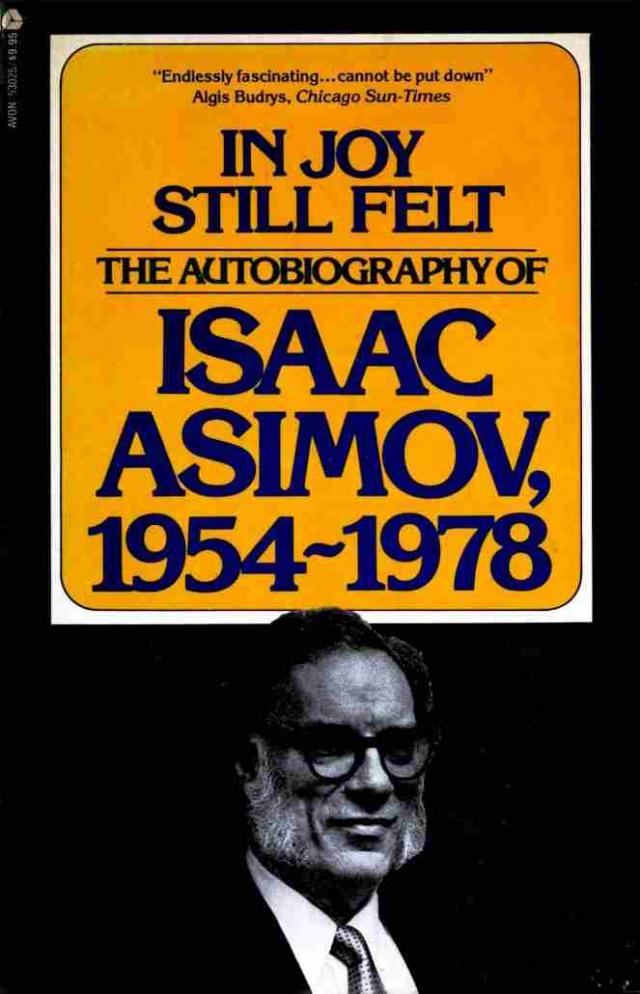
In Joy Still Felt: The Autobiography of Isaac Asimov, 1954-1978,
p.80


20
August 1, 1974, was “Non-Parents Day.” At least Ellen Peck of the National Organization of Non-Parents (“NON”) had established it so. Since she had gotten the idea from a remark I had made on a “David Frost Show” once, she hailed me as the “father of Non-Parents Day.” I crowned the two non-parents of the year with laurel wreaths in Central Park.
It was a small crowd and the ceremony was utterly undistinguished, but I felt a little uneasy. The reporters were there and I wasn’t sure about Robyn’s reaction. I called her that evening to assure her that my advocacy of non-parentism involved no personal animosity against her. She laughed and told me not to worry—that she agreed with my views on the matter.
21
The New York Times was instituting a new feature in its magazine section, and I had a telephone request to contribute a short mystery story. On August 4, I wrote what I considered a delightful short-short entitled “Little Things,” and sent it in.
To my astonishment, the Times turned it down. I sent it to EQMM, which took it at once and published it in their May 1975 issue. It was the first time in five years that EQMM had published a story of mine that was not a Black Widowers story.
22
Finally, on August 6, Janet could celebrate a birthday (her forty-eighth) that was not overshadowed by hospitalization and death. We had a fancy dinner, and took in a show. The excitement was raised to higher pitch by the fact that the Nixon tapes had now made quite clear the extent of Nixon’s crimes, as I was sure they would. My comment in my diary for August 5 was, “Nixon has owned up to being a crook and a liar, which is news that is something like thirty years old.”
But then, on August 8, Nixon gave up the fight and resigned. Spiro Agnew had resigned ten months before as a result of proved wrongdoing that had nothing to do with Watergate. It turned out, therefore, that in 1968 and again in 1972, the United States had elected two men for the highest offices of the land who had been shown, independently, to be criminal.
I was dissatisfied. Nixon’s resignation preserved his pension and numerous perquisites, and I was not impressed by the argument that it had spared the nation an ordeal. To my way of thinking, the ordeal was necessary to make certain it would never happen again. I felt that by taking the easy way out, we were storing up trouble for ourselves in the future.
23
On August 9, Stanley and I met with a Russian woman who brought news of my Uncle Boris, my father’s youngest brother, who, it seemed, was still alive in Leningrad when she had left the country, but who was trying to get to Israel. Eventually, Stanley tracked him down in Israel, and there has been correspondence since. Some of the very early material in In Memory Yet Green was obtained from him.
24
Sprague de Camp was in the hospital and, apparently, in a bad way. On August 10, we picked up the del Reys and drove to Villanova, Pennsylvania, where we had dinner with Catherine, and visited Sprague at the hospital. He seemed thin and drawn and more than half inclined to think he was dying—but fortunately he made a good recovery.
25
I had enough miscellaneous science essays now to put together another non-F & SF collection, Science Past—Science Future, and I took it in to Doubleday on August 12. It was my fourth such book, if we count Only a Trillion, published seventeen years before, prior to the start of my F & SF essay series.
Then, on August 15, a young woman named Naomi Gordon came to see me at the Cromwell. She had an idea for an elaborate anthology that would take advantage of the gathering furor over the Bicentennial celebration that would be on us in two years. The anthology was to be called The Bicentennial Man, and ten famous science-fiction authors (of whom I was to be one) would contribute original stories based on that theme.
I said I might do this and asked her to get the matter more firmly established and then come back. I was certain she would not manage it and that I would not see her again.
26
A new project had arisen. American Airlines had an in-flight magazine called American Way, for which I had written a humorous article called “Solutions!” nine months before, and which had appeared in the January 1974 issue of the magazine.
It had occurred to John Minahan, the editor of the magazine, that what was needed was a monthly column oriented to “change”—that is, to views of the possible future. It also seemed to him that I was the person to do the column.
I was interested. It would be something different, and it paid reasonably well. I wrote my first article for them on August 26, 1974. I called it “The Falling Birthrate,” and I talked about the changes the falling birthrate would involve in American society, especially with respect to the status of women. It appeared in the November 1974 issue of American Way, and additional articles continued at monthly intervals thereafter.
Three monthly columns were, however, too much, and I was tired of the “Please Explains” of Science Digest. There was a change in editor there, as Richard Dempewolff was let go. I suggested to the new editor that he might want to remold the magazine without my column, and he seemed to agree. The January 1975 Science Digest therefore carried my last column and, after 9½ years, that column came to an end. It had lasted about as long as my Hornbook review column had lasted. My F & SF column, however, now fifteen years old, was still going strong.
27
Boys’ Life was becoming a regular customer. They wanted a little mystery story, and I wrote “Sarah Tops”258 for them on August 26. It involved a young junior-high-school detective I grew instantly fond of, and whom I knew I would use again if I could. The story appeared in the February 1975 Boys’ Life.
28
The thirty-second World Science Fiction convention was being held in Washington and, on August 29, Janet and I took the train to Washington in order to attend. It proved to be the largest World convention we ever attended—four thousand people.
The de Camps were there, with Sprague looking quite well.
On August 30, Harlan and I had a public duel of the kind we often had to amuse the fans. This time we had a larger crowd than ever and we stood on two separate platforms, answering questions and poking what we considered to be good-natured fun at each other. Harlan was his usual salty self.
This time there was a Washington Post reporter in the audience, and the duel was written up in most unflattering terms. Harlan was horrified.
I said, “Forget it, Harlan. It was an in-joke for s.f. fans only and the reporter just didn’t understand.”
Harlan would not be soothed. He said we must never do it again and, of course, I said that if he didn’t want to, we wouldn’t.
The awards banquet on September 1 was not very successful. A relatively new hand at it, Andy Offutt, was the toastmaster and the task got away from him. Harlan didn’t help with his comments from the audience.
We got home on September 2.
David was now well established in an apartment of his own in Brighton, Massachusetts, and Robyn was about to start her college freshman year a second time—this time at Boston College.
29
Succeeding to the presidency had been Gerald Ford, an utterly undistinguished political wheelhorse who had been a U.S. representative at the time when Nixon had appointed him Vice President to replace Agnew.
Ford, on September 8, returned the compliment by pardoning Nixon without even eliciting an admission of guilt or regret. It was a miscarriage of justice on an absolutely cosmic scale. Furiously, I wrote a letter to Ford the next day, telling him that the act proved him unfit to be President.
40
Park Ten
1
On September 12, 1974, I began to put together the third of my books of recycled essays, Asimov on Physics.
2
For once the Dutch Treat Club had let me in for something uncomfortable.
Lowell Thomas was one of its oldest and most prestigious members, and I admired him tremendously—not for his politics, for he was far too conservative for me, but because, although he was well over eighty, he was sharp, vigorous, and hard-working. If I ever manage to grow old, it is my hope that I will be old in that way.
Consequently, when he came to me a year before to tell me that there would be a letter of invitation in the mail that he hoped I would accept, I thoughtlessly replied with an unqualified, ‘“Certainly, Lowell.”
The invitation came. It was from “the American Academy of Achievement” which, every year, put on a very lavish convention to which fifty “achievers” were invited and made much of, together with over a hundred high-school boys and girls who might be expected to be inspired by the achievers. I was invited as one of the achievers and would have been glad to go, if only because I had given my word to Lowell, were it not that the 1974 meeting was taking place in Salt Lake City.
What was I to do? There was no way I could get to Salt Lake City. I had to break my word and turn down the invitation with groveling embarrassment.
But now a year had passed and they were preparing the 1975 meeting and I was invited again. This time, the meeting was being held farther east than ever before (except for one meeting in Philadelphia in 1971.) The 1975 meeting was to be in Evansville, Indiana.
Ordinarily, I would have considered that far too distant for me also, but could I break my word a second time? I sighed and wrote a letter of acceptance in mid-September 1974. It meant that the following June I would have to drive westward nearly as far as the Mississippi River, something I viewed with the utmost apprehension—but I had said “Certainly, Lowell.”
3
The Encyclopaedia Britannica had come out with its first brand-new edition in a generation. It had a ten-volume Micropedia, with numerous short entries that served as an index. There was also a nineteen-volume Macropedia, with long entries of selected subjects. I bought this new edition (and eventually gave the old one to Robyn as help with her schoolwork).
The new edition arrived on September 29, and I promptly found that the Micropedia included the item “Asimov, Isaac” which meant that I had made the Britannica while I was still alive. As a matter of fact, this had now become routine. Science fiction had become so respectable that any encyclopedia could now be expected to have entries on several of the better-known science-fiction writers. Usually I, myself, together with Arthur Clarke, Robert Heinlein, and Ray Bradbury were included.
4
Have You Seen These?, the little book I had done for the Boskone the year before, was not entirely satisfactory. It was a limited edition, and there would be no reprints, no paperbacks, no chance to get reasonable distribution.
On October 10, therefore, I suggested to Larry that I prepare a new story collection that would contain the eight stories of Have You Seen These? together with other stories of the period that I had not collected yet. It would serve as a third volume of literary biography to follow Before the Golden Age and The Early Asimov.
Larry was agreeable and it did not take long to put the book together. Since one of the stories contained was “Buy Jupiter,” a title I loved, I called it Buy Jupiter and Other Stories. I had the complete manuscript at Doubleday by November 12, and, within a week, word reached me that Fawcett had bought the paperback rights.
5
Janet had been living in her apartment since the apartment house had been opened for occupancy in late 1968.
The six years had not been without flaws. There was an extraordinarily inefficient incinerator that routinely drenched us all in the smell of burning garbage; a central air-conditioning unit that didn’t work nearly as often as it did; and, worst of all, such poor construction that any noise in any apartment could be heard in all neighboring apartments (with magnification, I think).
One could co-operate with neighbors, of course. Living right next to us was a theatrical writer and producer, Barton Behr, who had professional occasion to play the piano all night. Fortunately, he was a goodhearted person who made every effort to avoid bothering us and, on the whole, he succeeded. He even tried to cut down on his smoking when it turned out that the walls would allow the passage of cigarette smoke.
But then, over the Labor Day weekend of 1974, the people immediately above us (who had wall-to-wall carpeting and were very quiet) moved out and two young male denizens of hell moved in.
The wall-to-wall carpeting was ripped up and a large concert piano was moved in. One of the young men played Bach and other classics with consummate skill so that we had a periodic concert that sounded as loudly in our living room as his, except that he could turn it on and off to suit his convenience and we could not.
They also had a flute, which one of them practiced Sunday mornings and of which we missed not one note. They also had a complex hi-fi record player, which they played frequently, with the volume turned up. They were also weight lifters, and the weights bumped the floors periodically.
They were advanced enough to believe in high heels but not in carpets. Their bedroom, immediately over our bedroom, was a hive of activity at night, and every footstep cuddled its way into our ears.
Their bathrooms were active as well. They had frequent occasion to urinate, which they somehow managed to accomplish with all the sound effects of a horse standing over a puddle.
Nor did they believe in showers; they took baths instead. The water gurgled into the tub for fifteen minutes; then, as they luxuriously soaked, a body could clearly be heard frictioning against the tub; and finally the water gurgled out for fifteen minutes. Nothing so terrible about that, except that the young men generally felt the need for such a purifying bath at about 3:00 a.m.
The fact was that our apartment had become uninhabitable. We tried to reason with the young men; we tried to complain to the landlord; when both courses failed, we knew we would have to move. In October, we began our search.
We knew what we wanted. We wanted an apartment large enough to house both of us and both our offices. We could each work out of our apartment, and it seemed silly to be forced to separate daily, or for either of us to waste the time and discomfort of commuting. We also wanted an apartment on the top floor, since we were both determined to have no one over us ever again, and in an apartment house sufficiently well constructed to keep noise leakage to a reasonable minimum. We needed something in the neighborhood, for Janet wanted to be near Central Park, Lincoln Center, the Museum of Natural History, and the White Institute. Finally, it could not be a condominium, for the search quickly revealed that no condominium would allow Janet to practice in her apartment, unless the apartment were on the ground floor.
It wasn’t going to be easy, but Janet scoured the neighborhood relentlessly; and if ever we felt ourselves weakening, the young men overhead would invariably supply us with new impetus.
6
Although the prospect of moving was a dismal one, life went on. On October 15, I wrote my twenty-first Black Widowers story, “Earth-set and Evening Star,”259 the gimmick of which rested upon the pronunciation of the name of a lunar crater. Fred Dannay rejected it on the ground that that was too esoteric for his readers. That very gimmick, however, made it a possible candidate for F & SF. I sent it off to Ed Ferman at once. He took it and it appeared in the August 1975 issue of that magazine.
Also on October 15, I had breakfast with Charles Renshaw, who was a prime example of how editors helped me infect the literary world.
I had first met him when he was working for the World Book Year Book. He then moved to Milwaukee, where he edited National Wildlife for some years. There he bought an occasional article from me, notably “What Do You Call a Platypus?,”260 which appeared in the March–April 1972 issue of the magazine.
Then, he had moved again to Chicago, where he edited Prism, a magazine published by the American Medical Association, and in the new incarnation I sold him several articles again, including one on the rising average age of society, which I called “The Coming Age of Age”; it eventually appeared in the January 1975 issue of the magazine.
On the evening of October 14, Janet had asked me for Charlie Renshaw’s address so that she could send him an article she had written, an autobiographical reminiscence of her visit to Italy in 1948, when she fell badly ill and was treated by an unusual Italian doctor. She felt the story would be useful to medical students and to doctors and that Prism would be a good outlet for it.
“Don’t bother mailing it,” I said (rather astonished at the coincidence), “I’m having breakfast with Charlie tomorrow and I’ll give him the manuscript.”
This I did, and Charlie winced visibly when I handed it to him. I imagine he couldn’t help but foresee the embarrassment of having to turn it down.
Time passed; Janet grew impatient; and finally when Charlie phoned me about something entirely different, I managed to ask him whether he had looked at that article yet. Embarrassed, he said he hadn’t but he would that very day. The next day, he called again, full of enthusiasm, to tell me he was taking the article and writing a letter to Janet about it. It was clear from the sound of his voice that he was enormously relieved. He had never expected to like it.
I had not read the article myself and I was astonished at Charlie’s enthusiasm. I asked Janet for a copy, read it, and was instantly full of enthusiasm myself. It was an absolutely delightful article.261 Ever since then I have tried, very gently, to urge Janet to write more nonfiction, but I have had no luck. Her heart is in fiction.


