

In joy still felt the au.., p.83
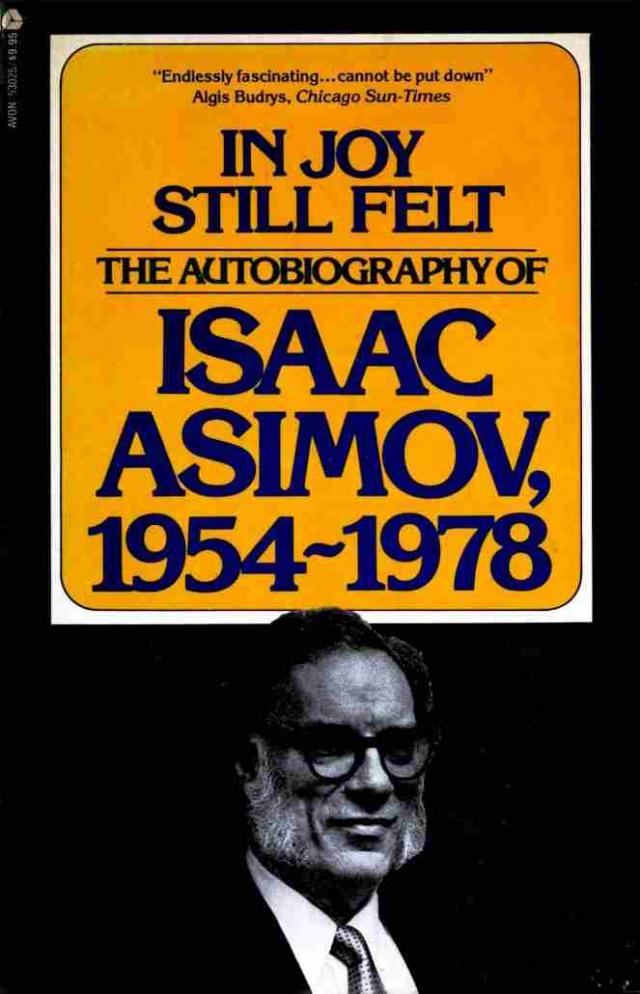
In Joy Still Felt: The Autobiography of Isaac Asimov, 1954-1978,
p.83


Well, you can’t let a pal down, so I calculated that if I left the university immediately after lunch and drove back briskly, I could make it with time to spare.
We drove back briskly indeed, but we were also caught in very unbrisk traffic jams on the Cross-Bronx Expressway, and by the time I got home, washed, shaved, changed, and made my way to the hotel by taxi, it was a very near squeak.
It was with great satisfaction that, despite everything, I walked into the rendezvous room at precisely 4:20 p.m.—only to be told by an unsympathetic publicity woman that the William Morris bit had just finished. I stared at my watch in concern and checked the time. It was 4:20 p.m.
What had happened was that Ellen Peck, the “sexual tornado” of the previous February, had been slated to push one of her books at the 4:00 p.m. slot and had come down in a peek-a-boo dress that had left too much latitude for peeking. She was persuaded to go back upstairs to change, and in order to keep the press from drifting away, Bill Morris was sent in twenty minutes early.
I was annoyed at this combination of events that had worked to make my hurried trip from the University of Connecticut meaningless, but since I was now at the convention I began to collect local color by attending a dinner party that very night.
The next day, Memorial Day, I heard Douglas Fairbanks, Jr., talk at lunch, was introduced to Anita Loos and Cathleen Nesbit, and participated in a Sense-vs.-Nonsense panel (not its official title, of course), with Walter Sullivan and Carl Sagan joining me on the “sense” side. For “nonsense,” we had Uri Geller, who bends spoons, and Charles Berlitz, who talks about the Bermuda Triangle.
That night we were at a party given by Crowell, of which Abelard-Schuman and John Day were now divisions. All of this I observed carefully (I even made notes) so that I could include references to it in the eventual book.
On May 27, I devoted an hour to autographing books for Fawcett. Dan Rather, the newscaster, was signing books a small distance from me, and after the ceremonies were over we exchanged compliments.
Then on Wednesday, May 28, I had lunch with some pleasant editors from The Saturday Evening Post, including Mary Alice Simpson, and the convention was over. I had local color dripping out of my ears.
After it was all over, I went to see Larry Ashmead.
“Do you think you can write a mystery based on the convention?” he asked.
“I think so,” I said. “I have a plot already.”
“Good. We’ll need it in time for the next convention.”
“You’ll have the manuscript in your hands long before next Memorial Day.”
“Not the manuscript, Isaac. The complete book!”
I stared in horror. “Then when do you want the manuscript?”
“The end of August.”
“But it’s the beginning of June now.”
“The beginning of August would be better.”
I felt awful. I had never written a novel in three months except for Fantastic Voyage, and there I had had a screenplay to copy.
“I’ll try,” I said dubiously.
7
Meanwhile, there was disconcerting news concerning “The Winnowing,” the science-fiction story I had sold to Physicians’ World four months earlier. Bought and paid for, it was to be included in the June issue of the magazine and had even been set in type for the purpose when the magazine suspended publication.
What could I do? I took the story to Ben Bova on May 29, and he took it at once. It appeared, eventually, in the February 1976 Analog.270
8
Janet and I went to Connecticut on May 31, to spend the day with the Walter Sullivans. We had a remarkably good time, but what most marked the day was that I played a game of croquet for the first time in my life.
9
Lester del Rey celebrated his sixtieth birthday on June 2, 1975, and Judy-Lynn had the Asimovs and Bovas join them for a birthday dinner at which large lobsters were featured. It was the first lobster bash I had had since leaving Boston.
Judy-Lynn seized the opportunity to talk business.
“Asimov,” she said, “I understand you wrote a science-fiction story for this cockamamy anthology about ‘Bicentennial man.’ How is it you don’t do one for me?”
“Well, Judy-Lynn,” I said, weakly, “the idea of the anthology interested me.”
“How about my idea about a robot that had to choose between buying its own liberty and improving its body? I thought you said that was interesting.”
My eyes widened. “Good Lord, Judy-Lynn, that’s right, you did suggest that once. I’m afraid I incorporated something like that in the anthology story.”
“Again?” she shrieked. “Again you’re using my ideas for other people?271 Let me see that story. Let me see it!”
I said, “What good will that do, Judy-Lynn? I’ve given it to Naomi Gordon.”
“Don’t you know anything, Asimov?” said Judy-Lynn. “That anthology isn’t coming out. Write to her and you’ll see.”
So I gave Judy-Lynn a carbon of the story the next day and almost at once she telephoned me to say, “I did my best not to like it, Asimov, but I didn’t manage. Get it back from that dame. I want it.”
I wrote to Naomi Gordon, and Judy-Lynn was right. The anthology had fallen apart. Naomi had been plagued by ill health and marital problems. The other stories never came in or were unsuitable when they did. She returned “The Bicentennial Man” and I returned the sum she had advanced me. I felt terrible, for it had been a good idea, and poor Naomi sounded heartbroken.
Finally, in January 1976, “The Bicentennial Man” appeared in the anthology Stellar-2 edited by Judy-Lynn.
10
Janet’s parents had, in their time, spent vacations at a huge, rambling resort, Mohonk Mountain House, set in a thoroughly isolated mountain spot near New Paltz, New York. They had thought it an idyllic wonderland.
A month before, on our way to Albany, where I was to give a talk, we passed New Paltz. Janet suddenly remembered, and since it was a beautiful day we turned off the highway and, on impulse, went to see what Mohonk Mountain House might be like.
We were thoroughly impressed. It was a holdover from a dying breed and it was like stepping back into the lavish days of an earlier age (with contemporary improvements). The countryside was delightful, and Janet had visions of a ramble in a pleasant wilderness. We arranged for a weekend there later on in the season, and on June 6, 1975, we drove there.
It was all that Janet expected. We walked endlessly, while she watched for birds through her opera glasses; we climbed to the top of a moderately tall hill; we canoed, visited gardens, danced, and, of course, ate like kings. It was just two days but they were terrific and we planned to return.
It was not a complete vacation, for there was Murder at the ABA to write. With its tight deadline, I dared not neglect it. I had started it on June 5, and while at Mohonk, I had to continue in pen-and-ink.
From the start, I made up my mind to stick as close to reality as I could. I began with the mad dash from the University of Connecticut and the failure to make a four-twenty appointment, even though arrival came at precisely four-twenty. I changed all the names, of course, and I didn’t have myself as a protagonist, but someone else, whom I named Darius Just.
I modeled Just, physically, on Harlan Ellison, making him a good writer, highly intelligent, handy with his fists, attractive to women—and five feet, two inches tall. (Naturally, I had written to Harlan Ellison, who always insists he is five feet, five inches tall, to make sure he wouldn’t mind. He sent me a letter giving full permission in the most generous possible way, so I eventually dedicated the book to him.)
I put myself into the book, too, under my own name. I had myself arrive at the convention in order to gather local color for a book to be called Murder at the ABA. I took care to describe myself exactly as I was, much as I had done in the case of Mortimer Stellar in “When No Man Pursueth” (though to keep peace with Janet, I made myself a little less unlovable in this case).
Some of the events that actually took place at the convention I assigned to myself and some to Darius Just; and, of course, I invented everything that involved the murder and the detection. It sounds a little confusing, but I had myself (Isaac Asimov) in the third person, write the story for Darius Just (who was in the first person).
I even intended to have occasional footnotes in which Darius and I would quarrel over the interpretation of events and of his supposed description of me. I worried a bit about the propriety of this, but it was fun; I enjoyed it. And since I had less than three months to do the novel, I wasn’t going to do anything that would spoil the fun. I needed the fun to keep me working.
11
On June 9, the John Bartholomew Tucker project came to life again. We were to make another test taping, but this time it was to be in a more elaborate studio. Heywood Hale Broun was there again, and this time so was William Rusher of National Review.
Rusher was one of the particularly articulate conservatives of the nation and I hated his politics—but I had to admit that he was a pleasant individual, quick-witted and genial. I got along with him very well.
12
I had lunch with James Fixx of Horizon on June 19 and we talked about possible articles I might do for the magazine. Fixx was intrigued by the wide variety of subjects my books dealt with and seemed particularly curious about my annotations. It seemed to him that they were odd books for a person like myself to have written.
“No,” I said, “I like poetry—the old-fashioned kind with meter and rhyme.”
“Could you annotate some poem for us?” he asked.
I reacted with considerable interest. Even while working on Asimov’s Annotated Paradise Lost, I had been planning to do a book of annotations of poems that were based on historical events. Such poems would lend themselves to copious explanations of the historical references and that would give me great pleasure. My annotations were not big sellers, however, and I hung back from trying to stick Doubleday with another.
If I could do an annotation for Horizon, however, that might be a start. If it worked, I could do a series, and then offer Doubleday the collection. I told Fixx, rather jubilantly, that I would try.
13
Murder at the ABA was going very well. In three weeks I had written forty-five thousand words and was roughly half done with the first draft.
Even so, I maintained a social life, too. On June 20, Lester and I hosted a Trap Door Spiders meeting at a Chinese restaurant. We brought two guests. One was Mark Chartrand, who had succeeded Ken Franklin as director of the Hayden Planetarium. The other was the Amazing Randi, a clever magician and a rationalist, who was quite certain that Uri Geller was a fraud and who took every possible occasion to demonstrate the follies of those who took Geller seriously.
14
Now, at last, it was time to drive out to Evansville, Indiana, to fulfill my promise to Lowell Thomas and attend the meeting of the American Academy of Achievement. New York to Evansville was the longest automobile trip I had ever undertaken, even longer than the Boston-to-Detroit trip ten years before.
We left at noon on June 24, 1975, and, fortunately, the weather was beautiful. Janet, who had been looking forward to the trip with misgivings, found the slopes on either side of the road, all through Pennsylvania, covered by a purple sea of what we found out was crown vetch. She was ravished thereby. It was a small item to give her such pleasure, but then, she found pleasure in simple things—which made her completely delightful to live with.
By the evening of the twenty-fifth, we were in Cave City, Kentucky, and the next morning we toured Mammoth Cave, which was perfectly cool and comfortable despite the fact that it was hot and muggy above-ground. In mid-afternoon on the twenty-sixth we were in Evansville, having covered a little over a thousand miles in fifty hours.
Rather to our surprise we found ourselves enjoying the convention. From the standpoint of personal luxury, we certainly had no complaints. We were put up in a large and modern hotel, given comfortable rooms, and fed delightfully.
Then, too, we met a number of people we might not have met otherwise. There were Art Linkletter and Jim Nabors from show business; Colonel Sanders, who began his famous chicken business with his first Social Security check; Jack LaLanne, a pint-sized physical marvel; Joe Gerard, the self-styled greatest salesman in the world, who had statistics to prove it; and many others.
On the evening of Saturday, June 28, we had the not entirely glorious pleasure of sitting through a banquet that actually lasted six full hours.
The fifty celebrities were seated around a vast U-shaped arrangement of tables, and some celebrities (notably Carl Sagan) showed up only for this banquet. We were seated in alphabetical order, with myself second from one end. The only person ahead of me was Nobel Laureate Carl D. Anderson, the discoverer of the positron. (He was quite deaf, and I don’t think he heard much of what went on.)
On the other side of me was Rick Barry, a basketball player who, when he stood up, was about six feet, seven inches tall. Virtually all that height was due to the length of his thighbone and, as we sat side by side, I compared the length of his thigh to that of mine. After a while I had the distinct feeling that my femur had been chopped off midway and that I was deformed.
Louis Nizer, the well-known lawyer, gave the keynote address, and delivered a stirring description of what everyday life would be like seventy-five years hence. In accordance with the determinedly upbeat philosophy of the proceedings, he pictured a technological paradise, and did it very well without manuscript or notes.
I was a little taken aback, first because he invaded my turf, since the speech was pure science fiction. Second, Rick Barry turned to me in amazement and said, “Isn’t it remarkable that he could speak that way without notes.”
I’d been doing that for a quarter century, but I could only nod and say, hollowly, “Remarkable.”
It was then the turn of each of the fifty celebrities to be lauded fulsomely, to walk up to the rostrum, receive a “golden plate,” and utter a few words of thanks.
I was the second one up, and with the echo of Nizer’s excellent address still softly reverberating, and Rick Barry’s remark still rankling, I couldn’t bring myself to confine my words to a mutter of thanks. I had to put on some display of my oratorical powers, even if only a brief one. I said:
“Mr. Nizer has given you an excellent picture of a wonderful future, and since I am a science-fiction writer, I can’t help but envy the clarity and eloquence of his vision. However, we must remember that the various governments of Earth are, in these complex times of ours, the direct mediators of change and it is they who largely determine the nature, quantity, direction, and efficiency of change. We must also remember that most governments are in the hands of lawyers; certainly our own is. The question, then, is what may we expect of lawyers?
“And in that connection, there is the story of the physician, the architect, and the lawyer who once, over friendly drinks, were discussing the comparative ancientness of their respective professions.
“The physician said, ‘On Adam’s first day of existence, the Lord God put him into a deep sleep, removed a rib, and from it created a woman. Since that was undoubtedly a surgical operation, I claim that medicine is the world’s oldest profession.’
“ ‘Wait a moment,’ said the architect. ‘I must remind you that on the very first day of creation, six days at least before the removal of Adam’s rib, the Lord God created heaven and earth out of chaos. Since that has to be considered a grand structural feat, I maintain that architecture must take pride of place.’
“ ‘Ah yes,’ purred the lawyer, ‘but who do you think created the chaos?’ ”
And my heart was gladdened when the roar of laughter turned out to be the best of the evening. (Nizer was laughing, too, I was relieved to see.)
15
After breakfast on June 29, we left Evansville and deliberately chose a scenic route for our homeward journey. That night we were in the depths of West Virginia at a motor lodge high in the Appalachians.
After dinner, we wandered out on the grounds and managed to make our way to a rocky ledge (well fenced) and stared down into a gorge through which a river wound its way.
The cloudless sky was still bright, but the twilight was deepening; the vista was absolutely bursting with green; the river was a silver curve; and around the bend of a mountain there slowly came a long freight train dragged by four locomotives. It crawled its way precariously along the narrow space between mountain and river, with its busy chug-chug far enough away to sound like the panting of a giant anaconda.
After a long while, Janet said, in an awed whisper, “Isn’t this amazing?”
“You bet,” I said, briskly. “One hundred sixty-six cars! Longest freight train I ever saw.”272
16
On July 1 we were at Charlottesville, Virginia, where we steeped ourselves in Jeffersoniana at the University of Virginia and at Monticello. Janet was reading a biography of Jefferson at this time and was fascinated by every aspect of it.273
We were home on July 2, having been away for eight days and having had good weather throughout. Despite our initial misgivings and apprehensions, it had been a most successful trip.
17
The good weather didn’t last. July came within a fraction of an inch of being the wettest in the New York Weather Bureau’s records, and on July 7, during one of the many rains, we experienced a leak in the bathroom adjoining our bedroom. It was the first serious problem to arise in our apartment, and it rather diminished the joy I felt in completing the first draft of Murder at the ABA on July 9.


