

In joy still felt the au.., p.28
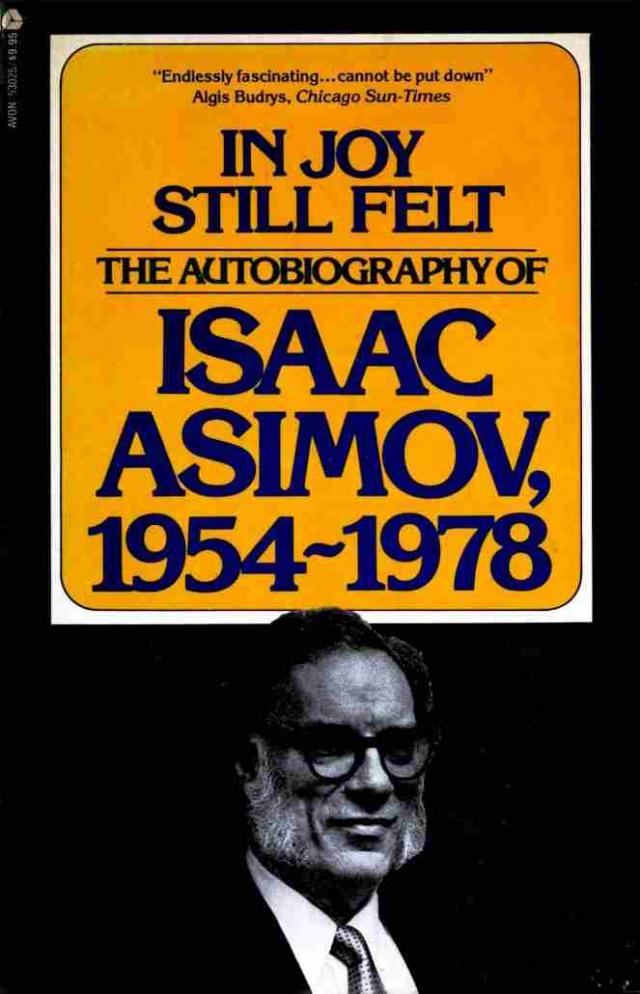
In Joy Still Felt: The Autobiography of Isaac Asimov, 1954-1978,
p.28


25
On March 23, I visited MIT to participate in a panel for some reason or other that I’ve forgotten. It was at that time I met Cleveland Amory, who had made a name for himself with his books on New England’s high society. He was tall, handsome, curly-haired, and the clear lion of the occasion.
We were to speak for twenty minutes apiece, and I came second and spoke my twenty minutes. (Years of lecturing to classes and timing myself to finish as the bell rang had made me vain of my ability to meet the time demanded of me.)
Amory came third and spoke for forty-five minutes, very wittily, and I loved every minute of it. Mrs. Amory sat between myself and him, however, and I couldn’t help but notice that periodically, and with gradually increasing force, she kept surreptitiously tugging at his trousers below tabletop level. This, I supposed, was a signal that he was talking too long. He ignored it.
26
I frequently make small errors in my books (not so frequently I make not-so-small errors), and I had a rather embarrassing one in The Intelligent Man’s Guide to Science.
In it, I had occasion to mention, briefly, the research of W. B. Castle in the matter of the absorption of Vitamin B12, since it is the failure of that mechanism that brings on “pernicious anemia.”
His papers on the subject (at least those I was aware of) appeared in the prestigious British periodical Biochemical Journal, and I assumed, therefore, that he was a British biochemist and identified him so in my book.
Someone at school told me that Castle was not a British biochemist at all, but an American physician, born in Cambridge, Massachusetts. Indeed, he worked at Boston City Hospital right across the street from the med school, and from the window of what had been my laboratory, I could see the window of his.
On March 23, I marched myself over to Boston City Hospital, found my way to his office (having called in advance and made an appointment). I explained the error and apologized and he took it in very good humor.
Fortunately I had the chance to make the correction quickly. I received a letter from Svirsky on March 29 to the effect that a third printing of The Intelligent Man’s Guide to Science was in the works and I could make minor corrections if I wished.
Meanwhile, on March 24, I finally completed Life and Energy, the book I had persuaded Tim Seldes and Dick Winslow to let me do. It was a good book, the kind of biochemistry book I had been hankering to do ever since the textbook days of ten years before, and it was 120,000 words long.
27
I drove to New York on April 3, 1961. That was the day my father was scheduled to be home from the hospital, so I drove straight to Windsor Place. My father looked wan and worn but he was otherwise all right.
I then went to Doubleday to deliver Life and Energy and chased back at once. I planned to stay overnight at my parents’ so as to be with my father as long as possible since, rather emotionally, he decided he had been near death. In fact, he asked me to give a friend a copy of The Intelligent Man’s Guide to Science and dictated the inscription I was to place in the book. It was florid and lengthy, and it embarrassed me greatly—but in this case my father’s wishes were paramount.
It was very pleasant to talk to my father, and I was delighted to see him as lively and as quick intellectually as he had ever been, but staying overnight was a bad notion just the same, for I got no sleep. My father spent the whole night trudging back and forth between bed and bathroom, as I suppose was, under the circumstances, inevitable.
28
Norbert Wiener was still after me to collaborate with him on a murder mystery. Fortunately, Jason Epstein, Norbert’s editor at Random House (and another one of the fearfully intelligent people with whom my life has been filled), quite clearly didn’t want this. I had a long dinner with him and Norbert on April 4, while I was still in New York, and Jason’s idea was that there be a book called Conversations with Norbert Wiener, with Norbert at one end of a tape recorder and me at the other.
It sounded easy except that I was not at all certain that I could ask the right questions, and I had a sinking sensation as to whose job it would be to edit thousands of pages of transcript. The only thing I could do was to say “Yes” and then never push it.
It is my experience that almost nobody is a pusher. If there is a project I want done, of course, I push everybody and eventually it gets done. If there is a project I don’t want done, I simply don’t push and then (almost always) nobody else pushes, either, and it doesn’t get done.
I didn’t push this time and nothing ever happened.
29
On April 11, I made one of my rare forays into civic affairs.
The city of Newton was facing a referendum on fluoridation of the water supply and I was in favor of fluoridation, as was, of course, the dental profession. I was asked to give a talk to a local PTA in support of the law, and I agreed; I felt it my duty.
Some time afterward, one of the people in the forefront of the pro-fluoridation movement called me to suggest I write an article for a newspaper in favor of fluoridation. I was well aware that I was not entirely an expert on the subject, and I envisioned myself as either having to do considerable research or as being converted into mincemeat by the anti-fluoridation fanatics.
I said to her, “Why not have so-and-so do it?,” referring to a leading dentist who had been one of the group who had pressured me into giving the talk.
“Oh,” she said, rather surprised at the suggestion, “surely you understand that so-and-so is a busy man!”
So I refused point-blank to do the article.
Could she have known how offensive her remark had been? The implication was, of course, that either I wasn’t a busy man myself, or else that writing was so easy a job that I could toss off an article between yawns.
Both assumptions are irritating in the extreme. Writing is hard work. The fact that I love doing it doesn’t make it less hard work. People who love tennis will sweat themselves to exhaustion playing it, and the love of the game doesn’t stop the sweating.
The casual assumption that writers are unemployed bums because they don’t go to the office and don’t have a boss is something every writer has to live with. I have never known a writer who hasn’t suffered as a result of this, hasn’t resented it, and hasn’t dreamed of murdering the next person who says, “Boy, you’ve sure got it made. You just sit there and toss off a story or something whenever you feel like it.”
30
On April 12, 1961 (the sixteenth anniversary of F.D.R.’s death), I was absolutely stunned and delighted by the news that the Soviets had orbited a man, had sent him once around the world, and had brought him back safely.
Yuri Gagarin was the first astronaut (or “cosmonaut,” to use the Soviet term) to enter space, and he was a countryman of mine. Like me, he was born in the Smolensk district of Russia.
31
The next day came the news from Elizabeth Moyers that Dean Soutter was resigning. Actually, said Elizabeth (who was an expert on office politics and who imagined it existing everywhere), he was being forced out by the Keefer group.
My conscience twanged miserably, for I knew that Soutter had fought valiantly on my behalf, and it might well be that it was that fight that had marked him down for the slaughter. On April 14, after I had given the second of my two lectures for that teaching semester, I rushed down to see Soutter and he told me essentially the same story that Elizabeth had.
Thereupon I felt it incumbent upon me to do for him what he had done for me. I called President Case and made an appointment to see him on the seventeenth. On that day I went over to the main campus and spent half an hour telling Case of the manifold virtues of Soutter and of the importance of keeping him at the school. According to my diary, Case “seemed impressed.”106
Then on May 5, Soutter had an interview with Case, something that I had arranged, and in my diary I say that Soutter “apparently won a partial victory.”
I suspect that if Soutter had been as fiendishly determined to keep his title as I had been, he would have managed. Soutter, however, had other things to do. There was a new medical school that the University of Massachusetts was thinking of starting, and Soutter was in line to be its head.
So he resigned on May 16 and left, I suppose, without much in the way of regret. I had the comfort, though, of knowing I did not let it happen without striking a blow on his behalf. I do not forget favors done me.
Once he was gone, I got wearily set for a new onslaught upon myself. I even had the fugitive thought that Keefer had gotten rid of him precisely in order to take me on in a fifth round—but it never happened. I was left to myself.
15
Over the Top
1
The Wellsprings of Life was receiving reviews that were every bit as good as those for The Intelligent Man’s Guide to Science. That gave me particular satisfaction, for The Wellsprings of Life was mine, and had not been tampered with in any way by editorial oppression.
In the April 23, 1961, Science, George Gaylord Simpson, the renowned vertebrate paleontologist of Harvard University, reviewed The Wellsprings of Life and referred to me as “a national wonder and a natural resource.”
That is, by all odds, my favorite quote about myself. Years later, Lester del Rey gave me a set of calling cards for my birthday, each reading “Isaac Asimov—Natural Resource,” and I said, “Why did you leave out the ‘national wonder’ part, Lester?”
He said, “I thought that much would embarrass anyone—even you.”
It is the only time I ever knew Lester to underestimate the extent of my cheerful self-appreciation.
2
On April 15, 1961, I had received a long letter from Doubleday pointing out possible errors, omissions, and other insufficiencies in Life and Energy. It was not from Dick Winslow, but from his new assistant, Lawrence P. Ashmead, a young geologist from Yale, whose first task it was to handle this book.
When Ashmead showed Dick a draft of the letter (according to the story told me by Ashmead in later years), Dick stirred uneasily and said, “You can’t do that. Asimov is a scientist and he’ll be very annoyed at being picked on like that.”
Ashmead insisted, however, and off went the letter.
Well, I did quiver a bit when I got it, but almost all the points were valid ones, and I worked away to make the necessary changes. On May 2, I drove in to New York and went to Doubleday with my corrections. I found that Dick Winslow was in the hospital with pneumonia, so I talked to Ashmead.
“Those were very good points you made,” I said. “Thank you very much. Here are my suggested corrections and let me know if anything more needs to be done.”
Larry Ashmead—and from then on he was only Larry to me—was greatly relieved that, despite Dick’s prediction, I had not stormed in furiously, and from then on I was on his gold-star list, and we have been close friends ever since.
This turned out to be a very convenient thing for me in my future career, but I didn’t foresee that at the time.
3
The next day I had lunch with Hugo Gernsback at his suggestion. He was now seventy-six years old and it was the first and only time I was ever alone with him.
I had rather looked forward to this, for I had been told he was a gourmet and knew places in New York, secret places, where one could feast like an emperor. That sparked my gluttony, and when he took me out of his office and proceeded to walk me for something like three fourths of a mile, I thought happily that he was taking me to some hidden rendezvous that he would not give away to any cabbie.
When we entered a Longchamps restaurant, I thought happily that there was a gourmet Elysium hidden in the back or in the cellar that used Longchamps as a front.
When we sat right down in Longchamps, I thought happily that this was a secret gourmet Longchamps that nobody knew anything about.
When he ordered a ham sandwich, I thought happily that this was a code for something so incredibly cordon bleu that no one but a few happy mortals had ever tasted it, and I ordered a ham sandwich, too.
I got a simple ham sandwich. In fact, it was rotten.
What Gernsback wanted to see me about was a new science-fiction magazine he was planning to start and that he hoped I would edit. That was something I couldn’t and wouldn’t do, even if he had treated me to a gourmet meal.
4
On May 13, 1961, the Interplanetary Exploration Society, which had died stillborn with Campbell’s speech at the Museum of Natural History 2½ years before, suffered the death of its Bostonian incarnation at last.
Alma Hill had arranged a picnic at the Arboretum and, with her usual calm assumption of cosmic subservience to herself, refused to set a definite place of meeting. “We’ll meet each other,” she said firmly, with the same self-assurance with which she had told me there would be a parking place outside the Hotel Touraine.
Remembering that the parking place had really been there, I took Gertrude down to the Arboretum with a certain amount of confidence. We met no one.
Others later told me they were there, too, and met no one. I don’t know how many of us wandered singly and in pairs without ever crossing each other’s path.
That was it. If there was ever another meeting of the society, I was not informed.
We had better luck the next day, though.
The MIT science-fiction society usually had a picnic at the Blue Hills Observatory on the first or second Sunday in May, and on the fourteenth, all four of us went there and had a wonderful time. There was lots to eat—cold cuts, cake, watermelon, soft drinks, beer, and an incredible number of other comestibles guaranteed to destroy any stomach more sensitive than mine or a college student’s. There was also a traditional walk up to the top of the hill on which the observatory was situated. This I would gladly have ignored because my joy in moving upward under my own power has always been restrained. David, however, wanted to make the climb and I didn’t want him to do it on his own.
After this occasion, I was always invited to the annual picnic, as was Harry Stubbs, and I went on every occasion that I could. Somehow, the custom arose of asking me to pick the actual Sunday out of the two possible and I always have, even when it was known in advance I could not attend. The superstition is that the Sunday I choose is always bright, sunny, and desirable. I can only recall one time when that superstition refused to work.
5
On May 22, I met George Gaylord Simpson, who had called me a “national wonder and natural resource.” It turned out, over lunch, that he was a science-fiction fan and read my F & SF articles, which made his opinion of me a little less surprising.
He was particularly interested in John Campbell, whom he had never met, but of whom he seemed to be in considerable awe. I went through some of my stories about Campbell—our meeting, his penchant for outrageous opinions, his incredible agility in argument, his tendency of late toward mysticism. Then I hesitated because I didn’t want to malign Campbell and yet I was overcome with a desire to epitomize him perfectly. Finally, the desire to epitomize won out and I said,
“I’ll tell you something, George, that I think will describe Campbell perfectly. Suppose you meet a man who asks you what your field of endeavor is and you tell him that you are the world’s greatest living vertebrate paleontologist, which is, of course, what you are. And suppose that, on hearing this, the man you meet fixes you with a glittering eye and proceeds to lecture you for five hours on vertebrate paleontology, getting all his facts wrong, yet somehow leaving you unable to argue them—you will then have met Campbell.”
6
That same day, I had dinner with John R. Pierce of Bell Telephone Laboratories. He had invented the word “transistor,” was working on communications satellites, and was a well-known science-fiction personality, having written for Astounding under the name of J. J. Coupling. He was in town to give a talk at MIT, a talk I attended.
Also at the dinner was Vannevar Bush, one of the pioneers of electronic computers, and he also read my F & SF articles.107
7
While talking to Simpson, Pierce, and Bush, all in the course of a single day, I found my desire to write science fiction suddenly activated. The next day, therefore, I sat down to write a short story. It wasn’t much of one, only two thousand words long, and, considering my talk with Bush, it’s not surprising it was about computers.
I called it “The Machine That Won the War,” wrote it in a single session, and sent it out to Bob Mills before the day was over. Mills took it at once and it eventually appeared in the October 1961 F & SF.108
8
I was making nonfiction progress as well. I had finally returned to The Search for the Elements, which Svirsky had said was unsuitable for his juvenile line, and had rewritten it with an eye toward adults. Naturally, that meant it grew longer and was now well over sixty thousand words long.
Having finished that chore, I finally began The Human Body on May 23, which I was now aiming for hard-covers with Houghton Mifflin, and then soft-covers with NAL.
I could tell from the first page that the book was going to be pleasurable for me. I experimented with a new device, which was to give the pronunciation and derivation of every anatomical and physiological term, placing these in parentheses immediately after the first use of the term and including an initial “G” or “L” to indicate whether the derivation was from Greek or Latin.


