

In joy still felt the au.., p.5
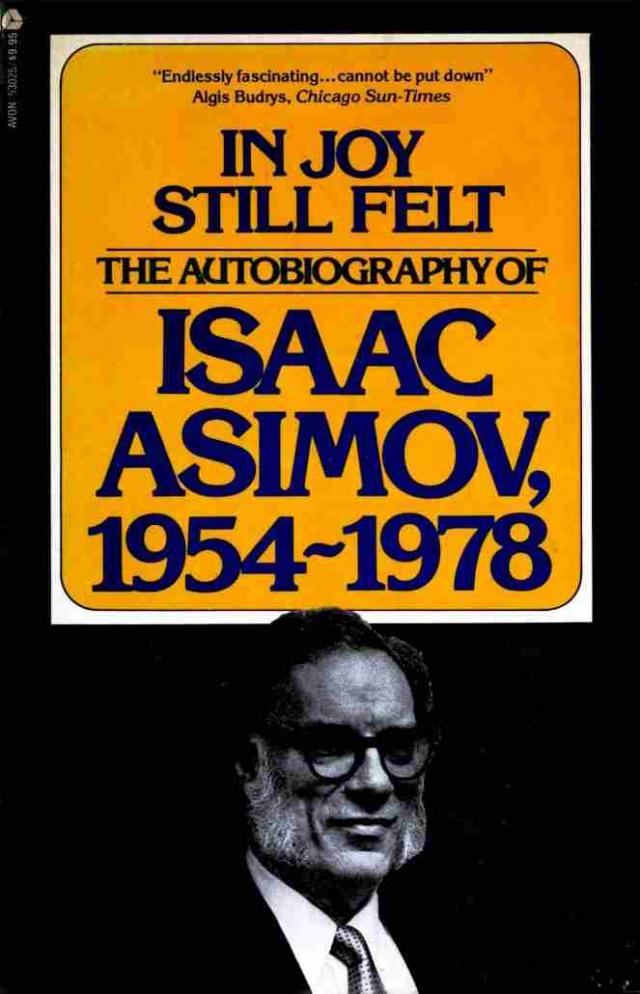
In Joy Still Felt: The Autobiography of Isaac Asimov, 1954-1978,
p.5


My name is often misspelled. The first name comes out Issac a considerable fraction of the time, and that “z” in my last name is as frequent. More exotic misspellings also occur sometimes.
I make it my business to complain each time. I have a strong sense of personal identity, and my name is me. Besides, once I became a writer, I realized that literary and financial success depended, at least in part, on the recognition level of my name, and any misspelling would tend to diffuse that.
This was the only time that my name was misspelled on one of my own books. It was misspelled only on the spine, though, for it was correctly spelled on the book jacket and on the title page. Nevertheless, I wrote to Doubleday at once to make sure that the mistake was corrected on all future printings and editions. This was done.
I was pleased with the result, aside from the misspelling, by the way. It had been very easy to do a short-story collection, and it appeared quickly, too. It appeared before The End of Eternity did, even though the latter had been contracted for over a year earlier.
10
On the day The Martian Way and Other Stories appeared, something else took place that pleased me even more. Walker’s secretary handed me an envelope without comment, and when I opened it, I found a notice that I was promoted to associate professor of biochemistry as of July 1, 1955.
I was delighted. I had not pushed for it, and Walker hadn’t said anything about it, but now that I had it I felt that a turning point in my career had come. An associate professorship gave me tenure, and my position and salary at the school were now assured.
That was enormously different from what my situation had been when I had arrived at the med school six years before, when either Lemon or Walker could have fired me out of hand, or when any failure of renewal of the grant would have left me without a job, as with Elderfield.
Looking back on it now, I feel quite sure that Walker had pushed through the promotion while Dean Faulkner was still in office. Walker must have felt that no such promotion would be approved after Faulkner was gone, and he was right, for on June 3 it was announced that Chester Keefer would be the new dean.
11
On May 14, 1955, I received a card from my old college friend Sidney Cohen. He had an office on upper Park Avenue now, and he was married!
And on May 21, 1955, Marcia also was married and became Mrs. Nicholas Repanes. It was a very quiet wedding day, and with a three-month-old baby on our hands we could not make the trip to New York to attend.
12
Robyn was a much quieter baby than David had been. David had laughed and gurgled and made random sounds from an early age, but Robyn, when she wasn’t crying, lay there quietly and at peace—which was fine except that we would have welcomed some indication she was making contact with the universe.
It was welcome news, therefore, when, on May 16, she produced a feeble little laugh, her first, when I was tickling her ribs. It was Gertrude’s birthday, too, so that it was a sort of birthday present.
13
On June 3, we went to New York, trying this time to drive in the evening to avoid the heat of the day. The experiment was a flop. It was indeed cooler and the children gave no trouble, but we arrived at 1:15 a.m. and I was fatigued to death.
On June 5, Gertrude, her brother John, and I made our ritualistic walk along the boardwalk at Coney Island, and the next two days I made my rounds. I took in the manuscript of the fourth juvenile, Lucky Starr and the Big Sun of Mercury, to Margaret Loesser.
14
Gertrude seemed annoyed with me in the course of this visit. Two small children and the matter of house-hunting had got her down, and when I left for Boston alone on June 8, she wouldn’t say good-bye to me.
I drove home, thinking the unthinkable for the first time. Our thirteenth anniversary was coming up and I was thinking that our marriage was a failure.
In all those years I had not made her happy and I didn’t see how I could make her happy in the future. I could see my faults.11 I was self-centered and wrapped up in my writing. I didn’t like to travel or do those things most people consider “having a good time.” I wasn’t handy around the house. I lacked the worldly-wise knack of knowing how to find the perfect house, how to make clever investments, how to finance things on expense accounts, and so on.
But what was the use of seeing those faults? There was no way I could change them. I could not make a silk purse out of the sow’s ear of my character. So I thought, for the first time, of separation and even of divorce. But how could that be? Even if I could bring myself to leave Gertrude (which was doubtful), could I leave the children?
I could feel myself beginning to drop into the life of “quiet desperation” that Henry Thoreau spoke of, and saw a vicious cycle intensifying. Clearly, the more I found myself unable to make Gertrude happy, and unable to live with her unhappiness, the more I would seek my writing as a refuge, and the more I would intensify the situation that helped create her unhappiness.
The next weekend I drove to New York again, stayed a couple of days, and drove back with the family this time. Gertrude seemed more cheerful, so I was relieved and my own spirits rebounded. On the other hand, Gertrude also kept thinking of divorce now and then, for she occasionally mentioned it as a possibly desirable way out. (I noted one such case in my diary entry for August 7, 1955.)
We drifted along. There were good times and happy times, but the thought of separation and divorce would recur, now and then, to one or the other of us.
15
Between these two visits to New York, the August 1955 If appeared with “Franchise.”12 Coming up in the near future was the September 1955 Astounding, with “Victory on Paper,”13 and the October 1955 F & SF, with “The Talking Stone,”14 the second of my Wendell Urth mysteries.
16
On June 27, 1955, David, now nearly four years old, went off to spend his first day at a summer day camp, Meadowbrook. It was not, on the whole, a successful experiment.
David was always self-willed and could never bend or compromise to suit others. And if he could not have his way, he grew angry and would not co-operate. Nor would he engage in rough-and-tumble. To put it briefly, he had trouble getting along with his peers.
I could sympathize, for as nearly as I could remember my own childhood at that age (and older) I, too, had difficulty getting along with my peers.
17
On July 1, 1955, I was officially Dr. Isaac Asimov, associate professor of biochemistry. On that same day, Chester Keefer was officially dean or, rather, director, which was the higher title. Under him was Lamar Soutter, who fulfilled the narrower duties of deanship. Soutter was a pleasant person with old-fashioned eyeglasses and an unassuming air. I liked him from the start.
As for Keefer, I couldn’t forget Bill Boyd’s dislike of him, and Walker’s forebodings concerning him—and the icy glance Keefer had given me that time I walked in late to the luncheon meeting.
What’s more, Keefer had been head of the Department of Medicine, and Lemon was a member of that department. Lemon was therefore a close associate of Keefer and had, I believe, influence over him. I was quite aware that Lemon did not have a particularly warm regard for me, especially since I was no longer connected with him in any way, and he knew that that had come about through my wish. I did not expect his influence, therefore, to be exerted in my favor.
Fortunately, Walker had been farsighted enough to get me my associate professorship in time. I had tenure, and what could anyone do to me? At least, that was my feeling at the time.
I was aware, of course, that I didn’t fit in to the close-knit and highly specialized academic community. I had never fit in from my earliest days in graduate school. I was never single-minded enough about my chemistry, and I was never sufficiently aware of the subtle nuances of the do’s and don’ts of academic life.
I was too loud, too boisterous, too indifferent, too nondeferential, too self-satisfied. Just as I never remembered the names of my parents’ customers or thought to greet them pleasantly when I met them on the street, so I never remembered the names of most of the faculty or remembered my place in the pecking order.
All this is not said as a kind of self-praise for my independence. I recognize it now (indeed, I recognized it at the time) as a source of trouble and annoyance for everyone around me. My not fitting in made me a piece of grit in the smoothly oiled functioning of a watch mechanism.
I was a danger to no one, to be sure. I was not pushing for promotion, or salary, or power, but even the fact that I wasn’t was an annoyance, since it implied an indifference to that which others found important, and an indication that I found importance lying elsewhere—which meant in my writing. I didn’t flaunt my growing success there, but neither did I hide it.
All in all, I expected trouble and, in my more soberly self-evaluative moments, even felt I probably deserved some. I just didn’t care. My attitude was a semicontemptuous, “What can they do to me?”
3
House-hunting
1
We took advantage of David’s absence during much of the daylight hours to begin house-hunting again, and we spent all the summer at it.
It was, however, once again, one of those really hot summers that would come to plague us at particularly crucial periods. July 1955 was the hottest in the Boston Weather Bureau’s records. Tempers were short, discomforts great. Furthermore, though David was out of the way, we had to take Robyn with us wherever we went, and she was generally just as uncomfortable in the hot weather as we were, and she kept telling us about it in the only way a baby can.
One house was a near-miss. It was put on the block by a couple who were getting a divorce, and it seemed to be almost good enough and almost cheap enough. Gertrude held back, partly because it was a fearful decision to make, and partly because Robyn was crying badly. We left, discussed the matter, convinced ourselves that we ought to (maybe) buy it, came back timorously—and found it had been snapped up by someone else.
That resolved our doubts about the house. We were sure we should have bought it, and were chagrined and unhappy over our failure to do so.
2
On July 22, I received a letter from Stanley telling me that he was virtually engaged to a divorcee with an eight-year-old son. On the thirty-first, Stanley was passing through Boston on his way to Annisquam and he stopped at our place. With him was Ruth, the young woman with whom he was in love.
She was a pleasant girl, with a ready smile, dark hair, and an unaffected way of talking. She had a slight stammer.
Apparently she was a science-fiction fan, and on first meeting Stanley, and having been introduced to him, she asked him what, in our family, we call The Question. That is: “Pardon me, but are you related in any way to Isaac Asimov?”
Stanley, who is the most patient and good-natured fellow in the world, takes the question with enormous goodwill (much more so than I would, were the situation reversed), but he had to admit that having it asked by a pretty girl in whom he took an instant interest was hard to take. Fortunately, he survived the shock and decided fairly quickly that this was the girl for him.
The most interesting occurrence of The Question, by the way, took place about now in New York. (I don’t know the exact date because I learned of the incident only long afterward from my mother, and she didn’t remember the statistics.)
After my parents sold the candy store, my mother decided to go to night school and learn how to write. She knew, of course, how to write Yiddish perfectly and Russian just as perfectly, but neither used the Latin script. She had to learn that to write English.
She learned quickly and in a very short time was able to send me short letters in painstakingly formed English writing. One of the teachers at the night school finally nerved himself to ask The Question.
“Pardon me, Mrs. Asimov,” he said, stopping her in the hall, “are you by any chance a relation of Isaac Asimov?”
My mother, who was four feet, ten inches tall, drew herself up to her full height and said, proudly, “Yes. He is my dear son.”
“Aha,” said the teacher, “no wonder you are such a good writer.”
“I beg your pardon,” said my mother, freezingly, “no wonder he is such a good writer.”
3
The heat continued into August without letup. We were driven to even small expedients. As I said in my diary for August 2, “I just got David a real short haircut. Gertrude sent me out saying, ‘Short’ and greeted me when I came back with ‘Not that short.’ ”
The heat was accompanied by a very severe polio epidemic in the Boston area—the last such epidemic to take place, as it happened, for the Salk vaccine had just been developed—and that kept us in a state of terror, too.
4
On August 3, I received my advance copy of The End of Eternity. The first thing I did was to check the spine. My name was correctly spelled.
A few days later I received the news that Planet Stories had ceased publication. That induced a nostalgic sigh. I had not dealt much with it; my only published story with them was “Black Friar of the Flame,” but they took that when no one else would. Now it was gone.
On August 10, I did some calculating from my records and found that in 17 years of writing, I had sold about 1,250,000 words of fiction. This was roughly 75,000 words a year, which wasn’t bad, considering that in those years I had to work in the candy store, in the Navy Yard, in med school, get my degrees, serve in the Army, and have a wife and two children.
5
When John Campbell accepted an item, he did so with a check. When he rejected one, however, he would (if the author were an important and regular contributor) do so with a long letter. Sometimes it was an unclear letter as he talked endlessly of whatever pet notions he was pushing at the time. This habit of his intensified in the postdianetics years.
Thus I had written an article entitled “The Abnormality of Being Normal” on the vast variety of genes and the virtual certainty that we were all quite different from each other. I mailed it to him on August 11, 1955, and on August 18 received a long letter from him with the returned manuscript, which he was rejecting (as nearly as I could make out) for the crime of being too important a subject for Astounding.
I shrugged and, in September, sent it to F & SF. Boucher rejected it, too, on September 23 and I retired the article till something else might turn up.
Then, on the twenty-fifth, I happened to be visiting Campbell’s house in New Jersey, and he said to me, “What’s happening to your article on genes?”
I said, dispiritedly, “I tried F & SF, but they turned it down.”
He said, with obvious astonishment, “Why did you send it to them?”
“It seemed a possibility.”
“But why not to me?”
It was my turn to be astonished. “I did send it to you. You turned it down.”
He said, “I did not turn it down. I asked for a revision.” And he told me what kind of revision.
When I got home, I reread his letter. For the life of me I could find no revision request in it. However, I revised the article according to his verbal instructions and, on October 12, I received a check for it.
6
Robyn was half a year old on August 19, 1955, and David was four the day after. The unprecedented summer heat had been broken by hurricanes which, fortunately, did not produce extensive power failures (the worst losses of power lasted only twenty minutes). Hurricane Diane, however, dropped over a foot of rain on the Boston area on August 18 and 19, and large parts of New England were badly flooded.
This was inconvenient. The World Science Fiction convention was about to come up in Cleveland over the Labor Day weekend of September 2 to 5, and some of the key highways from Boston to New York were flooded and closed.
My original plan had been to drive the family to New York and leave them there with the Blugermans, going to Cleveland by myself (or with Gertrude, if she felt like going).
As it was I would have to go to New York by train, and taking two children plus the necessary luggage on the train seemed too severe a task. So I went to New York by myself, and Mary Blugerman traveled in the other direction to keep her daughter and grandchildren company.
I left for New York by train on Monday, August 29, and went on my rounds on the thirtieth. I saw Lillian McClintock of Abelard-Schuman and got her to agree to my doing a book on the chemical elements as my fourth juvenile science book (though my second and third were not yet published).
I visited Leo Margulies and his wife, Cylvia, in the evening. Leo and I were good friends, now, something I wouldn’t have believed possible when he drove Sam Merwin to reject “Grow Old With Me” eight years before. I also met Fred Dannay (“Ellery Queen”) for the first time that day.
On August 31, I met Marcia as a married woman, and was very pleased indeed with her husband, Nick.
On September 1, 1955, Marty Greenberg picked me up in Manhattan, just two blocks from the old apartment in Stuyvesant Town, and we drove to Cleveland through mostly cloudy weather, without incident. It took us twelve hours—which Marty took in stride. I can’t think of anyone who drives more smoothly and effortlessly.
That night I met André Norton who, writing excellent science-fiction juveniles under that name, was actually a woman. The masculine character of science fiction at that time made that sort of thing seem sensible then.
As guest of honor, I had a two-room suite (at the convention’s expense), and I had parties in my room, as the guest of honor was supposed to do. It meant messing up the place with cigarette butts and liquor glasses and not being able to have any privacy or go to sleep till everyone decided to leave (and they never decided to leave). It seemed fun at the time but I never again gave parties at conventions.


